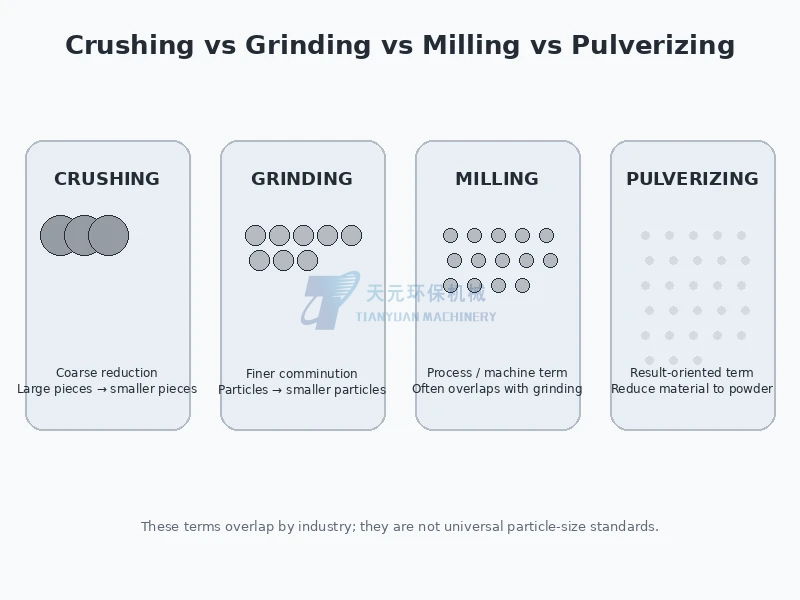
Crushing, grinding, milling, and pulverizing are all terms used for reducing the size of solid materials, but they do not describe four perfectly separated particle-size ranges. In industrial powder processing, crushing usually emphasizes coarse size reduction, grinding generally refers to finer comminution, milling often describes a grinding process carried out in a mill, and pulverizing emphasizes the result of reducing a material to a powder-like state. The exact meaning depends on the industry, material, equipment design, and product specification.
Key Conclusion
Crushing, grinding, milling, and pulverizing are overlapping size-reduction terms rather than universal particle-size standards. Crushing normally handles larger feed and produces smaller pieces for the next stage. Grinding usually performs finer reduction. Milling can describe either the fine-size-reduction process or the operation of a particular type of mill, so it frequently overlaps with grinding. Pulverizing is a broader result-oriented term indicating that a material has been reduced to powder or very small particles. For equipment selection, feed size, material properties, target particle-size distribution, required capacity, heat generation, wear, classification, and dust-control requirements are more useful than the equipment name alone.
Contents
Size Reduction as the Umbrella Concept
The broad engineering concept behind all four terms is size reduction, also called comminution in many technical fields. The purpose is to reduce solid material from a larger initial size to a smaller size by applying mechanical energy.
The forces can include compression, impact, shear, cutting, attrition, abrasion, or combinations of several mechanisms. Different materials respond differently to these forces. A brittle solid may fracture readily under impact or compression, while a fibrous material may respond better to cutting and shearing. A ductile metal may deform before it fractures.
This is why terminology alone cannot determine the correct equipment. Two machines both called mills can use completely different mechanisms. A hammer mill, pin mill, ball mill, cutting mill, and jet mill are all called mills, but their operating principles, feed-size limits, product ranges, heat generation, wear behavior, and suitable materials can be very different.
The same problem occurs with words such as grinder and pulverizer. They are often commercial or industry-specific equipment names rather than strict scientific categories.
What Is Crushing?
Crushing generally refers to the relatively coarse stage of size reduction. Large pieces are broken into smaller pieces that are easier to convey, feed, dry, grind, classify, or process further.
Typical crushing equipment includes jaw crushers, roll crushers, impact crushers, hammer crushers, cone crushers, shredders, and other machines designed to handle relatively large feed. The exact machine depends strongly on the material.
Crushing can be primary, secondary, or tertiary. Primary crushing handles the largest feed. Secondary crushing reduces that product further. A fine crusher may prepare material for a mill. The important point is that the term describes the stage and purpose more than one universal finished size.
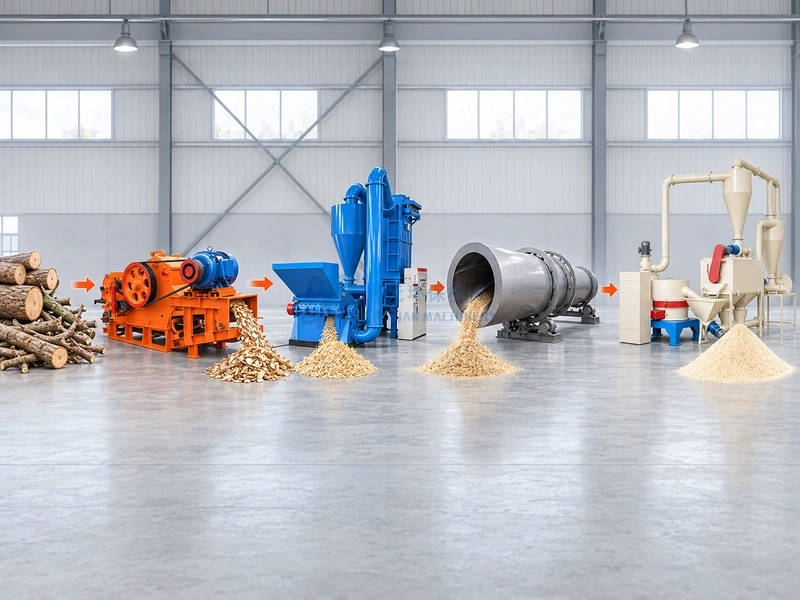
In a wood-powder line, for example, cutting or crushing large wood pieces is a pretreatment step. It makes the material small enough and uniform enough to enter subsequent fine grinding. Crushing the wood is not the same operation as producing finished wood flour.
In a suitable metal-powder project, long chips or large fragments may also require cutting or preliminary size reduction before they can be fed consistently to the fine-grinding system. That pretreatment should not be confused with the actual metal-powder grinding stage.
What Is Grinding?
Grinding usually refers to finer comminution after the material has already been reduced to a manageable feed size. The goal is normally to create smaller particles or powder by repeated mechanical interaction.
Depending on the equipment, grinding may rely on impact, attrition, compression, shearing, particle-to-particle collision, or combinations of these forces. The final result may range from a relatively coarse powder to a fine or ultrafine product.
Grinding usually consumes more energy per unit of useful size reduction as the required product becomes finer. This is because creating more and smaller particles increases total surface area, while more mechanical energy can be lost as heat, vibration, airflow, elastic deformation, and equipment losses.
For a real industrial process, grinding is therefore not simply a question of the smallest particle the machine can create. The useful questions include the required particle-size distribution, percentage of qualified product, capacity, recirculation, temperature rise, wear, contamination, dust generation, and stability of continuous operation.
What Is Milling?
Milling is one of the most confusing terms because it is used in several different ways. In powder processing, milling often means grinding or fine size reduction in a mill. A ball mill, hammer mill, pin mill, attrition mill, cutting mill, and jet mill are all examples of equipment whose names use the word mill.
In this context, milling and grinding can be almost interchangeable. A technical article may describe the same operation as fine grinding, fine milling, or powder milling depending on industry convention.
However, milling also has meanings outside powder processing. In machining, milling means removing material from a workpiece with a rotating cutting tool. Road milling means removing pavement. Grain milling can include breaking, grinding, separation, and flour production. Therefore the word must always be interpreted from context.
When discussing powder equipment, milling should usually be understood as a controlled size-reduction process performed in a mill rather than as a separate universal particle-size category.
What Is Pulverizing?
Pulverizing is generally more result-oriented than machine-oriented. The word indicates reducing a solid material to powder or to very small particles. A machine marketed as a pulverizer may use impact, hammering, grinding, cutting, attrition, or another mechanism.
This means pulverizer is not one single equipment design. Industrial pulverizers include many different machine families, and the term is especially common where the desired result is described simply as a powder.
In commercial language, pulverizing can overlap strongly with grinding and milling. A supplier may call a machine a pulverizer, another may call a similar design a grinder, and a third may call it a mill. Their names alone do not prove that the machines produce the same particle size or are suitable for the same material.
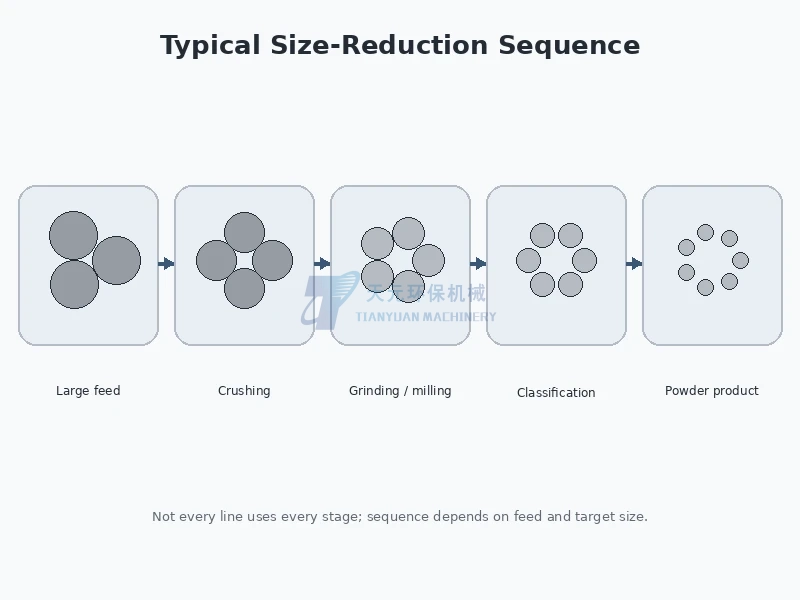
How Crushing, Grinding, Milling and Pulverizing Differ
Crushing
Usually the coarse or preliminary stage. The objective is to turn large pieces into smaller feed suitable for downstream processing.
Grinding
Usually a finer size-reduction stage. It is commonly associated with creating powder or significantly reducing already prepared particles.
Milling
Often overlaps with grinding. It frequently describes the operation of a mill or an entire fine-size-reduction process.
Pulverizing
Usually emphasizes the result—turning a material into powder—rather than defining one specific machine or universal size range.
The boundaries are intentionally described as “usually” rather than absolutely. Different industries use different terminology. In mineral processing, crushing and grinding may have fairly established stage distinctions. In food, plastics, pharmaceuticals, recycling, wood processing, and specialty powders, equipment names can overlap much more.
Why Equipment Names Overlap
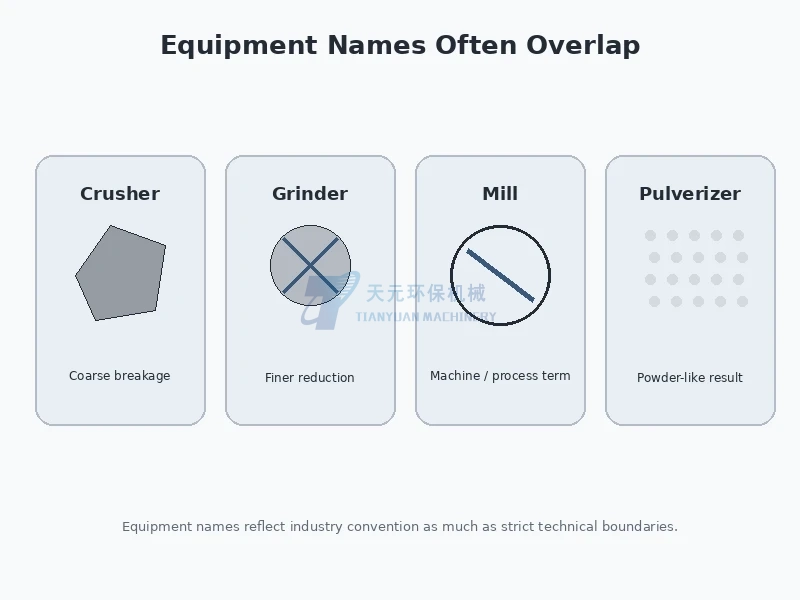
Equipment naming developed inside individual industries. A manufacturer may choose a name based on historical convention, machine construction, the target market, or the expected product.
A hammer machine used for coarse feed may be called a hammer crusher. A similar basic impact concept used for smaller feed may be called a hammer mill. A high-speed impact machine producing fine powder may be marketed as an impact mill, pulverizer, grinder, or fine mill.
This is why equipment comparisons should use technical parameters instead of names. A useful comparison includes maximum feed size, target product size, particle-size distribution, material hardness or toughness, moisture, temperature sensitivity, wear resistance, contact materials, airflow, screen or classifier design, power, qualified-product capacity, dust control, and safety requirements.
How to Select the Correct Size-Reduction Process
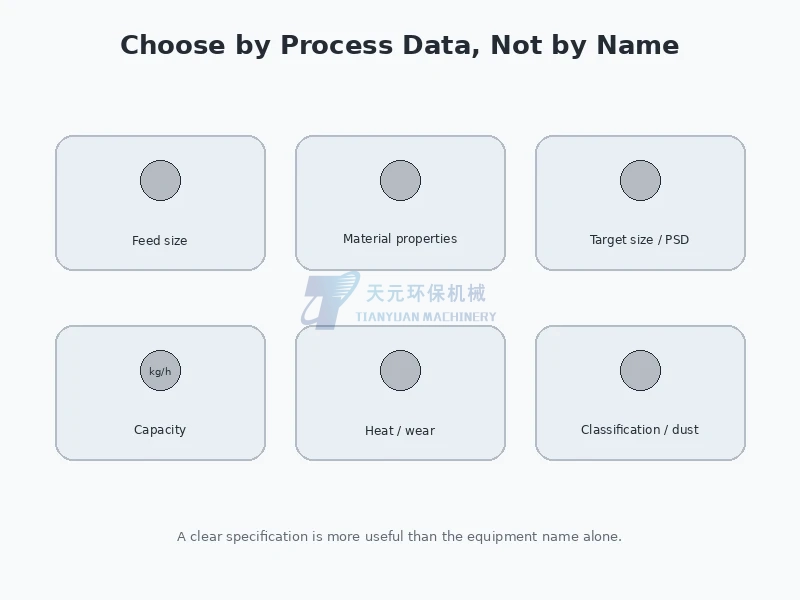
The first factor is feed size. A machine designed for fine powder normally should not be expected to accept very large, irregular raw material directly. Upstream crushing or cutting may be required.
The second factor is material behavior. Hard, brittle, soft, fibrous, elastic, ductile, sticky, abrasive, heat-sensitive, oily, wet, or combustible materials may require very different reduction mechanisms.
The third factor is the actual target product. “100 mesh” is more useful than “fine powder,” but even a single mesh number may still be insufficient. A stronger specification can define sieve standard, micron range, particle-size distribution, allowable oversize, required morphology, and acceptable contamination.
Capacity must also refer to the correct basis. Raw-material throughput is not always the same as qualified finished-product throughput. If a process uses classification and recirculation, only part of the material may become final product in one pass.
Heat generation and wear become increasingly important at finer sizes. Dust collection and, where relevant, combustible-dust safety must be treated as process-design issues rather than accessories added after the mill is selected.
How These Terms Apply to Tianyuan Equipment
For Tianyuan’s product positioning, the distinction between crushing and fine grinding is particularly important.
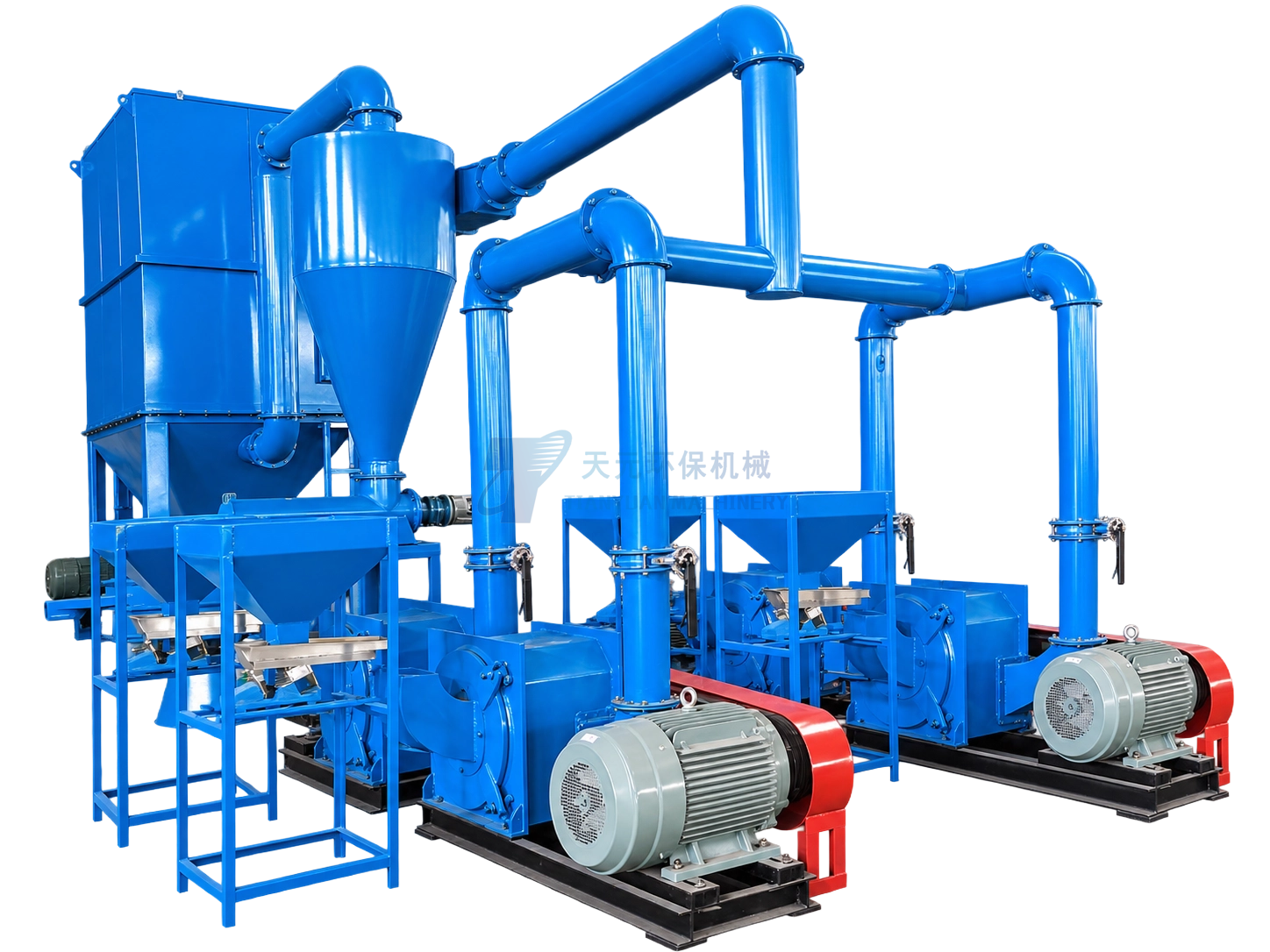
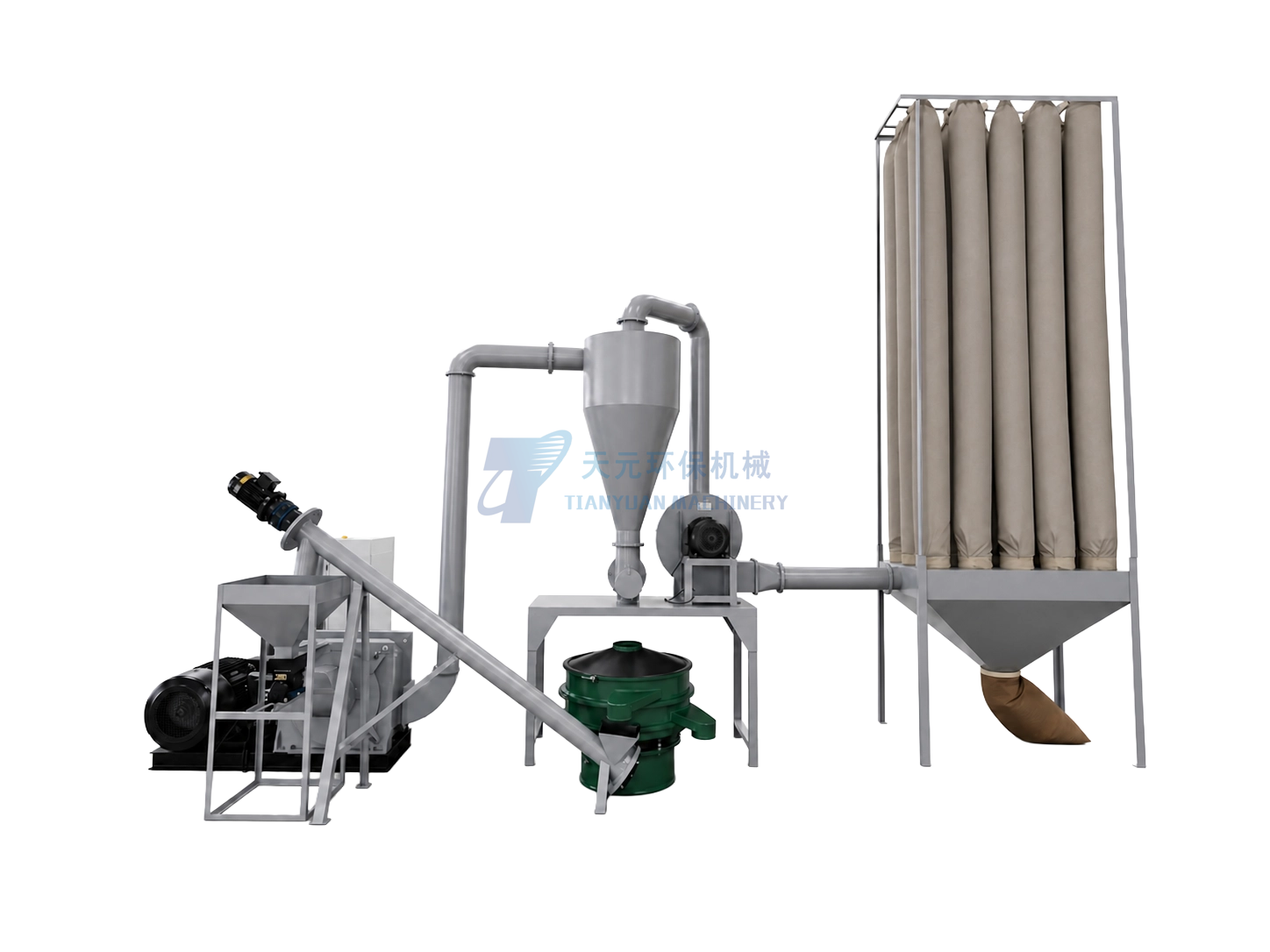
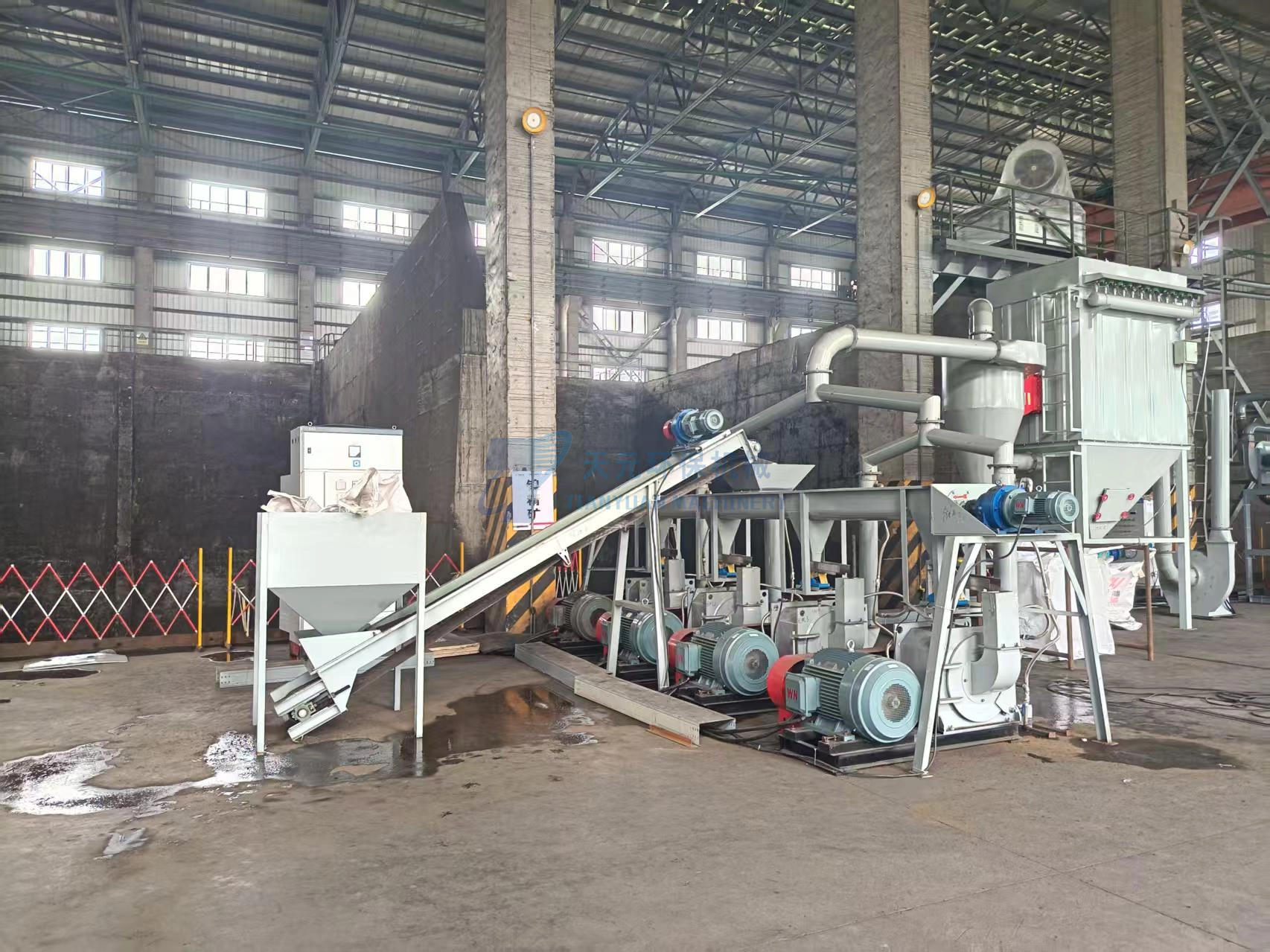
The wood powder mill is used for fine processing of suitable woody and plant-fiber feedstock after the material has been prepared to an appropriate feed condition. Cutting logs, reducing branches, crushing large wood pieces, or drying wet feed are upstream pretreatment operations. The wood powder mill should not be described as a general-purpose wood crusher.
The metal powder grinder is used for mechanical powder production from suitable metal materials. It should not be described as a mineral grinding machine, and it is not intended for stone, metallic ore, or non-metallic mineral powder. Suitable metal feed may also require sorting, cleaning, cutting, liquid removal, or other preparation before the fine-grinding stage.
For both product groups, the correct equipment decision begins with the real raw material and target product rather than the English word used in the machine name.
Frequently Asked Questions
What is the main difference between crushing and grinding?
Crushing usually refers to a coarser stage that reduces large pieces to smaller feed. Grinding normally performs finer size reduction and is more closely associated with producing particles or powder.
Are grinding and milling the same thing?
They frequently overlap in powder processing. Milling often means grinding in a mill, but the exact usage depends on the industry and equipment.
What does pulverizing mean?
Pulverizing generally means reducing a solid material to powder or very small particles. It describes the result more than one specific machine design.
Is a pulverizer always finer than a grinder?
No. Equipment names are not universal particle-size standards. The actual feed and product specifications should be compared.
Can one machine perform crushing and grinding?
Some machines cover a relatively wide size-reduction range, but large reduction ratios may still be more stable or efficient when divided into multiple stages.
Which term should I use when requesting powder equipment?
Use the term that best describes the process, but always provide feed size, material, target particle size, required capacity, moisture, contamination, and downstream application. These data are more important than the equipment name.
Conclusion
Crushing, grinding, milling, and pulverizing all belong to the broader field of size reduction, but their meanings overlap. Crushing normally describes coarse breakage, grinding generally describes finer reduction, milling often refers to grinding in a mill, and pulverizing emphasizes reducing material to powder.
Because these names vary between industries, they should never replace a real process specification. The reliable way to select equipment is to define the raw material, feed size, material behavior, target particle-size distribution, qualified-product capacity, temperature and wear limits, classification method, dust control, and downstream use.