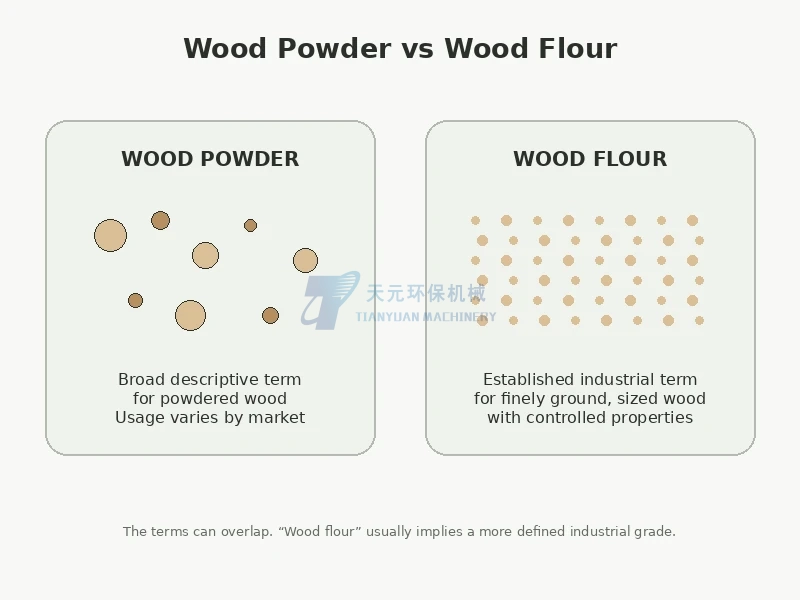
Wood powder and wood flour are closely related terms, and in some markets they are even used interchangeably. However, they are not always technically identical. Wood powder is usually a broad descriptive term for wood that has been reduced to a powder-like form, while wood flour is an established industrial term for finely ground wood that is normally dried, sized, screened, or classified to meet a more defined particle specification. Understanding this difference is useful when selecting raw materials, designing a production line, specifying particle size, or choosing a wood powder mill.
Key Conclusion
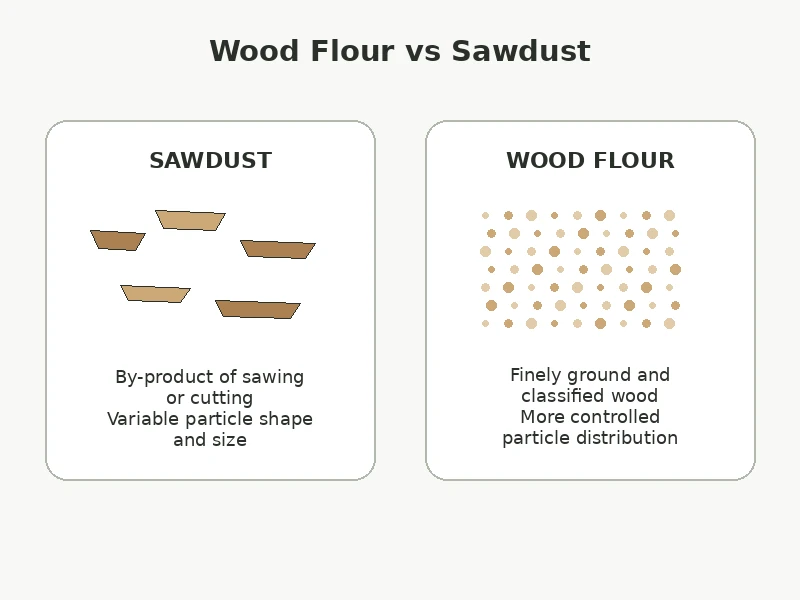
The safest technical distinction is that wood powder is a broad description, whereas wood flour normally refers to a more controlled industrial powder grade. Wood flour is typically produced from suitable dry wood material or clean wood-processing residues through fine grinding and subsequent screening or classification. Its quality may be defined by particle-size distribution, wood species, moisture, color, bark content, foreign matter, bulk properties, and downstream application. There is no single worldwide particle-size boundary that automatically separates all wood powder from all wood flour, so actual specifications are more important than the product name alone.
Contents
Why the Terminology Is Confusing
The confusion begins because wood powder and wood flour describe materials made from the same basic substance. Both consist of small wood particles created by reducing larger woody material. In normal commercial language, one supplier may advertise a product as wood powder while another supplier may sell a very similar material as wood flour.
The term wood flour has a longer and more established industrial history. Technical literature commonly uses it for finely divided wood produced from selected wood residues and then sized through mechanical or air classification. Wood powder, by contrast, is usually used more broadly to describe powdered wood without necessarily implying a particular standard, production method, or particle-size distribution.
This means the two terms can overlap. A sufficiently fine, clean, screened wood powder may in practice be sold or used as wood flour. At the same time, a coarse or poorly classified wood powder would not normally be considered a high-quality industrial wood flour grade simply because it looks powder-like.
For engineering and purchasing decisions, it is therefore better to ask for measurable properties rather than relying on terminology alone.
What Is Wood Powder?
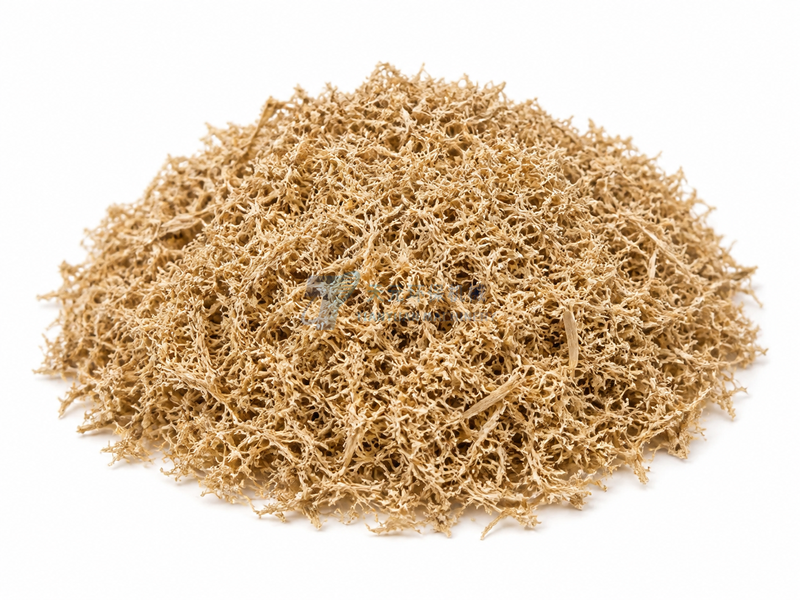
Wood powder can be understood as a broad descriptive category covering wood that has been mechanically reduced to a powder-like state. Depending on the source and industry, the material may range from relatively coarse powdered particles to a very fine dust-like product.
The term itself does not necessarily tell the buyer whether the material has been dried, screened, classified, cleaned, or standardized. It also does not automatically identify the wood species, bark content, moisture, color, or particle-size distribution.
For example, wood powder produced directly after one grinding stage may contain a wide range of particle sizes. Some particles may already be very fine while others remain much larger. The product may be perfectly acceptable for a low-specification application, but it may not be consistent enough for a formulation that requires predictable feeding, mixing, surface finish, or filler performance.
This is why the phrase wood powder is useful as a general material description but should not automatically be treated as a complete industrial specification.
What Is Wood Flour?
Wood flour is a more established industrial term for finely divided wood. It is commonly produced from selected dry wood residue, sawdust, prepared wood particles, or other suitable clean feedstock. The material is ground and then sized so that the finished product has a more controlled particle distribution.
Published technical references often describe wood flour as wood fine enough to pass through approximately 850 micrometre openings, equivalent to about a U.S. No. 20 standard sieve. This should be understood as a practical reference rather than a universal boundary. Commercial wood flour grades can be much finer, and different industries specify very different particle ranges.
The important characteristic is therefore control. A commercial wood flour supplier may control the amount retained on certain sieves, the percentage passing selected screens, moisture, wood species, bark content, ash or foreign material, color, and other properties depending on the intended use.
Wood flour is not simply “the finest possible wood powder.” It is a material prepared to meet a usable specification.
Particle Size and Consistency
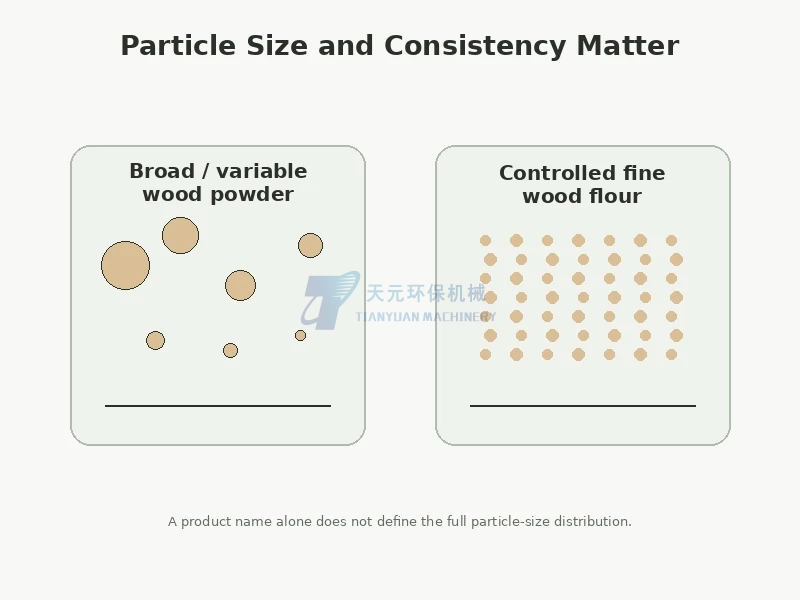
Particle-size distribution is one of the most useful ways to distinguish a general powder from a controlled industrial grade. A wood powder can have a broad distribution containing fine dust, medium particles, fibrous fragments, and a coarse tail. A specified wood flour product normally limits this variability more carefully.
One average particle size is not always enough. A product with an average around 200 micrometres could still contain a large amount of coarse material above the desired range or an excessive amount of ultrafine material below it. These two situations can create different processing behavior.
Wood particles are also not spherical. Their fibrous nature means that length, width, thickness, and aspect ratio may all matter. A long thin particle may pass through a sieve depending on its orientation even though one dimension is larger than the nominal opening.
For applications where consistency matters, it is therefore useful to specify screen analysis, particle-size distribution, or several sieve limits rather than only saying “fine wood powder.”
How Wood Flour Is Produced
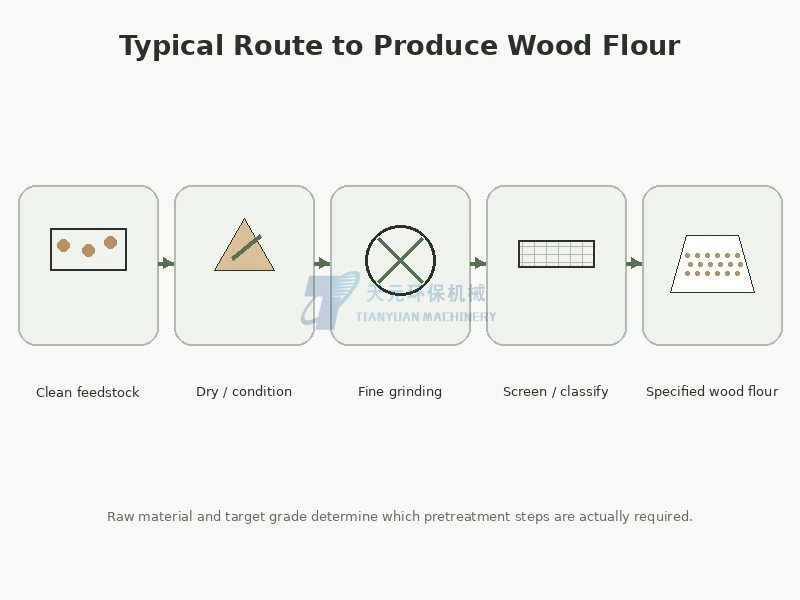
A typical wood flour process begins with suitable woody raw material. Depending on the feed, this may be clean sawdust, prepared wood chips, fine shavings, or another controlled plant-based fiber feedstock.
Cleaning and Feed Preparation
Large chips, stones, metal, bark, dirt, plastic, glue-contaminated pieces, and other unwanted materials may need to be removed. If the raw material is too large for stable fine grinding, cutting or primary crushing belongs to the pretreatment stage.
Drying or Moisture Conditioning
Moisture strongly influences grinding. Wet fibrous material can bend, agglomerate, block screens, and classify poorly. Excessively dry material may increase airborne dust. The correct moisture condition therefore depends on the raw material, target fineness, equipment, and final application.
Fine Grinding
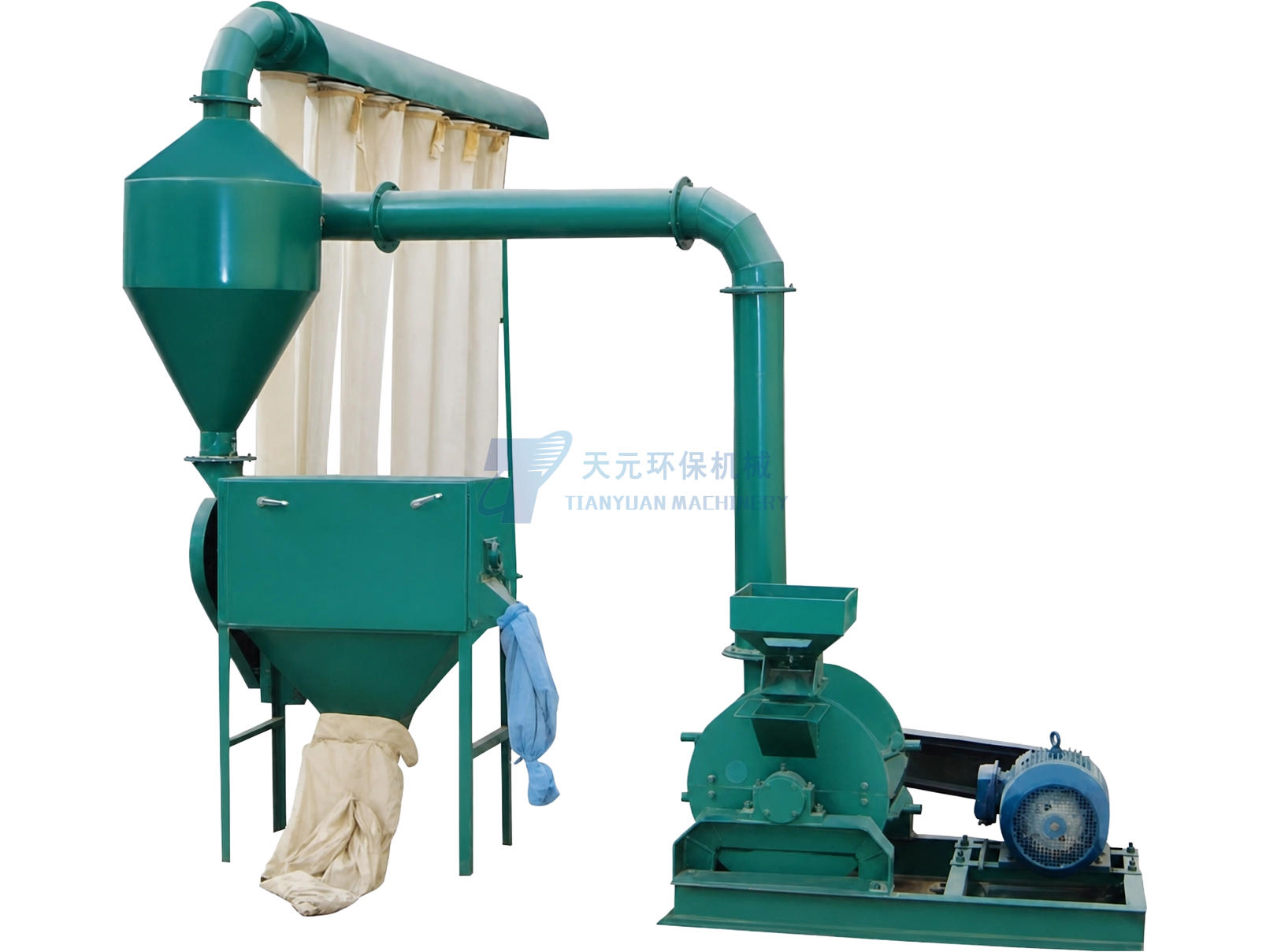
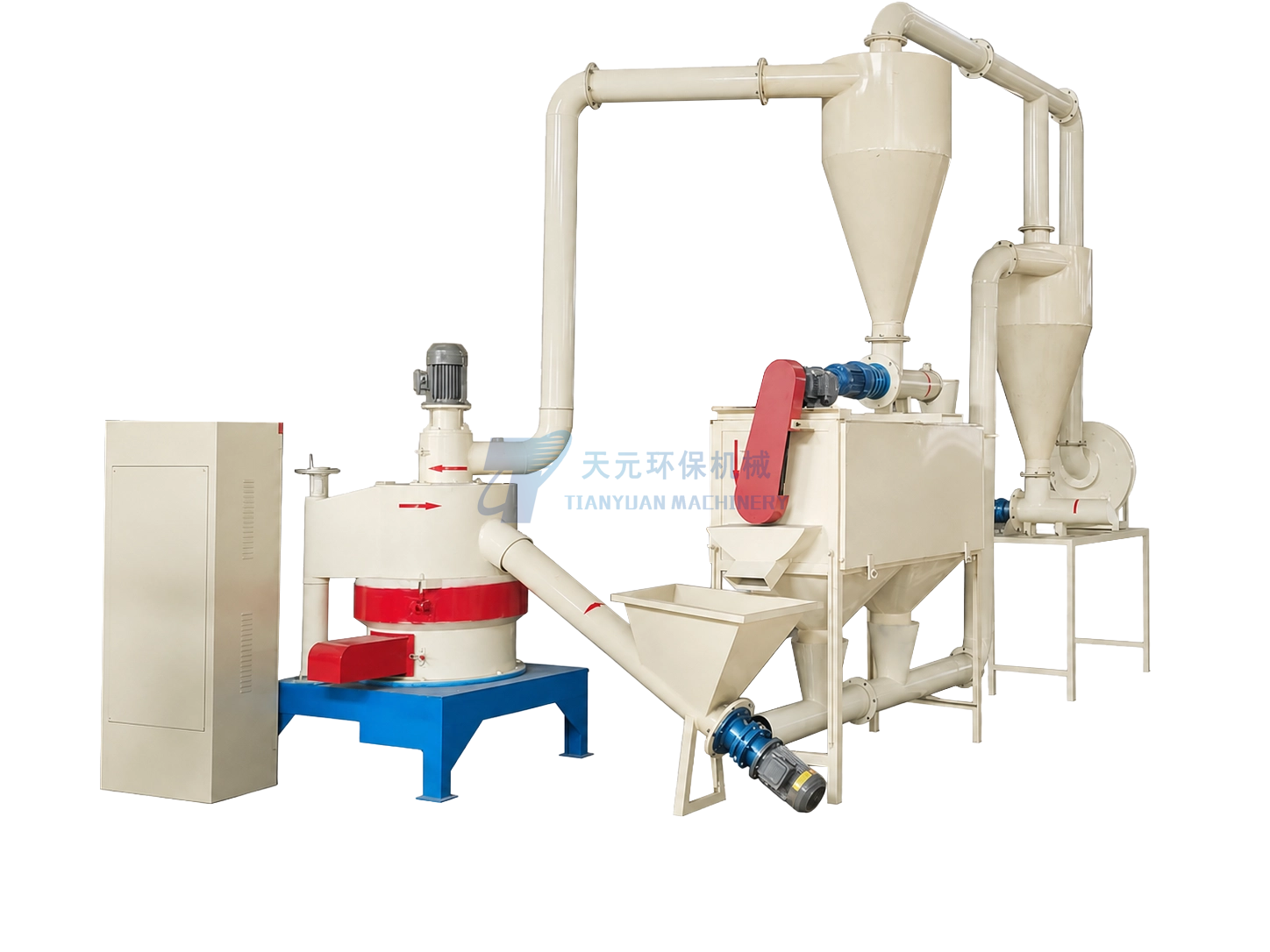
Prepared feed is reduced further using a suitable fine-grinding system. This is the stage associated with a wood powder mill or wood flour mill. It is different from the primary crushing of logs, branches, or large offcuts.
Screening or Classification
The ground material is separated into usable and oversized fractions. Depending on the target size, mechanical screening, air classification, or a combination of separation methods may be used. Oversized material can be returned for additional grinding where the process allows.
This final sizing step is one of the main reasons wood flour tends to be more consistent than an unsorted wood powder.
Applications and Material Requirements
Wood flour is used in a wide range of formulations and industrial products. Common examples include wood-plastic composites, thermosetting and thermoplastic fillers, molding compounds, adhesives, sealants, selected flooring materials, industrial absorbent or filler systems, incense-related formulations, and other applications where finely divided lignocellulosic material is useful.
The correct grade depends on the application. A wood-plastic composite producer may care about moisture, particle size, aspect ratio, color, and compatibility with the polymer. A filler application may place more emphasis on bulk density, purity, absorptiveness, or surface behavior. A product where visual finish matters may require a narrow particle range and consistent color.
Therefore, one wood flour grade should not automatically be assumed suitable for every downstream use.
How to Specify Wood Powder or Wood Flour Correctly
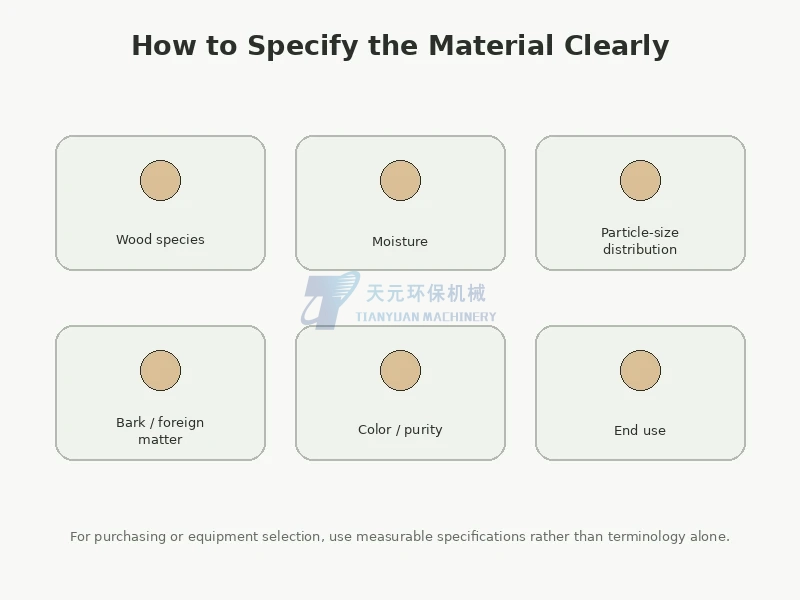
A useful material specification should begin with the wood source. The species or species group can influence color, density, fiber structure, extractives, and grinding behavior.
Moisture should be defined because it affects storage, grinding, classification, feeding, mixing, and downstream processing. Particle size should be stated using mesh, microns, screen analysis, or a particle-size distribution rather than an imprecise description such as “very fine.”
The acceptable amount of bark and foreign matter should also be stated. Recycled or mixed wood may contain glue, coatings, plastic, metal, stone, or treated wood that can make it unsuitable for certain applications.
For industrial projects, the end use should always be included because the target powder should be designed for the application instead of being made as fine as possible without a clear reason.
What the Difference Means for Equipment Selection
If the goal is simply to reduce large wood material into chips or coarse particles, a chipper or crusher is the appropriate pretreatment equipment. If the goal is to take already prepared material and produce a fine controlled powder, a wood powder mill or wood flour mill becomes relevant.
This distinction is important because primary crushing and fine grinding are different process stages. A wood powder machine should not be described as a replacement for all upstream cutting, chipping, drying, or crushing equipment.
For a real project, Tianyuan should evaluate raw-material size and form, wood species, moisture, contamination, target particle range, qualified-product capacity, classification requirement, dust collection, and final application before recommending a process. Typical configurations for a complete wood powder line are described in our wood powder production solution.
If the customer already has clean dry sawdust or fine wood residues, the process may be relatively simple. If the customer begins with branches, boards, wet chips, mixed waste, or contaminated material, additional pretreatment may be required.
Dust and Safety Considerations
Fine wood powder creates more airborne dust than coarse wood material. Dust control is therefore part of the production process, not only a housekeeping issue.
Fine wood dust can create worker-exposure concerns and, when combustible dust accumulates or becomes suspended under suitable conditions, can create fire or explosion hazards. The actual risk depends on particle size, moisture, dust concentration, ignition sources, ventilation, equipment, dust collection, housekeeping, and other operating conditions.
Industrial systems handling significant quantities of fine wood powder should therefore use appropriate dust-control engineering and should be reviewed against applicable local fire, occupational-health, and combustible-dust requirements.
Frequently Asked Questions
Is wood powder the same as wood flour?
They can overlap, but the terms are not always identical. Wood powder is generally broader, while wood flour usually refers to a finer and more controlled industrial product.
Is there a universal particle size that defines wood flour?
No. Technical literature provides practical reference ranges, but commercial grades and local definitions vary. The actual specification should state the required particle-size distribution.
Can sawdust be converted into wood flour?
Yes. Clean suitable sawdust can be dried or conditioned, finely ground, and screened or classified into a controlled wood flour grade.
Is finer wood flour always better?
No. The correct fineness depends on the downstream application. Excessive grinding can increase energy consumption, dust generation, surface area, and classification difficulty.
Does a wood powder mill replace a wood crusher?
No. Crushing is normally an upstream size-reduction stage for larger material, while a wood powder mill performs later-stage fine grinding on prepared feedstock.
What information is needed before selecting a wood flour production system?
Useful information includes wood species, feed form and size, moisture, impurities, target mesh or micron range, required product capacity, classification requirements, and final application.
Conclusion
Wood powder and wood flour describe closely related materials, and the terms can overlap in commercial use. The most useful industrial distinction is that wood powder is a broad description of powdered wood, while wood flour usually refers to a more deliberately prepared fine wood product with controlled particle size and quality.
For equipment selection and product quality, terminology is less important than measurable specifications. Wood species, moisture, feed condition, particle-size distribution, contaminants, capacity, classification, and final application should determine the process. A properly designed wood flour line therefore focuses on producing the right controlled powder for the intended use rather than simply producing the finest possible material.