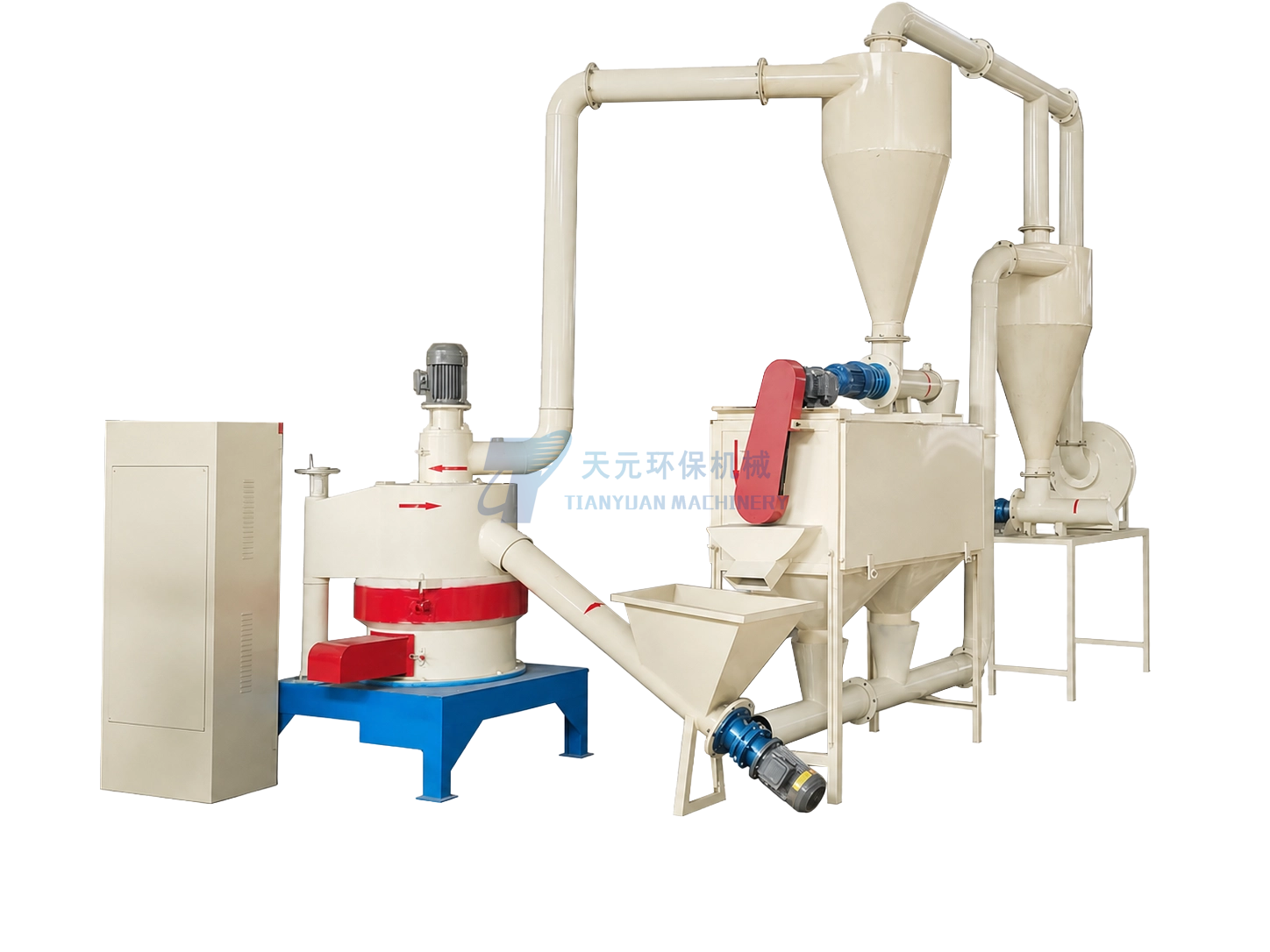
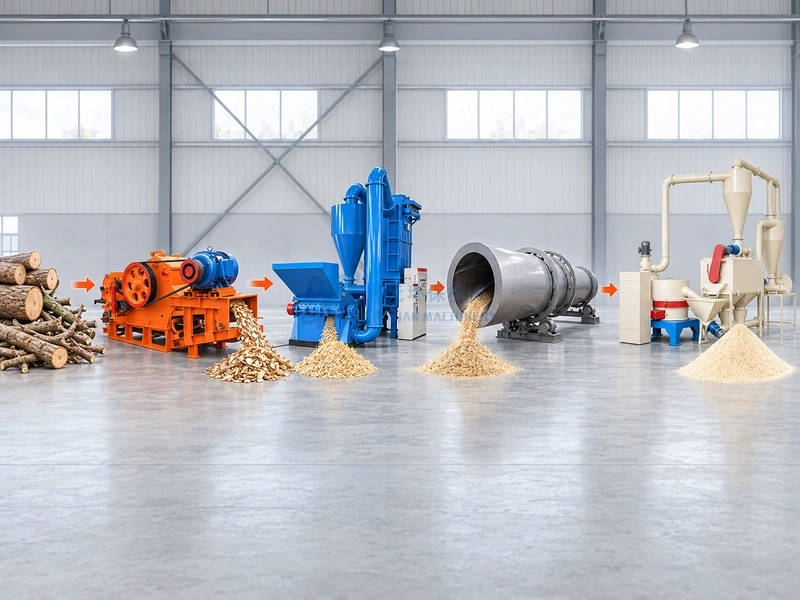
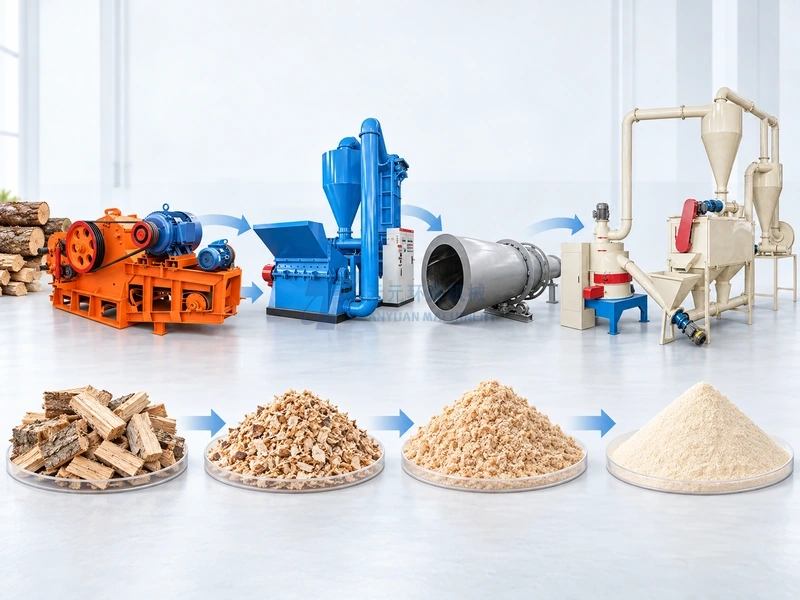
Wood flour is not normally made by feeding whole logs into one machine and collecting finished powder at the other end. Industrial wood flour production is a process chain that may include feedstock sorting, chipping or crushing, moisture control, fine milling, classification or screening, collection and dust control. The exact route depends on whether the starting material is logs, branches, chips, shavings or sawdust—and on the required particle size, capacity and final application.
Key Answer
Wood flour is made by preparing wood-based feedstock to a suitable size and moisture condition, reducing it through fine mechanical milling, separating the required particle-size fraction and collecting the finished powder. The process is therefore more than grinding alone: feed size, moisture, fiber structure, classification and dust collection all influence the final product.
Contents
What Is Wood Flour?
The term wood flour is used for finely divided wood particles rather than one single standardized particle size. The U.S. Forest Products Laboratory notes that, in practical use, wood flour commonly refers to wood particles fine enough to pass an approximately 850 µm opening (20 U.S. standard mesh). Commercial products can be substantially finer, depending on the application.
This distinction matters because sawdust, wood chips and wood flour are not simply three names for the same material. They represent different size ranges and feed conditions, and a fine-milling line should be configured around the material that actually arrives at the plant.
1. Prepare the Feedstock Before Fine Milling
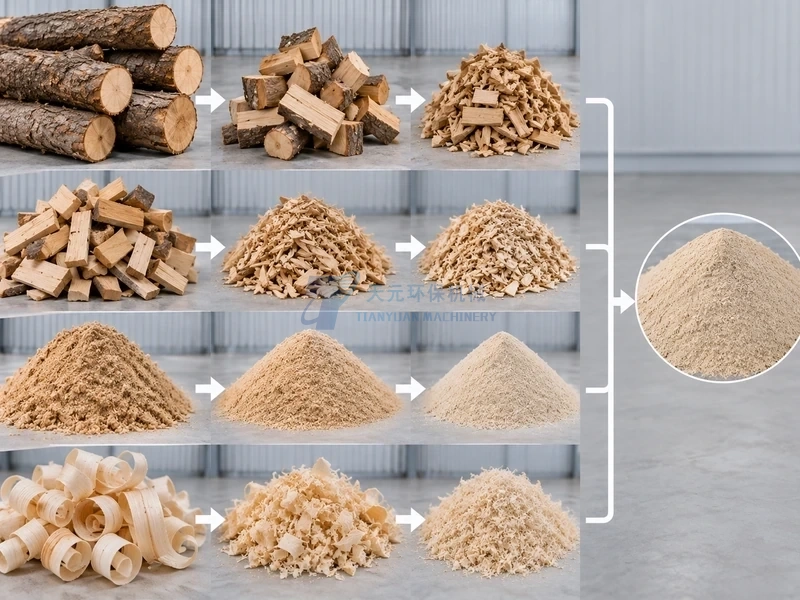
Logs, large branches, wood blocks, chips, shavings and sawdust require different preparation. Whole logs and large branches normally need chipping or crushing before they can enter a fine mill. Relatively clean sawdust or short shavings may require much less size reduction.
Recycled wood can also contain nails, screws, stones, plastics, dirt, coatings or adhesive residues. These contaminants can damage equipment and change the purity or suitability of the finished wood flour. Sorting, magnetic separation or other removal steps should therefore be considered when the feedstock source is variable.
2. Reduce Oversized Wood to a Mill-Compatible Feed Size
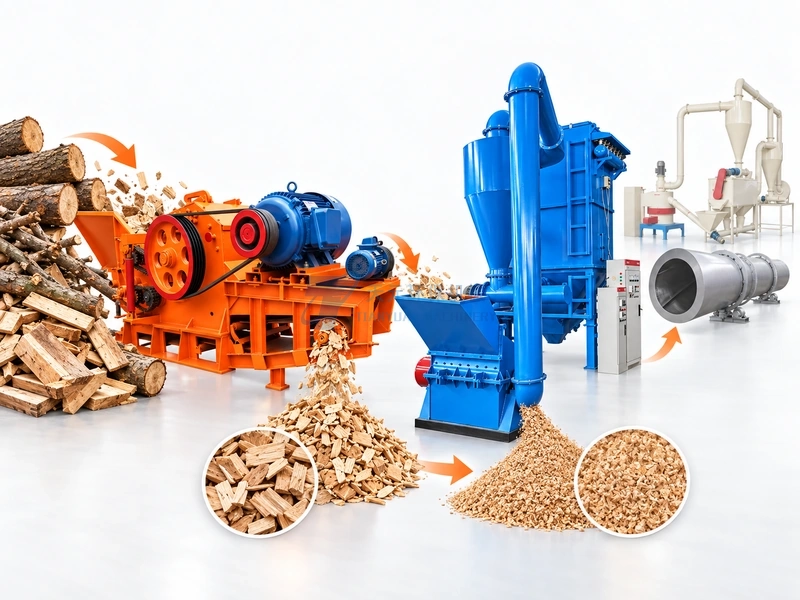
A wood flour mill should not be treated as a universal primary crusher. If the material is too large, a typical route is logs or branches → chipping → crushing → prepared chips or sawdust → fine milling.
For Tianyuan’s TYMF6R-600 project standard, feed size is evaluated at ≤5 mm. This means that large chips, blocks or branches normally require pretreatment before fine milling. Tianyuan’s wood crusher is one possible pretreatment unit when the actual feed and target size are suitable.
3. Control Moisture Before Fine Grinding
Wood is hygroscopic, and moisture changes its grinding behavior. Material that is too wet can become tougher, stickier and more difficult to screen. Excess moisture can contribute to buildup, screen blinding, unstable fineness and reduced qualified-product output.
Drying is therefore a process decision rather than a mandatory standalone machine in every line. If the incoming sawdust already meets the mill’s moisture requirement, a separate drying stage may not be necessary. If the feed is too wet, the line may require natural drying, airflow drying, rotary drying or another suitable moisture-control method.
Where continuous drying is required, a rotary drum dryer can be evaluated according to feed moisture, particle size, capacity, heat source and final moisture target.
4. Fine Milling Turns Prepared Wood into Wood Flour
Once feed size and moisture are suitable, the material enters the fine-milling stage. Wood is fibrous rather than a simple brittle mineral, so species, density, fiber toughness, moisture and feed geometry all affect how the particles break down.
The TYMF6R-600 is Tianyuan’s roller-type ultrafine wood powder mill for suitable wood and fibrous feedstocks. The current unified article specification is a feed size of ≤5 mm, a finished fineness range of 30–325 mesh and a processing capacity of 100–500 kg/h. Actual qualified-product output depends on the real material, feed condition and target fineness, so project capacity should be confirmed from the application rather than taken as a universal fixed number.
For equipment details, see the TYMF6R-600 ultrafine wood powder mill.
5. Classification and Screening Define the Qualified Fraction
Material leaving the grinding chamber is not automatically one perfectly uniform particle size. Classification and screening separate the required fraction from particles that remain too coarse. Depending on line design, oversize material can be returned for further processing while the accepted fraction continues to collection.
This is why “the mill can reach a certain mesh” and “the line can continuously produce a certain mass of qualified powder at that mesh” are different engineering questions.
6. Cyclone Separation, Product Collection and Dust Control
Fine wood powder is light and can move readily with process air. Conveying, cyclone separation, product discharge and dust collection therefore need to be designed as one system. A stable collection system helps recover useful product, control dust escape, maintain process airflow and deliver powder consistently to screening, packaging or storage.
For a complete route rather than a single machine, see Tianyuan’s wood powder production solution.
Why Mesh Size Alone Does Not Fully Describe Wood Flour
Commercial wood flour is normally a particle-size distribution rather than a collection of identical particles. Research from the U.S. Forest Products Laboratory has shown that wood-flour particle size and aspect ratio can influence the properties of wood–plastic composites. Wood species and milling conditions can also change the particle-size distribution obtained from the same nominal screen size.
For industrial purchasing, it is therefore better to confirm not only mesh size, but also particle-size distribution, moisture, contamination limits, wood species or color consistency, and the final application.
Typical Wood Flour Production Routes
| Starting material | Typical route | Main process question |
|---|---|---|
| Logs or large branches | Chipping → crushing → moisture adjustment → fine milling → classification → collection | How much pretreatment is needed before the fine mill? |
| Wood chips or shavings | Size check → optional secondary crushing → moisture adjustment → fine milling → classification → collection | Do particle size and moisture already meet the mill requirement? |
| Prepared sawdust | Contamination/moisture check → fine milling → classification → collection | Can pretreatment stages be simplified? |
Tianyuan Process Evaluation: What We Need to Know Before Selecting Equipment
A useful wood-flour project evaluation should begin with the real feedstock, not only the requested mesh. Tianyuan normally needs to confirm the wood species or material name, feed form, maximum size, measured moisture, contamination, target fineness, required qualified-product capacity, final use, existing equipment and site conditions.
A plant receiving dry prepared sawdust may only need fine milling, classification and collection. A plant receiving fresh branches may need chipping, crushing and drying before the same fine-milling stage. Both projects produce wood flour, but the process configuration is not the same.
Wood Dust Safety Must Be Designed into the Process
Dry fine wood dust is combustible. As particles become finer and more easily suspended, fire and dust-explosion hazards require serious assessment. Equipment temperature, bearings, ignition sources, static grounding, ventilation, housekeeping, dust collection and explosion/fire protection should be evaluated for the actual material and local regulations.
Frequently Asked Questions
Can sawdust be made directly into wood flour?
Yes, when the sawdust is clean and its particle size and moisture are suitable for the selected mill. Oversized, wet or contaminated sawdust may still require pretreatment.
Do all wood flour lines need a dryer?
No. Drying is required when the incoming material is too wet for stable fine milling and screening. Feedstock that already meets the moisture requirement may not need a separate dryer.
Is wood flour the same as sawdust?
Not exactly. Sawdust is a sawing by-product with a relatively broad and often coarser particle distribution. Wood flour is a finer, intentionally prepared wood-particle product that is usually screened or classified for a target range.
What determines the capacity of a wood flour mill?
Capacity depends on material species, fiber structure, moisture, feed size, target fineness, classification settings and the definition of qualified product. Finer targets can reduce the amount of accepted powder produced per hour.
Technical References
- USDA Forest Products Laboratory — Wood flour
- USDA Forest Products Laboratory — Effects of wood fiber characteristics on wood/polypropylene composites
- Polymers — Properties of wood flour manufactured from secondary processing mill residues
Conclusion
Industrial wood flour production is best understood as staged preparation followed by fine milling, classification and collection. Large feed is reduced first, wet feed is conditioned when necessary, prepared material is finely milled, and the required particle fraction is separated and collected.
The correct line is determined by the starting material and the finished-powder specification—not by the mill name alone.