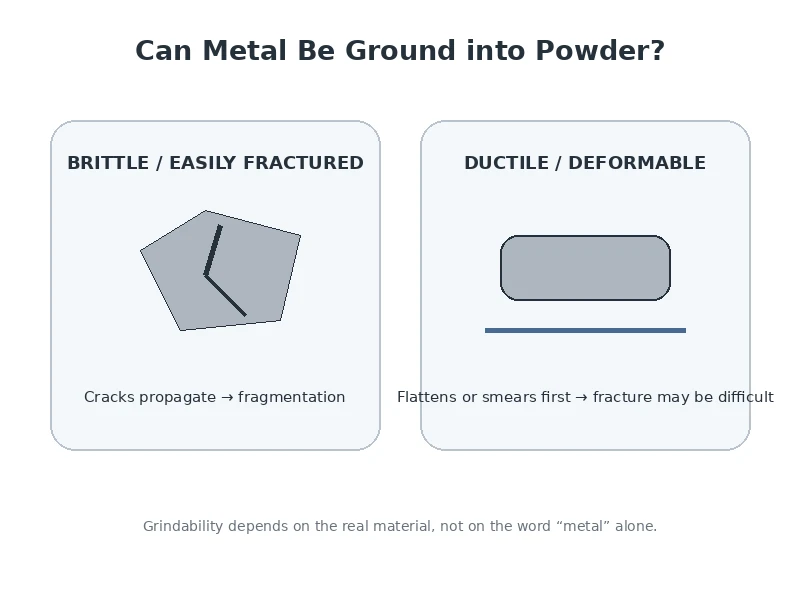
Yes, some metals can be mechanically ground into powder, but mechanical grinding is not equally suitable for every metal. Whether a metal can be converted efficiently from chips, flakes, granules, or other solid feed into powder depends on its brittleness, ductility, hardness, work-hardening behavior, feed form, target particle size, required particle morphology, heat generation, oxidation sensitivity, and safety conditions. Mechanical grinding is therefore a material-specific powder-production route rather than a universal answer for all metals.
Key Conclusion
Metal can be ground into powder when the material and process conditions allow repeated fracture or controlled size reduction. Brittle metals, brittle alloys, intermetallic compounds, and materials that have been prepared in a more fracture-prone condition are generally easier to pulverize mechanically. Highly ductile metals may instead flatten, smear, cold-weld, agglomerate, or work-harden before they fracture. A practical project should therefore be evaluated from the real feedstock and required finished powder rather than from the metal name alone. Sample testing is often the most reliable way to determine whether mechanical grinding is technically appropriate.
Contents
Can Metal Really Be Ground into Powder?
Mechanical comminution is a recognized route for producing or refining metal powders. The basic principle is straightforward: solid metal is subjected to repeated impact, compression, attrition, shear, or particle-to-particle collision until the material is reduced to a smaller size.
The difficulty is that metals do not all respond to mechanical force in the same way. A brittle alloy may crack almost immediately when stress exceeds its fracture strength. A soft and ductile metal may absorb the same mechanical energy through plastic deformation instead of breaking. In that situation the particle becomes thinner, longer, flatter, or work-hardened before meaningful size reduction occurs.
This means the answer to “Can metal be ground into powder?” should normally be: yes, for suitable materials and suitable powder requirements, but the process must be matched to the specific metal.
Mechanical grinding is especially relevant when the starting material already exists in solid form, such as machining chips, flakes, granules, brittle fragments, pre-crushed pieces, sponge-like material, or suitable recycling feedstock. It can also be used as a secondary operation after another powder-production method when further size reduction is needed.
Why Brittleness and Ductility Matter
Brittleness and ductility are among the most important factors in mechanical metal grinding. A brittle material tends to form and propagate cracks under repeated loading. Once cracks propagate through the particle, the material fragments into smaller pieces. Repeated fracture can continue until other limitations such as particle strength, classification efficiency, heat, wear, or agglomeration become important.
Ductile materials behave differently. Instead of immediately cracking, a ductile particle can deform. During milling it may be flattened between impact surfaces, stretched, smeared onto a contact surface, or pressed against other particles. The new surfaces created by plastic deformation can also promote cold welding between particles.
This does not mean that ductile metals can never be mechanically processed. Continued deformation can produce work hardening, and work-hardened particles may eventually become more susceptible to fracture. Different mill designs, operating conditions, feed preparation, cooling strategies, or material conditioning can also change the balance between deformation and fracture.
However, this is exactly why a universal statement such as “all metals can be ground to 200 mesh” is technically unreliable. The same machine and operating condition can give completely different results with zinc, copper, aluminum, titanium, iron, stainless steel, or a hard intermetallic compound.
What Happens to Metal During Mechanical Grinding?
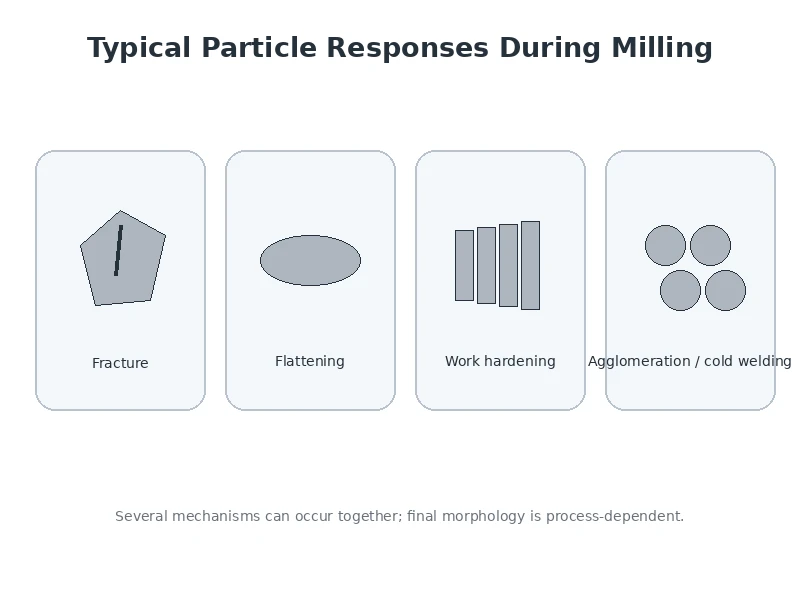
Several mechanisms can occur during mechanical milling, and more than one may occur at the same time.
Fracture
Fracture is the mechanism most directly associated with size reduction. Cracks form and propagate until one particle becomes two or more smaller particles. Brittle materials generally favor this mechanism.
Flattening and Plastic Deformation
Soft or ductile metal can deform under repeated impact. A roughly equiaxed particle may become a flake or thin plate. The apparent thickness decreases, but the maximum lateral dimension can temporarily increase. Therefore milling does not always produce a continuously decreasing particle size from the first minute of operation.
Work Hardening
Repeated plastic deformation can increase the hardness and reduce the remaining ductility of some metals. As work hardening develops, the balance may shift from deformation toward fracture. This is one reason milling behavior can change during a long process.
Cold Welding and Agglomeration
Fresh metallic surfaces can contact each other under high pressure and form agglomerates or cold-welded particles. Instead of becoming smaller, particles may temporarily become larger. This phenomenon is especially important in high-energy milling of ductile powders.
The final result is the balance between fracture, deformation, welding, deagglomeration, classification, and removal of finished particles from the grinding zone.
Why Feed Form Matters
The chemical composition of the metal is only part of the project. The physical form of the feed can be equally important.
Short chips may feed consistently while long curled machining chips can bridge in a hopper or wrap around moving components. Thin foil may behave differently from granules. Small brittle pieces may fracture efficiently while a large compact block may first require cutting or crushing. Oil-covered machining chips may need cleaning or liquid removal before dry powder processing is considered.
Heat treatment and previous manufacturing history can also change mechanical behavior. The same nominal alloy may respond differently if one batch is annealed, another is heavily work-hardened, and a third has a different microstructure.
Therefore, a useful project inquiry should include photographs and representative samples of the actual feedstock rather than only the alloy name.
Typical Mechanical Metal Powder Route
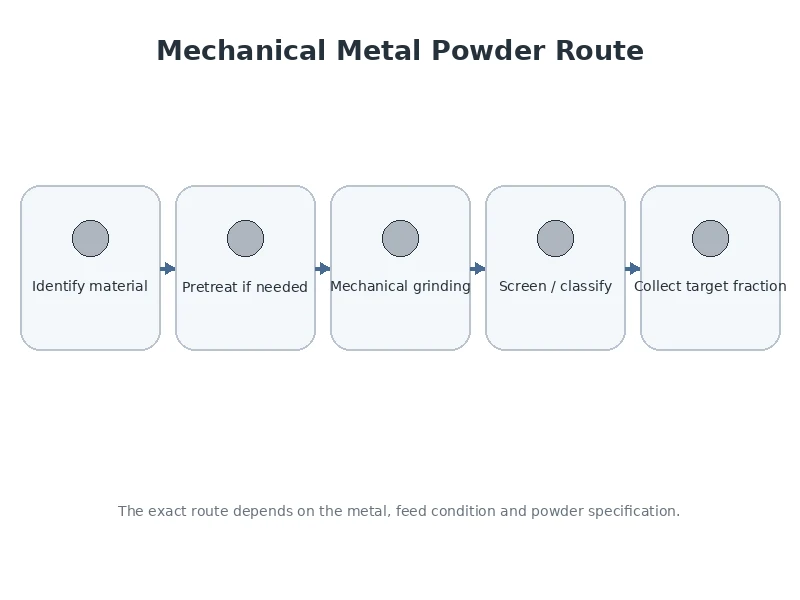
A mechanical metal-powder project can be evaluated through a sequence such as:
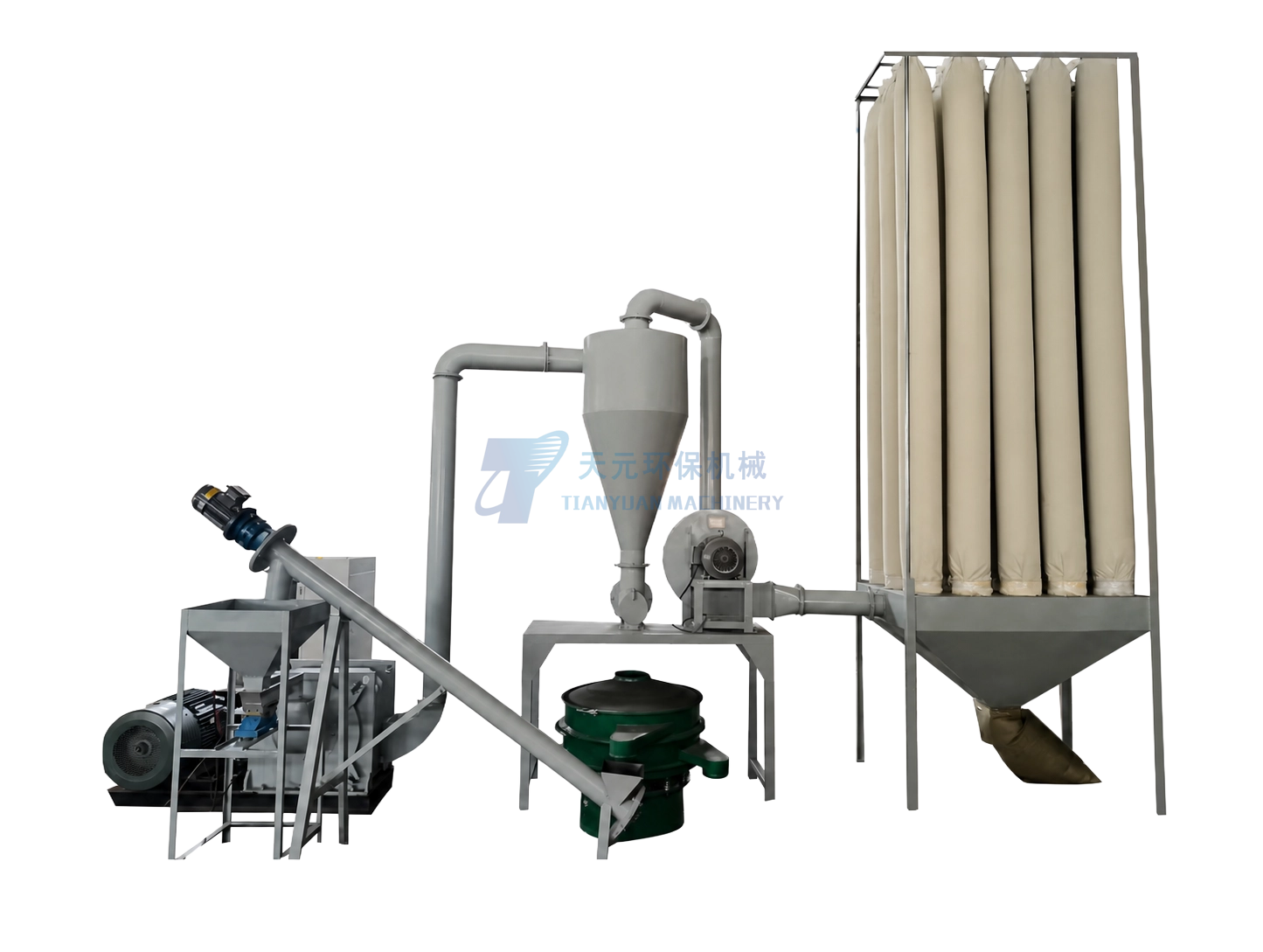
Material identification → feed inspection → necessary pretreatment → controlled feeding → mechanical grinding → screening or classification → oversized-material recirculation if appropriate → finished-powder collection → quality verification → packaging.
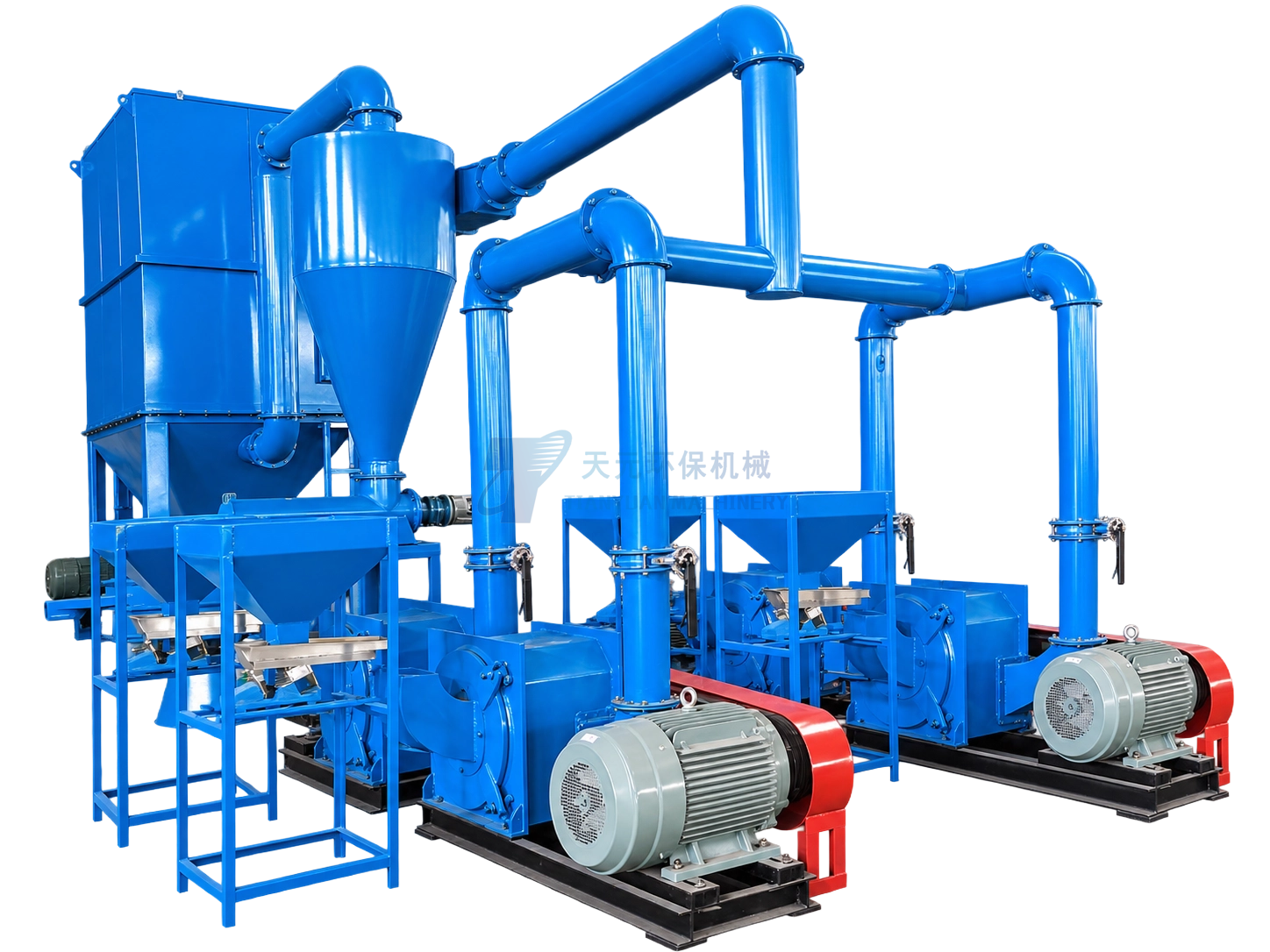
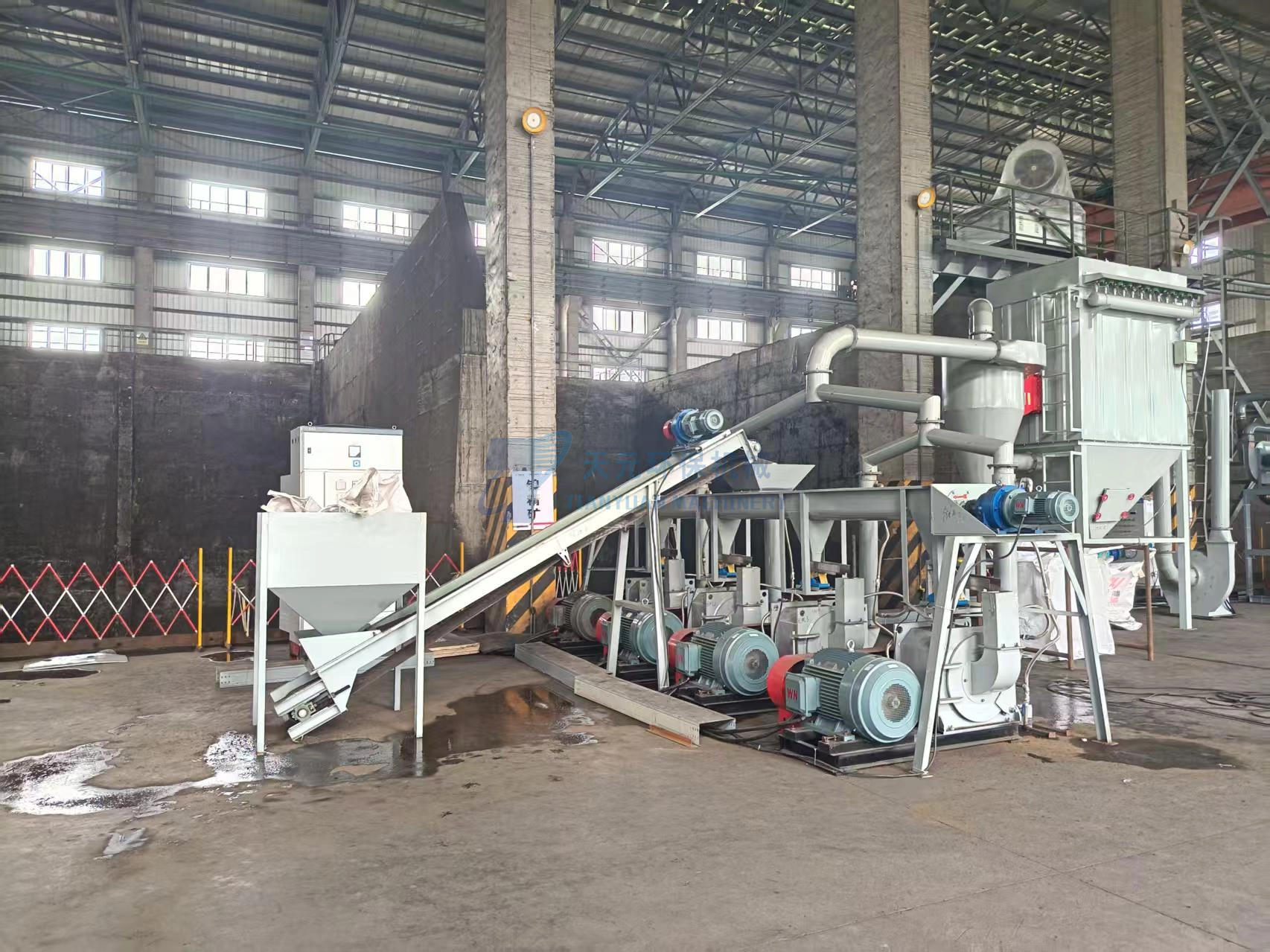
Not every project requires every stage. A clean, dry, uniform granular feed may need little pretreatment. Long machining chips, contaminated scrap, mixed alloys, oily material, or large pieces can require additional preparation before stable fine grinding is possible. The exact stage combination depends on the feedstock and the target powder specification; typical line configurations are described in our alloy and metal powder processing solution.
Classification is especially important. A grinding chamber does not create particles of exactly one size. Fine particles, near-size particles, and oversized particles normally coexist. Removing the acceptable fraction while returning or separately treating the coarse fraction can improve control of the finished product.
How Fine Can Mechanical Grinding Go?
There is no technically responsible universal answer such as “all metals can reach 300 mesh.” The achievable fineness depends on the specific metal, the mill, operating energy, classification system, particle morphology, temperature, wear, contamination limits, and acceptable production rate.
As powder becomes finer, several effects become more important. The number of particles increases rapidly, total surface area rises, particles become easier to entrain in air, agglomeration may become stronger, and classification becomes more demanding. More energy can be converted to heat rather than useful fracture.
The commercially useful question is therefore not only “What is the smallest particle that can be produced?” but “What fraction of the production can consistently meet the required particle specification?”
Feed capacity and qualified finished-powder capacity should also be distinguished. A system may process a certain mass of raw material per hour, while only part of that material immediately falls within the target size range. The rest may need recirculation or additional processing.
Particle Shape and Powder Quality
Mechanical grinding usually does not produce the same particle morphology as atomization. Gas-atomized powders can be relatively spherical because droplets solidify in flight. Mechanically produced powders are commonly more irregular, angular, fractured, or flattened.
This does not make mechanical powder inherently better or worse. It means the production route must match the downstream application. An application requiring high sphericity and very controlled flow behavior may favor another process. An application that accepts irregular particles and values the direct processing of suitable solid feedstock may be compatible with mechanical grinding.
Particle size alone is therefore insufficient. Powder specifications may need to consider particle-size distribution, morphology, apparent density, flowability, purity, oxidation level, and contamination from wear surfaces.
Heat, Oxidation and Dust Safety
Turning solid metal into fine powder changes the safety conditions of the material. The much larger surface area of fine particles can increase oxidation and chemical reactivity. Mechanical grinding also introduces energy into the system and can generate heat through impact, friction, deformation, bearings, airflow, and recirculation.
Some metal powders are combustible and can form explosible dust clouds under appropriate conditions. Aluminum and magnesium require particularly careful consideration, while other metal powders including iron and zinc can also present combustible-dust hazards depending on their specific properties and particle condition.
A safe system cannot be defined simply by adding a dust collector. Actual design may need to consider the material’s combustibility data, particle size, temperature, oxygen level, ignition sources, static electricity, grounding and bonding, dust concentration, ventilation, collection method, housekeeping, fire protection, explosion protection, and local regulatory requirements.
For combustible metal projects, qualified dust-safety professionals should review the process and applicable standards before production conditions are finalized.
How to Evaluate Whether Mechanical Grinding Is Suitable
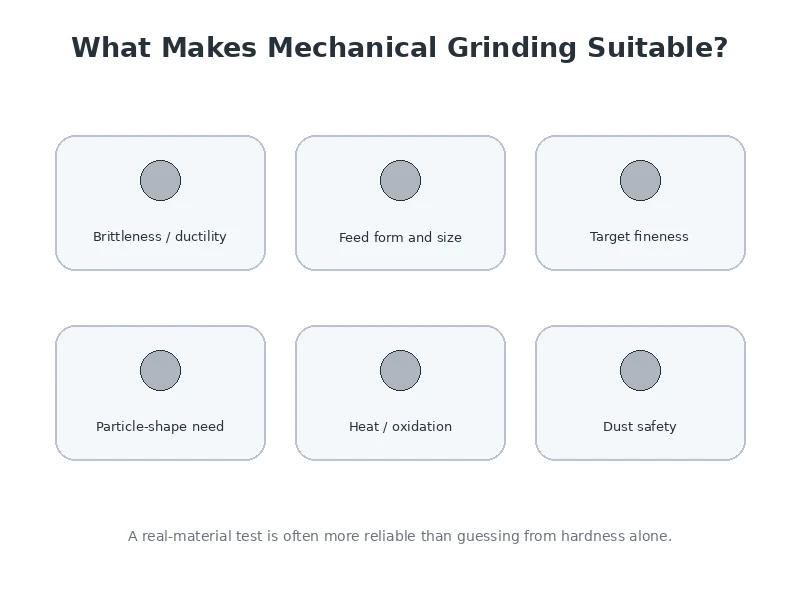
A useful evaluation should begin with the actual project data rather than with a machine model.
The first question is the material: metal name, alloy grade if known, and whether different grades are mixed. The second is feed condition: chips, flakes, granules, foil, pieces, powder, sponge, or another form. Dimensions, oil, water, coatings, oxides, dirt, and foreign metal should also be identified.
The target product should then be defined. Useful information includes target sieve size or micron range, particle-size distribution if required, acceptable particle shape, purity requirement, expected qualified-product capacity, and final use.
Finally, process constraints must be reviewed: heat sensitivity, oxidation, dust hazards, acceptable wear contamination, classification requirements, available utilities, environmental controls, and local safety requirements.
For materials whose behavior is uncertain, a representative material test can provide far more useful information than a theoretical answer. A test can reveal whether the material feeds consistently, whether it fractures or mainly deforms, whether pretreatment is required, what particle morphology develops, and whether the target fraction can be separated efficiently.
Tianyuan’s metal powder grinding equipment is intended for suitable metal materials processed by mechanical size reduction. It is not a mineral grinding machine and should not be selected for stone, metallic ore, or non-metallic mineral powder. Project suitability should be confirmed from the actual metal feedstock and powder requirement.
Frequently Asked Questions
Can any metal be ground into powder?
No universal grinding process works equally well for every metal. Brittleness, ductility, work hardening, feed form, target fineness and process conditions all affect whether mechanical grinding is practical.
Why are brittle metals easier to grind?
Brittle materials tend to propagate cracks and fracture under impact or compression instead of absorbing most of the energy through plastic deformation.
Why do ductile metals sometimes flatten instead of becoming powder?
Ductile metals can plastically deform under repeated impact. They may flatten, smear or cold-weld before sufficient work hardening and fracture occur.
Can machining chips be used to make metal powder?
Suitable machining chips can be evaluated as feedstock, but chip length, alloy consistency, oil, moisture, contamination and feed behavior must be checked. Pretreatment may be required.
Does mechanical grinding produce spherical metal powder?
Normally it should not be assumed to produce highly spherical particles. Mechanical fracture and deformation commonly create irregular, angular or flattened morphologies.
Is finer metal powder always better?
No. The required particle size should be determined by the final application. Excessive grinding can increase energy use, dust generation, oxidation, agglomeration and classification difficulty.
Why is sample testing useful before selecting a metal powder grinder?
Testing shows how the real material feeds, deforms, fractures, heats and classifies. It can also reveal whether additional pretreatment or a different powder-production route is needed.
Conclusion
Metal can be mechanically ground into powder, but the feasibility and usefulness of the process depend on the specific metal and the required finished powder. Brittle materials usually fragment more readily, while ductile metals may first deform, flatten, work-harden, agglomerate or cold-weld.
A sound project therefore begins with material identification, feed inspection and a clear powder specification. Mechanical grinding should be selected when the real material behavior, achievable particle distribution, morphology, qualified-product capacity and safety conditions all support the process. When uncertainty remains, representative sample testing is the most practical next step.