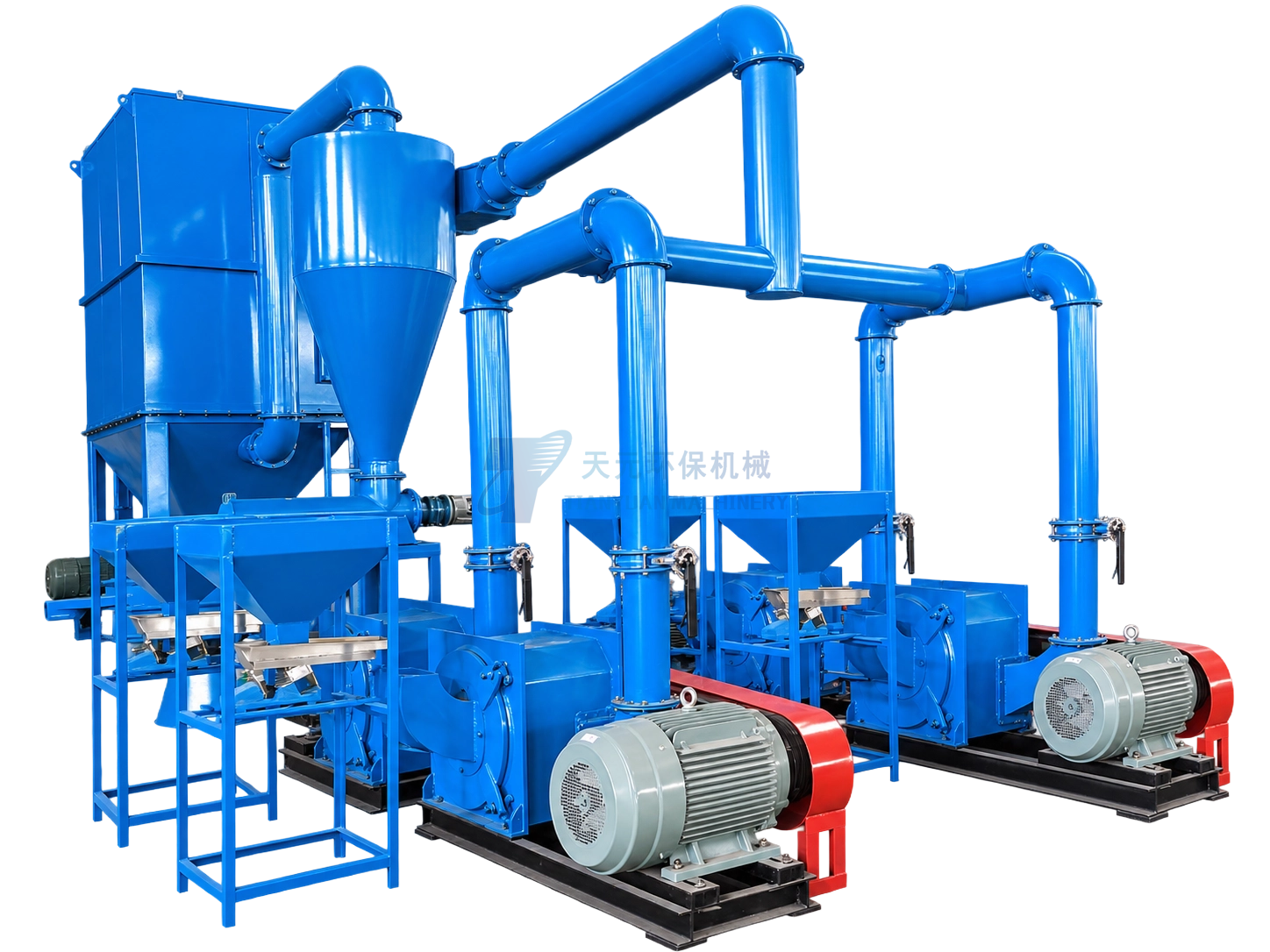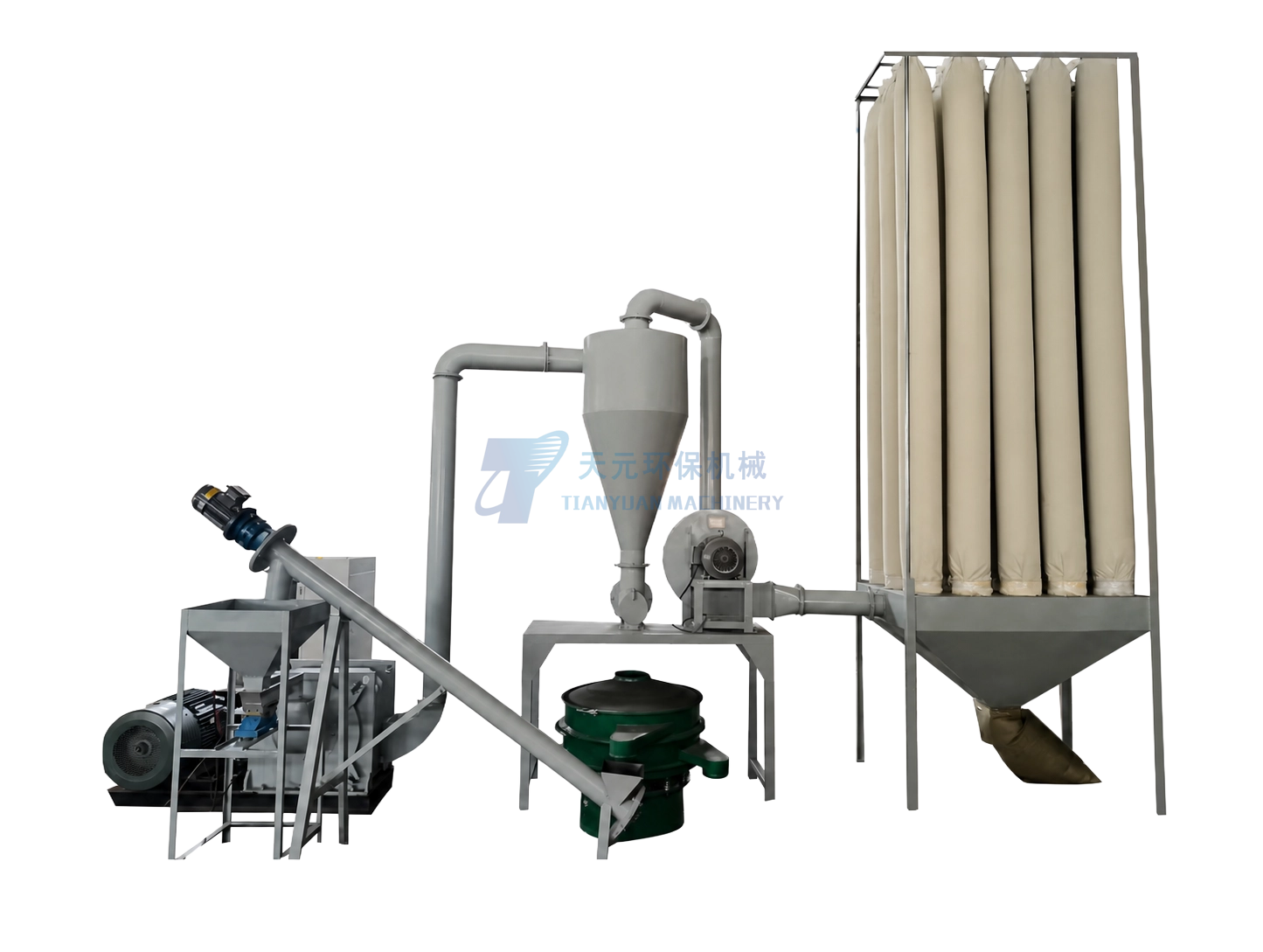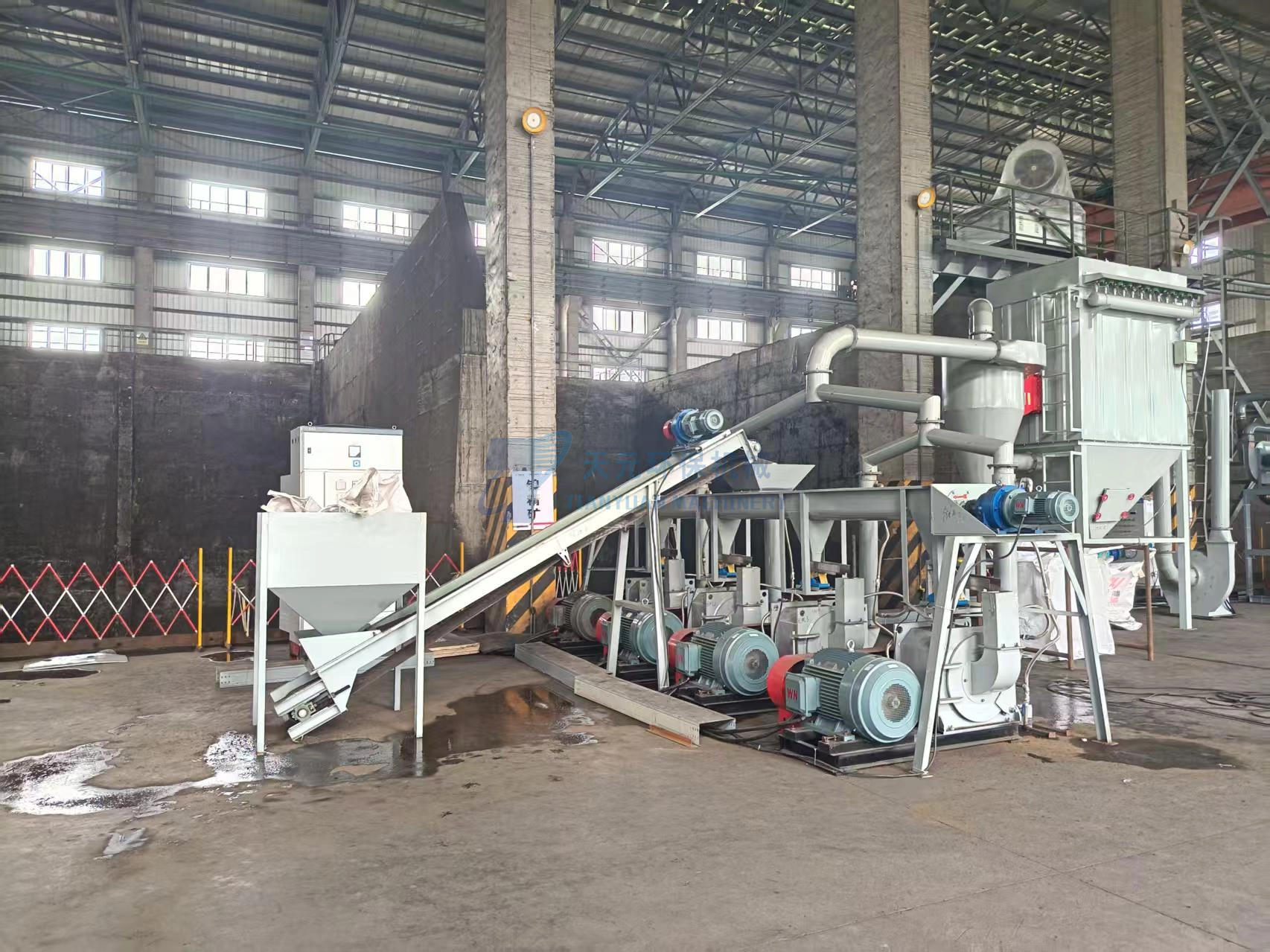
The equipment in this explanation is a metal powder grinding mill. This page describes the process; the model page is the TYJSMF500.
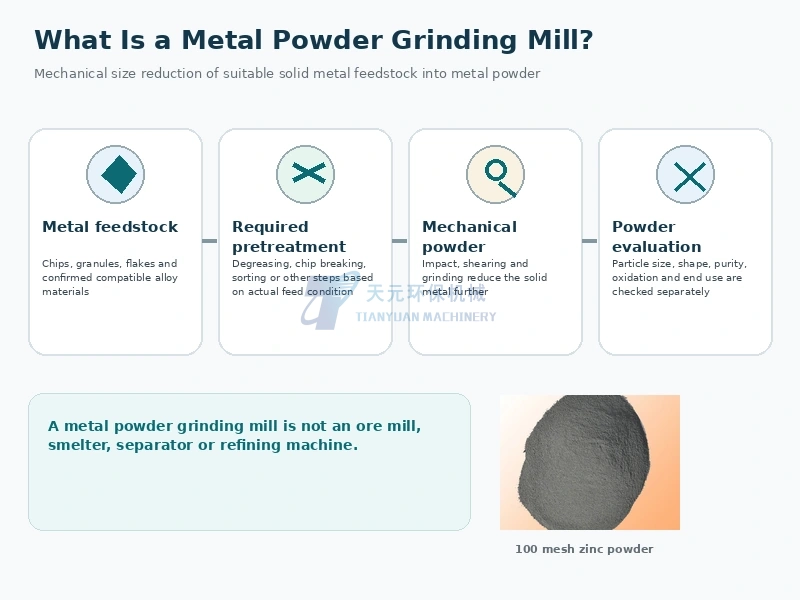
A metal powder grinding mill is a mechanical powder-production machine used to reduce suitable solid metals and alloys into finer powder. Typical feed can include prepared chips, granules, flakes, selected alloys and confirmed recovered metallic fractions. It is not an ore-grinding mill, and it does not replace smelting, metal separation or refining.
Mechanical milling is only one route for making metal powders, and reaching a certain mesh does not fully define powder quality. Metal grade, hardness, ductility, feed form, liquid contamination, oxidation and dust hazard all affect the real process.
Key takeaway
A metal powder grinding mill applies impact, shearing, grinding and related mechanical actions to prepared solid metal feedstock, then works with screening, classification, conveying and collection to obtain the target powder. Selection must start from the actual material + feed form + powder specification + end use.
Contents
What is a metal powder grinding mill?
Mechanical comminution of solid metal is one established powder-production route. Reduction, electrodeposition and atomization are other established routes, so “metal powder production equipment” is broader than mechanical grinding alone.
Tianyuan’s TYJSMF500 is used for evaluated granular, chip-like and flake-like metal feed. The current product range is 20–325 mesh, 50–500 kg/h and feed size ≤5 mm; actual performance varies with material and target fineness.
How is it different from an ore mill?
| Item | Metal powder grinding mill | Ore / mineral grinding equipment |
|---|---|---|
| Feed | Metal/alloy already produced | Ore/mineral containing metal-bearing phases |
| Goal | Reduce solid metal into finer powder | Reduce ore size for beneficiation, leaching, smelting, etc. |
| Refining role | Does not refine | Grinding alone also does not refine metal |
Copper chips are already metallic copper; copper ore is a mineral feed. Grinding ore finer does not create pure copper powder.
Main functions and process flow
Mechanical powder production deforms and fractures solid metal through impact, shear, friction and grinding. The exact internal structure must come from the machine’s real documentation, not from generic ball mills or ore mills.
- Characterize the feed: metal/alloy, grade, form, size, oil/emulsion/water and contamination.
- Pretreat: break long chips, remove excessive liquid or separate the metallic phase when required.
- Feed steadily: deliver prepared granules, short chips or flakes.
- Mechanical size reduction: reduce the solid metal by impact, shear and grinding.
- Screen/classify: separate acceptable powder and manage coarse material.
- Evaluate: confirm particle size, morphology, purity, oxidation, flow and final-use requirements.
Which metal feedstocks can be evaluated?
| Feed group | Examples | Key checks |
|---|---|---|
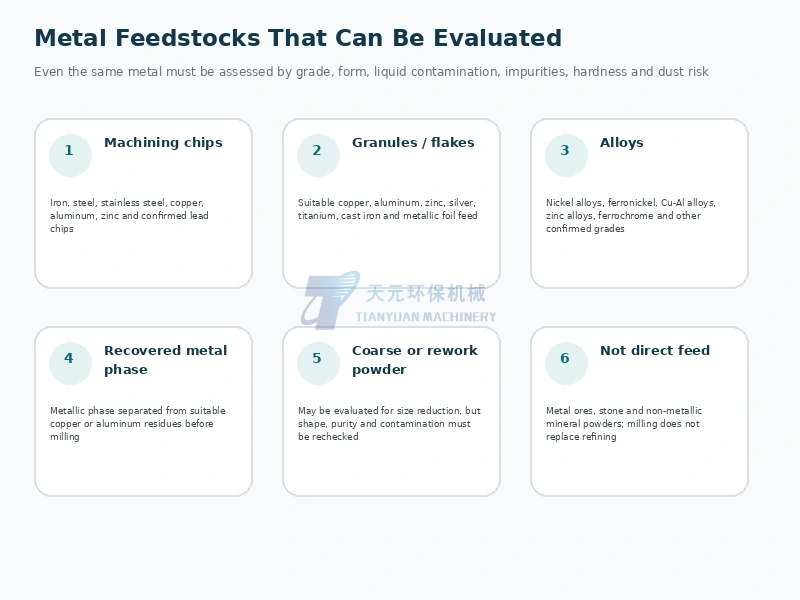
| Machining chips | Iron, steel, stainless steel, copper, aluminum, zinc and confirmed lead chips | Chip length, tangling, cutting fluid, mixed-metal contamination |
| Granules / flakes | Suitable copper, aluminum, zinc, silver, titanium, cast iron and metal foil | Grade, size, hardness, ductility, oxidation |
| Alloys | Nickel alloys, ferronickel, Cu-Al alloys, zinc alloys, ferrochrome | Chemistry, heat-treatment state, hardness, downstream limits |
| Recovered metallic fraction | Separated metal phase from suitable copper/aluminum residues | Separate metal first; grinding is not refining |
| Coarse / rework powder | Compatible oversize or rework powder | Morphology, purity, oxidation and contamination |
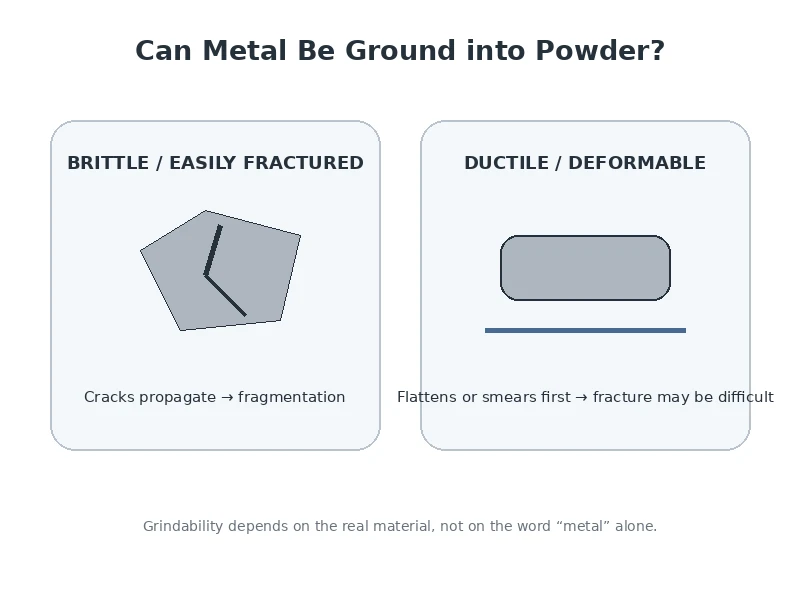
For a broader material assessment, see Can Metal Be Ground Into Powder?.
When does pretreatment matter?
Long turning chips may bridge or tangle and normally require chip breaking before fine grinding. Oily or wet chips may require degreasing, centrifuging, washing or drying. Mixed recycling residues should first be separated so that the feed entering the grinder is the intended metallic fraction.
What is the role of TYJSMF500?
TYJSMF500 is Tianyuan’s core machine for evaluated mechanical metal-powder projects. Its current live range is feed ≤5 mm, 20–325 mesh and 50–500 kg/h. These numbers are an operating envelope, not a promise that maximum fineness and maximum throughput occur together for every metal.
Different metals respond differently to deformation, work hardening, cold welding, fracture and wear. Titanium and some nickel alloys, for example, need separate tooling and wear evaluation.
Why is metal powder more than a mesh number?
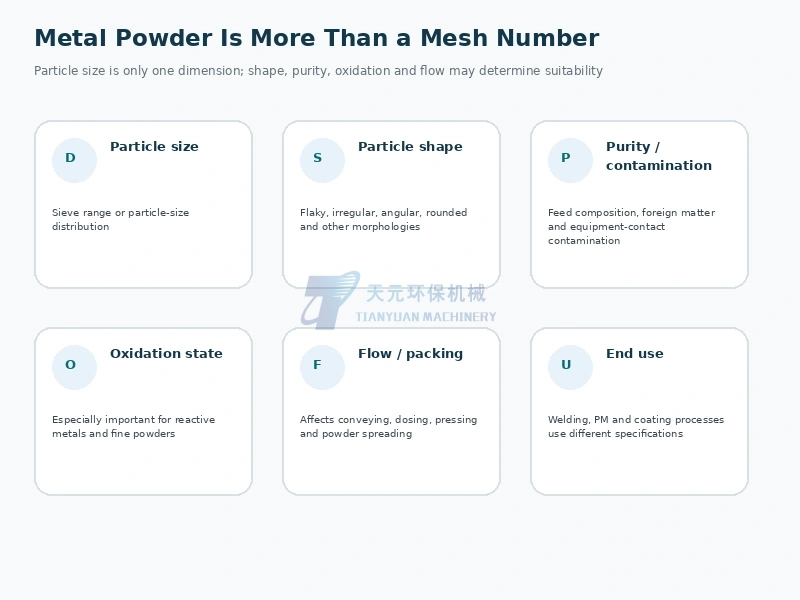
| Property | What it describes | Why it matters |
|---|---|---|
| Particle size/distribution | How large particles are and the coarse/fine balance | Affects screening, dosing, pressing, spreading and sintering |
| Particle shape | Flaky, irregular, angular, rounded, near-spherical, etc. | Affects flow, packing and surface area |
| Purity/contamination | Foreign metals, non-metals and wear debris | Affects chemistry and consistency |
| Oxidation state | Surface oxidation and activity | Important for reactive metals and special uses |
| Flow/packing | How powder moves and fills volume | Affects dosing, pressing and spreading |
| End use | Which process receives the powder | Defines acceptable limits for all other properties |
If the downstream process requires high sphericity, specified flow, low oxygen or high purity, those requirements should be stated before machine selection.
Where are metal powders used?
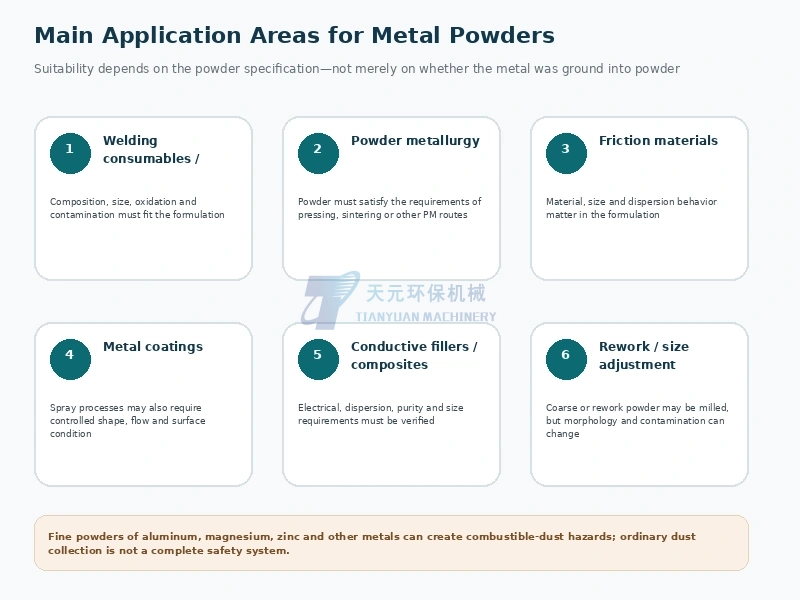
Welding consumables and fluxes: powder chemistry, size, oxidation and contamination must fit the formulation.
Powder metallurgy: powders for pressing, sintering or other consolidation routes may require controlled distribution, compressibility, flow and purity.
Friction materials, composites and conductive fillers: morphology, dispersion, purity and size depend on the formulation.
Metal coatings and high-specification powders: thermal spray, cold spray and additive manufacturing often impose tighter requirements on shape and flow; mechanical milling must be verified against the actual downstream specification.
Rework / size adjustment: oversize or rework powder may be milled, but morphology, oxidation and contamination must be checked again. See Tianyuan’s Alloy and Metal Powder Processing solution.
Process boundaries and safety
Fine powders of aluminum, magnesium, zinc and other metals can create combustible-dust hazards; ordinary dust collection is not a complete fire/explosion protection system. High-oil, sticky, wet, high-strength or high-wear feeds require separate assessment. Metal ores and non-metal mineral powders are outside the definition of this machine.
FAQ
Is it the same as a metal ore mill?
No. It processes material that is already metal or alloy, not ore.
Can every metal be ground directly into powder?
No. Grade, ductility, hardness, feed form, contamination, target properties and safety all matter.
What range does TYJSMF500 cover?
The current live page states 20–325 mesh, feed ≤5 mm and 50–500 kg/h; each material still needs project confirmation.
Does mechanical milling always make spherical powder?
No. Flaky, irregular and angular morphologies are common; real morphology must be measured.
Is mesh enough for PM or additive manufacturing?
No. Distribution, morphology, flow, purity and oxygen can also be specified.
Conclusion: start with the real feed and required powder
A metal powder grinding mill is a mechanical powder-production tool, not a universal machine that converts any metal into any powder specification. The correct solution links material grade, feed form, size, morphology, purity, oxidation, safety and end use.
For compatible projects, TYJSMF500 is Tianyuan’s core mechanical route. When high sphericity, special purity or tightly controlled oxygen is required, compare mechanical grinding with atomization and other routes. See Metal Powder Production Methods.
Need an assessment for a mechanical metal-powder project?
Prepare the metal/alloy name and grade, feed photos and form, maximum dimensions, oil/emulsion/water condition, contamination, target particle size, morphology/purity requirements, required qualified output and final use. Zhengzhou Tianyuan Environmental Protection Machinery Co., Ltd. can evaluate chip breaking, degreasing, separation, representative testing, grinding, screening and collection.