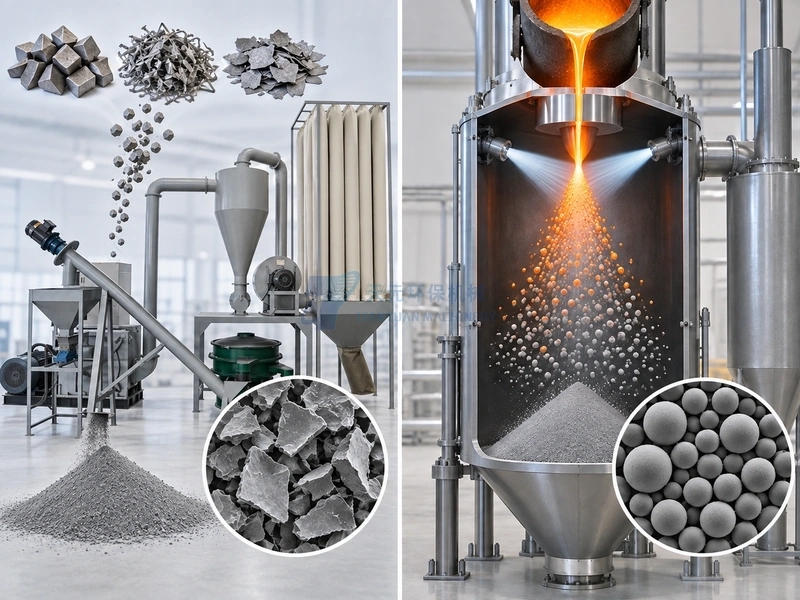
Mechanical milling and atomization can both be used to produce metal powders, but they form particles in fundamentally different ways. Mechanical milling starts with solid metal feed and reduces its size through impact, shear, attrition or compression. Atomization starts with molten metal and breaks the liquid stream into droplets that solidify into powder. The correct route therefore depends not only on particle size, but also on morphology, flowability, purity, feed condition, downstream use and safety requirements.
Key Conclusion
Mechanical milling and atomization should not be treated as interchangeable metal-powder processes. Mechanical milling reduces an existing solid feed and normally produces irregular, angular or flattened particles. Gas or plasma atomization forms particles from molten droplets and is generally better suited when high sphericity and good powder flow are required. Mechanical milling can be a practical route when suitable solid feedstock is already available and the downstream application accepts mechanically produced particle morphology.
Contents
Why Mechanical Milling and Atomization Are Different Powder Routes
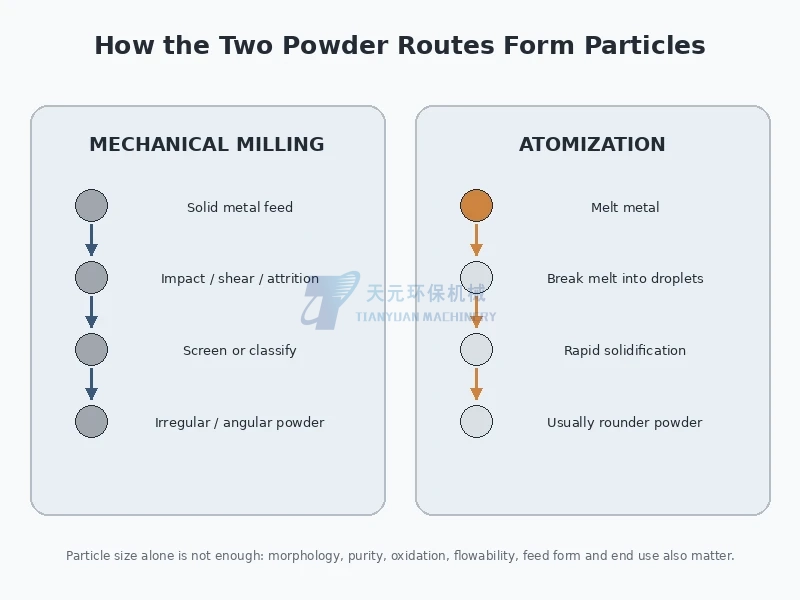
Mechanical comminution of solid metal and atomization of molten metal are recognized as different metal-powder production routes. The distinction begins with the physical state of the feed.
Mechanical milling begins with solid material. Chips, flakes, granules or prepared metal particles are subjected to mechanical forces until they are reduced to smaller particles. The process may then use screening or classification to separate the target fraction.
Atomization begins from a melt. A stream of molten metal is broken into droplets by gas, water, plasma, centrifugal force or another atomizing mechanism. Those droplets cool and solidify into powder.
This difference in particle formation is more important than simply comparing mesh or micron values. A solid fragment created by fracture does not have the same morphology or internal history as a droplet that solidified from liquid metal.
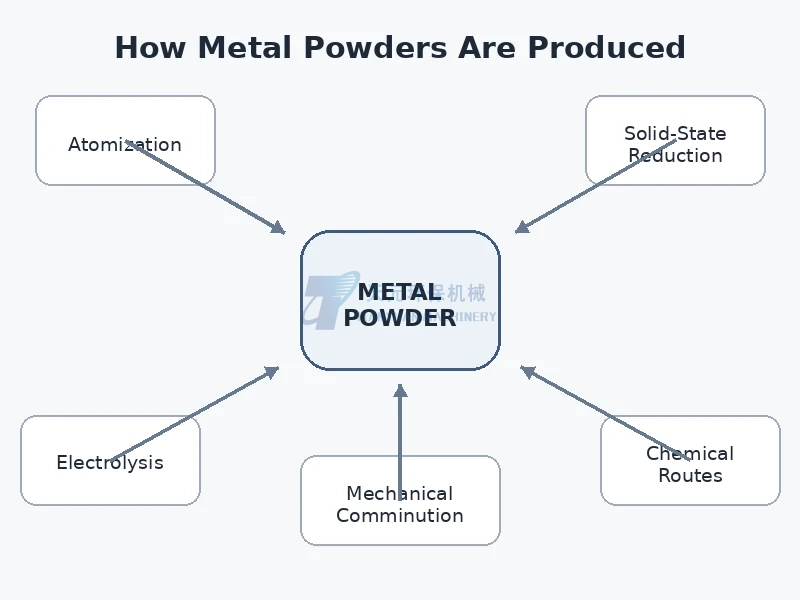
For a broader overview of powder-production routes, see our metal powder production methods guide.
How Mechanical Milling Forms Metal Powder
Mechanical milling reduces the size of solid metal through impact, shear, attrition, compression or combinations of these mechanisms. Whether the process produces useful powder depends heavily on how the real metal behaves under repeated mechanical stress.
Brittle materials tend to fracture more readily. Ductile metals can behave very differently: particles may flatten, smear, elongate or cold-weld before they fracture. Repeated deformation can also cause work hardening, which changes the balance between deformation and fracture during processing.
High-energy mechanical-alloying research describes repeated cold welding, fracturing and rewelding of metal particles. Conventional size-reduction equipment is not automatically a mechanical-alloying system, but the research illustrates an important principle: ductile metal particles do not always become smaller immediately when mechanical energy is applied.
This is why a project should be evaluated from actual feedstock rather than from the metal name alone. Feed form, dimensions, oil or liquid contamination, alloy condition, target particle size and acceptable particle morphology all influence whether mechanical grinding is appropriate.
Our separate guide on whether metal can be ground into powder explains these grindability factors in more detail.
How Atomization Forms Metal Powder
Atomization creates powder from molten metal. Gas atomization uses high-velocity gas to break the melt stream into droplets. Plasma and other atomization technologies use different energy sources, but they also form particles from liquid metal before solidification.
Surface tension tends to drive freely moving liquid droplets toward a lower-surface-area shape, which is why suitable gas and plasma atomization processes commonly produce spherical or near-spherical powders.
Not all atomized powder is spherical. Water atomization often produces more irregular particles because cooling and solidification occur rapidly. Gas atomization can also produce satellites, irregular particles or internal porosity depending on alloy chemistry and process conditions.
Mechanical Milling vs Atomization: The Practical Differences
| Factor | Mechanical milling | Atomization |
|---|---|---|
| Starting material | Solid metal feed | Molten metal |
| Particle formation | Fracture, deformation and wear | Droplet breakup and solidification |
| Typical morphology | Irregular, angular or flattened | Gas/plasma routes often near-spherical; water atomization can be irregular |
| Feed opportunity | Can evaluate suitable chips, flakes, granules and recycled solid feed | Requires a melt suitable for the selected atomization route |
| Flowability | Depends strongly on irregular morphology and size distribution | Spherical gas-atomized powders commonly offer better flow |
| Contamination concerns | Wear surfaces and processing history must be considered | Melting atmosphere, crucible/contact materials and oxidation must be considered |
| Typical selection driver | Solid feed availability and acceptable powder morphology | Morphology, flowability and melt-based powder requirements |
The table should not be interpreted as saying that one route is universally cheaper, cleaner or more efficient. Actual economics depend on the metal, scale, particle-size yield, energy use, inert gas requirements, classification, recycling of off-size powder, wear and safety systems.
Why Particle Morphology Matters as Much as Particle Size
Two metal powders with the same nominal particle size can behave very differently if their shapes are different. A near-spherical powder can have different flowability, packing behavior and surface interaction from an angular or flaky powder of similar size.
This is particularly important in additive manufacturing, powder feeding and other processes where consistent flow or spreading is critical. Gas-atomized powders are widely used in such applications because rounded particles can improve flow and spreading behavior.
Other applications do not require high sphericity. If an irregular particle is acceptable or useful, producing a highly spherical powder may provide little practical benefit.
Particle size should therefore be specified together with morphology, particle-size distribution, purity, oxidation limits, apparent density, flow requirements and final use.
How to Decide Which Route Fits the Application
If the application requires high sphericity, predictable powder flow or a powder specifically qualified for an additive-manufacturing feed system, an appropriate gas, plasma or other atomization route should usually be evaluated first.
If suitable solid metal feedstock is already available and the downstream application accepts irregular or angular morphology, mechanical milling may be worth evaluating. Suitable projects can avoid remelting the feed solely for powder formation, but this does not automatically make mechanical milling the lowest-cost solution in every case.
The correct question is not “Which process is better?” It is “Which process can produce the required powder from the available feedstock at acceptable quality, yield, safety and cost?”
Tianyuan Process Evaluation: Where Mechanical Milling Fits
Tianyuan does not treat mechanical grinding as a universal replacement for atomization. The more useful engineering boundary is whether a customer’s solid metal feed can be reduced reliably and whether the mechanically produced powder meets the downstream specification.
For a mechanical-powder project, the first information to confirm is the metal or alloy, feed form, feed size, oil or contamination condition, target particle-size range, required qualified-product capacity, acceptable particle morphology and final application.
If the product specification requires highly spherical powder, exceptional flowability or properties that depend on melt atomization, a mechanical grinder should not be presented as an equivalent substitute.
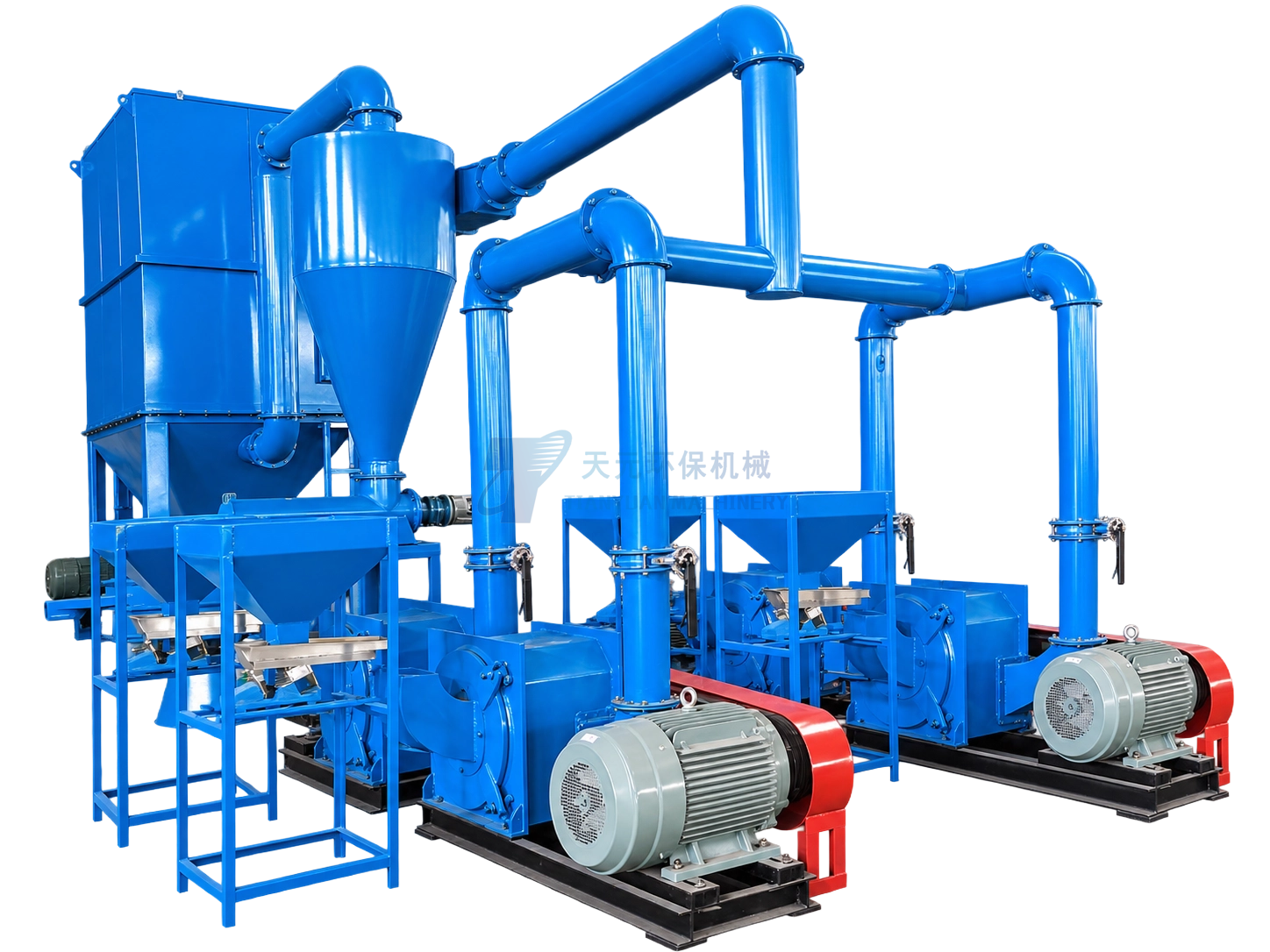
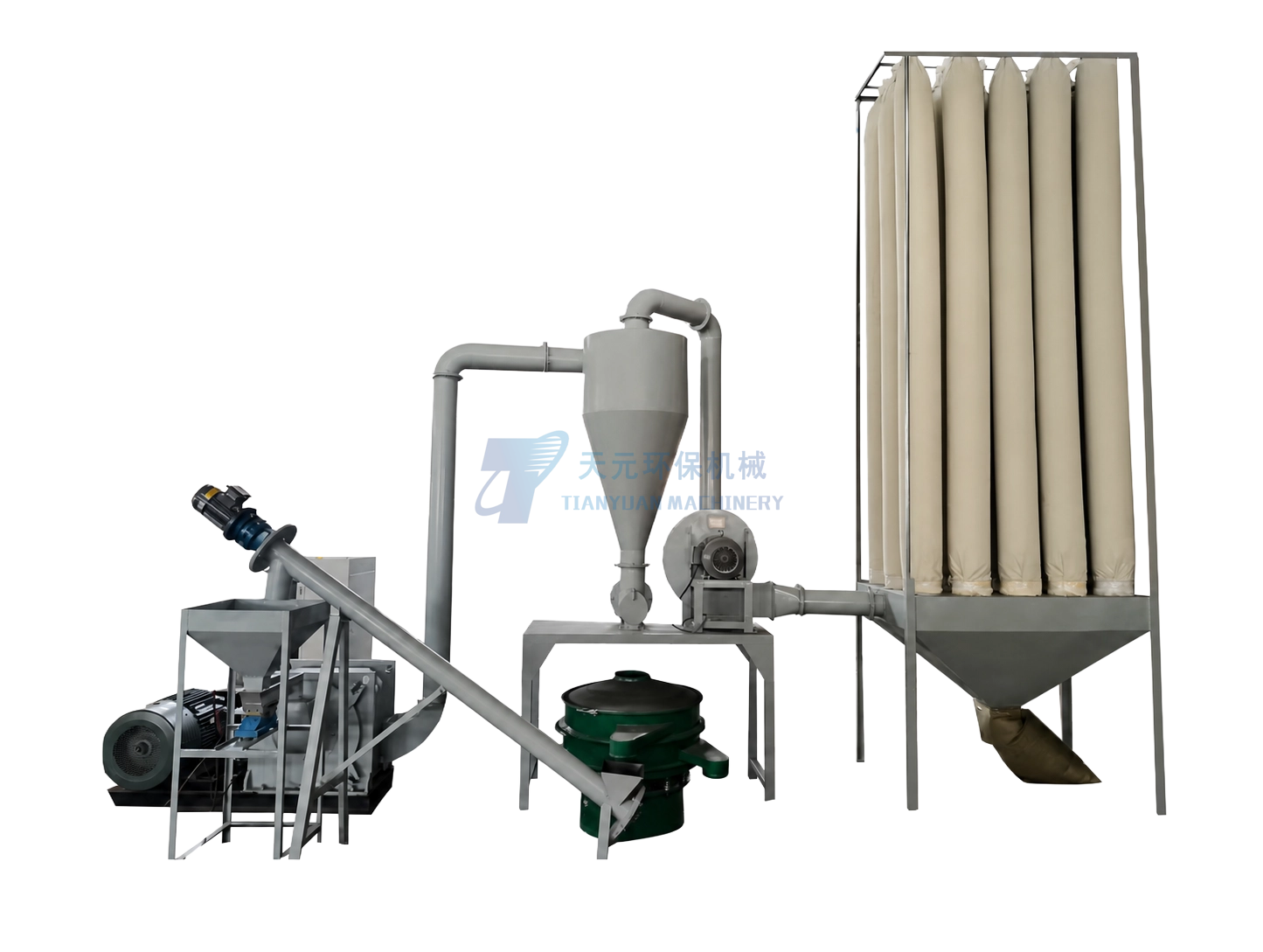
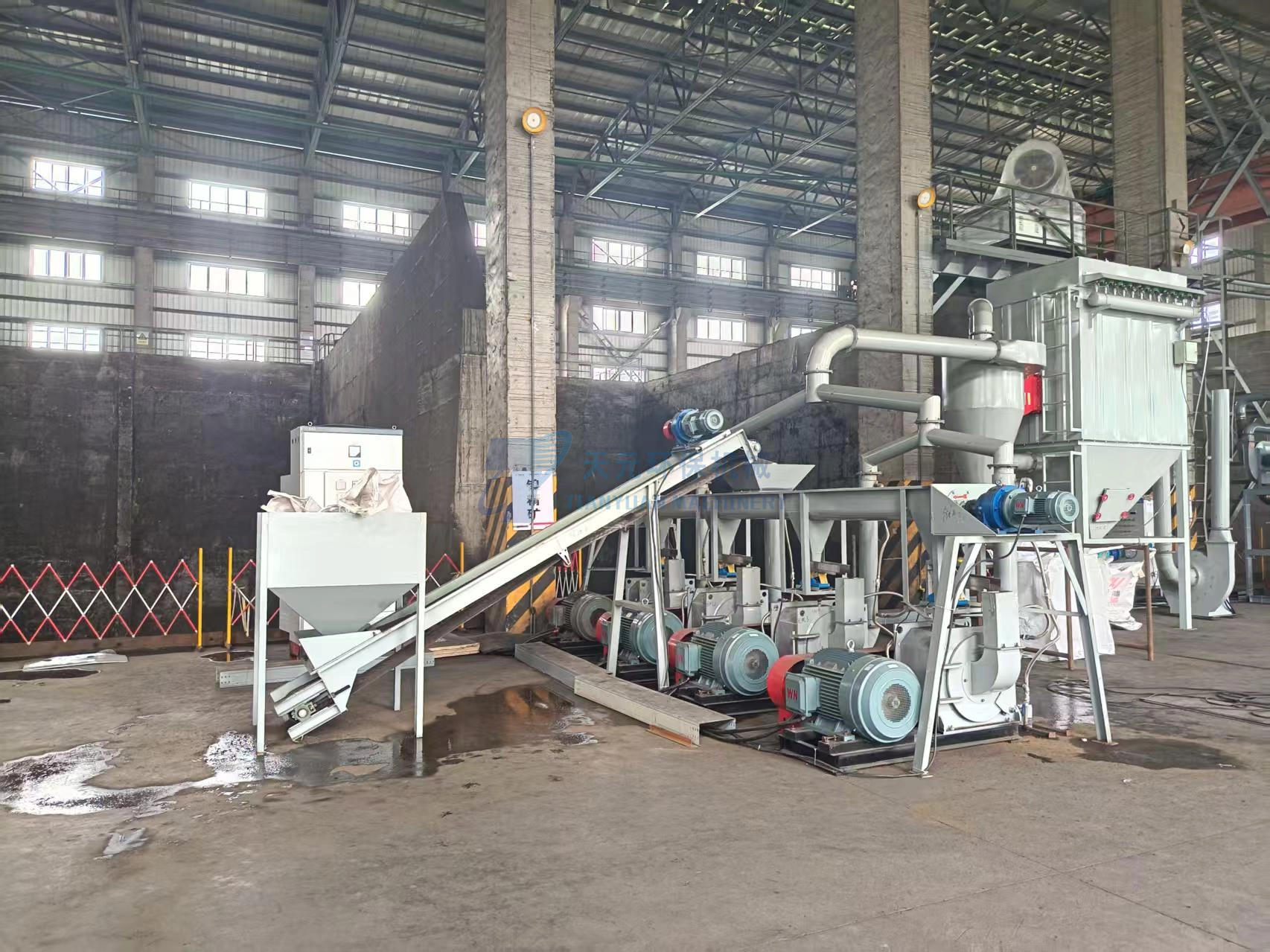
If the solid feed is suitable for mechanical processing and irregular powder morphology is acceptable, Tianyuan can evaluate the process through its metal and alloy powder-processing solution and the TYJSMF500 metal powder grinding mill.
Safety Boundaries Are Different but Important for Both Routes
Atomization involves molten metal, high temperature and, depending on the process, pressurized gas, plasma or reactive-alloy controls. Mechanical milling avoids a molten-metal step but introduces its own hazards through impact, friction, temperature rise, fine metal dust and possible ignition sources.
Fine powders of aluminum, magnesium, zinc and other combustible metals require project-specific dust and fire/explosion risk assessment. Dust collection alone should not be treated as a complete safety solution. Material explosibility, grounding, static control, ignition prevention, oxygen conditions, housekeeping and protection systems must be reviewed by qualified professionals for the actual process.
Frequently Asked Questions
Is atomized metal powder always better than mechanically milled powder?
No. The correct powder depends on the downstream application. Atomization is advantageous when spherical morphology and flowability are important, while mechanically produced powder can be appropriate when irregular morphology is acceptable and suitable solid feedstock is available.
Can mechanical milling completely replace gas atomization?
No universal replacement exists. Mechanical milling does not normally reproduce the particle morphology or melt-solidification history of gas-atomized powder.
Why is gas-atomized powder usually more spherical?
Gas atomization forms particles from liquid droplets. Surface tension can drive droplets toward rounded shapes before solidification, although real powders can still contain satellites and irregular particles.
When is mechanical milling worth evaluating?
It is worth evaluating when suitable solid metal feed is available, the material can be reduced reliably, and the final application accepts the resulting particle morphology and purity.
Conclusion
Mechanical milling and atomization are two fundamentally different metal-powder production routes. Mechanical milling reduces solid feed by fracture and deformation, while atomization forms particles from molten droplets.
Gas or plasma atomization is generally the stronger candidate when spherical morphology and good flowability are central requirements. Mechanical milling deserves consideration when suitable solid feedstock is already available and the downstream application accepts mechanically produced particle shapes.
The route should ultimately be selected from the complete powder specification—not particle size alone—including morphology, purity, oxidation, flowability, feed condition, qualified-product yield, final use and process safety.