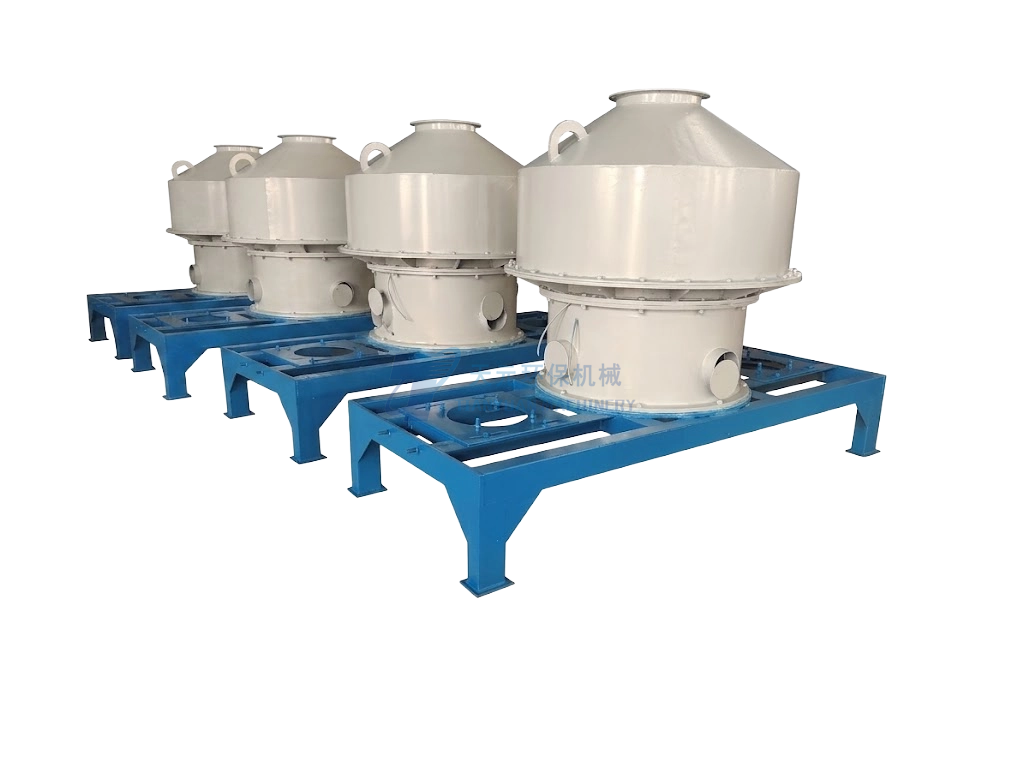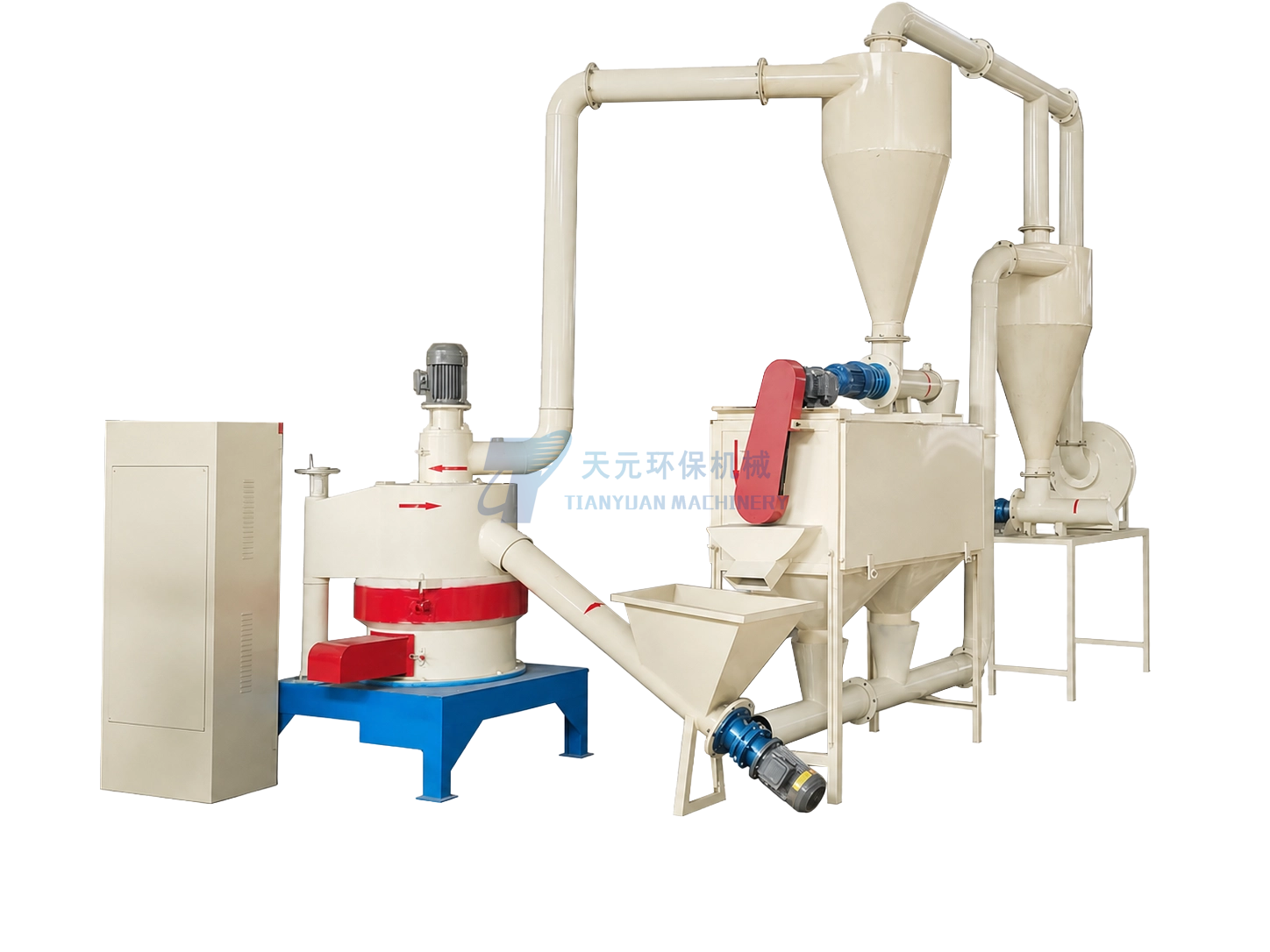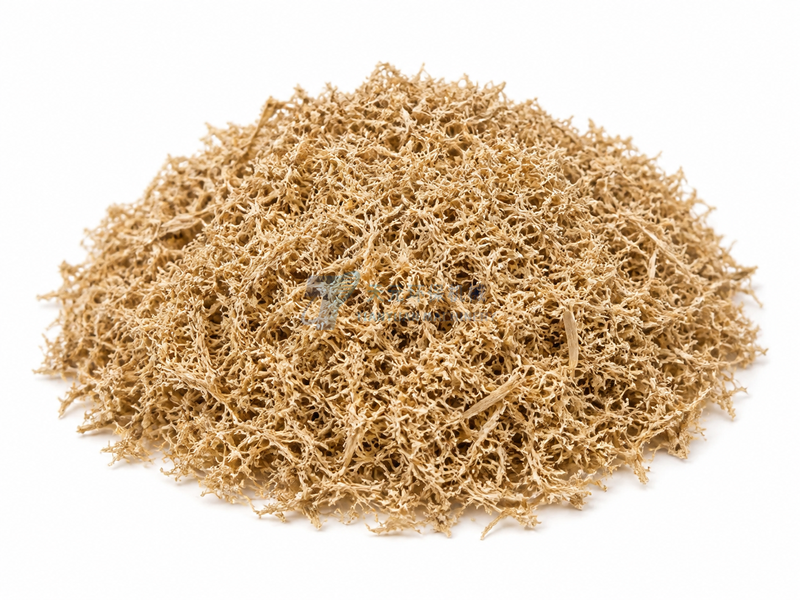
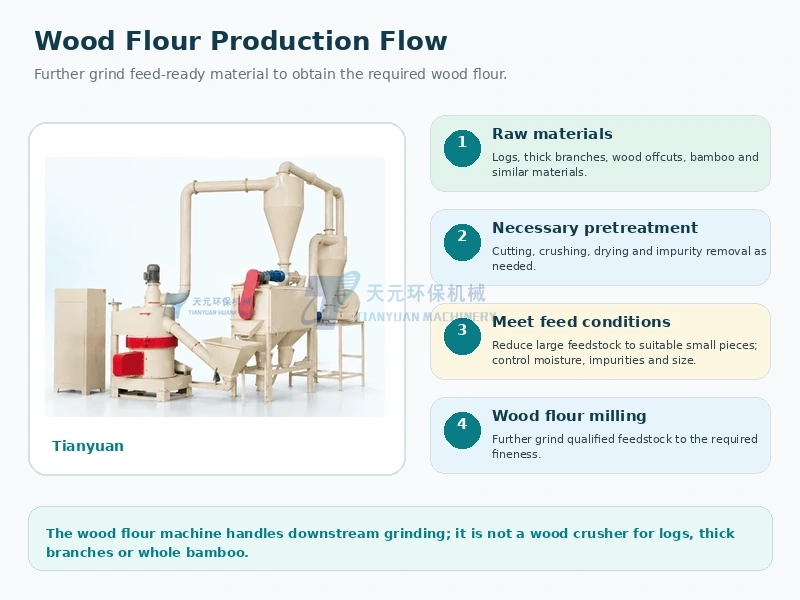
A wood flour machine is a fine-grinding machine used to reduce wood-based materials, plant fibers and other confirmed compatible feedstocks into powder after they have already met the required feed conditions. It performs the grinding stage; it is not a wood crusher designed to take whole logs, thick branches or full bamboo culms directly.
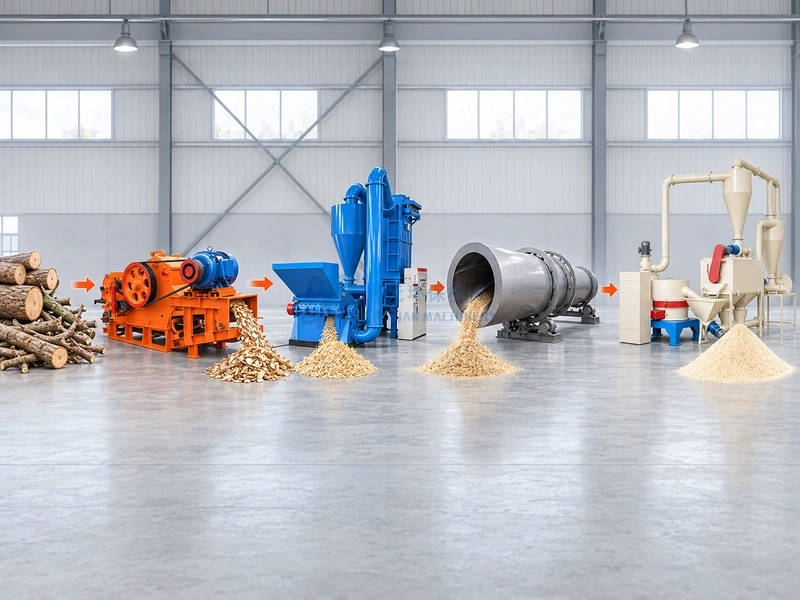
In a complete wood flour process, the equipment is selected from both ends of the process: the real condition of the incoming material and the specification of the finished powder. Oversized material may require chipping or crushing, wet feed may require drying, and contaminated feed may require cleaning before fine grinding.
Key takeaway
The core job of a wood flour machine is to take feedstock that is already suitable for fine grinding and reduce it further into the required powder. Selection should consider feed form, feed size, moisture, impurities, target fineness, required output and the final use of the powder. A wood flour machine and a wood crusher are different stages of the same processing chain.
Contents
What is a wood flour machine?
In process terms, a wood flour machine is a downstream fine-grinding unit for wood and plant-fiber powders. It receives material that has already been properly prepared, then uses mechanical grinding, shearing, impact, rolling or a combination of these actions to reduce particle and fiber-bundle size. Screening, classification and collection are then used as needed to obtain the target powder.
The term should not be interpreted as “a machine that can accept any piece of wood.” Sawdust, wood chips, bamboo residues, shells and selected plant fibers can all behave differently because of hardness, toughness, moisture, oil or sugar content, abrasiveness and dust characteristics. Each material must be matched to the process rather than simply matched by name.
What is the difference between a wood flour machine and a wood crusher?
| Item | Wood crusher | Wood flour machine |
|---|---|---|
| Process position | Front-end size reduction | Downstream fine grinding |
| Typical feed | Logs, branches, larger wood pieces and offcuts | Sawdust, wood chips, bamboo chips and other feed already within machine requirements |
| Main purpose | Reduce bulky feedstock to a manageable size | Reduce prepared feedstock further to the target powder |
| Main output concern | Size suitable for conveying and the next process | Particle size, distribution, moisture, cleanliness, fiber morphology and end-use suitability |
For example, whole bamboo intended for bamboo powder normally needs cutting or crushing before fine grinding. If moisture is too high, drying may also be needed. This is why asking only for the “maximum piece the machine can swallow” is not enough for process selection.
For a dedicated explanation of front-end size reduction versus fine grinding, see Crushing vs Grinding vs Milling vs Pulverizing. A broader process overview is available in How Is Wood Flour Made?.
What does a wood flour machine do?
1. Further reduce prepared feedstock
The most direct function is to further reduce sawdust, wood chips, bamboo chips, shells and other compatible materials after pretreatment, creating a powder that can be screened, blended, compounded or otherwise used downstream.
2. Provide a more controlled powder for downstream processing
Wood-plastic composites, incense formulations, resin systems and rubber composites may all have different requirements for particle size, moisture, cleanliness, color, fiber morphology and batch consistency. The grinding machine works together with screening, classification and collection to make the powder more suitable for the intended process.
3. Add value to wood, bamboo and selected biomass residues
Sawdust, wood processing residues, bamboo residues, shells, corn cobs and selected plant fibers can be turned into controlled powders when their feed condition and final use are compatible with the equipment.
What is the basic wood flour process?
- Characterize the feed: material, form, size, moisture, impurities and intended end use.
- Pretreat when necessary: chip, crush, dry, clean or size the material.
- Feed steadily: deliver prepared material to the grinding system.
- Fine grind: reduce the feedstock further in the wood flour machine.
- Control particle size: use the machine and, where required, screening or classification.
- Collect and finish: screen, blend or pack according to the product requirement.
The exact line is not identical for every material. Sawdust may already be close to the correct feed size, while wood offcuts, bamboo culms or moringa branches usually require more preparation. The process should follow the real feedstock.
What materials can a wood flour machine process?
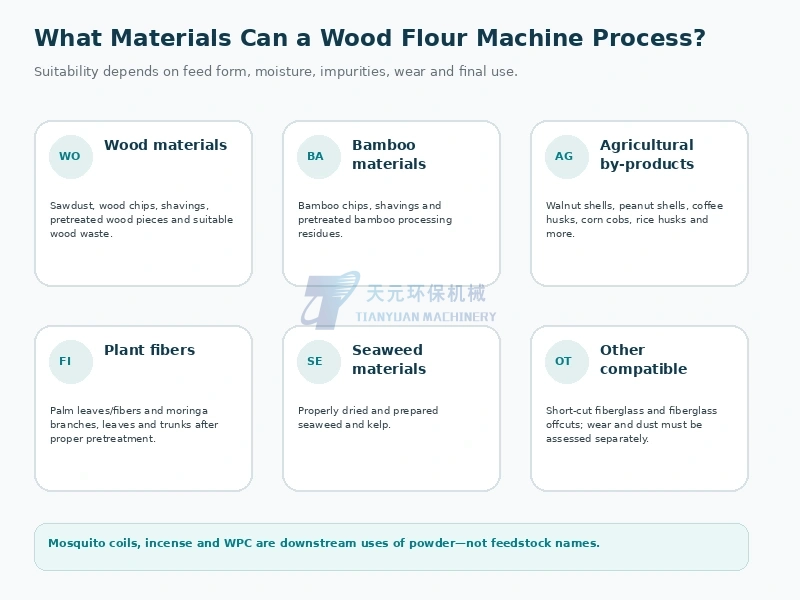
| Material group | Typical examples | Key checks |
|---|---|---|
| Wood materials | Sawdust, wood chips, shavings, pretreated pieces, suitable wood waste | Feed size, moisture, metal/mineral contamination, coatings |
| Bamboo materials | Bamboo chips, shavings and processing residues | Fiber length, size, moisture and target bamboo powder fineness |
| Agricultural by-products | Walnut shell, peanut shell, coffee husk, corn cob, rice husk | Hardness, oil/sugar content, moisture and end use |
| Plant fibers | Palm leaves/fibers and other compatible fibrous biomass | Fiber entanglement, drying condition and system suitability |
| Moringa materials | Branches, leaves and trunks | Crushing and drying before fine grinding; hygiene requirements for food/feed uses |
| Seaweed | Properly dried and prepared seaweed or kelp | Salt, moisture, stickiness, hygiene and corrosion considerations |
| Other compatible materials | Short-cut fiberglass and fiberglass offcuts | Wear, dust and final fiber properties require separate evaluation |
Mosquito coils, incense and WPC are downstream uses of powder, not feedstock names. The machine processes compatible wood, bamboo, plant-fiber or other approved feed materials.
How should a wood flour machine be selected by fineness?
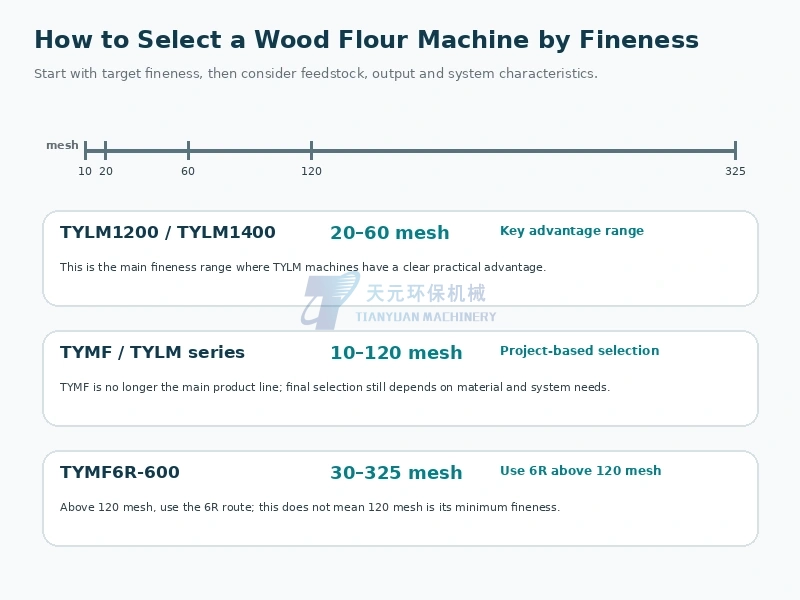
Tianyuan currently starts wood flour machine selection with the target product fineness, then considers feedstock characteristics, required output and the practical advantages of each system in that fineness range.
| Target / machine | Selection direction | Meaning |
|---|---|---|
| 20–60 mesh | TYLM1200 / TYLM1400 | Confirmed practical advantage range for the TYLM series |
| 10–120 mesh | TYMF or TYLM can be evaluated | TYMF is no longer the main product line; final choice depends on the project |
| Above 120 mesh | TYMF6R-600 | For the Tianyuan machines discussed here, fine powder above 120 mesh uses the 6R route |
| Confirmed TYMF6R-600 range | 30–325 mesh | 100–500 kg/h; max feed diameter 5 mm; actual performance varies with material and target fineness |
The operating range of a machine is not the same as its most advantageous fineness range. TYMF6R-600 can work within 30–325 mesh, so “use 6R above 120 mesh” does not mean it can only operate above 120 mesh. Likewise, the 20–60 mesh advantage of TYLM should not be read as a universal hard limit.
See the current product pages for the TYLM1200 vertical wood powder mill and the TYMF6R-600 ultrafine wood powder mill. For the overall selection method, see How to Choose a Wood Powder Mill.
Where are wood, bamboo and plant powders used?
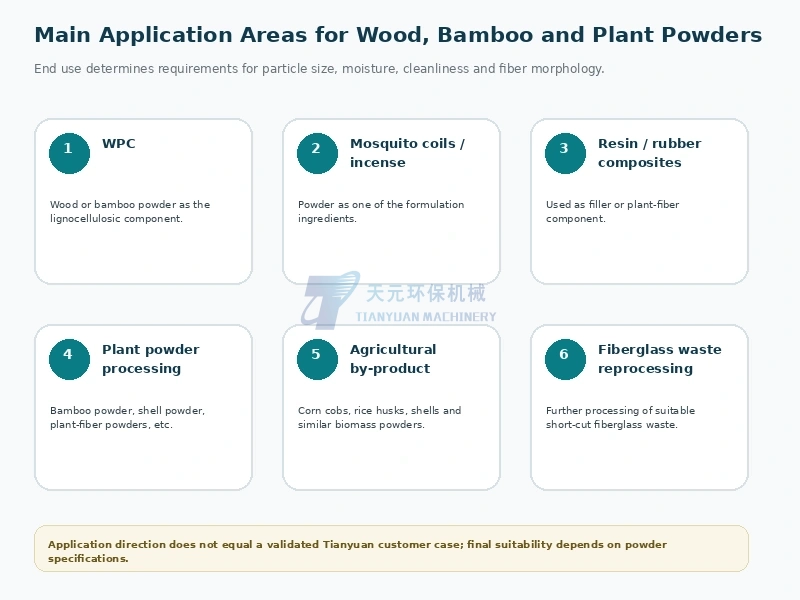
Wood-plastic composites (WPC)
Wood flour and bamboo powder can be used as lignocellulosic components in WPC and related composites. Published research shows that particle size and morphology can affect composite behavior, so a powder should not be judged for a WPC formulation by mesh number alone.
Mosquito coils and incense
Some wood and plant powders are used as formulation ingredients in mosquito coils and incense products. The downstream producer determines the required fineness and formulation properties. The wood flour machine makes the powder; it is not the final forming equipment.
Resin, rubber and other composites
Wood, bamboo and plant-fiber powders may be used as fillers or fiber components in selected resin, rubber and composite systems. Moisture, cleanliness, dispersion behavior and fiber morphology may be as important as nominal fineness.
Plant powder and agricultural by-product processing
Bamboo powder, shell powder, corn-cob powder, rice-husk powder and palm-fiber powder can be produced to specifications that reflect their intended downstream use.
Fiberglass waste reprocessing
Short-cut fiberglass and selected fiberglass offcuts are not conventional wood feedstocks, but they may be suitable for dedicated size-reduction projects. Machine wear, dust control and the required final fiber characteristics must be evaluated separately.
Why is mesh size not enough to define wood flour quality?
Mesh is a common way to communicate particle size, but it does not fully describe a powder. Particle-size distribution, fiber aspect ratio, moisture, color, contamination, bulk behavior, batch consistency and the acceptance method used by the downstream process can all matter.
For related particle-size terminology, see Mesh vs Micron. For the full material-to-powder route, see Tianyuan’s Wood Powder Production solution page.
- Particle-size distribution: two powders sold at the same nominal mesh can still contain different proportions of coarse and fine particles.
- Fiber morphology: wood flour is not made of ideal spheres; elongated fibers and bundles influence handling and compounding.
- Moisture: affects grinding, screening, storage and downstream processing.
- Impurities: metal, sand, coatings or other contamination can affect both the machine and the finished powder.
- End-use specification: WPC, incense, composite materials and powder sales may use different acceptance criteria.
Operating boundaries and combustible-dust safety
A wood flour machine is not a universal machine that can directly process every material at every fineness. Oversized feed, excessive moisture, sticky or oily materials, corrosive materials and highly abrasive feedstocks may require dedicated assessment or pretreatment.
Fine wood and other organic powders can also create combustible-dust hazards. Public occupational-safety guidance identifies wood dust as a combustible dust under suitable particle-size, concentration and ignition conditions. A normal dust collector should therefore not be treated as a complete fire- and explosion-protection system; plant-specific safety engineering is required.
FAQ
Can a wood flour machine grind whole logs directly?
Normally no. Logs, thick branches and whole bamboo generally need cutting, crushing or other pretreatment so that feed size, moisture and contamination meet the requirements of the selected machine.
Is a wood flour machine the same as a wood crusher?
No. A crusher mainly performs front-end size reduction. A wood flour machine performs downstream fine grinding on already prepared feedstock.
Which machine is preferred for 20–60 mesh wood flour?
Based on Tianyuan’s current selection experience, TYLM1200 and TYLM1400 have clear practical advantages in the 20–60 mesh range. Final selection still depends on material and required output.
Which machine is used above 120 mesh?
For the Tianyuan machines discussed here, powder above 120 mesh uses TYMF6R-600. Its confirmed operating range is 30–325 mesh, so 120 mesh is a selection boundary, not the machine’s minimum fineness.
Is finer wood flour always better?
No. The correct fineness depends on the downstream use. Finer powder can change throughput, energy use, screening behavior and product performance.
Conclusion: define the powder first, then select the machine
A wood flour machine takes feedstock that has already met the required feed conditions and reduces it further into powder suitable for downstream use. The correct solution starts with the real raw material and the required finished powder, not with a machine model in isolation.
For 20–60 mesh wood flour, TYLM1200 and TYLM1400 are Tianyuan’s current priority routes. For fine powder above 120 mesh, TYMF6R-600 is used. In all cases, feed size, moisture, contamination, required output and final use should be confirmed before the process is finalized.
Need a wood flour processing assessment?
Prepare the material name and photos, current feed size, moisture condition, contamination, target fineness, expected output and final use of the powder. Zhengzhou Tianyuan Environmental Protection Machinery Co., Ltd. can use this information to evaluate pretreatment, grinding, screening and collection requirements.