Wood particles do not enter a mill as uniform solid beads. Sawdust, chips and fibrous fragments can retain directional features of the original wood. Two feeds with similar nominal dimensions can therefore produce different combinations of particle length, width and shape.
Key answer: Wood fiber structure matters because size reduction can involve both splitting along the material’s organization and breaking across elongated elements. A narrower fragment is not necessarily proportionally shorter, and passing a sieve does not make every particle spherical. Evaluate feed condition, the milling action and the required powder together.
Contents
What does “wood fiber structure” mean in a milling project?
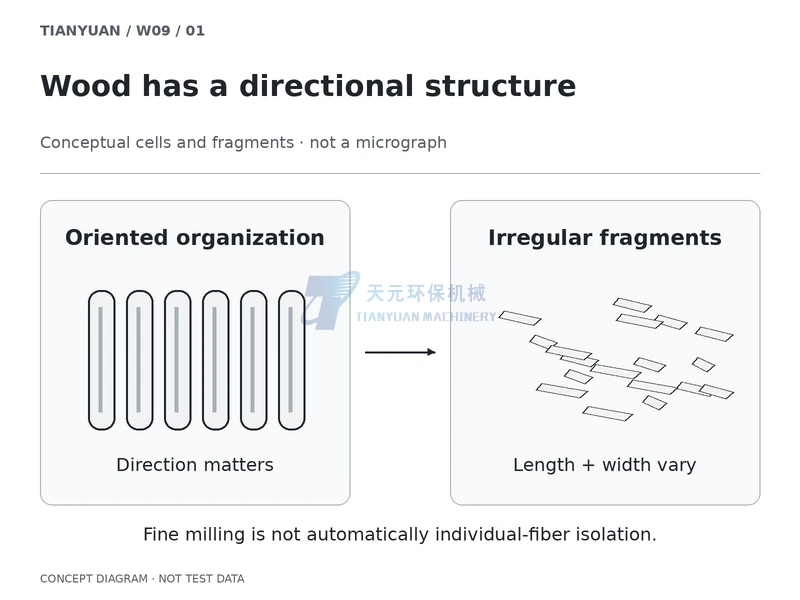
The USDA Wood Handbook explains the directional cellular organization of wood. Many elongated cells follow the stem axis, while other tissues have different orientations. A cell wall and the internal space of a cell are also distinct features.
In equipment discussions, “fiber” may mean a long woody particle, an individual cell or a bundle of cells. Agree on that meaning before specifying a product. Producing wood flour is not automatically the same operation as pulping, isolating individual fibers or manufacturing nanocellulose.
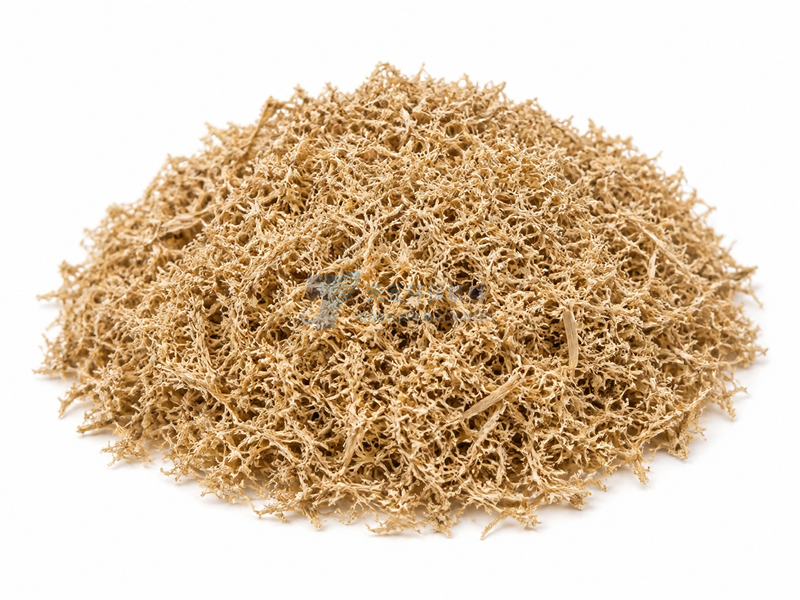
For process records, describe what can actually be observed: compact chips, flat fragments, curled shavings, string-like pieces or bundles. Our drawings are conceptual views, not microscopy, anatomical measurements or evidence of a particular Tianyuan machine’s breakage mechanism.
Splitting along a particle is different from shortening it
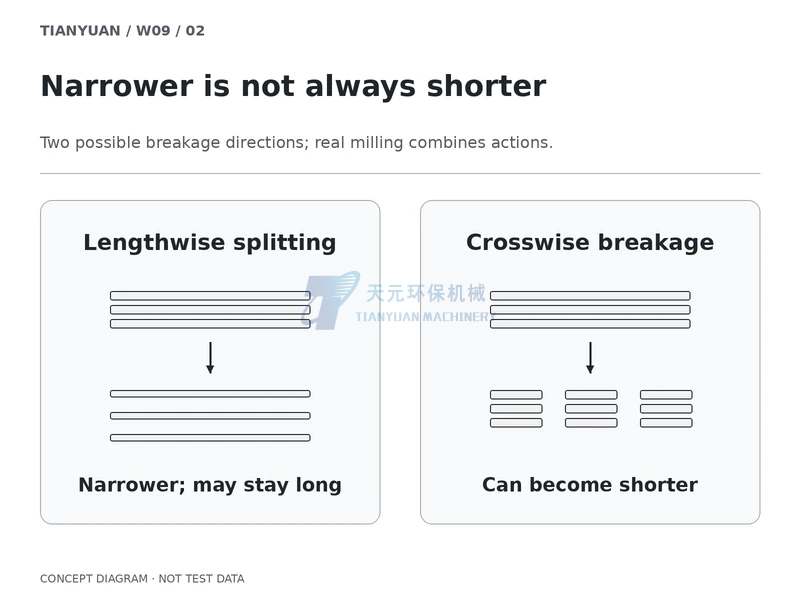
Consider a long bundle as a simplified geometric example. Separating it lengthwise can make narrower pieces without removing much length. Breaking across it can shorten the pieces. Real milling combines repeated contacts, changing orientations and several forms of deformation and fracture; neither sketch represents the sole action of a complete mill.
This distinction is useful when powder appears fine but still contains elongated pieces. Record the relevant dimensions before concluding that a component has failed. Also distinguish an individual fragment from several particles adhering together: those situations may require different investigation.
Do not assume that a longer residence time or a smaller screen will necessarily solve the customer’s problem. First decide whether the requirement concerns passage through an aperture, a maximum measured length, a shape distribution or performance in the final formulation.
Feed preparation and moisture must be recorded separately
A practical comparison should identify how the feed was produced. Sawing, chipping, tearing and preliminary size reduction can leave different shapes. A maximum width alone may miss long string-like material that is relevant to feeding and downstream processing.
A published study of a vibratory ring-and-puck mill reported an influence of moisture on the resulting wood-particle morphology. That finding is a reason to control the comparison conditions, not a transferable capacity, energy or particle-size guarantee for Tianyuan equipment.
Use a consistent moisture basis and method, and record storage and preparation history. There is no universal optimum moisture value in this article. When equipment settings or preparation have to change between feeds, report those changes instead of attributing every difference to “tough fibers.”
Why sieve passage does not establish every fiber’s length
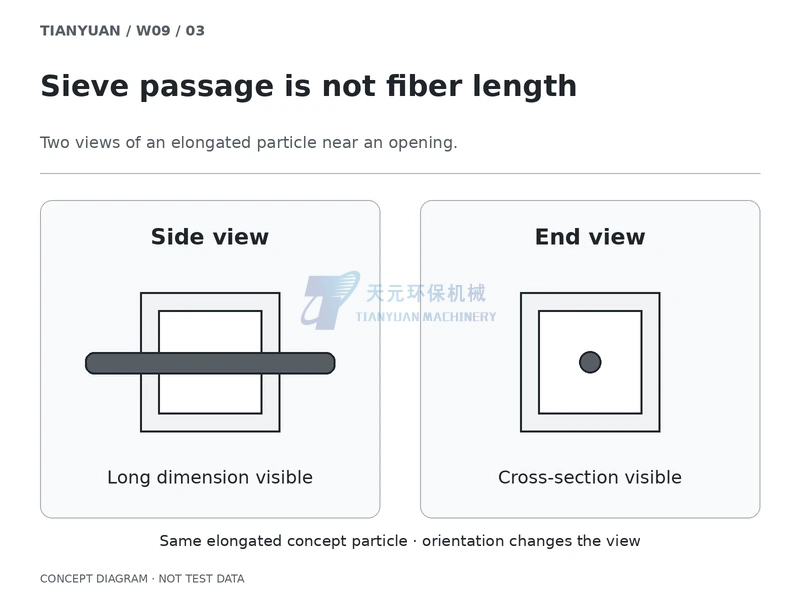
A sieve result describes passage through an opening under a specified procedure. It is not a limit on every dimension of every particle. RETSCH’s sieve-method guidance notes that orientation and motion affect how elongated particles pass openings.
For a fibrous product, keep the mass passing or retained by the sieve separate from any image-based length and width measurements. An equivalent diameter from another technique should not be relabelled as actual fiber length. Describe the measured dimension, weighting basis and preparation conditions.
This is also why the roles of screening and air classification need to be distinguished. Before changing the production separator, check whether the apparent discrepancy is a real material change or simply a difference between measurement methods.
A trial should connect feed structure to an accepted product
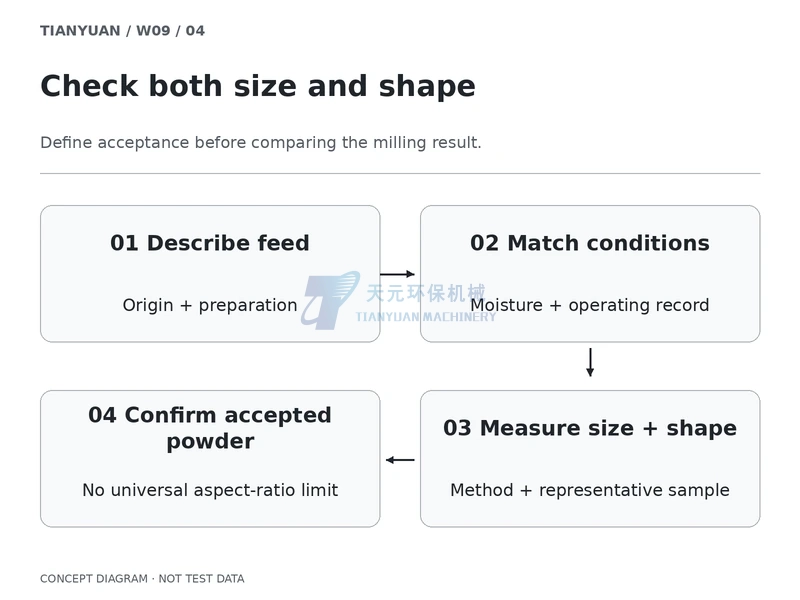
The following is a proposed comparison record, not a prescribed test standard. Begin with the final use and acceptance method, then record the feed and the outcome together.
- Identify the wood source, preparation route and visible feed form.
- Document feed dimensions and moisture basis; include length when string-like pieces matter.
- Record actual feeding, operating settings, observations of temperature and any recycle.
- Measure accepted powder output and the agreed size and shape characteristics.
- Keep sampling locations, dispersion conditions and image-analysis definitions consistent.
When reporting aspect ratio, define the length and width used and explain whether the result describes one particle or a distribution. A selected photograph is not a batch specification. Agreement on a representative sample and a repeatable method is more useful than a visually attractive example.
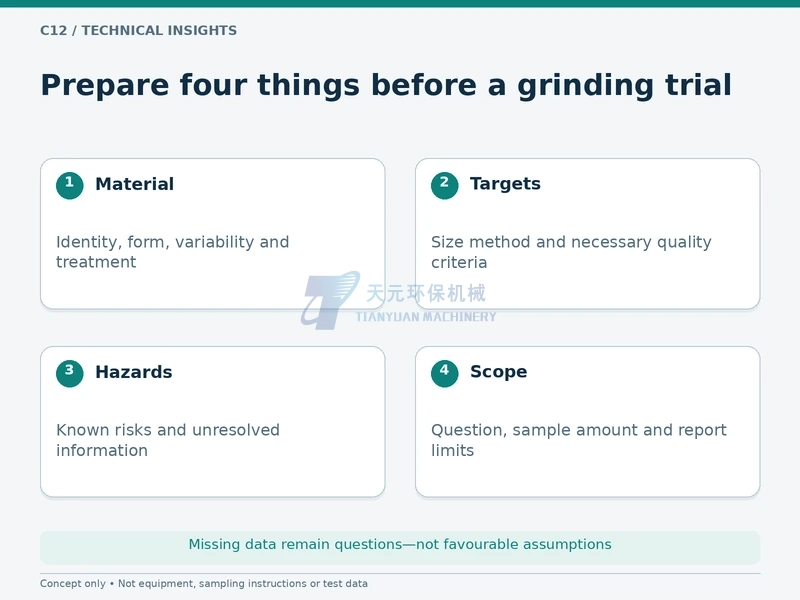
Use the grinding-test preparation checklist to define what the trial must answer. The decision may concern feed preparation, fine milling or subsequent separation; it should not be reduced automatically to choosing a finer sieve.
Tianyuan process judgment: qualify the full feed geometry
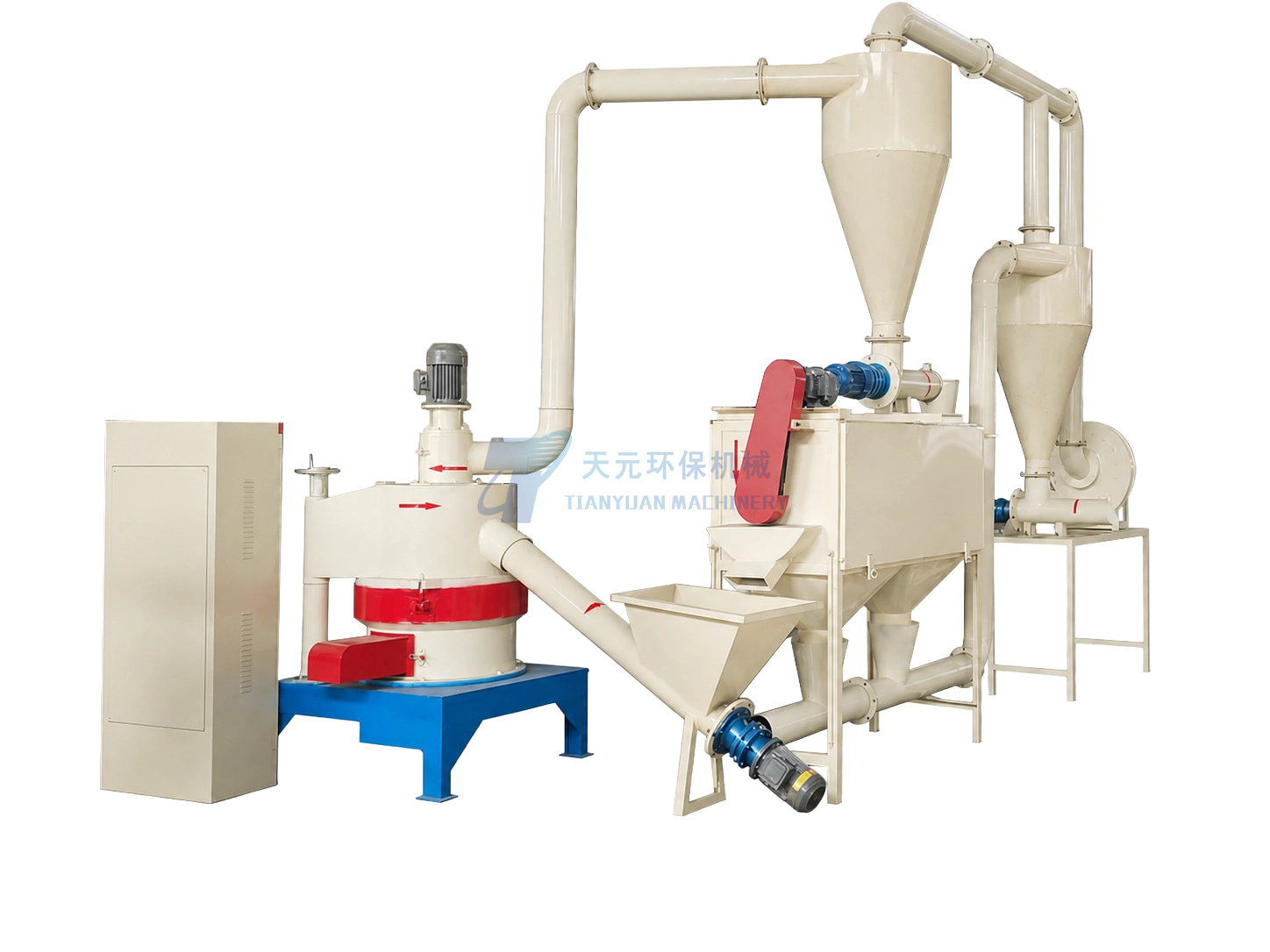
The TYMF6R-600 ultrafine wood powder mill is a downstream fine-milling machine for prepared woody or plant-fiber feed, not a log crusher. Its confirmed range is 30–325 mesh, 100–500 kg/h and a maximum feed diameter of 5 mm. A diameter limit does not authorize arbitrarily long string-like feed; overall geometry and feeding suitability still require confirmation.
Actual capacity depends on material, feed condition, target fineness and site conditions. The upper fineness and throughput values are not a simultaneous guarantee, and these figures do not apply to other machine models or auxiliary equipment.
Wood-flour production also requires material-specific dust-risk assessment. HSE’s woodworking guidance addresses fire and explosion hazards. Ordinary extraction and grounding are not, by themselves, a complete prevention and protection design.
FAQ
Are all elongated pieces unbroken original wood fibers?
No. They can be woody fragments, bundles or agglomerates. Use appropriate observation and measurement before assigning a structural explanation.
Does splitting a particle lengthwise mean the product target has been met?
Not necessarily. Width may decrease while length remains unsuitable for the end use. Assess the agreed size and shape requirements together.
Will two batches with the same mesh label have the same fiber shape?
That is not guaranteed. Feed condition, orientation and the measurement procedure can leave different shapes within the same nominal grade.
Why not specify one universal aspect-ratio limit?
The useful limit depends on the end use, dimension definitions and sampling method. It should come from an agreed specification and validation, not an invented general threshold.
Will making the feed drier always produce the desired fiber form?
No. Moisture interacts with the process. Feeding, dust management, safety and the required product must also be considered.
Conclusion
Wood’s directional organization means fine grinding is more than shrinking every dimension equally. Distinguish length from width, identify the feed state and measurement method, and adjust the process according to accepted output. Representative trials are more reliable than selecting equipment from “high fiber content” or a mesh label alone.