Screening and air classification both separate powder into particle-size fractions, but they do not use the same physical principle. Screening separates particles by whether they can pass through a defined opening. Air classification separates particles according to their aerodynamic response in a controlled air stream, which means particle size, density and shape can all affect the result.
Key Answer
If the goal is to remove oversize particles against a defined screen opening or add a final safety check, screening is usually the more direct method. If the goal is to adjust a fine cut point continuously, control a closed grinding circuit or process dry fine powder that tends to blind a screen, air classification is often more suitable. In many powder lines, the two methods are complementary rather than interchangeable.
Contents
The Basic Difference: Aperture vs Aerodynamic Response
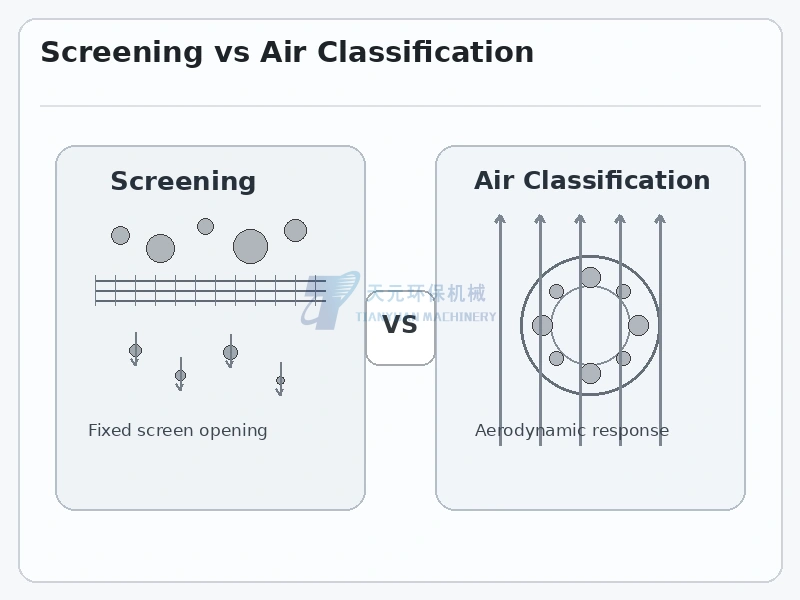
The simplest way to distinguish the two methods is this: screening asks whether a particle can physically pass through an opening; air classification asks how that particle behaves in a moving air stream and force field.
That difference matters because a screen opening is a geometric dimension, while an air-classifier cut point is a process result. A dense spherical particle, a light fibrous particle and a thin flake can have similar measured widths but behave differently in an air classifier. Their behavior on a screen can also differ because orientation affects whether an irregular particle can pass through an aperture.
How Does Screening Separate Powder?
Screening uses a perforated surface, woven mesh or other defined opening. Particles that can pass through become the undersize fraction, while particles that remain on the screen become the oversize fraction. ASTM E11 describes test sieves as a particle-sizing medium used to classify materials according to designated particle size.
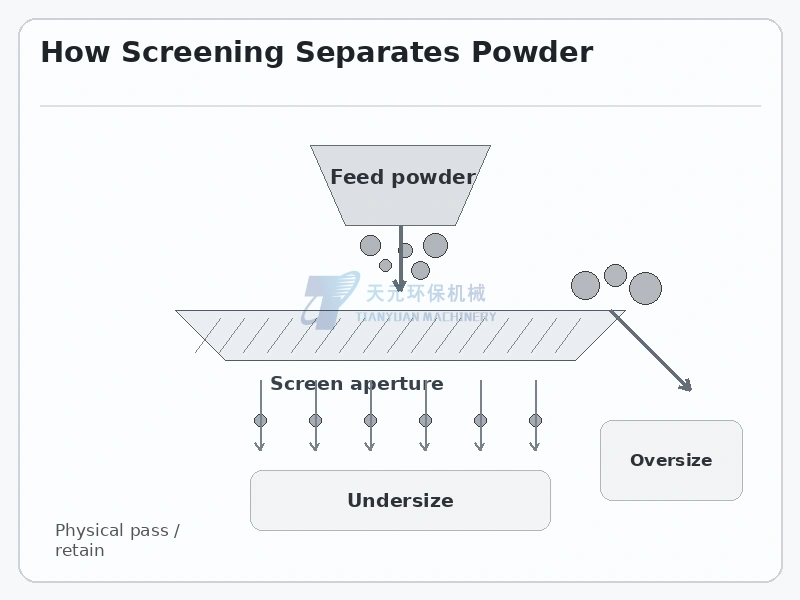
In industrial production, the screen may vibrate, rotate or move in another controlled way to give particles repeated opportunities to contact the openings. The basic advantages are easy-to-understand cut logic, direct removal of oversize particles and the ability to create several size fractions with multiple decks.
However, screening is not a perfect geometric gate. Near-size particles may pass only when presented in a favorable orientation. Fibers, flakes and needle-shaped particles can therefore behave differently from spheres. Moisture, static charge, agglomeration and fine-powder adhesion can also blind the openings and reduce capacity.
How Does Air Classification Separate Powder?
Air classification does not require a fixed screen opening. The feed is dispersed in an air stream and separated according to the balance of aerodynamic drag with gravity, inertia or centrifugal force. Ullmann’s reference work on air classifying describes the process in terms of particle settling velocity, which depends on particle size, shape and density.
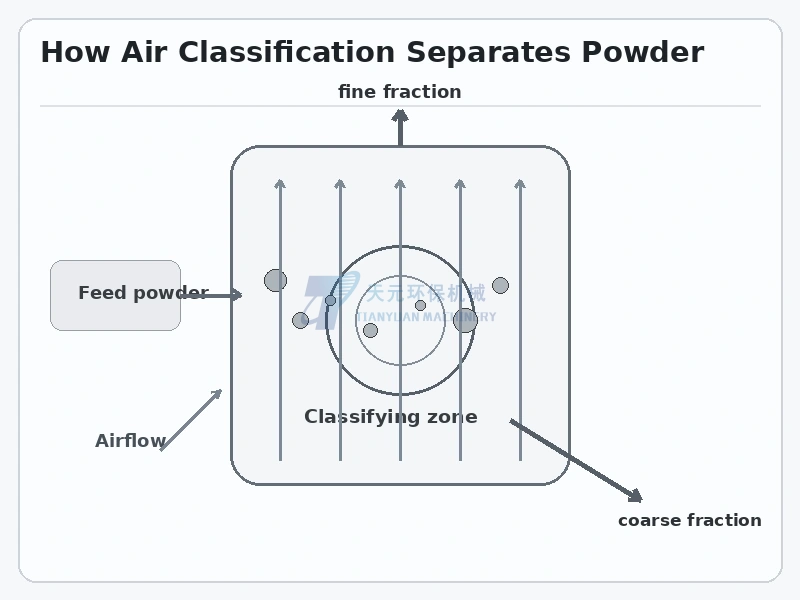
In a dynamic classifier, a rotating classifying wheel can create a controllable centrifugal field. Fine particles that are sufficiently carried by the air can pass through the classifying zone, while coarser or aerodynamically heavier particles are rejected. The practical cut point is influenced by wheel speed, airflow, feed rate, particle density, particle shape and powder dispersion.
This makes air classification attractive when a production line needs continuous fineness adjustment without changing a physical screen every time the target changes.
Screening vs Air Classification: Key Differences
| Factor | Screening | Air classification |
|---|---|---|
| Separation basis | Physical pass/retain through a defined opening | Aerodynamic behavior in air and a force field |
| Main variables | Aperture, particle size and shape, screen motion | Size, density, shape, airflow, wheel speed and feed rate |
| Fineness adjustment | Normally requires changing the screen or deck | Can often be adjusted by airflow or classifier speed |
| Oversize protection | Very direct | Not the same as a fixed-aperture safety screen |
| Very fine dry powder | May suffer blinding or low throughput | Can be more flexible if the powder disperses well |
| Multiple fractions | Multiple decks are practical | Usually designed around fine/coarse products per stage |
| Closed grinding circuit | Useful for final checks or recycle screening | Well suited to dynamic fineness control and coarse recycle |
| Sensitivity to density and shape | Important, but geometric passage remains central | Often strongly affects the separation result |
Why a Screen Aperture and an Air-Classifier D50 Are Not the Same Thing
A screen aperture is a physical opening size. By contrast, the D50 cut size of an air classifier normally refers to a particle size at which about half of that size fraction reports to one product stream and half to the other under the specified operating condition. AVEKA’s technical paper on high-efficiency air classification describes D50 as the cut size and uses a selectivity curve to describe separation sharpness.
Therefore, a 100 µm screen opening is not equivalent to an air classifier adjusted to D50 = 100 µm. The two values describe different physical concepts. A useful product specification should state whether it is based on screen residue, percent passing, D10/D50/D90, a maximum-particle limit or another measurable criterion.
When Is Screening Usually the Better Choice?
- The product specification is directly tied to a screen opening or screen residue.
- You need to remove occasional oversize particles, foreign material or agglomerates.
- You want a final safety screen before packaging.
- You need several size fractions from a multi-deck screen.
- The powder is sufficiently free-flowing and does not blind the screen excessively.
For metal powders, screening can be particularly useful when the acceptance criterion includes a maximum particle size or a defined residue on a test sieve. It gives a process-control step that is closely related to that specification.
When Is Air Classification Usually the Better Choice?
- The powder is fine enough that conventional screening becomes prone to blinding or low throughput.
- The grinding system needs continuous, adjustable fineness control.
- Coarse particles should be returned automatically to the mill in a closed circuit.
- Frequent product changes would otherwise require repeated screen replacement.
- The dry powder disperses well in an air stream and its aerodynamic behavior is suitable for classification.
Air classification is not automatically better for every fine powder. Dense metal particles, thin flakes, fibrous wood particles, agglomerates and electrostatically charged powders may behave differently from simple spherical-particle assumptions. Representative material testing is therefore important when the separation behavior is uncertain.
Why Are Screening and Air Classification Often Used Together?
The two methods can perform different jobs in the same line. A typical concept is:
Grinding → air classification → cyclone collection → final screening → finished product
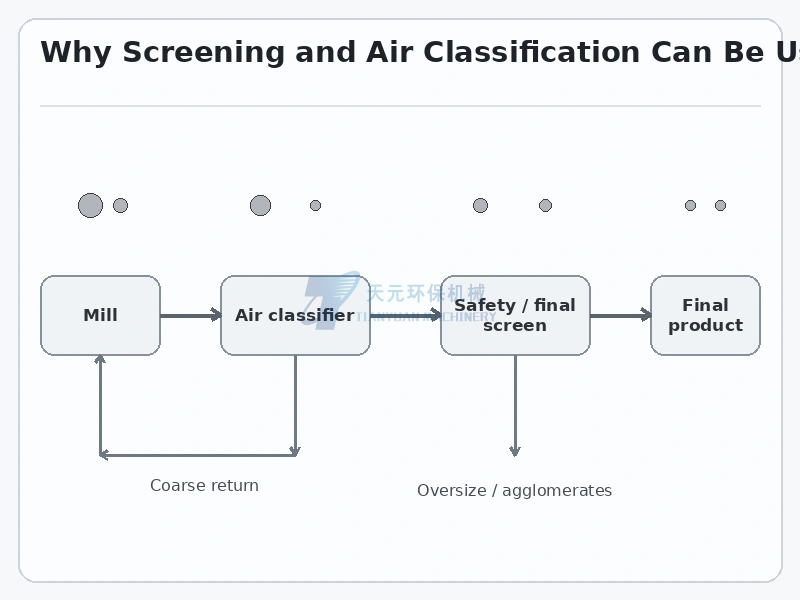
In this arrangement, the air classifier controls the circulating fineness during milling, while the final screen removes occasional oversize particles or agglomerates before the powder is accepted as finished product.
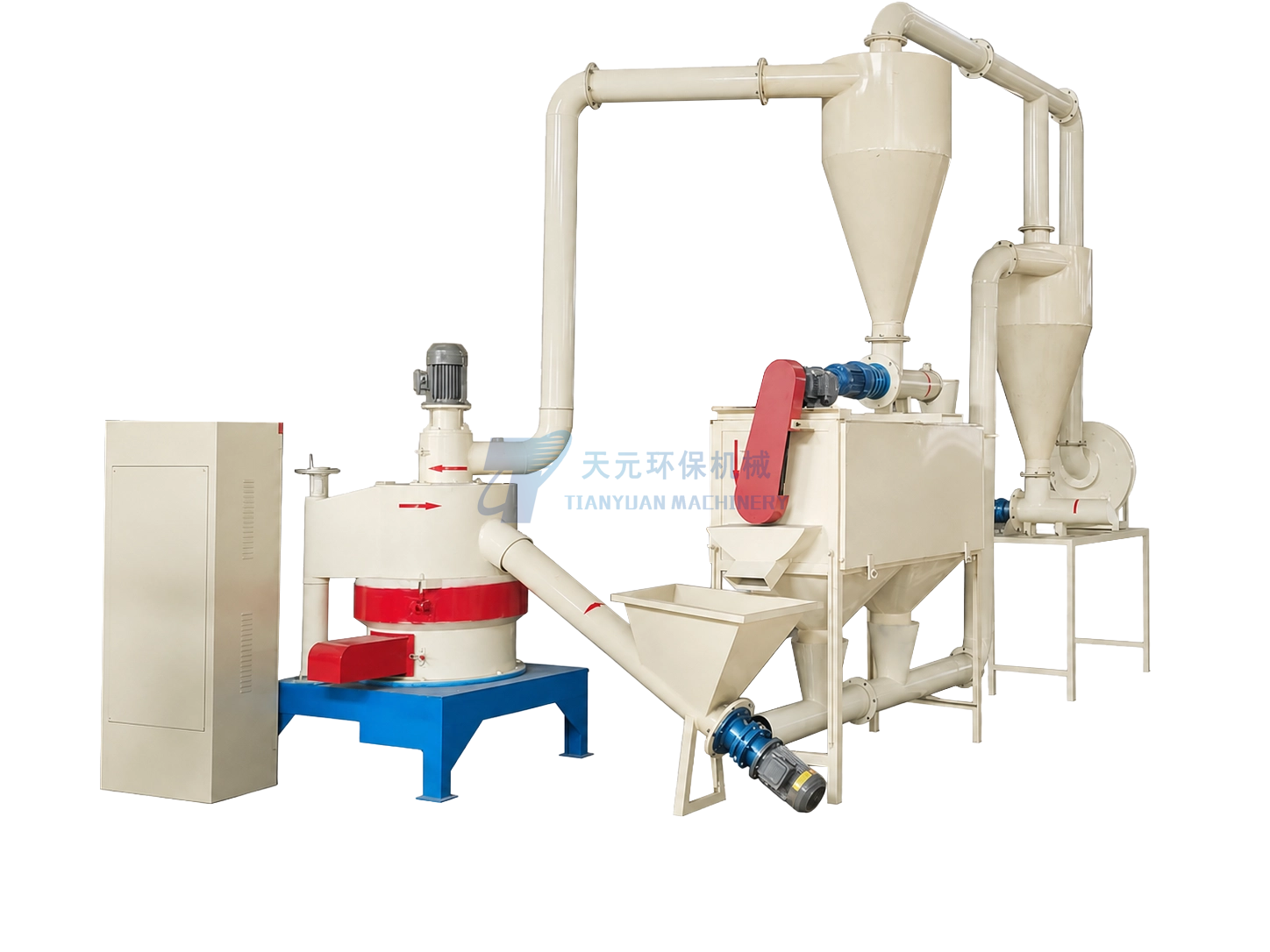
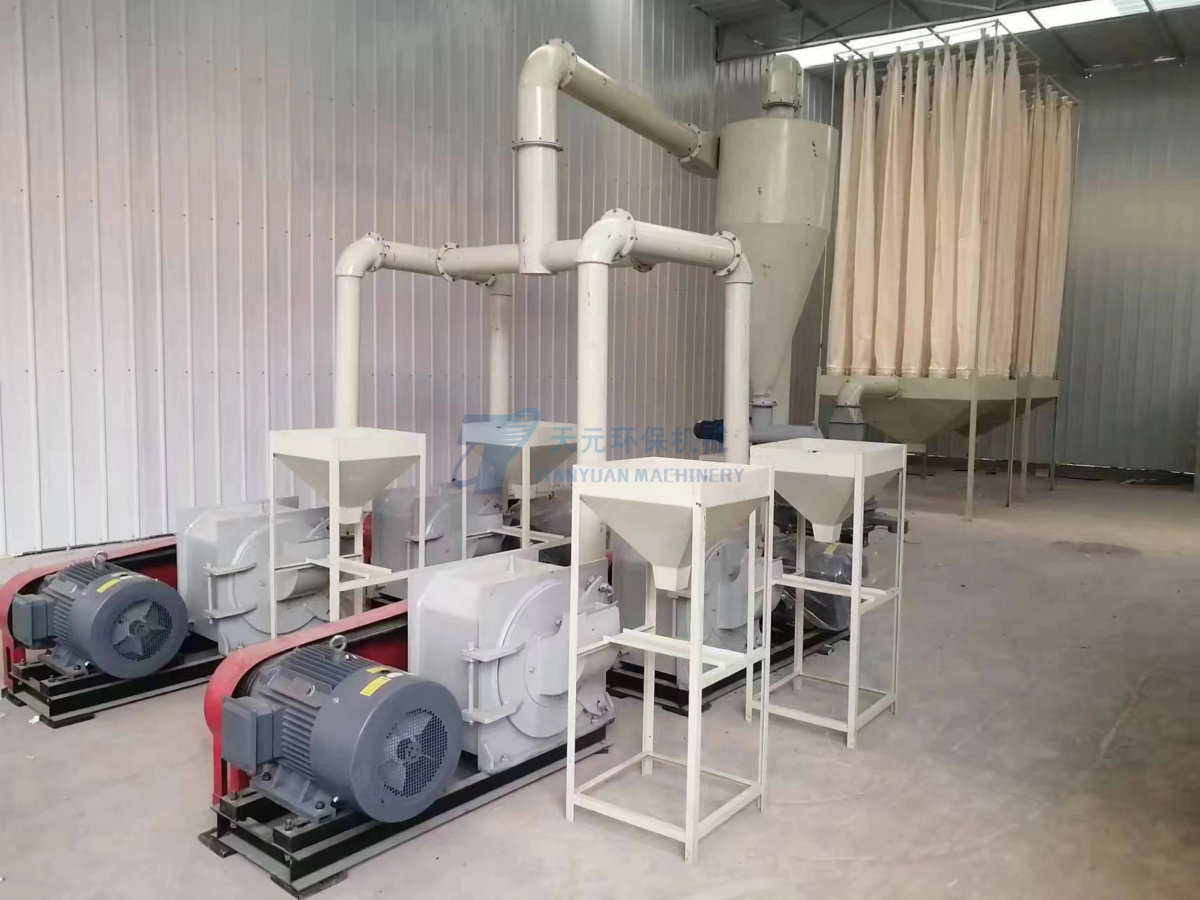
Tianyuan’s current TYMF6R-600 wood powder machine process description includes both an air classifier and screening equipment. The TYJSMF500 metal powder grinding mill line also uses screening as part of finished-powder control. The exact configuration must still be selected for the real material and product requirement.
How Does the Choice Change for Wood Powder and Metal Powder?
Wood powder
Wood powder is fibrous. Fiber length, width, aspect ratio and moisture affect both screen passage and aerodynamic response. A long thin fiber may pass an aperture only in a favorable orientation, while its drag in an air stream may be much greater than that of a compact particle with similar mass.
For wood flour projects, process selection should therefore consider wood species, fiber morphology, measured moisture, agglomeration tendency and whether the downstream specification is written as a screen-based requirement or a particle-size distribution.
Metal powder
Metal powders are generally denser, and mechanically produced powders may be irregular, angular or flaky. Those characteristics can strongly influence air classification. If the customer has a strict maximum-particle or sieve-residue requirement, a final screen can provide a separate quality-control barrier even when an air classifier is already used upstream.
Combustible metal powders require project-specific evaluation of dust, static electricity, temperature rise and fire/explosion hazards. A blower, ordinary dust collector or air-conveying system should not be treated as a complete explosion-safety solution by itself.
What Information Is Needed Before Choosing the Process?
- Material name and composition
- Particle density and particle shape
- Feed particle-size distribution
- Moisture content
- Agglomeration, adhesion or static tendency
- Target mesh or particle-size distribution
- Maximum-particle requirement, if any
- Required D50/D90 or percent-passing values, if specified
- Required qualified-product capacity
- Whether coarse material must be recycled to the mill
- Dust and fire/explosion safety conditions
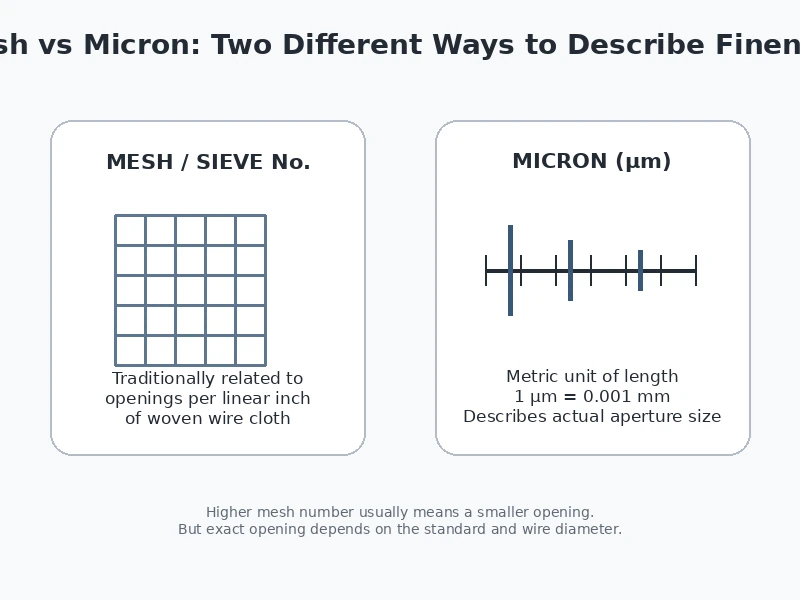
A single statement such as “we need 100 mesh” is usually not enough to decide whether screening, air classification or a combined system is the correct solution.
FAQ
Which is more precise: screening or air classification?
There is no universal winner. Screening is directly tied to a physical aperture, while air classification offers adjustable cut control but is more sensitive to density, shape and dispersion. Precision must be judged against the actual material and acceptance specification.
Can an air classifier completely replace a screen?
Not always. If the final requirement is a strict maximum-particle limit or a screen-residue specification, a final safety screen may still be valuable.
Can screening handle very fine powder?
Yes, but blinding, static charge, agglomeration and throughput become more important as particle size decreases. Special methods such as air-jet sieving also exist, but laboratory capability should not be confused with industrial continuous-production capacity.
Does air classification separate only by particle size?
No. Particle density and shape influence aerodynamic behavior, so particles with similar geometric size can report differently in an air classifier.
Can both methods be installed in the same powder line?
Yes. A common arrangement uses air classification for dynamic fineness control and screening for final product protection or oversize removal.
Technical References
- ASTM E11-24 — Standard Specification for Woven Wire Test Sieve Cloth and Test Sieves
- Ullmann’s Encyclopedia / Wiley — Air Classifying
- AVEKA — Modern High Efficiency Air Classification and a Practical Example
- Hosokawa Alpine — Ventoplex C Air Classifier
- Retsch — Air Jet Sieving Machine AS 200 jet
Conclusion
The real difference between screening and air classification is the separation mechanism. Screening is based on passage through a fixed opening; air classification is based on particle motion in an air stream and force field.
Use screening when a defined aperture, oversize removal or final safety check is the priority. Consider air classification when adjustable fine separation and closed-circuit fineness control are more important. For many industrial wood-powder and metal-powder lines, using both methods for different tasks is the more practical solution.