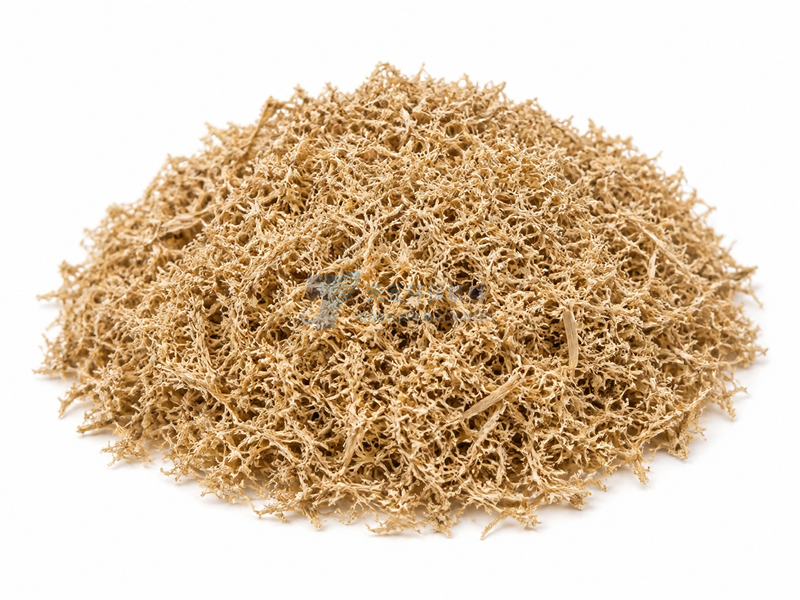
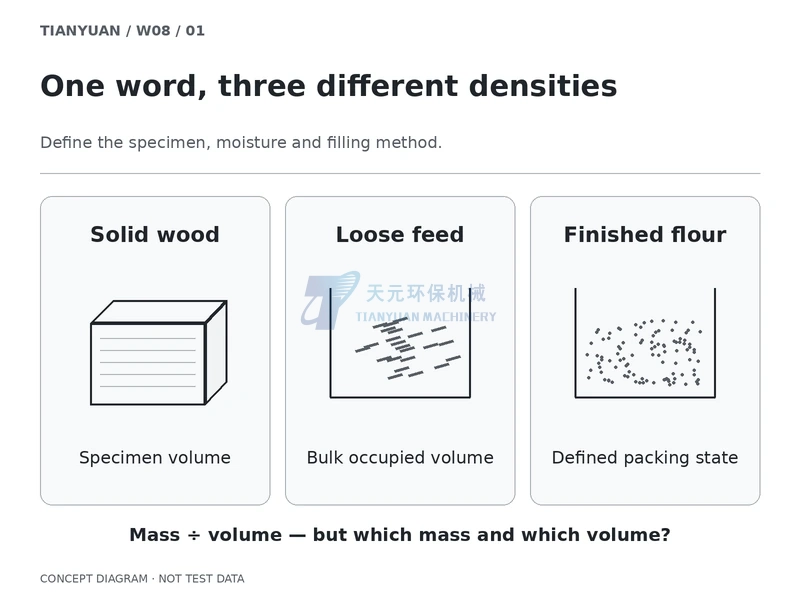
A full hopper of sawdust does not always contain the same mass. Equally, a dense piece of timber does not identify the correct mill settings by itself. Before discussing the wood density effect on grinding, establish whether the measurement describes solid wood, loose incoming particles or finished wood flour.
Key conclusion: Density helps explain mass loading, occupied volume and some separation behaviour, but it does not independently predict grindability, energy consumption or capacity. Use a stated moisture and volume basis, distinguish volumetric feeding from mass feeding, and compare the same accepted powder specification.
Contents
Which density are you measuring?
Solid-wood density describes the mass of a specimen divided by its external volume at stated conditions. That volume includes the wood’s internal cellular voids, but not the spaces between separate particles in a hopper. It is not the same as the density of cell-wall substance.
| Quantity | What it describes | Do not substitute it for |
|---|---|---|
| Solid-wood density | A defined specimen and moisture/volume basis | Loose sawdust bulk density |
| Feed bulk density | Mass per occupied bulk volume under a stated filling method | A material hardness or grindability rating |
| Finished-flour bulk density | Milled powder in a specified loose or compacted condition | Feed density or a guaranteed packaging volume |
The USDA wood-physics chapter explains why both mass and volume change with moisture. Oven-dry density, density at a stated moisture content and basic density using oven-dry mass with green volume must not be silently mixed. Record the object, moisture basis, method and unit; distinguish loose from tapped or settled results.
Why the same feeder setting may change the mill load
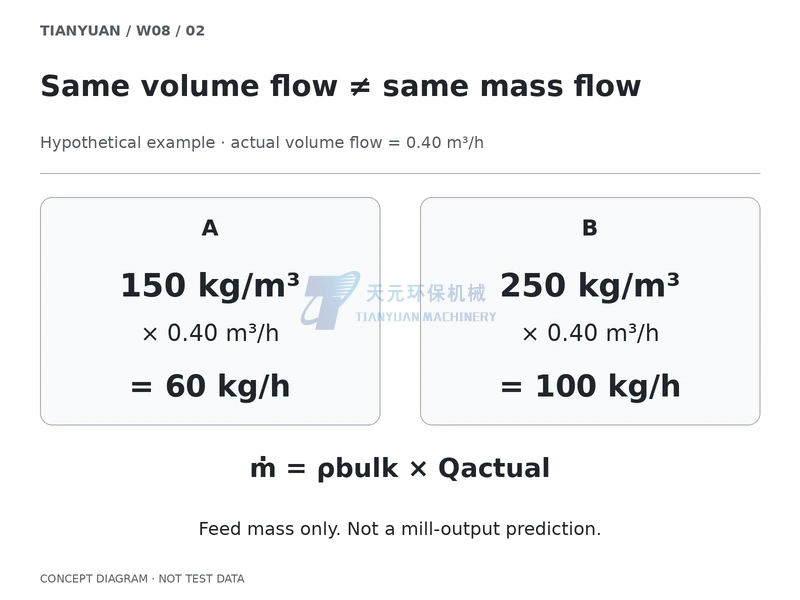
For a representative bulk state, mass flow equals bulk density multiplied by the actual bulk-volume flow. A screw-speed setting alone does not establish that volume flow: filling, slip, bridging and hopper level can also change.
Illustrative calculation—not a machine test: suppose two hypothetical feeds both move at an actual 0.40 m³/h. At bulk densities of 150 and 250 kg/m³, their incoming mass flows are 60 and 100 kg/h respectively. These are assumed values, not species measurements or mill ratings. They do not predict accepted-powder output.
After changing feedstock, check whether the actual kg/h has changed before interpreting a higher motor load as poorer grindability. The USDA-hosted Wood Flour chapter also relates bulk density to particle size, moisture, species and feeding behaviour.
Does denser wood necessarily require more grinding energy?
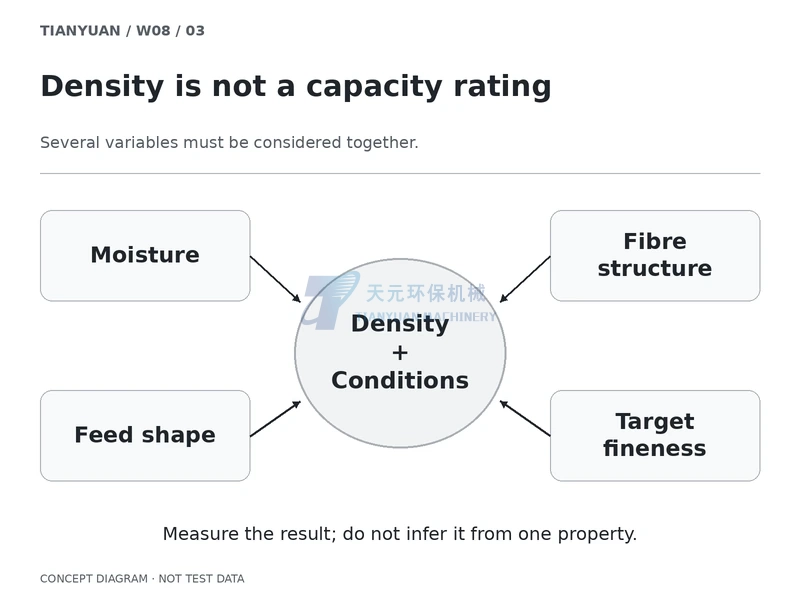
Not as a universal rule. Density carries information about the material, but breakage also depends on fibre direction, moisture, toughness, defects, incoming particle form, loading mechanism and the requested product. Density is not a hardness scale, and low density is not proof of low energy use.
Published two-stage Douglas-fir grinding research found an energy–size relationship within its tested system. Its useful lesson here is to compare a defined product endpoint—not to transfer its numerical results to another species or to a Tianyuan mill.
When two lots differ in density, moisture and initial size together, report a multi-variable comparison. A difference in current, residence behaviour or accepted output cannot honestly be attributed to density alone.
Why density must be checked again after milling
Milling changes the particle population and its packing. Do not calculate bag volume from the density of the original timber or assume incoming bulk density is the finished-flour value. Establish the relevant loose, settled or compacted condition and measure it consistently.
Particle density, size and shape also interact in an air stream. Screening and air classification answer different separation questions. A hopper bulk-density measurement cannot, by itself, specify an aerodynamic cut size.
How to compare two feeds without confusing density and capacity
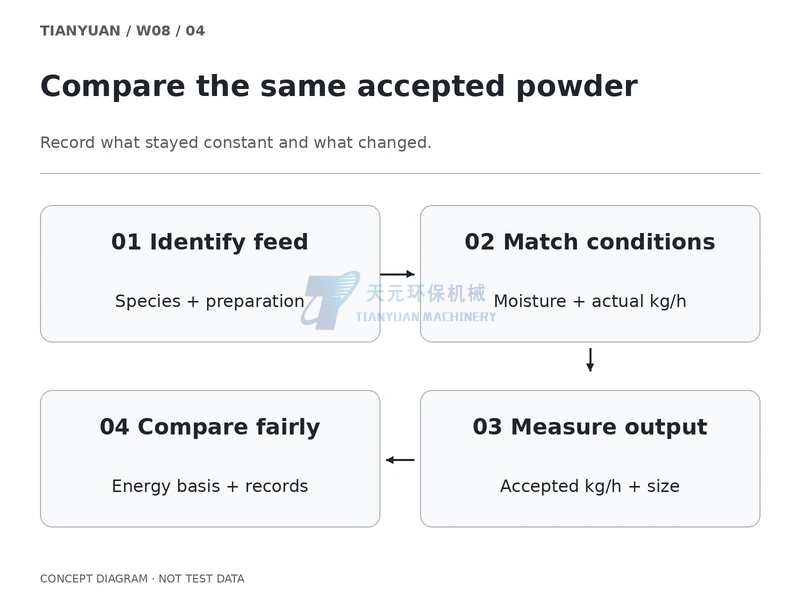
A useful comparison begins with the same intended use, particle-size acceptance method and definition of qualified output. Then document what was held constant and what had to change.
- Identify the species or controlled blend, source and pretreatment history.
- Record incoming size, moisture basis, bulk-density method and actual mass feed rate.
- Track accepted product kg/h together with size distribution, return material, product moisture and stable operation.
- For energy comparison, define the metering boundary and use accepted product mass on a consistent moisture basis.
- Report start-up, idle running and any drying consistently; do not count circulating return material again as new production.
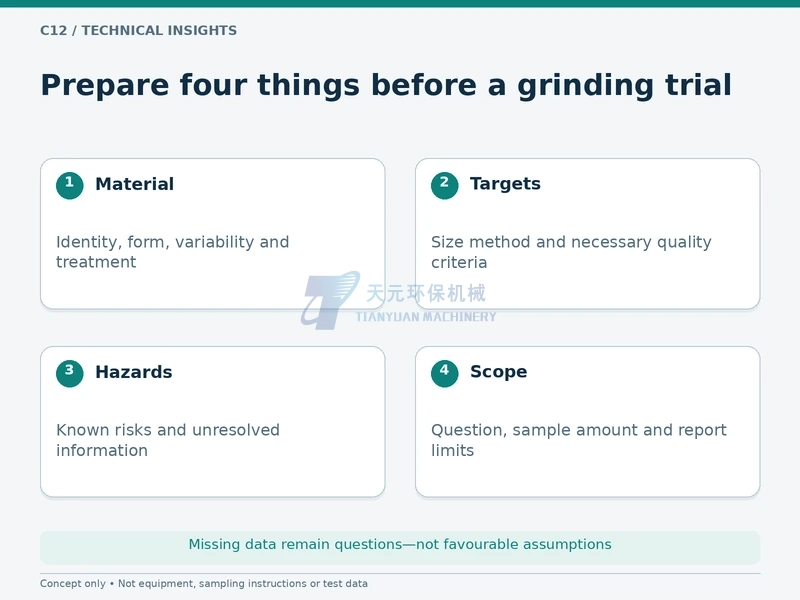
The recommended comparison is an engineering evaluation plan, not a universal test standard. Agree the scope through grinding-trial preparation; sample quantity and duration must fit the actual material and question.
Tianyuan process judgment: use density to explain the load
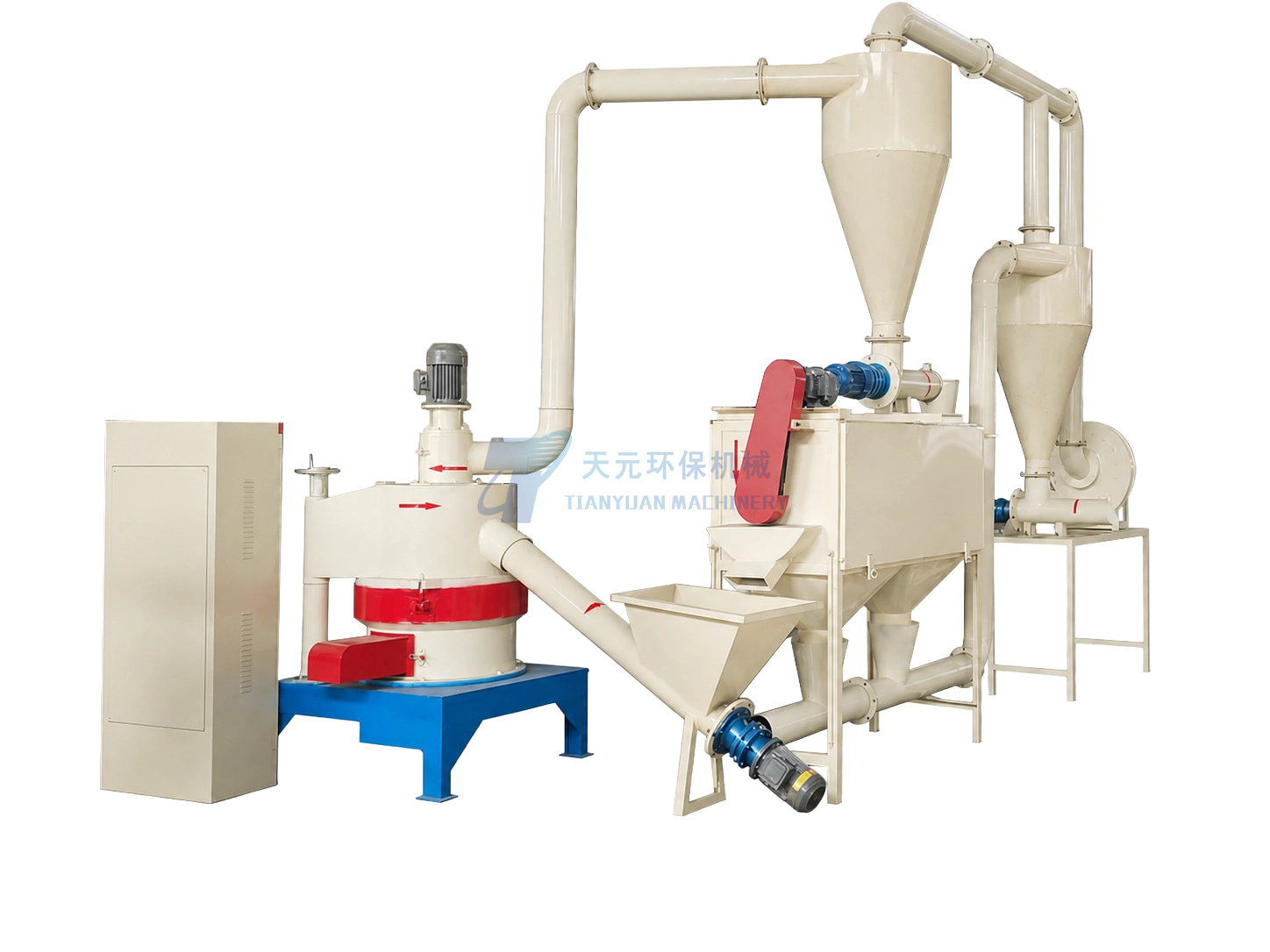
For Tianyuan projects, density is an input to feeding and process assessment—not a direct lookup for guaranteed output. The TYMF6R-600 performs downstream fine milling of prepared woody or plant-fibre feed, not primary log crushing. Its confirmed range is 30–325 mesh and 100–500 kg/h, with maximum feed diameter ≤5 mm.
Actual capacity depends on material, feed condition, target fineness and site conditions. Maximum fineness and maximum throughput are not a simultaneous promise, and these figures do not rate other models or auxiliary equipment.
Low bulk density is not a dust-safety classification. HSE identifies fire and explosion hazards from wood dust. Material-specific risk assessment and protective design remain necessary; ordinary extraction and grounding alone are not a complete protection system.
Frequently asked questions
Is denser wood always harder to grind?
No. Compare identified material, moisture, fibre condition, feed form and the same accepted product. Density alone is not a grindability test.
Can timber density determine the volume of a bag of wood flour?
Not directly. Packaging volume requires the finished powder’s bulk density under the agreed filling and settling conditions.
Does the same screw speed make a fair trial?
Not by itself. Actual volume flow, filling and bulk density can differ; verify mass flow and report any control changes.
Can densities measured at different moisture contents be compared directly?
Only with their bases explicitly understood. Otherwise the comparison includes differences in water mass and specimen volume.
Does a lighter bulk material guarantee lower energy use or lower dust risk?
No. Specific energy and dust hazards require their own material- and process-specific evaluation.
Conclusion
Wood density is useful for understanding material and loading, not for replacing trials. Separate specimen density from bulk density, state the moisture basis and actual mass feed, then compare the same qualified wood flour before drawing conclusions about capacity or energy.