A clean offcut from a known manufacturing process and a mixed load of used timber may both be called recycled wood, yet they do not arrive with the same evidence. The decision is whether a defined material stream can become acceptable wood flour for a named use, not whether a machine can make its pieces smaller.
Selected, traceable recovered wood may be evaluated for wood-flour production after suitable preparation. Painted, preservative-treated, bonded or unidentified mixed wood must not be approved as clean feed by default. Confirm source history, relevant contaminants, the mill’s permitted feed and the receiver’s powder requirements. Fine grinding is size reduction; it is not proof of decontamination.
Contents
1. Classify the source before planning a trial
A material name is not a treatment history
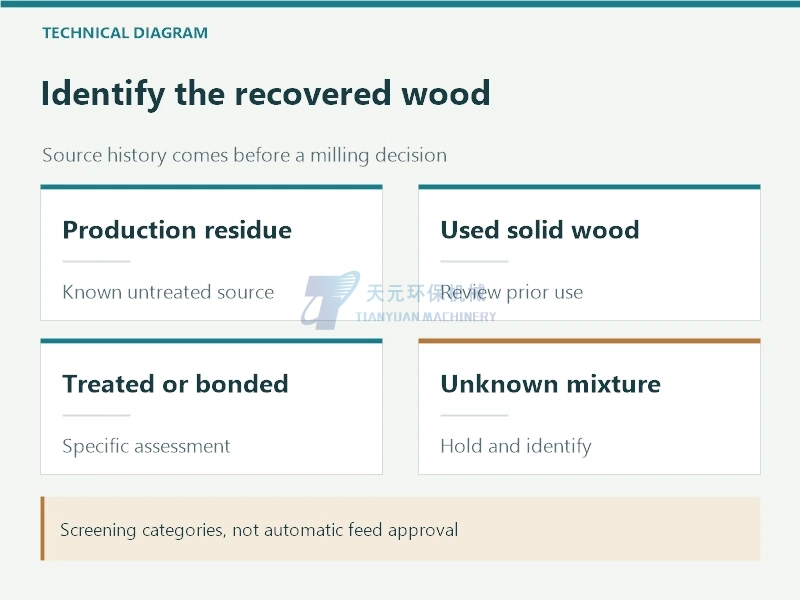
Record who generated the material, its original product or process, previous service, storage and any known coating, adhesive or preservative. Keep unlike sources separate while information is missing. The following groups support an initial review; they are not waste classifications or blanket acceptance rules.
Clemons’ USDA reference on wood flour describes clean, consistent wood sources and preparation for powder applications. It supports checking source quality but does not approve every recycled stream. Known untreated residue still needs inspection and testing for its proposed use.
| Source description | Initial decision | Evidence still required |
|---|---|---|
| Traceable untreated production offcuts or residue | Candidate for material assessment | Actual cleanliness, moisture, dimensions and product requirements |
| Used wood with documented history | Review prior use and exposure | Treatment history, attached material and representative inspection |
| Painted, preserved or bonded products | Keep separate for specific assessment | Identified substances, equipment suitability and an approved receiving application |
| Mixed wood with unknown history | Hold pending identification | A reliable source record and a defensible sampling and acceptance plan |
2. Separate physical cleaning from chemical suitability
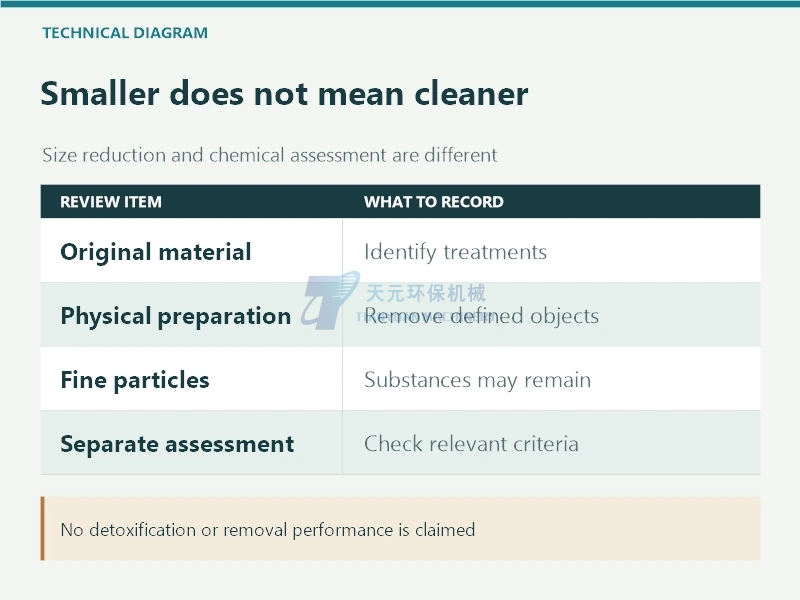
Visible nails, grit and attached foreign pieces raise different questions from substances within wood or a bonded panel. Removing a visible object only addresses that object. A magnetic separation result cannot demonstrate the absence of coatings, adhesives or preservative chemicals; a pale colour or weak odour is not a chemical clearance test.
EPA’s information on chromated arsenicals provides a concrete example of chemical wood treatment. Use it to understand why treatment identity matters, not to infer that all preserved wood contains the same chemistry. Grinding changes particle size and may distribute contaminants into smaller fractions; it should not be described as detoxification. Disposal and product-permission questions require the applicable local assessment, rather than transferring US guidance into a universal rule.
3. Define the receiving application before accepting feed
Mill suitability and product acceptance are separate decisions
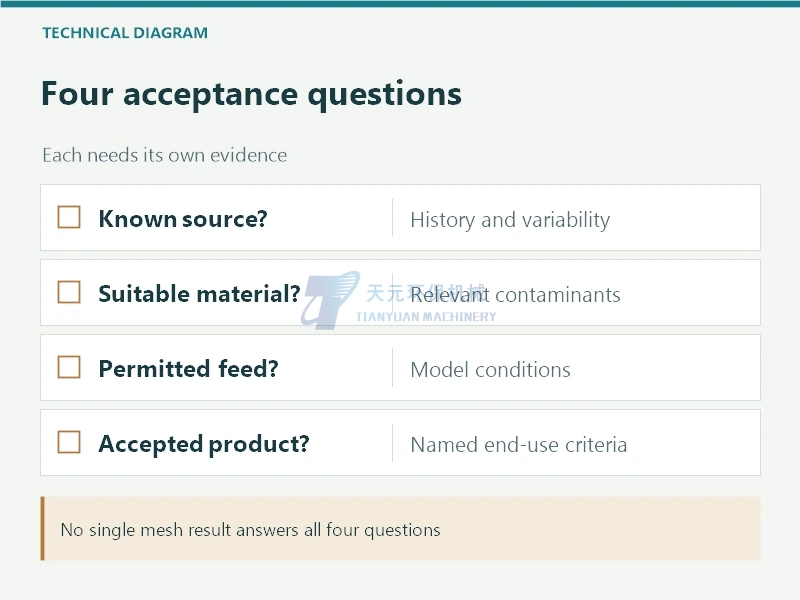
Specify the intended wood flour before selecting a preparation route. Agree particle-size distribution and its measurement method, moisture basis, relevant appearance or ash requirements, and substance checks justified by the source and end use. No single mesh number establishes cleanliness. The wood-flour quality guide explains the broader acceptance framework.
Acceptance for one application does not authorize another. A compound producer’s formulation check, for example, cannot serve as approval for incense or other uses with different exposure and performance requirements. Those are downstream uses of suitable powder, not evidence that any used wood is suitable feed. Have the receiver identify its requirements and unresolved questions before a milling trial.
4. Prepare an eligible stream for the fine-mill interface
Only after the material is eligible for further assessment should the process route be developed. Sorting and appropriate contaminant removal may be followed by chipping, crushing or conditioning where required. Inspect each output against the next stage’s requirements. Logs, branches and large used-wood pieces are not automatically fine-mill feed; the wood-pretreatment guide explains those interfaces.
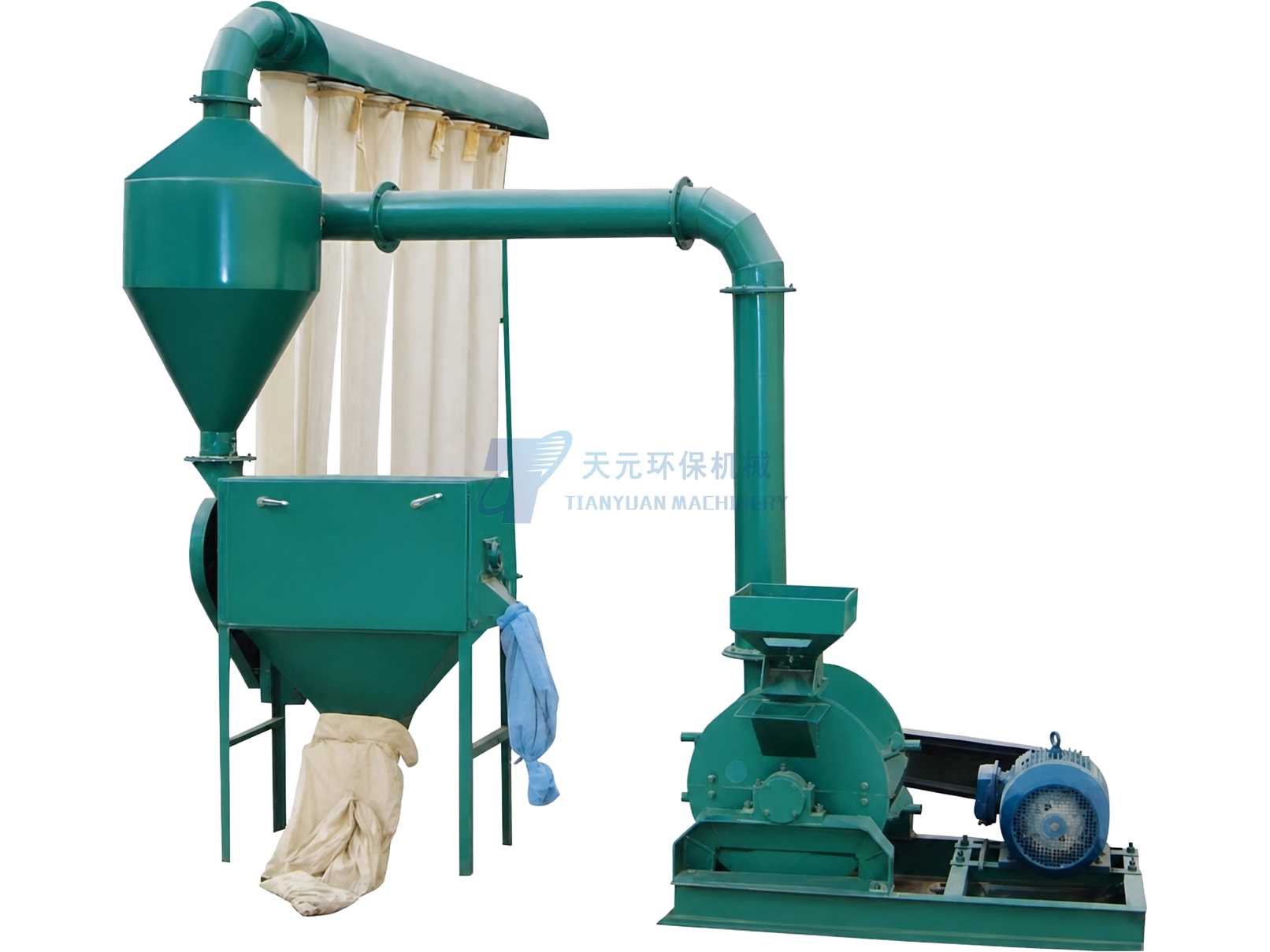
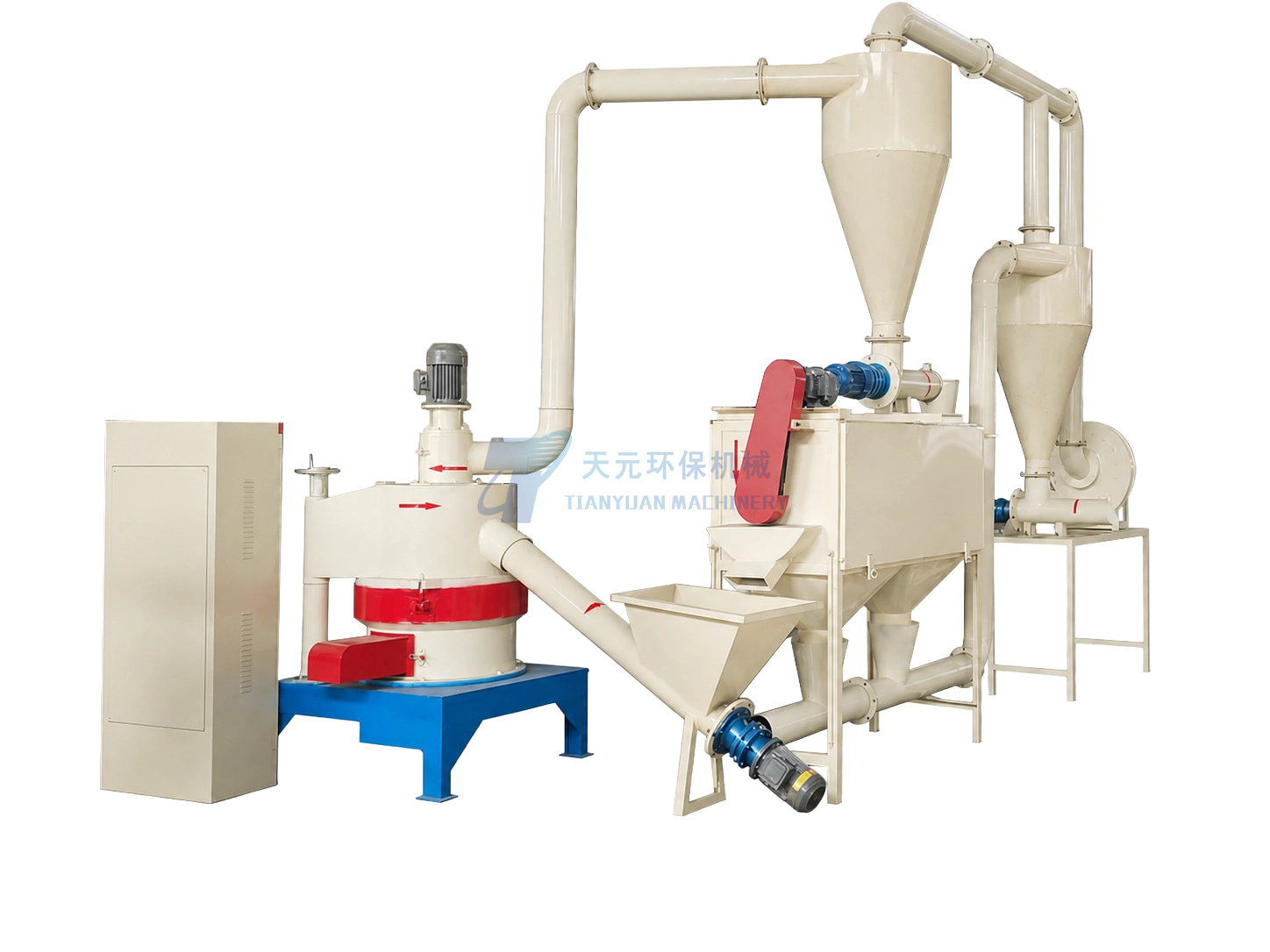
The TYMF6R-600 product page lists 30–325 mesh, 100–500 kg/h and a maximum feed diameter of 5 mm. These model ranges depend on material, preparation, fineness and configuration; they do not promise the finest powder at the highest output. Full dimensions and form also matter. The model is not a decontamination unit, and its specifications do not establish suitability for treated or bonded recycled wood.
5. From eligible feed to finished powder and its uses
Once a stream is eligible for further assessment, configure the route around its actual condition: sorting and removal of foreign material, chipping or crushing, drying where required, then fine milling, classification and powder collection. Sawdust that already meets the mill’s feed requirements may not need all the preparation stages used for logs, branches or large used-wood pieces; confirm this by measurement rather than by the material name.
Accepted wood flour can be used in applications such as wood-plastic composites (WPC) and incense, but each application has its own particle-size, moisture and cleanliness requirements. Confirm the acceptance criteria and test representative material before selecting equipment or promising output.
Recovery value differs between waste streams. Assess the costs of sorting, power use, wear and powder collection across the whole route rather than assuming that every waste stream has the same value.
6. Test representative material and account for every output
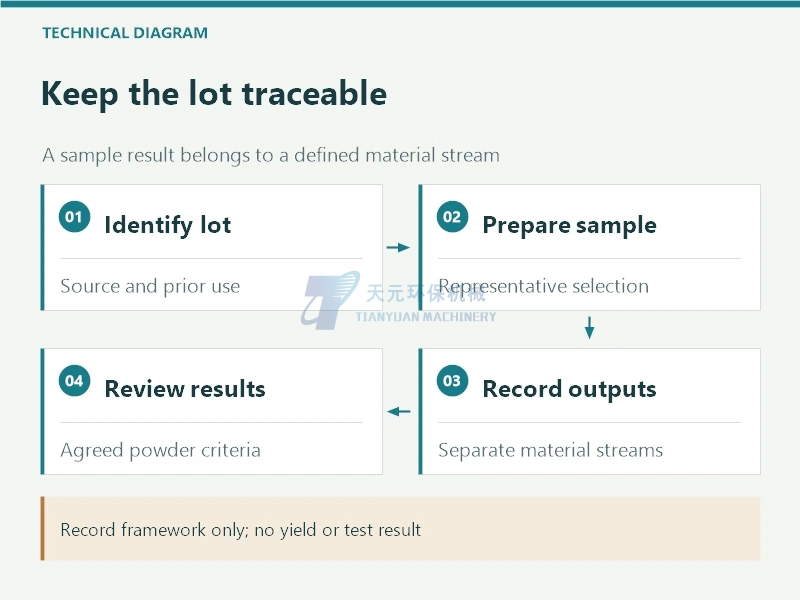
Keep the source assessment attached to the trial sample. Record sampling locations, batch identity, treatments performed before delivery and any known variability. A convenient handful of the cleanest pieces cannot establish the condition of an entire mixed load. Agree the sample quantity and safe trial scope with the technical team, using the grinding-test preparation guide.
Record incoming material, removed material, returned coarse fraction, collected dust and accepted powder as distinct streams where relevant. Their masses and moisture bases must be clear before comparing recovery. Compare powder results with agreed criteria; a low concentration in one collected fraction does not demonstrate that a contaminant disappeared from the process.
7. Decide whether to proceed, hold or exclude the stream
Proceed to the next agreed step only when the source is sufficiently documented, equipment conditions are met and the receiving application has an appropriate acceptance plan. Hold a lot if treatment identity, contamination or sampling remains unresolved. If the material cannot meet the applicable requirements through an assessed route, keep it outside the proposed wood-flour stream; do not dilute it with clean wood merely to obtain an apparently better sample.
Retain the decision, supporting results and lot identity. Reassess when the supplier, prior use, coating system or mixture changes. A successful sample is evidence about that sample and test conditions, not permanent qualification of all later deliveries. The existing waste-wood equipment overview explains process roles; this article establishes the material-entry questions that come before equipment selection.
8. Carry the assessment into dust handling and storage
A chosen milling route still needs control of worker exposure and safe handling of fines. HSE guidance on wood dust supports capture at source and suitable control arrangements. If the feed contains additional substances, a generic wood-dust description is insufficient to characterize every exposure. Provide the assessed material information to those designing and operating the process.
Keep evaluated feed, held material and accepted powder identifiable through storage and transfer. Preserve records of sampling time and subsequent handling, and check whether moisture or foreign material changed before release. Neither dry appearance nor a closed bag substitutes for product acceptance. The actual system and receiving use require their own review.
Frequently asked questions
Can all used pallets become wood flour?
No blanket conclusion is justified. Establish their material, previous use, treatments, contamination and the receiving application, then assess representative feed.
Does removing nails make recycled wood clean?
It addresses the removed nails. Coatings, adhesives, preservatives, grit and other contaminants require their own assessment and, where needed, suitable testing.
Can particleboard or coated board be treated as ordinary solid wood?
No. Bonding and surface treatments change the material description. Identify them and obtain specific equipment and application assessment before considering a trial.
Does finer grinding remove preservative chemicals?
Fine grinding reduces size; it does not demonstrate chemical removal or detoxification. Do not assume that a change in appearance proves suitability.
What should accompany a recycled-wood inquiry?
Provide source and prior-use history, known treatments, representative photographs and samples, dimensions, moisture method, available contaminant results and the intended powder specification.
What to prepare next
Start with an identifiable source and a named receiving use. Separate physical preparation from chemical suitability, agree the powder criteria and validate representative material within confirmed equipment conditions. Where information is missing, retain the lot and resolve the question before milling; an ability to reduce size is not an acceptance decision.
To discuss a waste-wood stream, contact Tianyuan Machinery with your material, intended model and production requirements.