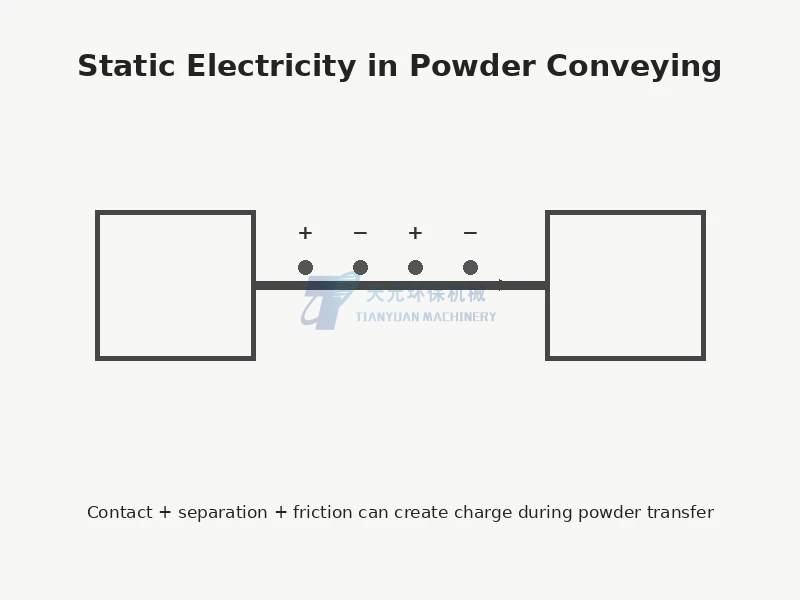
Powder conveying creates repeated contact, separation, friction and impact between particles and equipment surfaces. These mechanisms can generate electrostatic charge on the powder, ducts, hoses, bins, conveyors and other process components.
Core conclusion: Static electricity in powder conveying is not only a nuisance shock issue. It can affect powder behavior and, where combustible dust is present, electrostatic discharge can become an ignition source. Static control therefore belongs in the conveying-system design and in the broader dust-hazard assessment.
Why powder conveying generates static electricity
When materials contact and separate, charge can be transferred between surfaces. Powder handling repeats this continuously as particles rub against each other and against chutes, screw conveyors, pneumatic lines, hoses and vessel walls. Faster transfer, dry conditions and electrically insulating materials can make charge accumulation more significant.
OSHA combustible-dust guidance states that dry powders can build static electrical charges during transfer and mixing operations and identifies electrical grounding and bonding as precautions. OSHA technical guidance on conveyors also lists electrostatic build-up and discharge as a potential ignition mechanism.
Where charge can accumulate
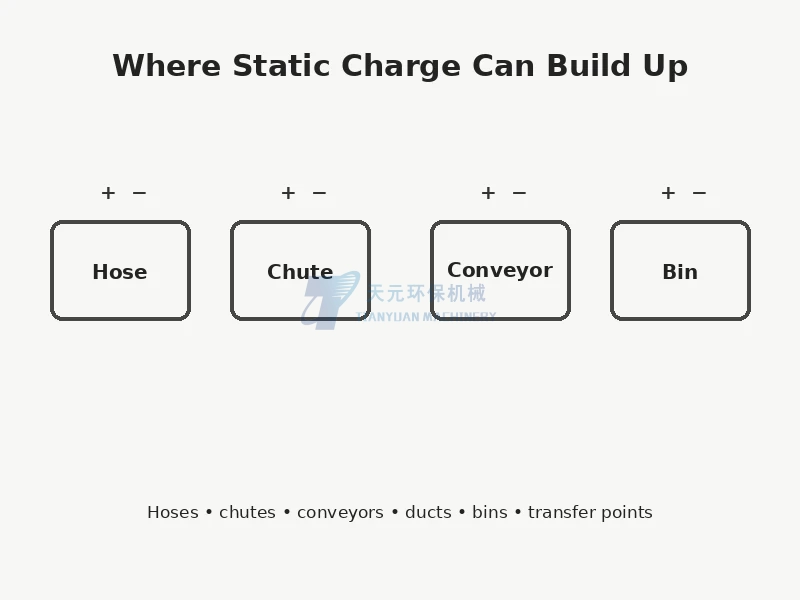
- Flexible hoses and non-conductive connections
- Chutes, spouts and loading points
- Screw, belt and pneumatic conveying sections
- Bins, hoppers and packaging stations
- Metal duct sections separated by insulating gaskets or flexible connectors
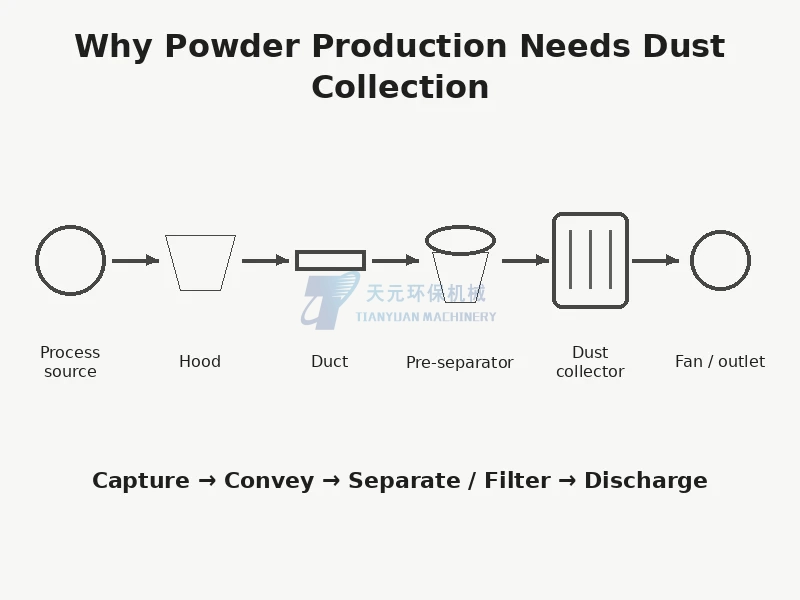
- Dust collection ducts, hoods and collectors
- Painted, corroded or poorly connected bonding points
OSHA has documented hazards involving non-conductive flexible ducting used with combustible dust. Where electrical continuity is broken, charge can accumulate while product is flowing and the resulting discharge can become an ignition source.
Bonding vs grounding
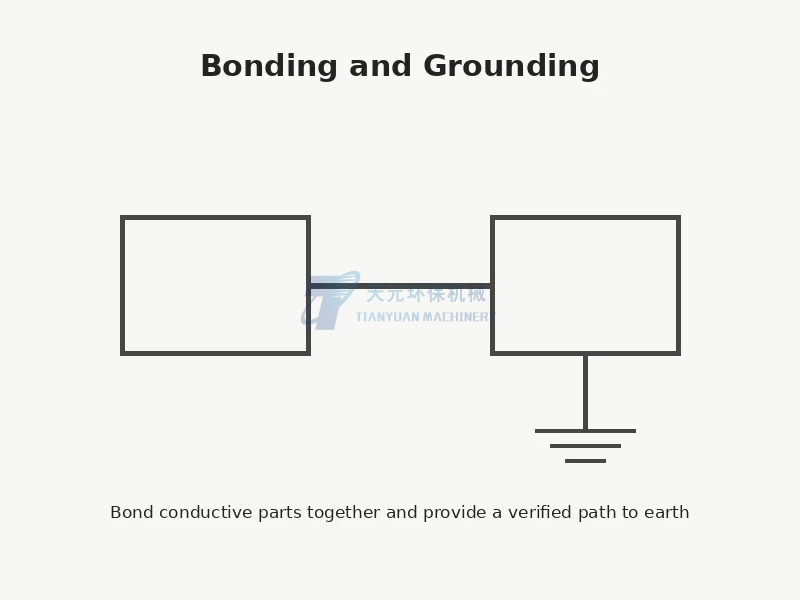
Bonding electrically connects conductive components so they remain at approximately the same potential. Grounding provides a conductive path from equipment to earth so accumulated charge can dissipate.
A ground connection on one machine does not guarantee electrical continuity through an entire conveying train. Flexible sections, coatings, gaskets, corrosion and removable joints can interrupt the path, so continuity must be designed, inspected and verified.
Why combustible dust changes the risk
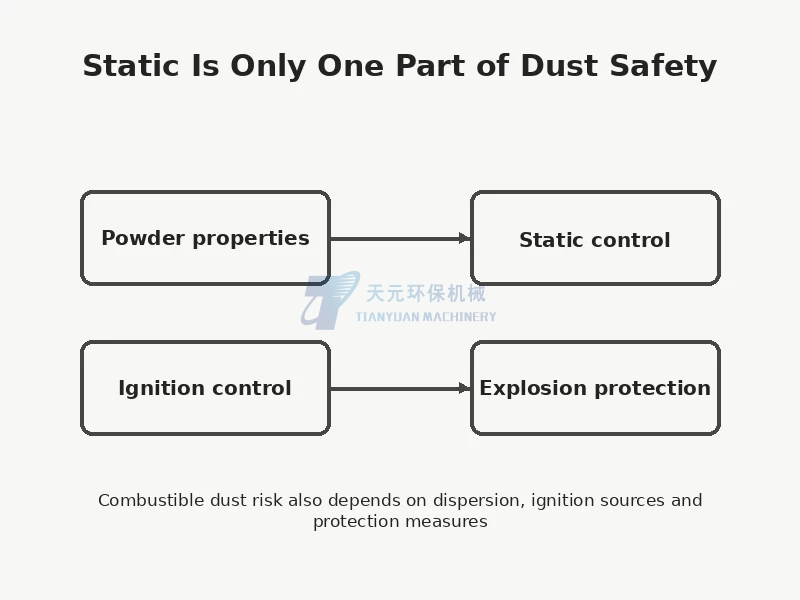
OSHA lists wood dust and metal dusts such as aluminum and magnesium among combustible-dust examples and includes static electricity control, bonding and grounding among ignition-control measures.
But bonding and grounding do not make a combustible-dust process automatically safe. Dust explosibility, particle size, dispersion, concentration, ignition sources, electrical classification, isolation, venting or suppression, inerting and housekeeping may also need evaluation.
How this applies to Tianyuan powder lines
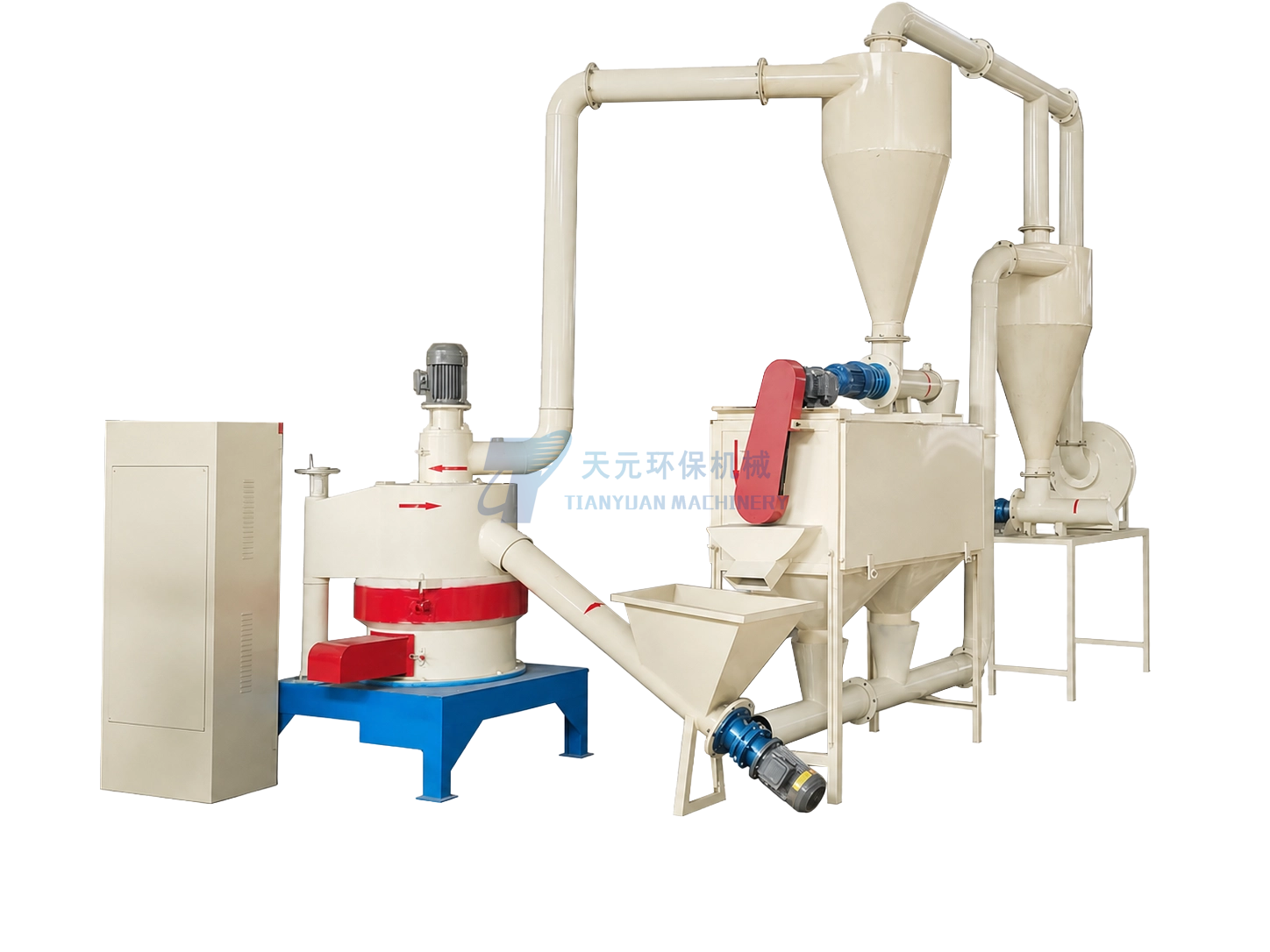
Tianyuan’s TYMF6R-600 wood-powder line (TYMF6R-600) includes screw conveying, ductwork, cyclone separation, screening and dust collection. The TYJSMF500 metal-powder line (TYJSMF500) also uses air conveying, cyclone separation, screening and material return. These are points where material movement and equipment connections should be considered when evaluating static control.
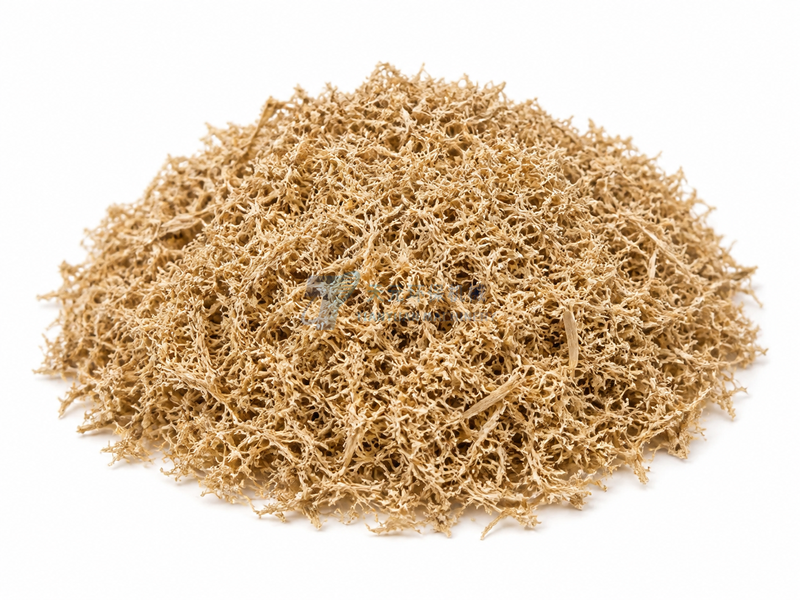
Wood powder and metal powder should not be treated as having the same hazard profile. The actual material, particle size and operating conditions must be assessed before the conveying and safety configuration is finalized.
Design and inspection checklist
- Identify the powder and whether it can be combustible or reactive.
- Record particle-size range and airborne fine fraction.
- Identify every conveying and transfer method.
- Locate insulating hoses, sleeves, liners and gaskets.
- Verify electrical continuity across conductive sections.
- Provide appropriate bonding and grounding for conductive equipment.
- Inspect connection points for paint, rust, looseness or damage.
- Do not treat humidity as a substitute for electrical controls.
- Determine whether combustible-dust measures beyond static control are required.
FAQ
Does stainless-steel equipment automatically eliminate static risk?
No. Conductive metal can dissipate charge only if electrical continuity and grounding are maintained.
Can ordinary plastic hose be used for powder conveying?
It depends on the material and hazard. With combustible dust, non-conductive hose can add electrostatic risk.
Does high humidity remove the need for grounding?
No. Humidity can influence charge accumulation but should not replace appropriate bonding and grounding.
Is grounding enough to make a combustible powder line safe?
No. Static control is only one ignition-control measure; additional prevention and explosion-protection measures may be required.
Conclusion
Static electricity in powder conveying results from repeated contact, separation and friction. The correct approach is to treat electrostatic control as part of conveying design: verify conductivity, continuity, bonding and grounding, then include those measures within the overall combustible-dust hazard assessment.