Grinding, classifying, screening, conveying and discharging powder can all place fine particles into the air stream. A powder dust collection system captures those particles close to where they are generated, moves the dust-laden air through ductwork, separates or filters the solids, and provides a controlled discharge path for the collected material.
Core conclusion: Dust collection is not merely an environmental accessory. In a powder line it supports airborne particulate control, controlled material recovery, process airflow and housekeeping. However, ordinary filtration must not be treated as a complete fire- or explosion-protection system where combustible dust may be present.
What a powder dust collection system does
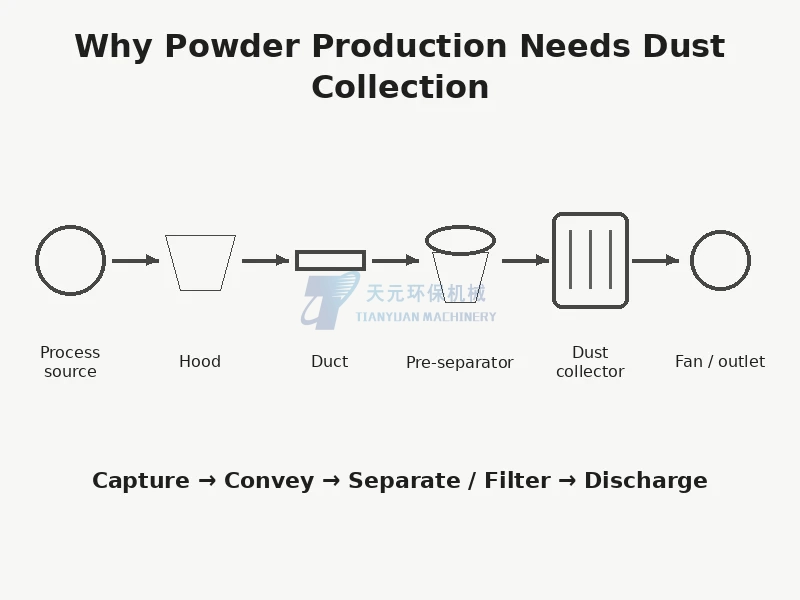
A useful dust collection system starts before the filter. Dust first has to be contained or captured at the process source, then conveyed through suitable ductwork, and finally separated or filtered. The collected solids also need a controlled route out of the separator or hopper. Some powder lines use a cyclone or another pre-separator before a fabric or cartridge collector; other processes may feed the final collector directly.
The U.S. EPA describes fabric filters, also called baghouses, as devices that remove particles from contaminated gas by depositing them on filter material. EPA notes that the accumulated dust cake contributes strongly to capture of small micrometer and sub-micrometer particles and that pressure drop rises as dust accumulates, so periodic cleaning and monitoring are part of normal operation.
The system usually serves several process functions
- Capture dust from mills, classifiers, screens, transfers and discharge points.
- Direct entrained powder to a controlled collection point instead of allowing widespread settling.
- Support a defined negative-pressure or induced-airflow path through the process.
- Reduce loading on downstream filtration when appropriate pre-separation is used.
- Provide operating indicators that can be inspected and maintained rather than relying on room dilution.
Why source capture matters
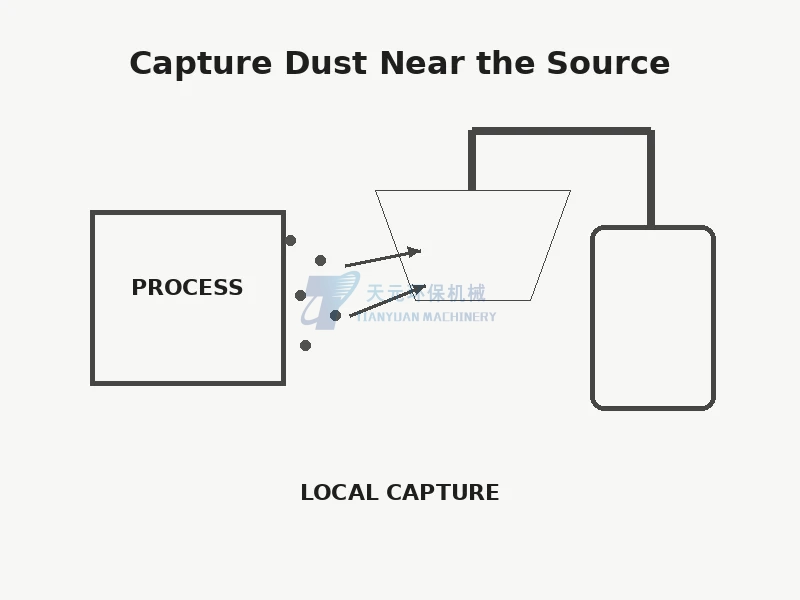
A highly efficient filter cannot compensate for poor capture at the source. Local exhaust or an enclosure is intended to prevent dust from dispersing through the work area before it enters the collection system. OSHA ventilation requirements similarly describe local exhaust as an engineering control used to prevent dust and other contaminants from dispersing in harmful concentrations.
Typical pickup points include mill outlets, classifier discharges, screens, screw-conveyor transfers, bagging stations and product drops. Hood geometry, pickup velocity, duct diameter and system airflow have to work together. Simply installing a collector downstream does not guarantee that dust will enter it.
Typical system components
- Capture hood or enclosure: contains dust at the generation point.
- Ductwork: transports dust-laden air while balancing velocity, pressure loss and wear.
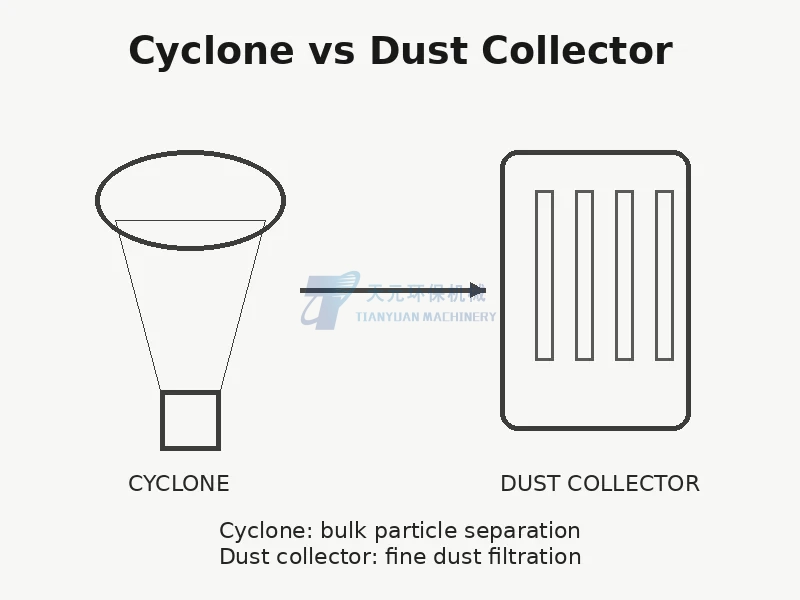
- Pre-separator or cyclone, when appropriate: removes part of the heavier or higher-loading solids before final filtration.
- Fabric, bag or cartridge collector: captures the finer remaining particulate.
- Hopper and discharge device: removes accumulated solids in a controlled way.
- Fan: provides the pressure difference needed to move air through the system.
- Monitoring: may include differential pressure, airflow, temperature and other process-specific indicators.
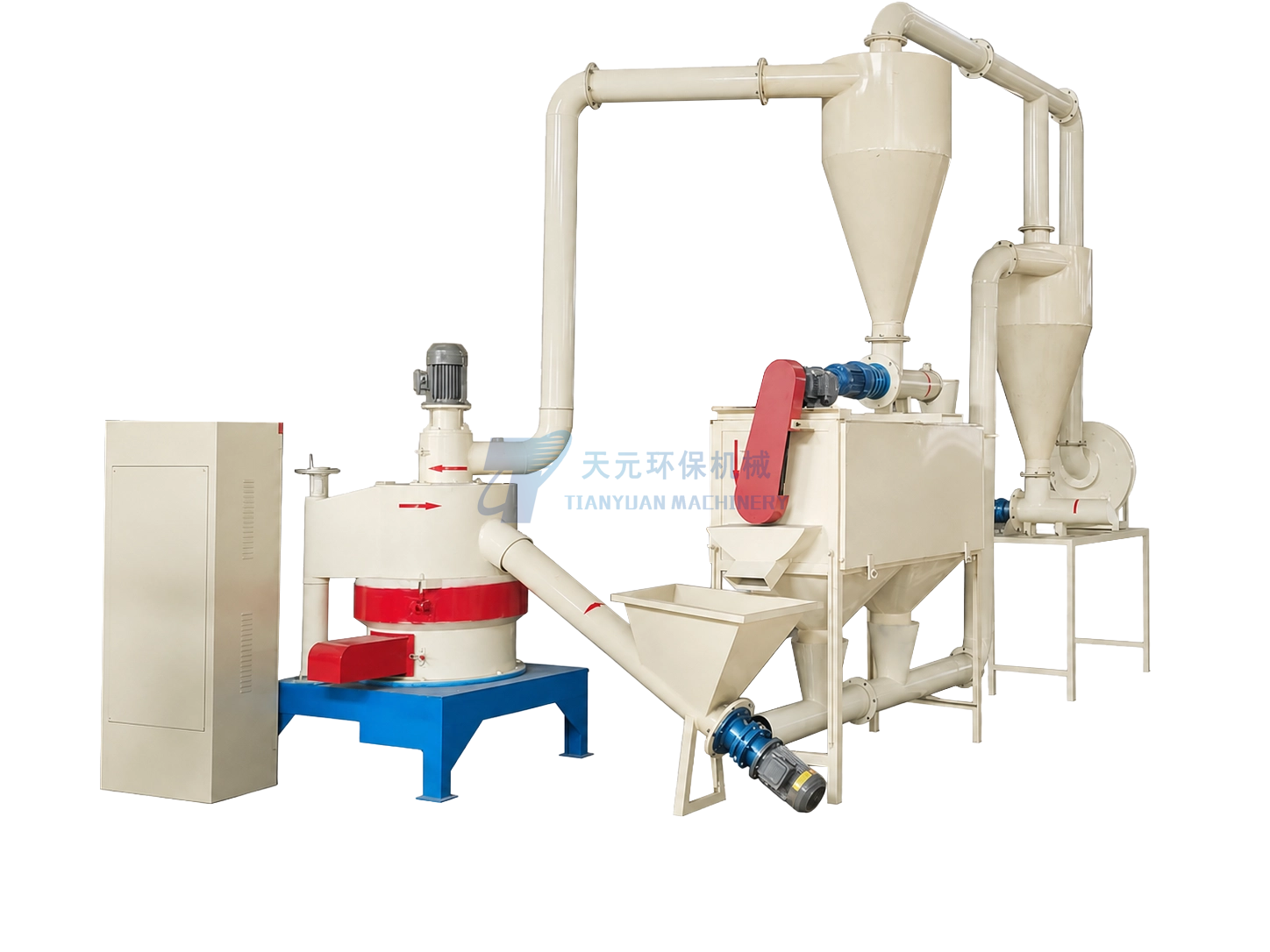
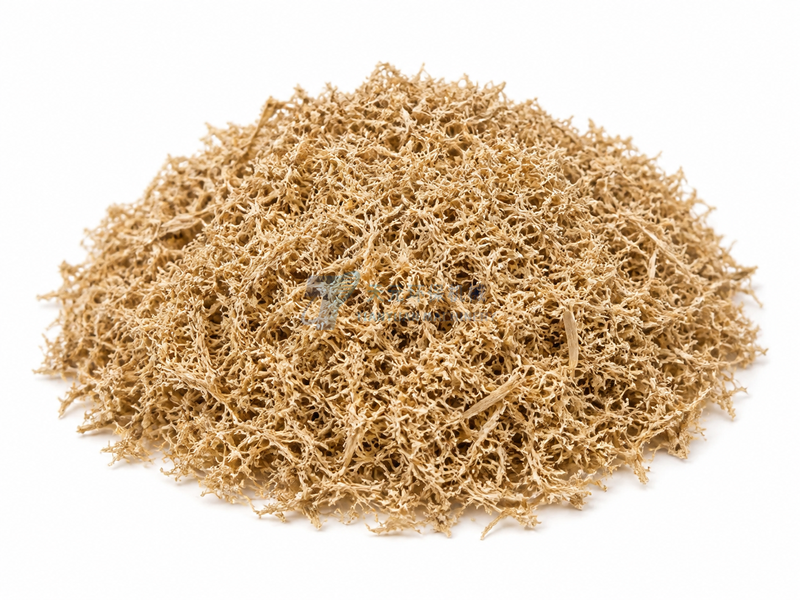
Tianyuan’s current TYMF6R-600 wood-powder page shows cyclone separation and dust collection as different process stages. The TYJSMF500 metal-powder page likewise separates cyclone recovery, screening and dust filtration. These are examples of process roles, not a claim that every project requires the same layout.
Why filter loading and pressure drop matter
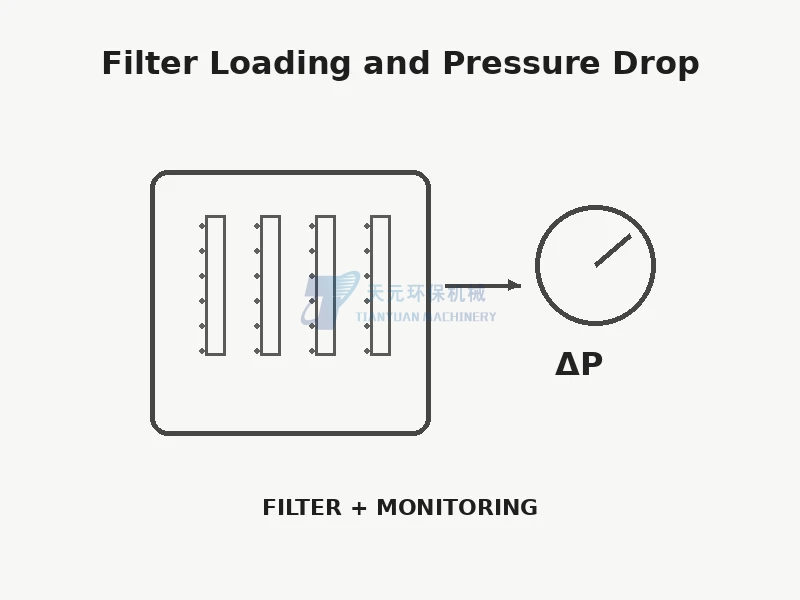
As dust accumulates on filter media, resistance to airflow increases. EPA identifies differential pressure as an important fabric-filter operating indicator and explains that filter media must be cleaned periodically to avoid excessive pressure drop. This is why a collector cannot be selected only from housing size or one nominal airflow number.
Filter area, dust loading, particle properties, cleaning method, temperature and moisture all affect stable operation. When a process carries a high solids loading, a suitable pre-separator can sometimes remove a large part of the easily separated material first. That reduces the load reaching the final filter but does not turn the cyclone into a substitute for the dust collector.
Wood and metal powder need different safety review
Wood dust and some metal dusts can be combustible. OSHA specifically lists wood dust and metal dusts such as aluminum and magnesium among combustible-dust examples and explains that finely divided combustible material suspended in air can become explosible under certain conditions.
For combustible powders, filtration efficiency alone is not a complete safety design. Project review may need to consider dust explosibility, ignition sources, grounding and bonding, static electricity, equipment location, isolation, venting or suppression, housekeeping and safe handling of collected dust. Appropriate measures depend on the real material, jurisdiction and qualified professional assessment.
This is particularly important for Tianyuan projects: both wood-powder and metal-powder lines may require dust collection, but their hazard profiles should not be assumed to be identical. Fine metal powders can also introduce oxidation, heat and ignition concerns that require separate evaluation.
How to select the system
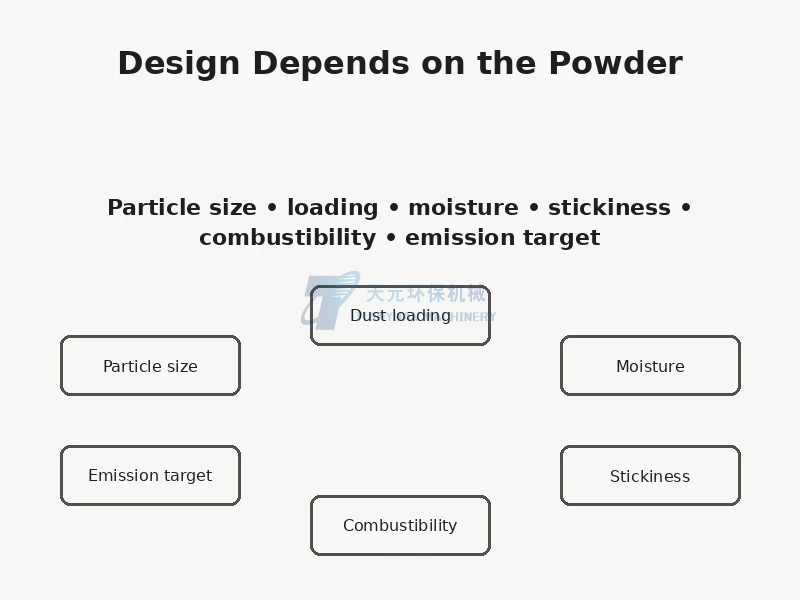
- Material identity and composition: wood, plant fiber, metal or alloy.
- Particle-size distribution and the fraction expected to become airborne.
- Production rate and expected dust loading at each pickup point.
- Required airflow for the mill, classifier, conveying line or enclosure.
- Temperature, moisture and tendency to stick or cake.
- Combustibility, reactivity or other hazardous properties.
- Whether collected dust can re-enter the product stream or must be handled separately.
- Local workplace exposure and emission requirements.
Tianyuan therefore treats dust collection as part of process configuration rather than a fixed accessory copied from one application to another. The final arrangement should be confirmed for the actual material, target fineness, capacity and site conditions.
FAQ
Does every powder line need a cyclone before the dust collector?
No. A cyclone can be useful as a pre-separator when loading and particle characteristics justify it, while some systems can feed a final collector directly.
Can dust collected in the filter automatically be sold as finished product?
No. Collected dust may have a different particle-size distribution or may combine material from several pickup points. It must meet the product specification before it is treated as finished product.
Is a high-efficiency dust collector enough for combustible wood or metal dust?
No. Filtration and combustible-dust protection are different engineering questions. Combustible dust requires a separate hazard assessment and suitable prevention and protection measures.
Why can the dust collection design change when the same mill processes a different material?
Because density, particle size, moisture, stickiness, combustibility and dust loading can change significantly from one feedstock to another.
Conclusion
Powder production needs dust collection because grinding and downstream handling continuously create fine particles that can enter the air stream. A well-designed system captures dust at the source, conveys it, separates or filters it and removes collected solids in a controlled way. The correct design starts with the real powder and operating conditions, and combustible powders require safety assessment beyond ordinary filtration.