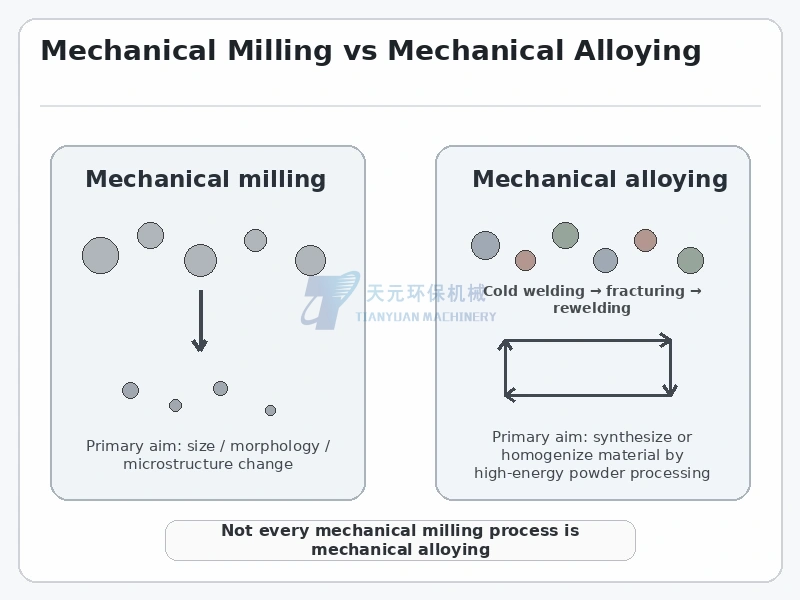
Mechanical milling and mechanical alloying are closely related terms, but they do not describe the same process. Mechanical milling can reduce particle size, alter particle morphology or refine microstructure in a solid powder. Mechanical alloying is a more specific high-energy powder-processing route in which powders repeatedly cold-weld, fracture and reweld so that different components become progressively mixed and alloyed in the solid state.
Key Conclusion
Not every mechanical milling process is mechanical alloying. If the engineering objective is to reduce the size of an existing solid metal feed, the problem is primarily mechanical size reduction. If the objective is to synthesize or homogenize an alloy through repeated cold welding, fracturing and rewelding in a high-energy milling system, the process belongs to mechanical alloying. The equipment, process variables and acceptance criteria are therefore different.
Contents
Why Are Mechanical Milling and Mechanical Alloying Often Confused?
Both processes use mechanical energy to work on solid powders, and both may use the word “milling.” In materials-science literature, however, the terms describe different objectives. Mechanical attrition literature commonly distinguishes mechanical alloying from mechanical milling by the starting material and intended transformation: mechanical alloying starts from a mixture of powder components and aims to create a more homogeneous alloyed material, while mechanical milling can start from a chemically uniform or prealloyed powder and primarily modify its particle size, morphology, defect structure or grain structure.
This distinction is important for industrial equipment selection. A machine that reduces metal chips or granules into a finer powder is performing mechanical comminution, but it should not automatically be described as a mechanical-alloying system.
What Does Mechanical Milling Do?
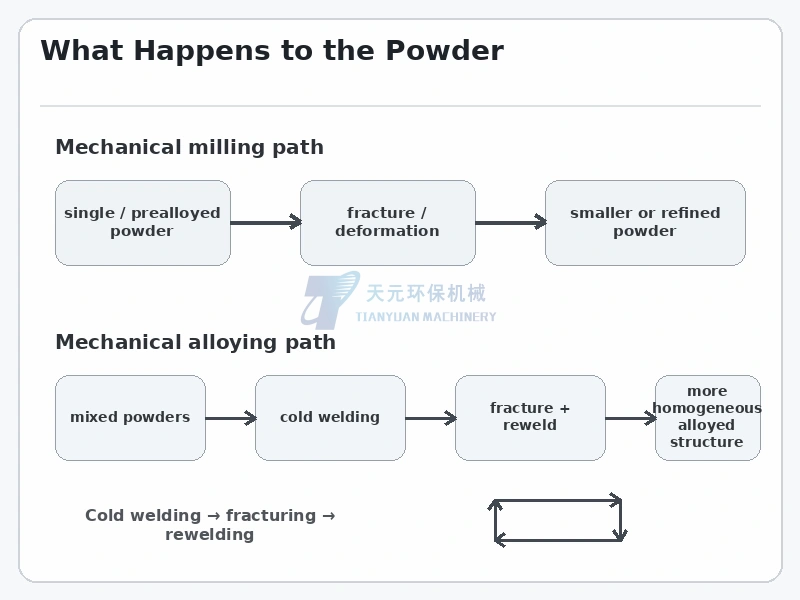
Mechanical milling applies impact, shear, compression, attrition or combinations of these forces to a solid material. In industrial powder processing, the main target may simply be to reduce the size of granules, chips, flakes or preprocessed particles. Depending on the metal and equipment, particles may fracture, flatten, smear, work-harden or become more irregular before the target fraction is obtained.
High-energy mechanical milling can also change microstructure. Repeated deformation can introduce defects, refine grains and, under sufficiently energetic conditions, create nonequilibrium structures. That does not automatically make the process mechanical alloying. The defining question is whether the process is intended to alloy or homogenize different powder components in the solid state.
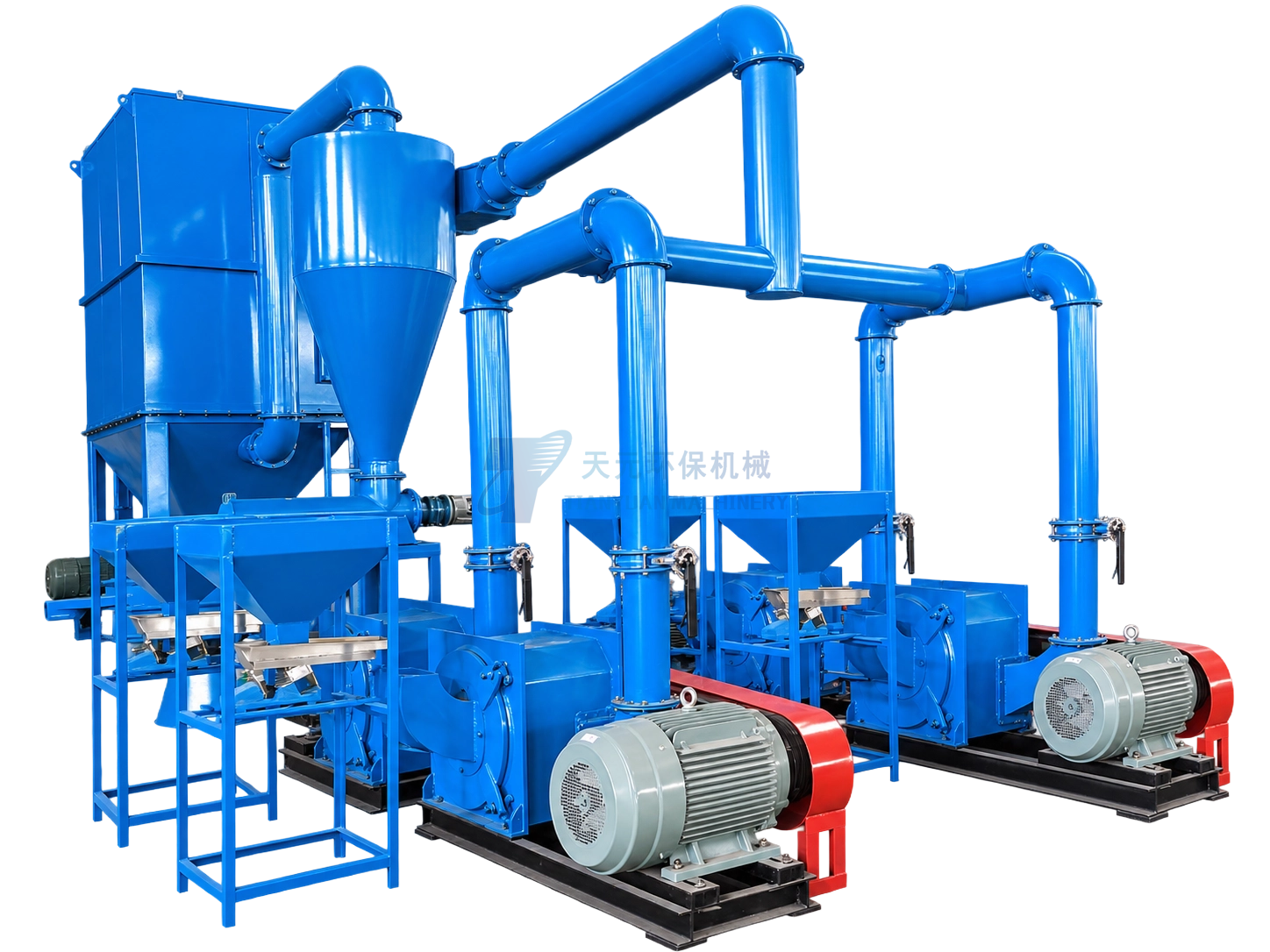
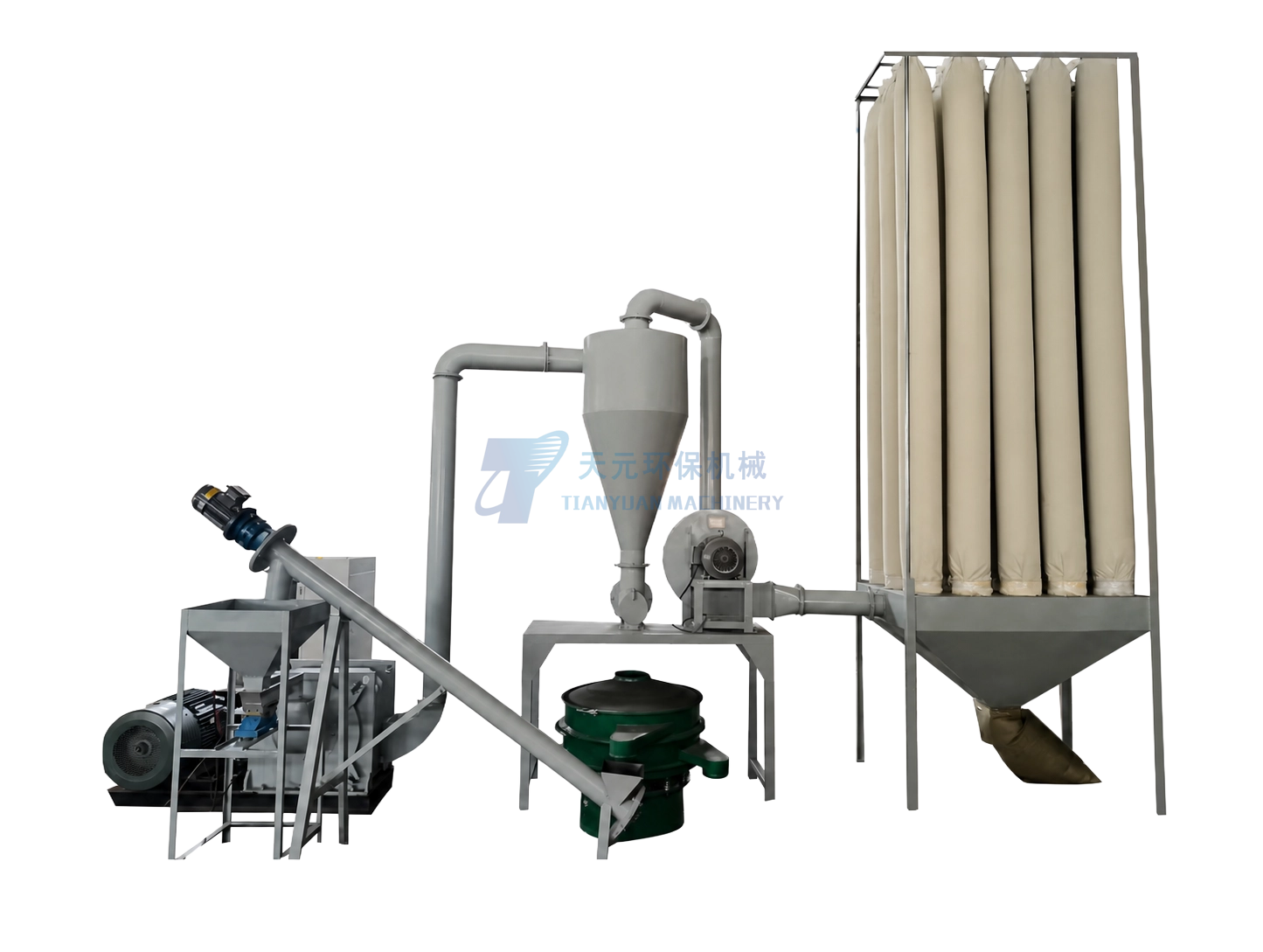
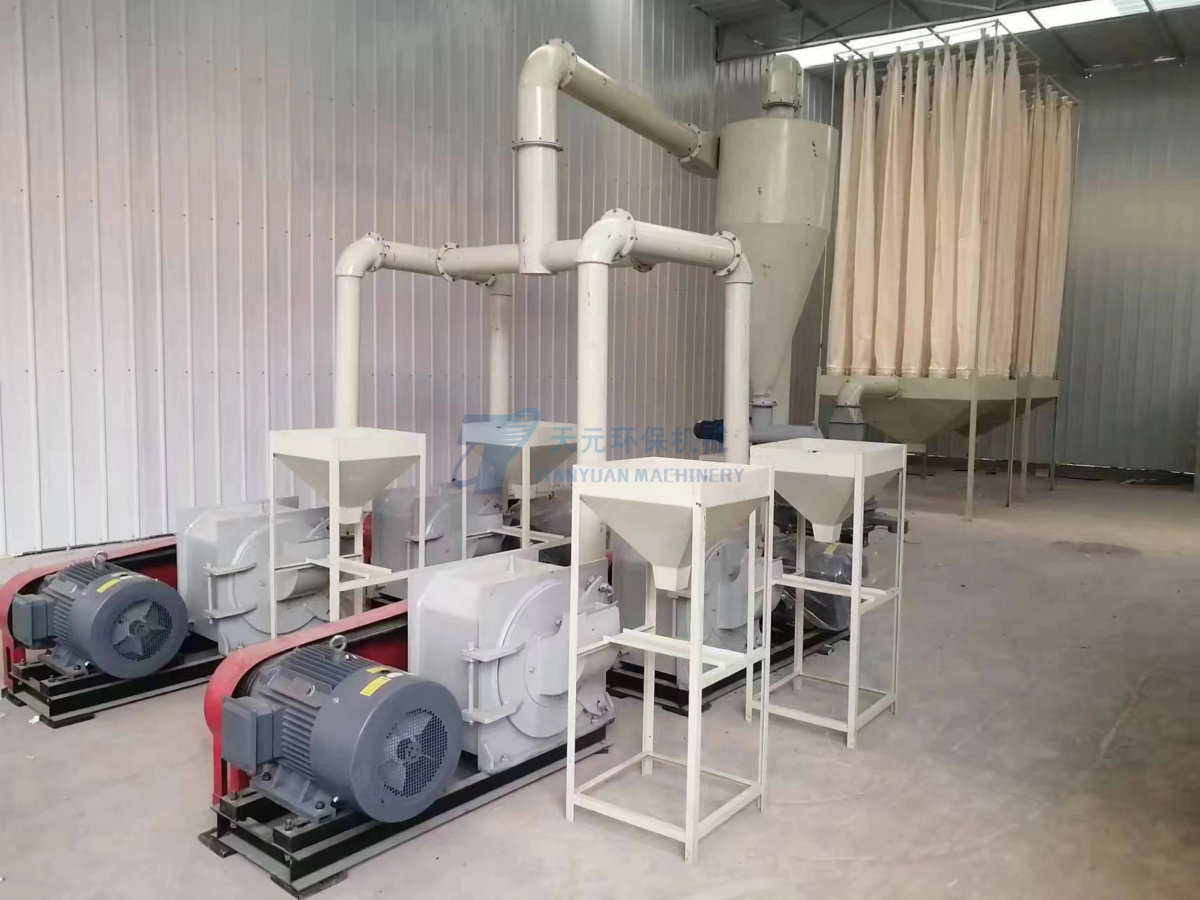
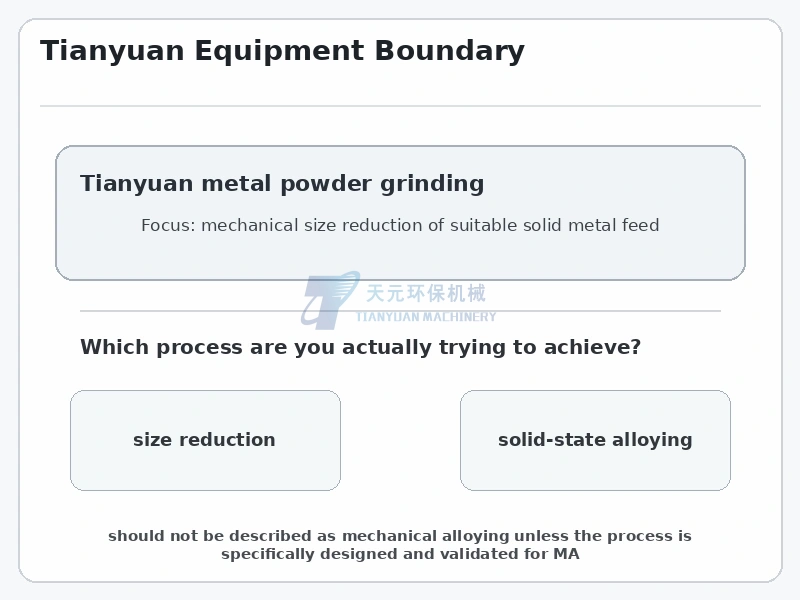
For Tianyuan’s metal-powder applications, the practical focus is mechanical size reduction of suitable solid feedstock. The TYJSMF500 Metal Powder Grinding Mill mechanically processes suitable metal granules, chips and flakes and uses screening and recirculation to control the finished fraction. This should be described as mechanical powder processing, not as mechanical alloying.
What Does Mechanical Alloying Do?
Mechanical alloying is a solid-state, high-energy powder-processing technique. Classic and modern reviews describe its central mechanism as repeated cold welding, fracturing and rewelding of powder particles in a high-energy mill. The process is often carried out in ball mills, planetary mills, attritors or other systems designed to deliver repeated high-energy collisions to a powder charge.
At the beginning, different powder components may still exist as distinct particles. During milling, ductile particles flatten and weld together, creating composite particles. Further collisions fracture these particles and expose new interfaces. Repeated welding and fracturing gradually refine the internal lamellae and promote short diffusion distances and chemical homogenization.
Mechanical alloying has been used to produce oxide-dispersion-strengthened alloys, supersaturated solid solutions, metastable phases, nanocrystalline materials, amorphous alloys, intermetallics and other advanced powder systems. The target is therefore not merely “smaller powder.” It is a controlled material transformation.
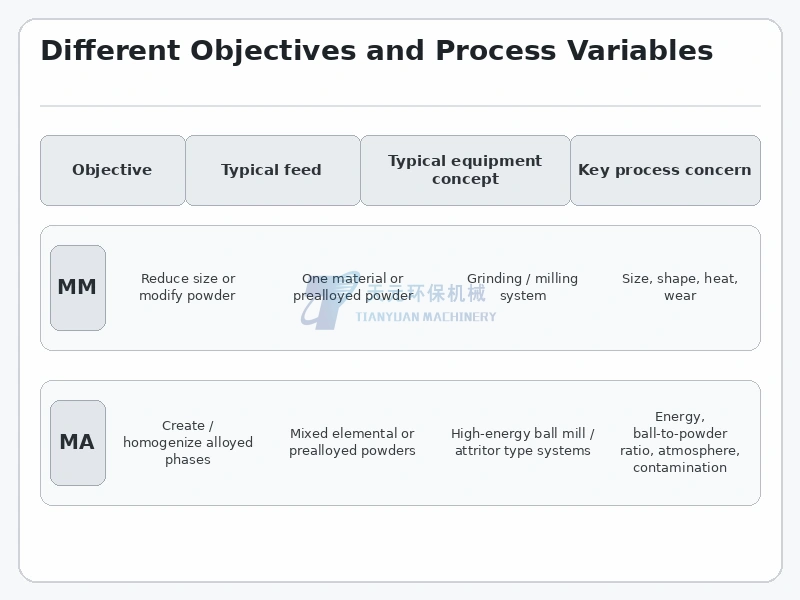
Mechanical Milling vs Mechanical Alloying: Key Differences
| Factor | Mechanical milling | Mechanical alloying |
|---|---|---|
| Primary objective | Reduce size, change morphology or refine structure | Synthesize or homogenize alloyed/composite material in the solid state |
| Typical starting feed | One material, chips, granules, flakes or prealloyed powder | Mixtures of elemental powders, prealloyed powders and/or second phases |
| Dominant mechanism | Fracture, deformation, attrition, shear | Repeated cold welding, fracture, rewelding and mixing |
| Typical equipment | Many types of grinding and milling equipment | High-energy ball mill, planetary mill, attritor, SPEX-type system |
| Key operating variables | Feed form, particle size, heat, wear, residence time, screen/classification | Milling energy, speed, time, ball-to-powder ratio, media size, atmosphere, process control agent |
| Typical acceptance data | Particle-size distribution, morphology, purity, yield, throughput | Phase composition, chemical homogeneity, microstructure, contamination and alloying state |
Why Mechanical Alloying Is Not Simply “Grinding Two Powders Finer”
Putting two powders in the same machine and reducing their average particle size does not by itself prove that mechanical alloying has occurred. A true MA process must create the intended level of intimate mixing, solid-state alloying or phase evolution. Depending on the project, confirmation may require X-ray diffraction, microscopy, elemental mapping, phase analysis or other materials-characterization methods.
This is why the acceptance criterion for mechanical alloying cannot be limited to mesh or micron size. Particle size may change during MA, but the process is judged primarily by what happened to the material itself.
Which Process Variables Matter Most in Mechanical Alloying?
Mechanical-alloying results are sensitive to a larger set of interacting variables than ordinary size reduction. Important variables include the mill type, milling speed or intensity, ball-to-powder mass ratio, grinding-media size and material, powder loading, process-control agent, milling time, atmosphere and temperature.
Changing one parameter can alter the balance between cold welding and fracture. Excessive welding can cause agglomeration and material sticking to the vial or media. Excessive fracture can prevent sufficient intimate mixing. Process-control agents are often used for ductile systems to limit uncontrolled cold welding, but they can also introduce carbon, oxygen or other contaminants depending on chemistry and later heat treatment.
Why Are Contamination and Atmosphere Especially Important in MA?
High-energy mechanical alloying can involve many hours of repeated collisions between the powder, grinding media and container. Wear from steel, tungsten carbide, zirconia or other contact materials may enter the powder. Modern reviews identify contamination as one of the persistent engineering challenges of mechanical alloying.
Atmosphere can be equally important. Reactive powders may oxidize, nitridize or react with moisture if the process is not controlled. Many MA systems therefore use sealed vessels and inert gas or vacuum conditions appropriate to the material. The correct atmosphere must be selected from the chemistry of the powder and the desired final phase, not from a generic recipe.
Tianyuan Process Boundary: Mechanical Powder Grinding Is Not Mechanical Alloying
Tianyuan should not present a conventional metal powder grinding project as mechanical alloying unless the system is specifically engineered and validated for that purpose. The current TYJSMF500 process is intended to mechanically reduce suitable solid metal feed and control the finished powder through screening, conveying and collection.
If a customer needs high-energy ball milling to synthesize a new alloy, create a supersaturated solid solution, form an amorphous phase or demonstrate composition homogenization by XRD/SEM/EDS, that is a different materials-processing project. It should not be treated as an ordinary metal-powder grinding request.
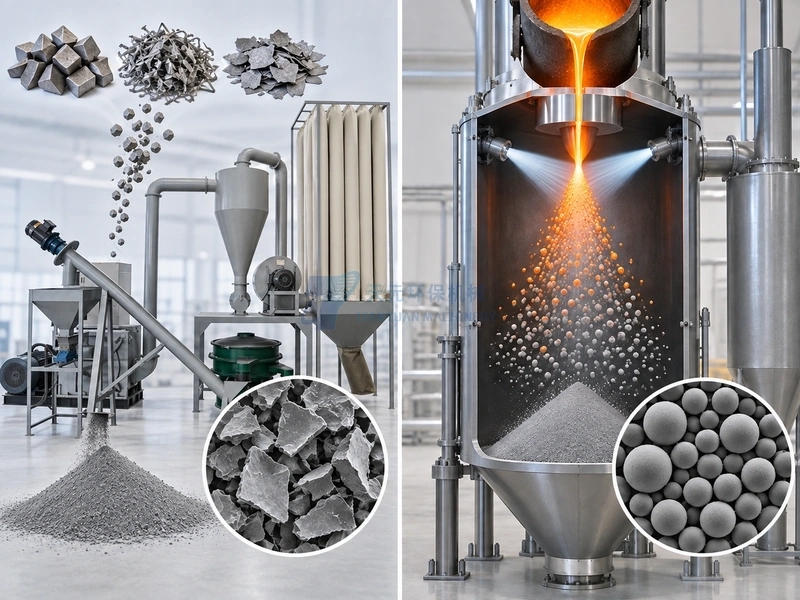
For context on other powder-production routes, see Mechanical Milling vs Atomization and the Metal Powder Applications section.
How Do You Decide Which Process You Actually Need?
- If the feed is already a defined metal or alloy and the target is smaller particles, evaluate mechanical grinding/milling.
- If the feed is a mixture of powders and the target is a new alloyed, composite or metastable structure, evaluate mechanical alloying.
- If the customer only specifies mesh or micron size, the request is not yet sufficient to define an MA process.
- If the customer specifies phase formation, composition homogeneity or nanostructure, materials characterization becomes part of process acceptance.
- If combustible or reactive metal powder is involved, project-specific dust, atmosphere, ignition and fire/explosion safety review is required.
FAQ
Is all mechanical milling high-energy ball milling?
No. The term is used differently across industries. In materials research it often refers to high-energy powder milling, while industrial powder processing can use the term more broadly for mechanical size reduction. The actual equipment and objective must be identified.
Does mechanical alloying always start with pure elemental powders?
No. It can start from elemental powders, prealloyed powders and second-phase materials. The defining feature is the intended solid-state alloying or homogenization produced by repeated high-energy powder interactions.
If copper and zinc powders are milled together, is that automatically mechanical alloying?
No. Simple mixing or particle-size reduction is not enough. The process must create and verify the required alloyed or homogenized structure under appropriate high-energy milling conditions.
Why are ball mills commonly used for mechanical alloying?
Grinding balls repeatedly trap and deform powder between colliding media and the vessel wall, which supports the cold-welding and fracture cycles central to mechanical alloying.
Is Tianyuan’s TYJSMF500 a mechanical-alloying machine?
It should be described as a mechanical metal-powder grinding and size-reduction system. It should not be marketed as mechanical-alloying equipment without a dedicated MA design and process validation.
Technical References
- Suryanarayana, C. Mechanical alloying: a critical review. Materials Research Letters, 2022.
- Suryanarayana, C. & deBarbadillo, J. Sixty Years of Mechanical Alloying—Past Achievements, Current Challenges, and Future Prospects. Advanced Engineering Materials.
- Suryanarayana, C. Mechanical Alloying: A Novel Technique to Synthesize Advanced Materials. Research, 2019.
- Mechanical milling/alloying of intermetallics. Intermetallics, 1996.
Conclusion
The most important difference between mechanical milling and mechanical alloying is the engineering objective. Mechanical milling can reduce the size of an existing material or modify its morphology and microstructure. Mechanical alloying is a high-energy solid-state synthesis route that repeatedly cold-welds, fractures and rewelds powders to create an alloyed or composite structure.
For Tianyuan’s metal-powder business, mechanical grinding should remain clearly separated from mechanical alloying. A customer who needs particle-size reduction of suitable solid metal feed is asking for a powder-processing solution. A customer who needs a new alloy phase or verified composition homogenization is asking for a materials-synthesis process with different equipment, controls and characterization requirements.