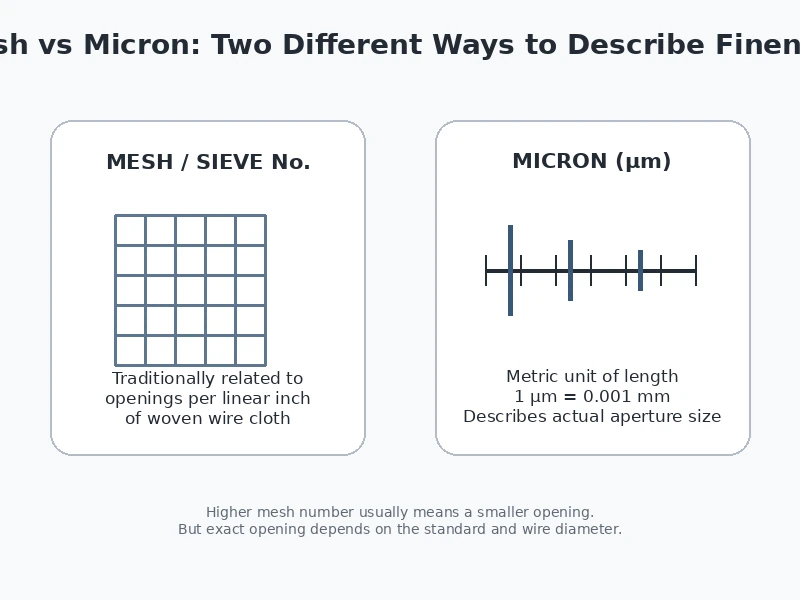
Mesh and micron are both widely used when discussing powder fineness, screening, filtration, and particle size, but they do not measure exactly the same thing. Mesh is traditionally associated with the number of openings in one linear inch of woven wire cloth, while a micron, or micrometre (µm), is an actual metric unit of length. This is why a mesh number can be converted to an approximate sieve opening only when the sieve standard and wire construction are known.
Key Conclusion
Mesh and micron should not be treated as two perfectly interchangeable units. Micron directly expresses a length: 1 µm equals 0.001 mm. Mesh is a sieve or screen designation whose actual clear opening depends on the mesh count, wire diameter, weave, and the standard being followed. Under ASTM E11, for example, No. 80 has a nominal opening of 180 µm, No. 100 is 150 µm, No. 200 is 75 µm, and No. 325 is 45 µm. For equipment selection and powder specifications, it is therefore better to state both the sieve standard and the opening in microns rather than relying on the mesh number alone.
Contents
What Does Mesh Mean?
Mesh is a traditional way of describing woven screen or sieve cloth. In its basic sense, mesh count refers to the number of openings across one linear inch of the screen. A higher mesh number normally indicates more openings per inch and therefore a smaller opening between adjacent wires.
This explains the general direction of the scale: 20 mesh is relatively coarse, 80 mesh is finer, 200 mesh is much finer, and 325 mesh is finer again. However, the mesh number itself does not state the exact width of the clear opening. The wires occupy part of the one-inch distance, so wire diameter must also be considered.
For a simplified woven screen, the pitch between neighboring wires can be estimated as 25.4 mm divided by the mesh count. The clear opening is then approximately the pitch minus the wire diameter. This is why simply calculating 25,400 divided by the mesh number does not give the actual opening in microns. That calculation gives the pitch before the wire thickness has been subtracted.
Standardized test sieves solve this problem by defining nominal openings and tolerances. ASTM E11 and ISO 3310-1 are two important standards used for laboratory and industrial test sieves. When a sieve is specified under one of these standards, the nominal aperture should be read from the relevant standard rather than estimated from a simplified formula.
What Is a Micron?
A micron is the commonly used name for a micrometre, written as µm. It is a metric unit of length. One micrometre equals one-millionth of a metre, or 0.001 millimetres. Unlike mesh, micron is a direct dimensional measurement.
When a sieve is described as having a 75 µm opening, the nominal width of the opening is being expressed directly. When a powder specification says a particle is 75 µm, it is describing a particle dimension measured or inferred by a particular analytical method. Those two uses are related, but they should not automatically be assumed to mean exactly the same thing.
A particle can have an irregular shape, and its ability to pass through a sieve depends on orientation as well as dimensions. A long, thin particle may pass through an opening in one orientation even though one of its dimensions is larger than the nominal aperture. This is particularly relevant for fibrous wood powders, flakes, and irregular mechanically produced metal powders.
How Mesh and Micron Are Related
The relationship is inverse: as the mesh number increases, the nominal opening generally decreases. This is why higher mesh numbers are associated with finer screening. The relationship is not linear, however, and should not be represented by a universal equation that ignores wire diameter and sieve standard.
For example, a theoretical pitch for 100 openings per inch is 254 µm. But an ASTM E11 No. 100 test sieve has a nominal clear opening of 150 µm because part of that pitch is occupied by the wire. Similarly, a theoretical 200-opening pitch is 127 µm, while the ASTM E11 nominal opening for No. 200 is 75 µm.
This difference is the reason many online “mesh conversion formulas” produce misleading results. A quick formula may be useful for understanding the direction of the relationship, but it should not be used to write a purchase specification, select a laboratory sieve, or guarantee a powder particle size.
Common Mesh-to-Micron Reference Table
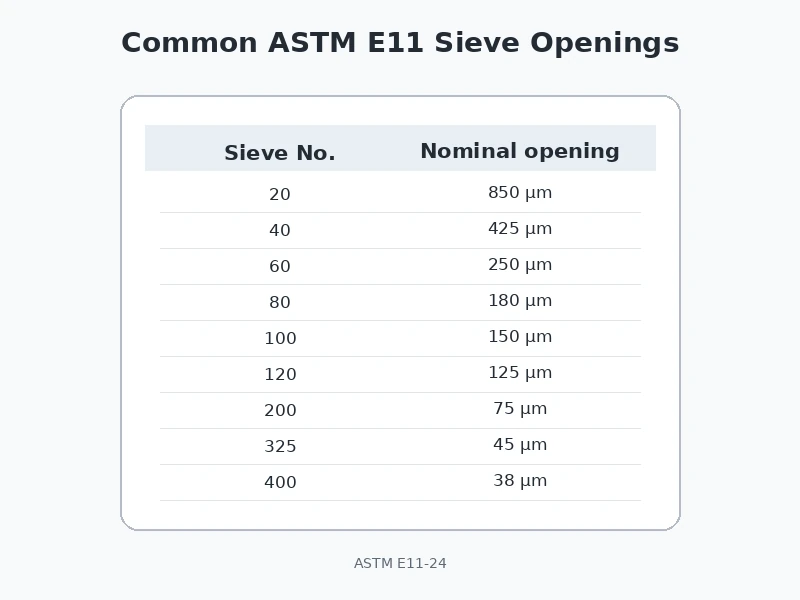
The following values are useful reference points from the ASTM E11 sieve series. They should be read as nominal sieve openings under that standard, not as a universal conversion for every woven screen sold with the same mesh count.
| Sieve No. | Nominal opening | Millimetres |
|---|---|---|
| 20 | 850 µm | 0.850 mm |
| 25 | 710 µm | 0.710 mm |
| 30 | 600 µm | 0.600 mm |
| 40 | 425 µm | 0.425 mm |
| 50 | 300 µm | 0.300 mm |
| 60 | 250 µm | 0.250 mm |
| 70 | 212 µm | 0.212 mm |
| 80 | 180 µm | 0.180 mm |
| 100 | 150 µm | 0.150 mm |
| 120 | 125 µm | 0.125 mm |
| 140 | 106 µm | 0.106 mm |
| 170 | 90 µm | 0.090 mm |
| 200 | 75 µm | 0.075 mm |
| 230 | 63 µm | 0.063 mm |
| 270 | 53 µm | 0.053 mm |
| 325 | 45 µm | 0.045 mm |
| 400 | 38 µm | 0.038 mm |
Different historical sieve series may use slightly different values or designations. This is one reason a specification such as “200 mesh powder” is less clear than “passes an ASTM E11 No. 200 sieve, nominal aperture 75 µm.” The second description identifies both the standard and the nominal opening.
Why Mesh-to-Micron Conversion Is Not an Exact Universal Formula
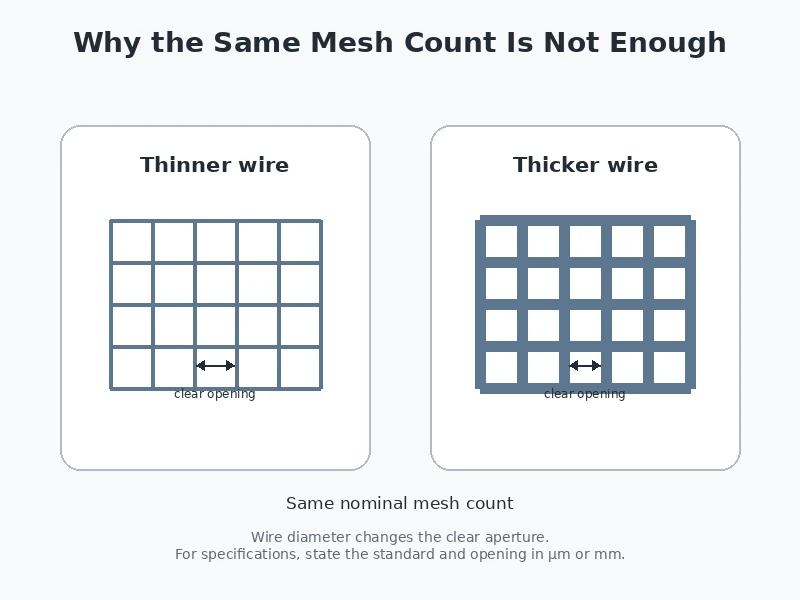
The most important reason is wire diameter. Imagine two screens with the same number of openings per inch. If one uses thinner wire, more of each pitch remains open. If the other uses thicker wire, the clear space between wires is smaller. The mesh count may therefore be the same while the aperture is different.
Weave construction also matters. Plain square woven wire is not the only form of industrial screen. Other woven constructions and filtration cloths can be specified by different parameters. For precision particle classification, the relevant standard, nominal aperture, material, wire diameter, tolerance class, and test method should be considered.
There is another source of confusion: some tables are based on ASTM U.S. sieve designations, others on Tyler series, legacy industrial mesh tables, filtration screens, or manufacturer-specific wire combinations. Their values can be close without being identical. Therefore a difference of a few microns between two published charts does not necessarily mean one of them is simply wrong; they may be referring to different sieve systems.
Mesh Is Not the Same as Particle-Size Distribution
A sieve tells us whether a particle passes through or is retained by a particular opening under specified test conditions. A real powder, however, contains a distribution of particle sizes. Saying a product is “100 mesh” does not tell us whether nearly all of it is close to 150 µm or whether most particles are much smaller and only a small coarse fraction approaches the sieve opening.
This distinction matters when comparing grinding performance. Suppose two grinding systems both produce material that passes a No. 100 sieve. One product may contain a large fraction between 100 and 150 µm. Another may have most particles below 50 µm. Both could potentially be described in commercial language as “100 mesh,” yet their handling, surface area, bulk density, dust behavior, downstream processing, and energy required for production can be very different.
For more complete characterization, projects may use sieve fractions or instrumental particle-size distribution data such as D10, D50, and D90. D50, for example, represents the particle size at which 50% of the measured distribution is below that value according to the specified measurement basis. These values are not direct substitutes for sieve mesh, but they provide much more information about the complete powder distribution.
What Do +Mesh and -Mesh Mean?
In sieve terminology, a minus sign commonly means material passes through the stated sieve, while a plus sign commonly means it is retained on that sieve. Therefore, “-200 mesh” is commonly interpreted as material passing the No. 200 sieve. If ASTM E11 No. 200 is intended, the nominal aperture is 75 µm.
A range may use two sieve designations. For example, material described as -100 +200 is generally the fraction that passes the coarser No. 100 sieve but is retained on the finer No. 200 sieve. Under ASTM E11 nominal openings, that would correspond to a sieve fraction between 150 µm and 75 µm.
However, the standard and test method still need to be stated. Without them, plus and minus notation can be misunderstood, especially when buyers and suppliers in different countries use different sieve series or local conventions.
How to Specify Powder Fineness for Grinding Equipment
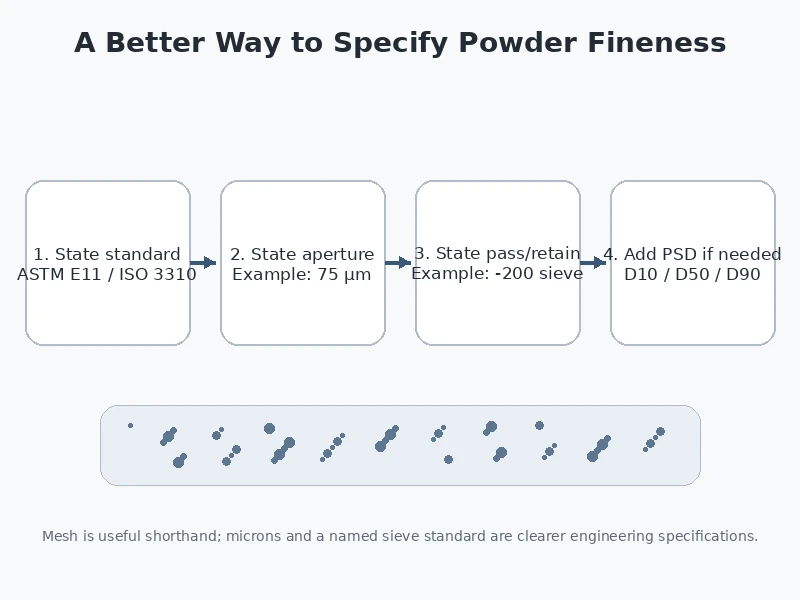
When requesting a metal powder grinding system or a wood powder mill, providing only “80 mesh,” “100 mesh,” or “200 mesh” is often insufficient. A better technical request should state what the number means and what proportion of the finished powder must meet it.
A practical specification could say: “At least the required product fraction should pass an ASTM E11 No. 100 sieve with a nominal 150 µm opening,” or define several sieve fractions. If instrumental particle-size data are important, the customer can additionally provide target D50 or D90 values and the measurement method.
The raw material must also be considered. Metal powders produced by mechanical grinding can be irregular, angular, flattened, or otherwise non-spherical depending on the material and process. Wood powder is fibrous and can have elongated particles. Therefore, sieve passage should not automatically be interpreted as an equivalent spherical particle diameter.
Capacity also depends on the requested fineness. The amount of feed processed by a grinder is not necessarily equal to the amount of finished product meeting a specific fine-powder specification. As the target becomes finer, classification efficiency, recirculation, heat generation, wear, dust collection, and the percentage of acceptable product can become increasingly important.
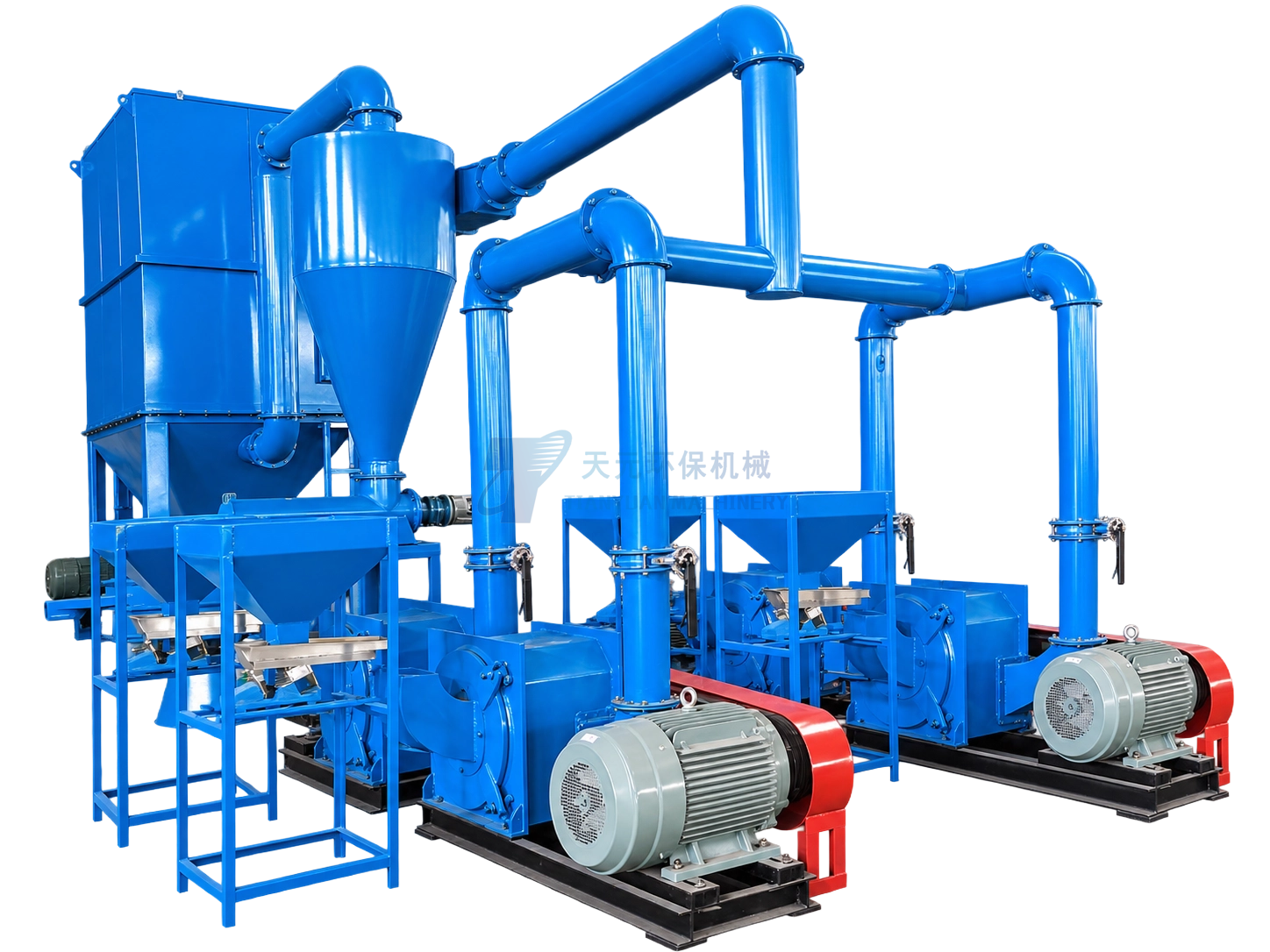
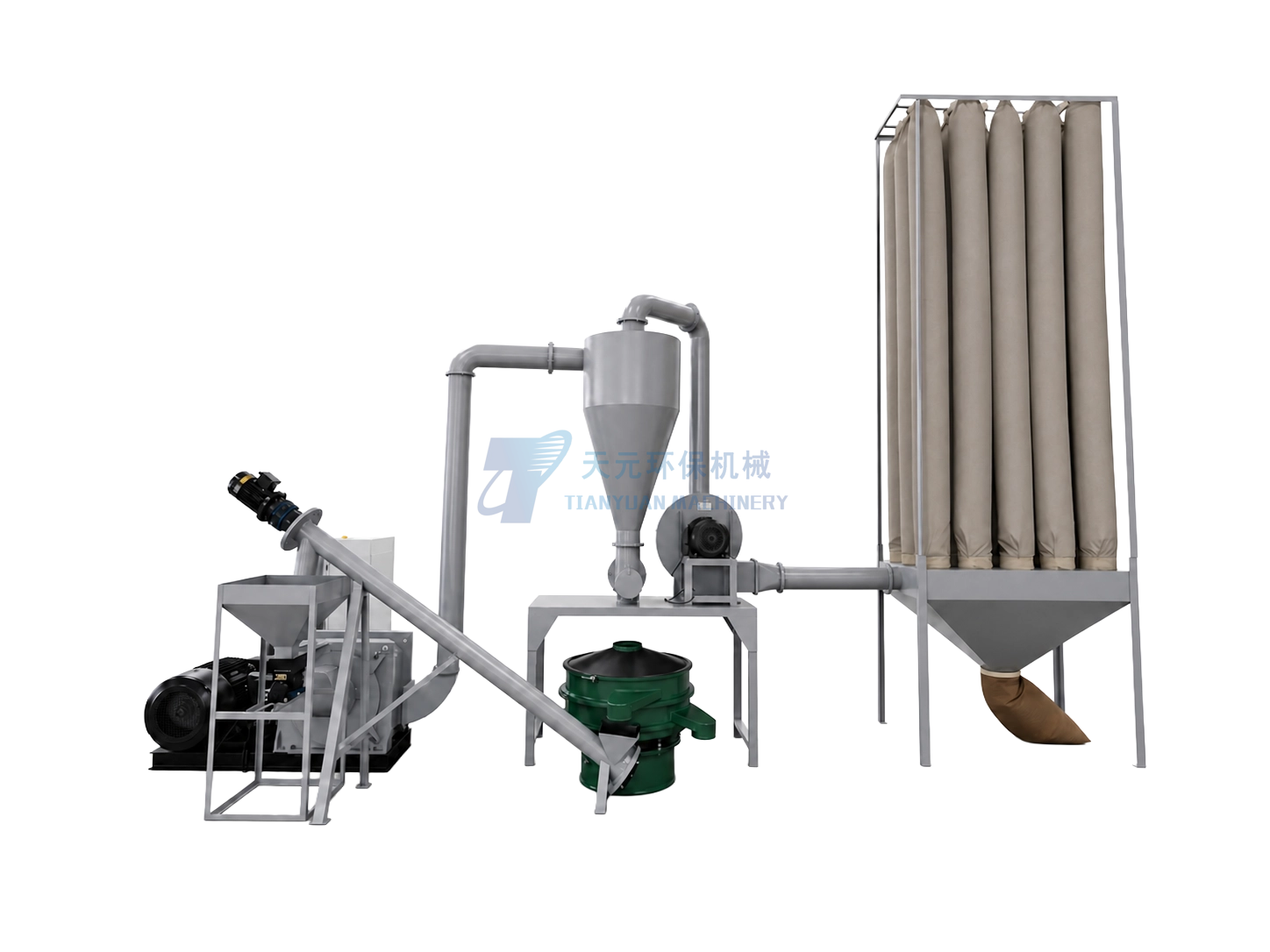
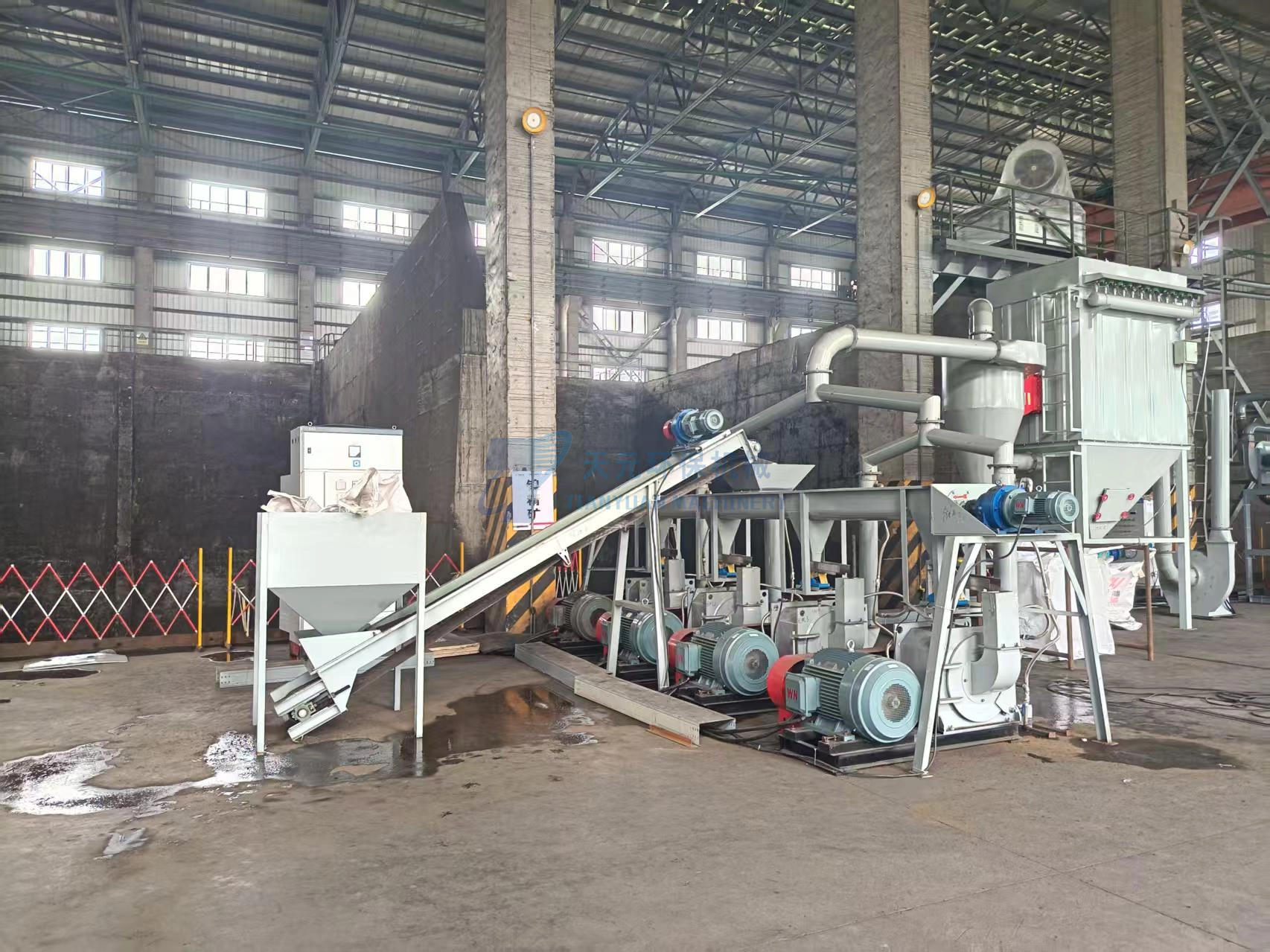
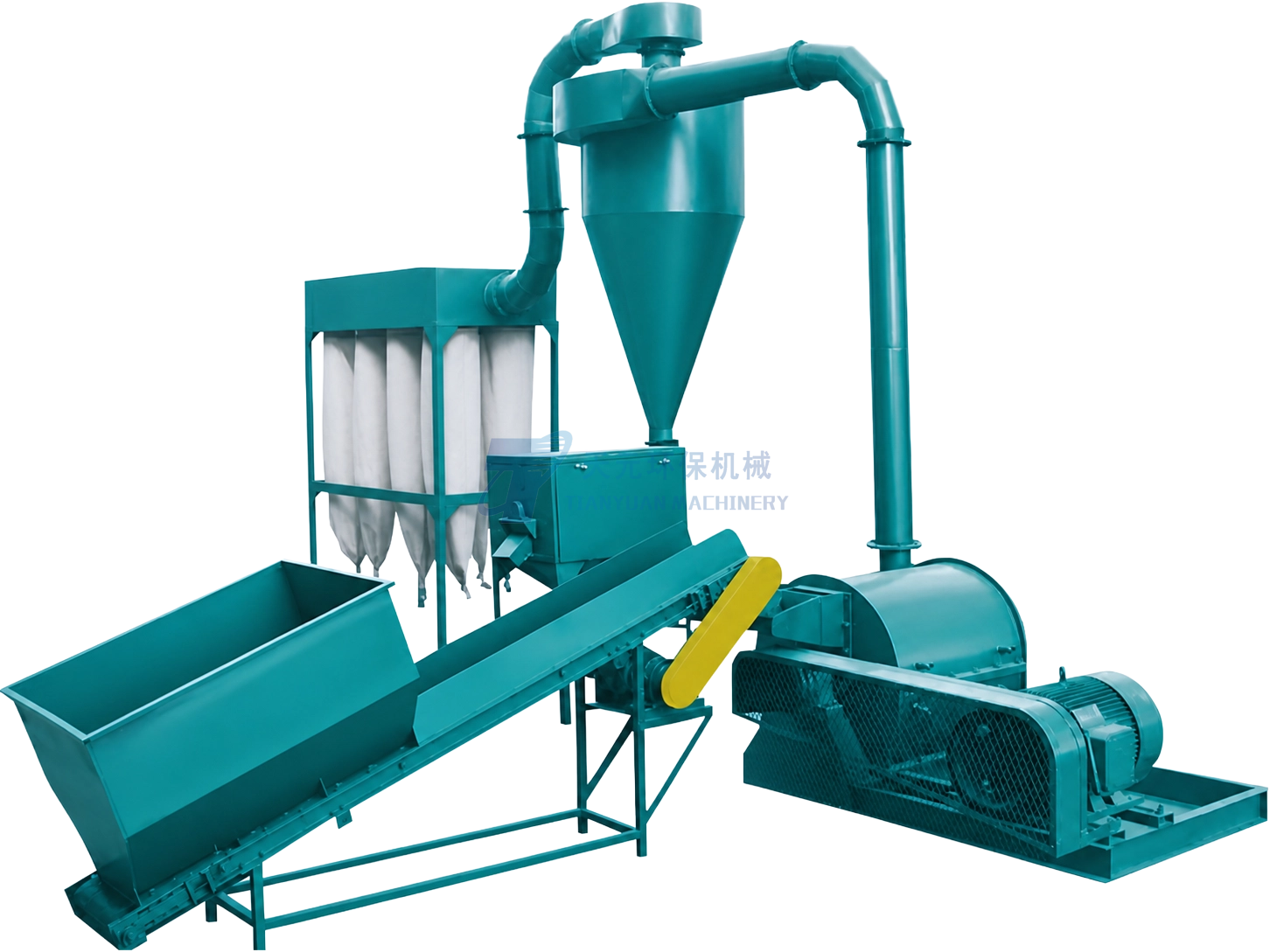
For this reason, Tianyuan evaluates grinding projects from the combination of raw material, feed size and form, moisture or contamination condition, target particle-size specification, required qualified-product capacity, classification method, and downstream use. A single mesh number can be a useful first description, but it should not be treated as a complete process specification.
Frequently Asked Questions
How many microns is 80 mesh?
Under ASTM E11, No. 80 has a nominal opening of 180 µm. Other mesh tables may show slightly different values if they are based on another sieve series, so the standard should always be identified.
How many microns is 100 mesh?
ASTM E11 No. 100 has a nominal opening of 150 µm.
How many microns is 200 mesh?
ASTM E11 No. 200 has a nominal opening of 75 µm. Some older or alternative sieve tables may list a value around 74 µm, which is why the reference standard matters.
How many microns is 325 mesh?
ASTM E11 No. 325 has a nominal opening of 45 µm.
Does a higher mesh number mean a finer powder?
Generally yes when referring to the same sieve series. A higher sieve number normally has a smaller nominal opening. However, the mesh number does not describe the entire particle-size distribution of the powder.
Can I convert mesh to micron with one formula?
Not accurately for engineering specifications. A simple formula can estimate pitch, but actual aperture also depends on wire diameter and the sieve standard. Use a recognized sieve table instead.
Which is better for specifying powder size: mesh or micron?
For clear technical communication, micron or millimetre aperture together with the sieve standard is usually better. For a complete powder specification, particle-size distribution or defined sieve fractions may also be required.
Conclusion
Mesh and micron describe related aspects of particle classification, but they are not the same unit. Mesh is associated with sieve construction and sieve designation; micron directly measures length. The actual opening represented by a mesh number depends on the sieve standard and wire geometry.
For powder processing projects, the safest approach is to specify the recognized sieve standard, nominal aperture in µm or mm, passing or retained requirement, and—when necessary—the complete particle-size distribution. This provides much clearer information for grinding, classification, quality control, equipment selection, and communication between suppliers and customers.