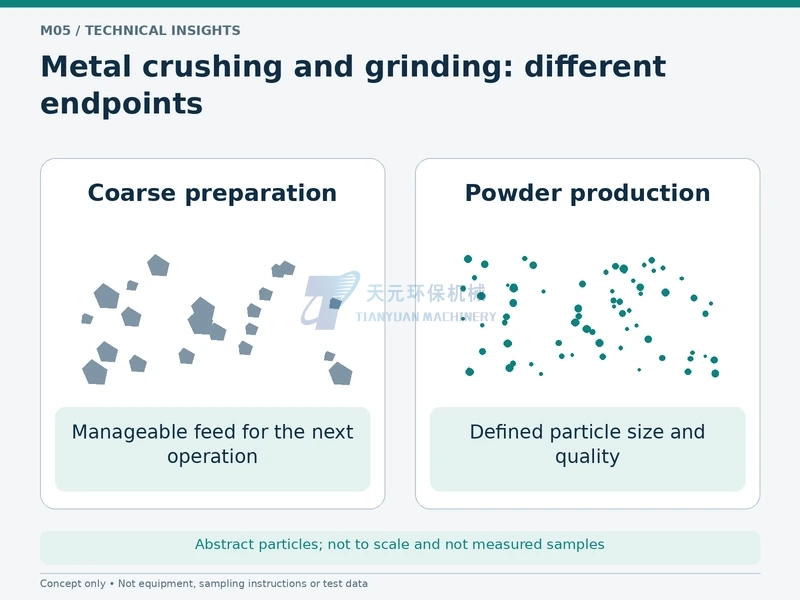
Making metal scraps, turnings or flakes smaller does not necessarily turn them into a usable powder. Equipment names overlap between suppliers and languages, so compare the feed condition, intended duty and accepted output rather than relying on the word “crusher” or “mill.”
Key answer: Metal crushing generally prepares coarse material or changes its form for handling and downstream processing. Metal powder grinding pursues a specified powder size distribution and relevant quality criteria, often with screening or classification. The two duties can be combined in a staged route, but there is no universal size boundary separating them for every metal and machine.
Contents
Compare the endpoint, not only the equipment name
Fragments, short turnings or granules from a coarse reduction stage may be ready for handling or a subsequent process. They are not automatically a powder meeting a customer specification. Powder production needs an agreed fineness or size distribution and, where relevant, checks on purity, contamination, morphology, moisture or oxidation condition.
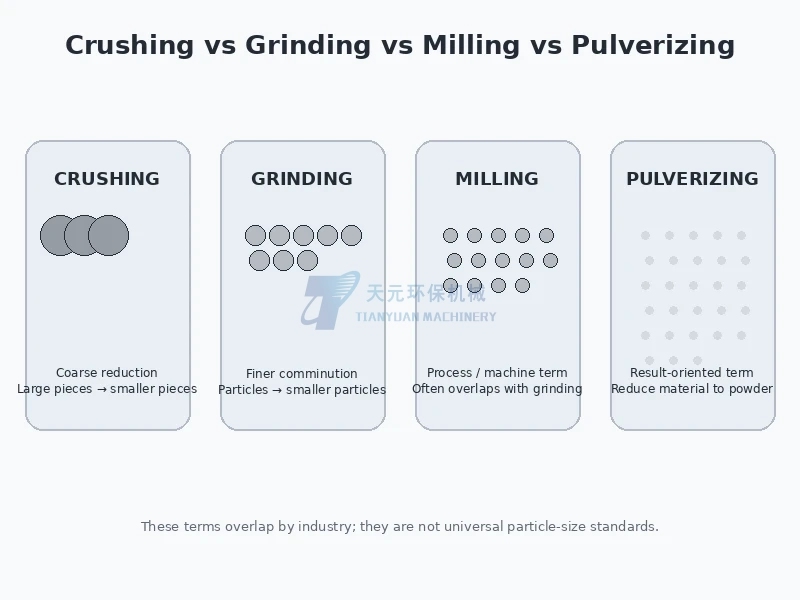
A little fine dust generated by a crusher does not establish that it has completed powder production. Dust by-product, mixed-size output and accepted powder are different categories. For broad definitions of the English verbs, see the separate crushing, grinding, milling and pulverizing article; this comparison is specifically about metal feed preparation versus a powder endpoint.
Different duties need different acceptance checks
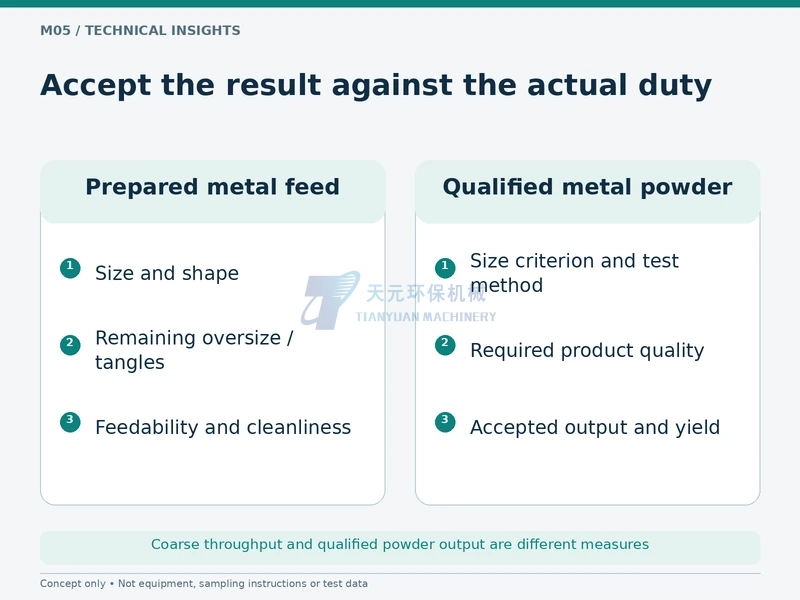
Coarse metal preparation
Check whether size and shape suit the next inlet, whether long tangled pieces or oversize fragments remain, and whether feed continuity and contamination conditions are acceptable. The endpoint is suitable feed for the agreed next step.
Metal powder production
Verify the target fraction using an agreed method, then the necessary quality criteria and accepted yield. Merely seeing dust or collecting small particles does not prove compliance with the finished-powder specification.
Before comparing capacities, check that the duties are comparable. An hourly scrap-crushing rate and an accepted fine-powder rate may involve different targets, recycle loads, observation periods and feed conditions. Input mass and qualified output mass should not be assumed equal.
Metal may deform instead of readily fracturing
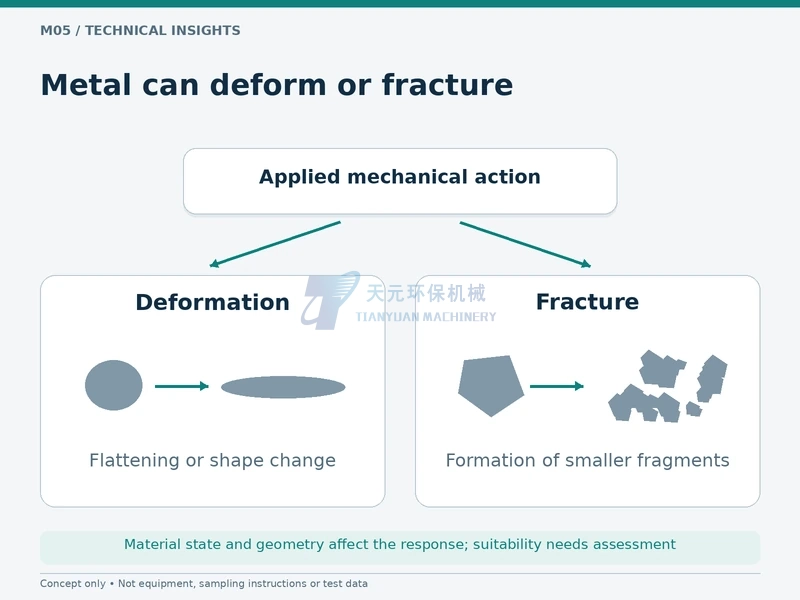
Metal can shear, flatten, plastically deform or fracture under load, sometimes through several behaviours together. RETSCH’s size-reduction overview distinguishes mechanisms such as impact, pressure, cutting and friction; it does not justify a claim that one mechanism works equally well for every metal.
Ductile feed may change shape before it becomes fine powder. Alloy condition, feed geometry, surface state and operating conditions therefore matter alongside the material name. Evaluate the actual feed. Mechanical size reduction is also not proof of validated mechanical alloying or spherical-powder production capability.
When is crushing before grinding useful?
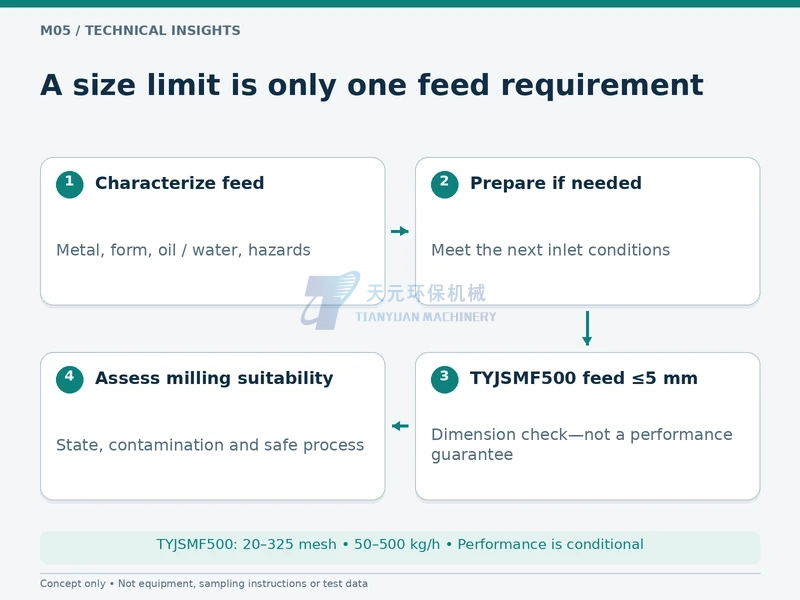
Tangled long turnings, irregular large pieces or material exceeding the mill’s inlet requirements may need suitable preparation. The goal is not merely a smaller nominal size: the material must also feed controllably and satisfy compatibility, contamination and safety requirements.
Industrial grinding and classification routes are selected for the material and product task. Suitable clean granules already meeting the inlet requirements may not need another crushing stage. Conversely, “below 5 mm” is not proof that every metal can go straight into fine milling. Shape, material state, oil, water and hazards still require review.
TYPC and TYJSMF500 serve different process roles
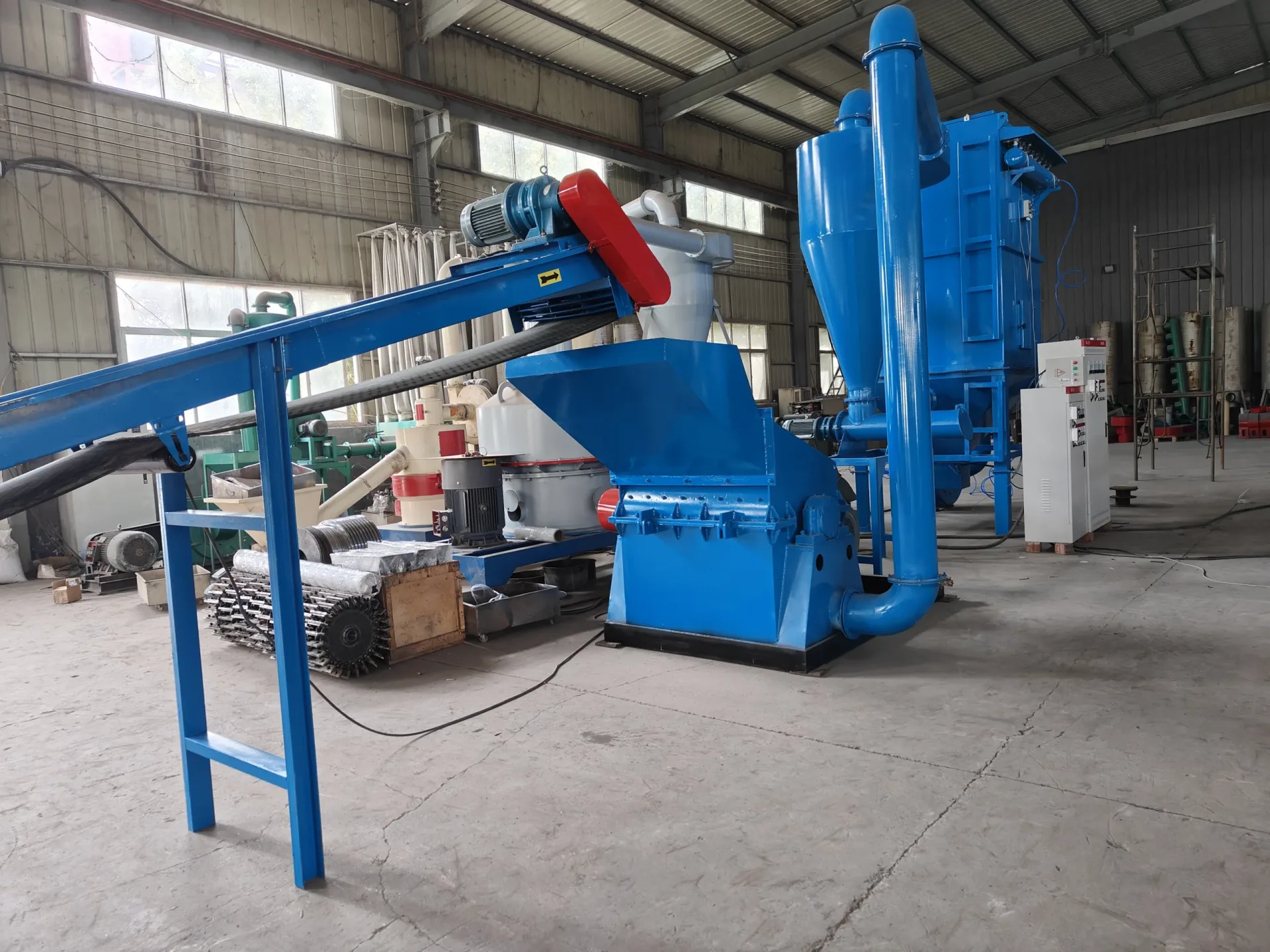
Tianyuan’s TYPC metal crusher is presented as supporting preparation equipment. Its suitability for particular turnings, sheet material or scrap must follow its published scope and material assessment. This article assigns it no invented universal discharge size or capacity.
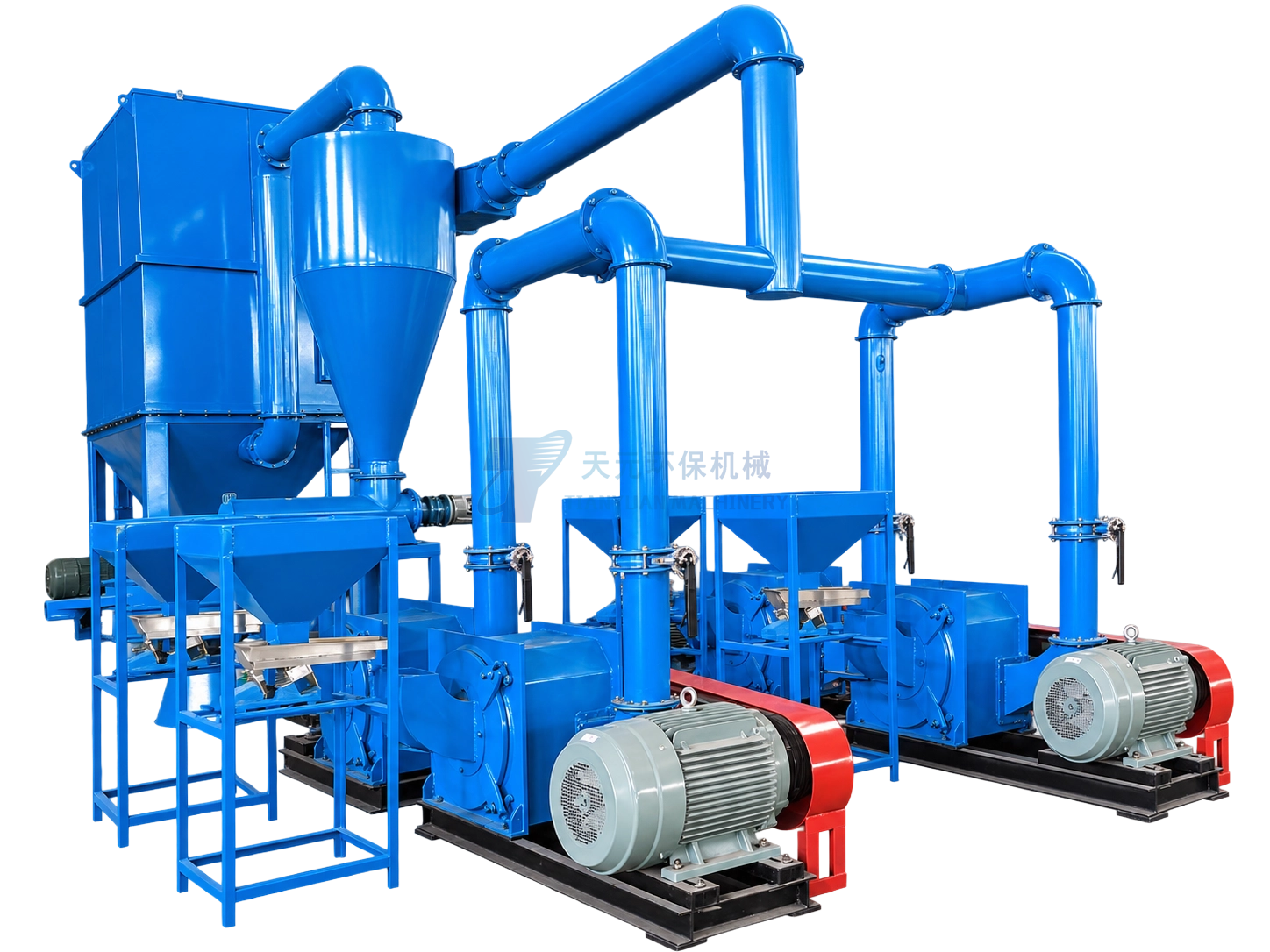
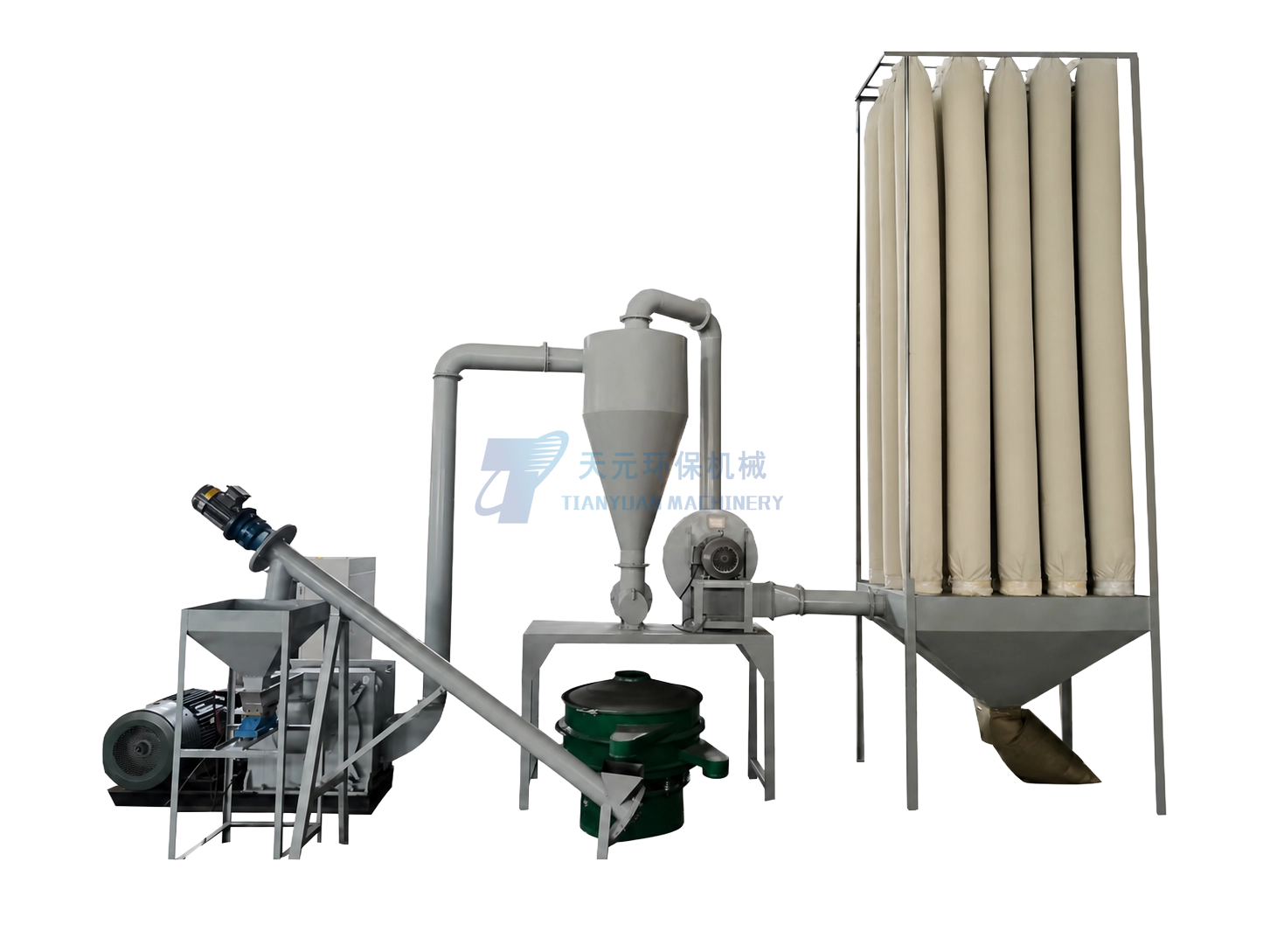
The TYJSMF500 metal powder grinding mill serves the downstream mechanical powder-production duty for suitable metals and alloys. Its confirmed reference range is 20–325 mesh, 50–500 kg/h and feed no larger than 5 mm. Actual performance depends on material, feed state, target fineness and site conditions; maximum fineness and maximum output are not a simultaneous guarantee.
Do not apply those mill values to a crusher, conveyor, screen or complete system, or assume every metal can achieve every combination within the range. Tianyuan’s metal-powder application is not an ore, stone or non-metallic-mineral grinding application.
The powder route may still need screening or classification
Mill discharge can contain a distribution of sizes. Screening or suitable classification organizes the target fraction, and return of oversize depends on the material and system loading. Cyclone gas–solid recovery is not the same as final size acceptance; recovered powder must not be labelled conforming without verification.
In a closed circuit, record fresh feed, return material and accepted powder separately. Repeated circulation is not additional production. Select equipment for the complete task—stable feeding, size control and accepted yield—not only a momentary discharge from the main machine.
Both coarse reduction and fine milling need hazard review
Coarse crushing can also generate fine dust. Fine metal milling may involve temperature rise and newly exposed surfaces. For a combustible or reactive material, review feed handling, mechanical contact, transfer, dust capture and return as separate points of concern. Safety does not begin only after a very fine finished product exists.
OSHA lists some metal dusts as combustible-dust examples. Its hazard guidance emphasizes process-specific prevention and protection. An ordinary collector or grounding connection is not a complete fire and explosion protection system. This article provides no unverified metal-milling settings or universal explosion-protection arrangement.
Write the enquiry as a processing task
- Identify the metal, known grade or condition and whether it arrives as blocks, turnings, flakes or granules.
- Describe dimensions, tangling, oil, water, coatings and other contamination.
- State whether the required output is suitable downstream feed or finished powder.
- Define the target size and measurement method, plus necessary quality criteria.
- Specify the required accepted output and disclose known hazards.
These facts help determine whether coarse preparation is needed, whether the material is a candidate for mechanical powder production and what suitability trial is justified. If a material does not suit a particular route, changing the process may be more appropriate than promising that a larger motor will solve the problem.
FAQ
Can a metal crusher automatically be used as a powder mill?
No. Its name and the presence of some dust do not prove it can reliably produce powder meeting the required specification.
What size separates crushing from grinding?
There is no universal boundary for all machines and metals. Distinguish the duty, inlet condition and accepted endpoint.
Can all metal chips below 5 mm be milled directly?
No. Feed geometry, material condition, oil, water, contamination and hazards still need assessment.
Why can a crusher have a higher throughput than a powder mill?
The duties and acceptance targets differ; the fine-powder route may also include return material and rejection. Compare like-for-like tasks, not isolated numbers.
Does coarse crushing need dust and ignition controls?
It needs assessment. Fine by-product and local deposits can matter; visible particle size alone does not prove safety.
Conclusion
Metal crushing commonly prepares feed size and form; metal powder grinding targets a defined powder specification. Decide whether to combine the stages from the actual material, inlet requirements and product acceptance criteria. Duty and verification are more reliable distinctions than terminology, a single mesh number or an hourly processing figure.