Fine powder can move between a grinder, classifier, cyclone, screen, storage hopper and packaging station without being handled openly. In practice, the most common options are enclosed screw or other mechanical conveying and pneumatic conveying driven by a pressure difference. The right choice depends on the material and the process route, not on the word “fine” alone.
Key answer: Use a suitably enclosed screw conveyor for a straightforward, usually shorter equipment-to-equipment transfer when the powder feeds consistently. Consider vacuum pneumatic conveying where powder must be drawn from one or more pickup points into a receiver; consider positive-pressure conveying where a validated route must push powder toward downstream receivers. Dilute versus dense phase is a separate decision based on conveying behavior. No option is universally best for every fine powder.
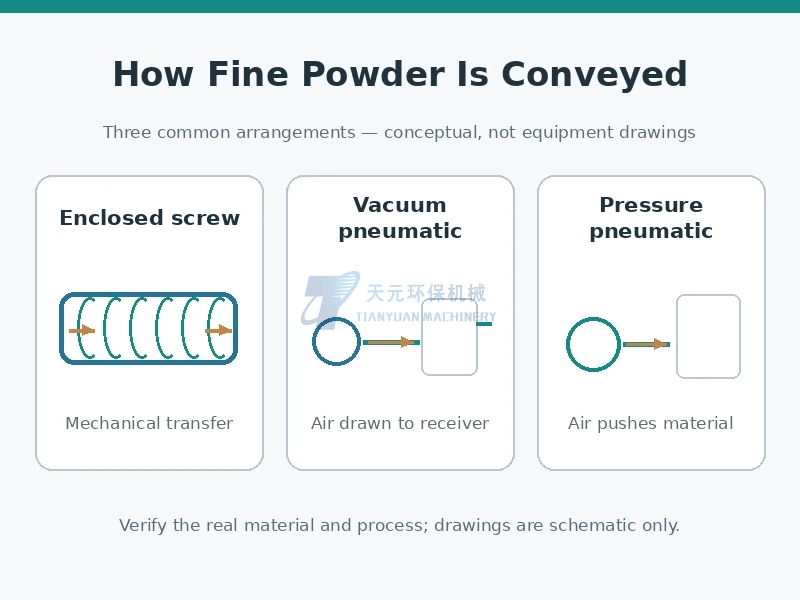
Common ways to convey fine powder
The three arrangements solve different layout problems. A covered screw physically moves material with a rotating flight. Pneumatic systems use air or another suitable conveying gas in a closed pipe and require a pickup, gas mover, receiving separator or filter, and controlled powder discharge. A short transfer between adjacent machines may require less equipment than a long route with several changes of direction.
Coperion describes pneumatic conveying as bulk-solids transport through a pipe using air or another gas and distinguishes pressure from vacuum systems. Piab likewise identifies the conveying line, feed arrangement, receiver and air source as fundamental elements. Neither description makes pneumatic transfer mandatory for every powder line.
When enclosed screw conveying makes sense
An enclosed screw conveyor can meter or transport powder between nearby processing units without introducing a large volume of conveying air. It can be practical below a mill, between a separator and a screen, or near a packaging hopper when the inlet and outlet locations allow a relatively direct mechanical route.
Its suitability has limits. Fine powders may bridge in the hopper, adhere to the flights, cake if moisture changes, or leak through poorly sealed joints. Abrasive particles can accelerate wear; fragile agglomerates and temperature-sensitive materials may be altered by mechanical shear. Inclined conveying also changes filling and performance. The screw diameter, flight geometry, clearance, fill level, speed and discharge control must be checked against the real material.
A screw is worth evaluating
The route is compact and mechanically accessible; powder feeds reliably; the project wants direct transfer or controlled metering without extra conveying-air separation.
Do not assume it will work
The powder is highly cohesive, bridges repeatedly, requires many bends, is vulnerable to shear, or presents a safety concern requiring a different containment or protection concept.
Vacuum versus pressure pneumatic conveying
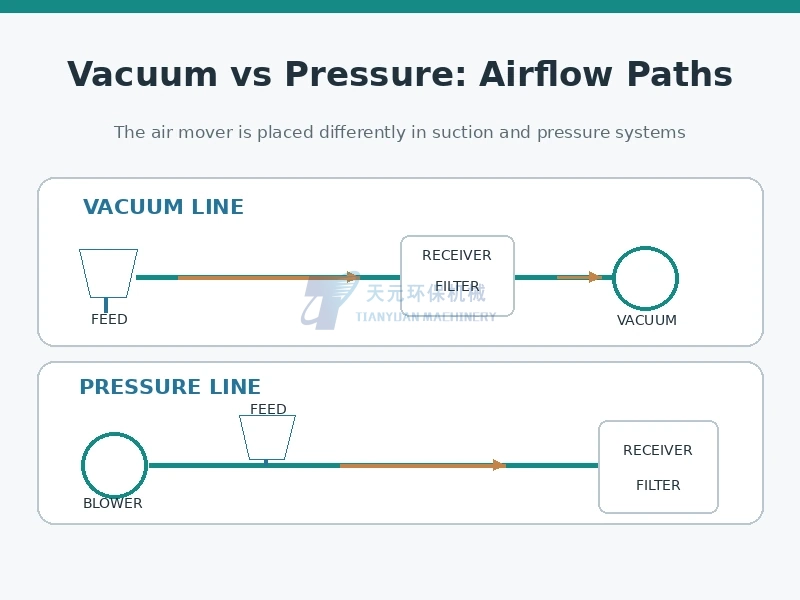
Vacuum conveying: the gas mover creates a pressure below ambient at the receiving end. Powder is drawn from a pickup point through a line to the receiver, where gas and solids are separated and the powder is discharged. A pressure deficit can reduce the tendency for dust to escape through a small leak during normal operation, but it does not remove the need for sealing, filtration or hazard controls.
Positive-pressure conveying: a blower or compressed-gas source establishes pressure at the feeding end. A suitable feeding/airlock device introduces powder into the line, and a receiver separates material from the conveying gas at the destination. This architecture can serve longer or more complex validated routes, but line pressure, feeder sealing, bends, product wear, filters and potential external leakage must be accounted for.
The pressure arrangement is independent of the dilute/dense phase decision. Vacuum is not a synonym for dilute phase, and a pressure system is not automatically dense phase. Either arrangement must be checked against the material, throughput, route and required containment.
Dilute phase versus dense phase conveying
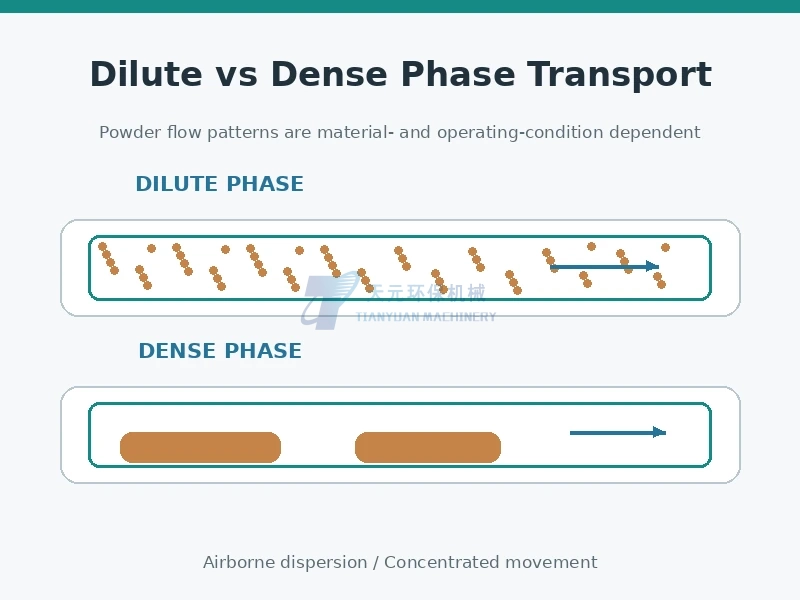
Dilute phase keeps solids relatively dispersed in moving gas and generally uses higher gas velocity. It is flexible for many powders and routes, but higher velocity may increase pipe wear, particle attrition or the amount of conveying gas that must be filtered at the destination.
Dense phase moves a higher solids concentration at a generally lower velocity in suitable flow regimes, including plugs, slugs or moving beds. It can reduce wear and degradation for compatible materials, but stable dense phase is not possible for every powder. AIChE notes that permeability, fluidization and air retention help determine whether a material can flow in a suitable dense-phase regime. Some fibrous or cohesive materials form immobile plugs instead.
Coperion recommends defining bulk density, flowability, particle-size distribution, moisture, abrasiveness and temperature, then specifying distance, elevation, bends and capacity. These parameters are more useful than selecting “dense phase” solely because a powder is very fine. The final velocity and line size should be confirmed by engineering calculation and, where appropriate, material trials.
Why fine powders are difficult to transfer
Poor flow and feeding instability
Cohesive powders can form arches or ratholes above an outlet, so the nominal conveyor capacity is not the same as the sustainable powder feed rate. Hopper shape, the extraction pattern, feed control and material condition affect whether the line starts and stays supplied.
Moisture, deposits and pressure loss
Hygroscopic or damp powder can stick to walls, collect at bends, blind filters or cake in a receiver. In pneumatic transfer, gas velocity, solids loading, pressure losses and the ability to keep moving must be assessed as one system. Increasing fan speed without investigating the source of blockage can create other problems.
Product quality and the receiving stage
Attrition can create more fines; product may contaminate at worn contacts; and receiver discharge can disturb downstream weighing or screening. The collected dust is not automatically finished product. Gas-solid separation, filter performance, discharge sequencing and maintenance access all belong in the design.
How Tianyuan integrates conveying with milling
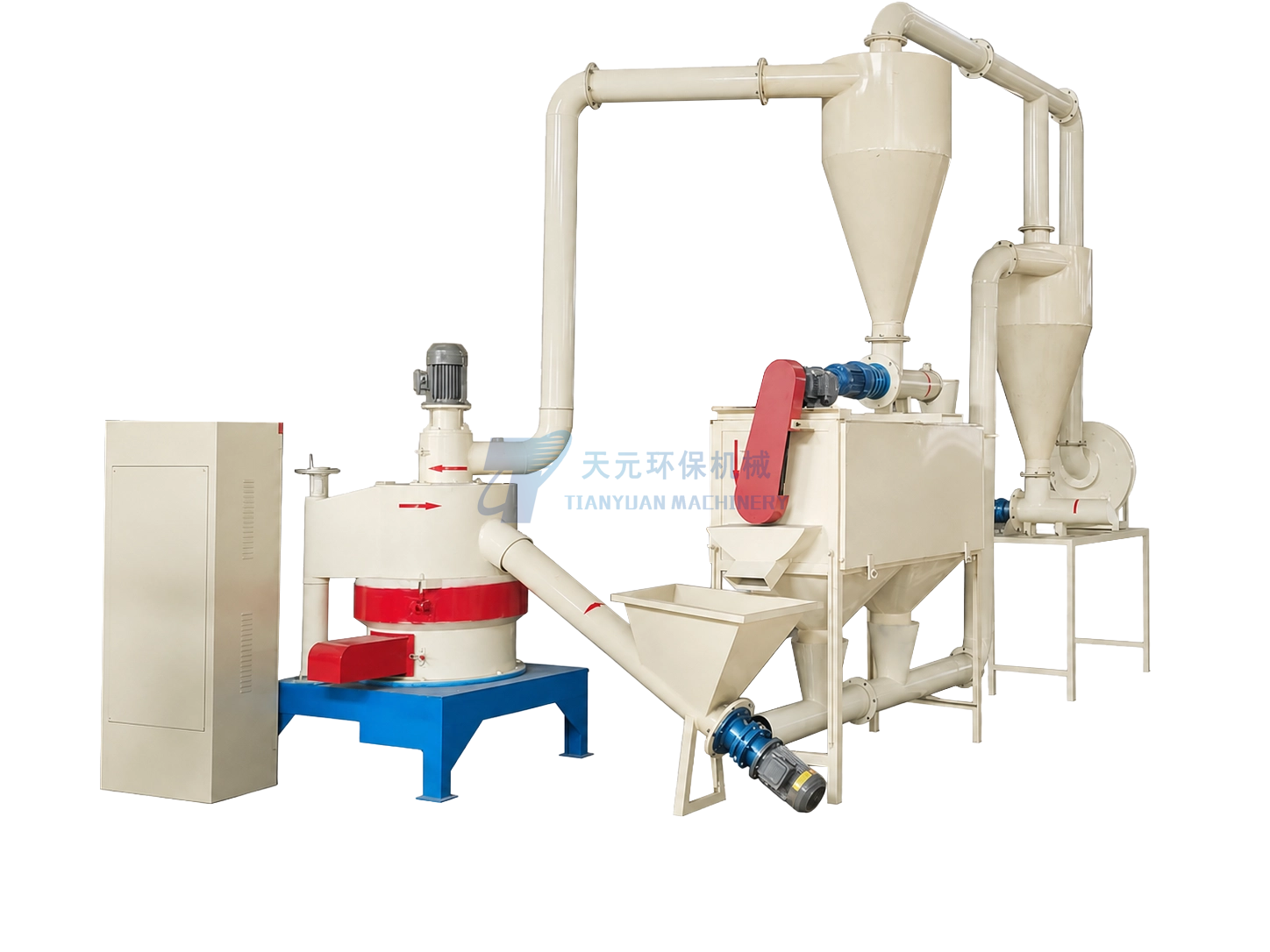
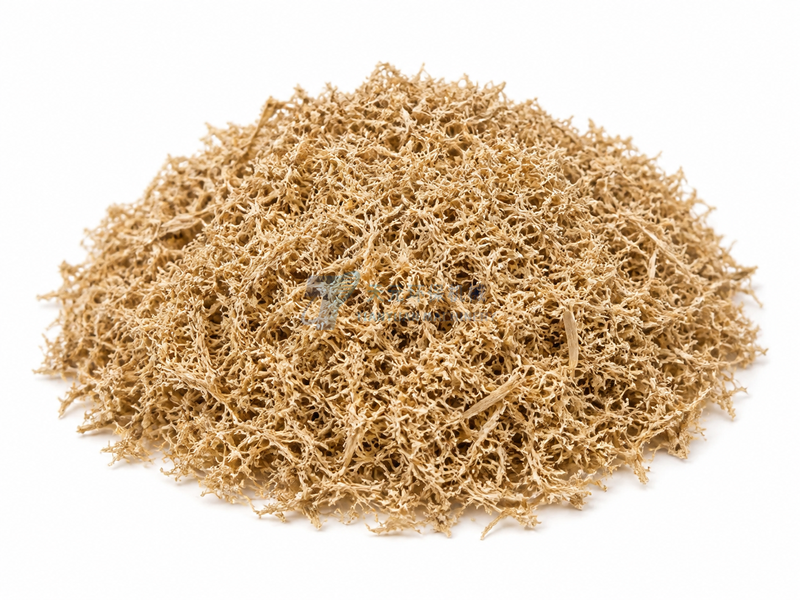
Tianyuan’s TYMF6R-600 wood powder mill and TYJSMF500 metal powder grinding mill product pages show that conveying, cyclone separation, screening and dust collection are separate process functions around the core milling stage. Some connections can use enclosed mechanical transfer; others may use the process airflow or a specifically designed pneumatic line. This is a system-design decision, not a claim that one standard conveyor suits every customer.
TYMF6R-600 is a wood-powder grinding model rated at 30–325 mesh, 100–500 kg/h and maximum feed diameter 5 mm. TYJSMF500 is a metal-powder grinding model rated at 20–325 mesh, 50–500 kg/h and feed size ≤5 mm. Actual milling output depends on the material and operating conditions. These figures do not specify a conveyor capacity or guarantee maximum output at the finest setting.
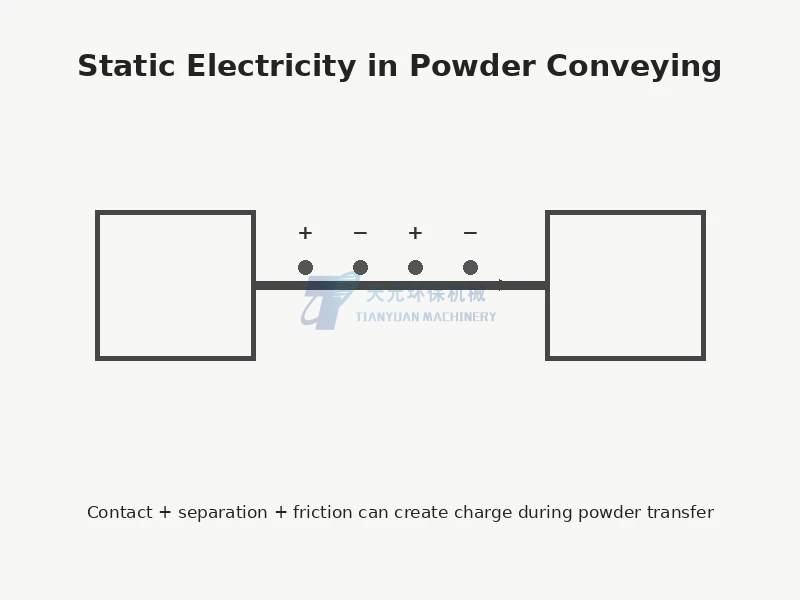
Wood flour and some fine metal powders may form combustible dust. A standard collector, fan or grounding strap is not a complete fire/explosion-protection system. For ignition and electrostatic issues, see Tianyuan’s article on Static electricity in powder conveying; for the distinct function of collection equipment, see Dust collection in powder production. A qualified, material-specific hazard assessment is needed before specifying conveyance of combustible or reactive powders.
Selection checklist before equipment sizing
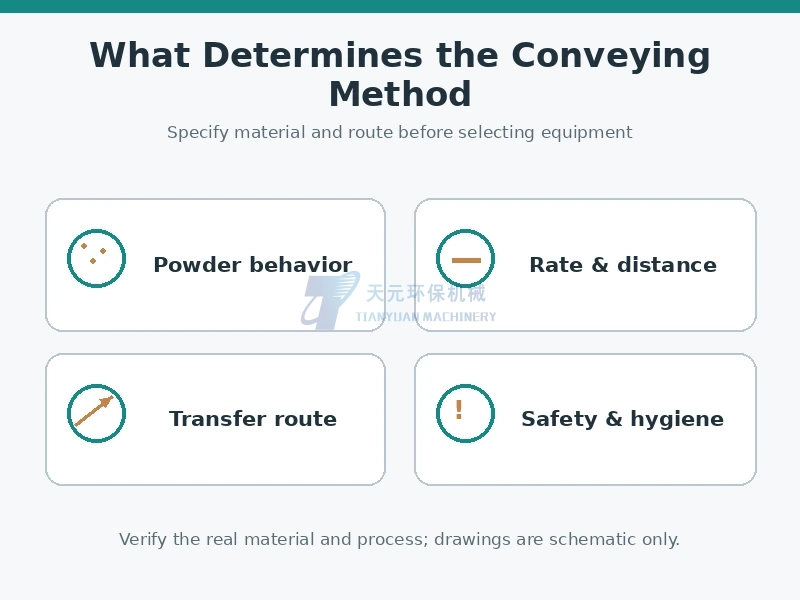
- Identify powder composition, particle-size distribution, shape, bulk density, moisture and flowability.
- State required mass flow, batch or continuous duty, and acceptable feed variation.
- Measure horizontal distance, vertical rise, number of bends, pickup points and receiving points.
- Check whether mechanical contact, conveying gas, product attrition or temperature rise is acceptable.
- Specify containment, cleanup, wear, corrosion, contamination and access requirements.
- Assess combustibility, reactivity, oxygen exposure and whether an inert gas or special protection is required.
- Define how powder will be received, separated from gas, screened, weighed or packed.
- Use representative powder tests and engineering verification when flow behavior is uncertain.
FAQ
Must all fine powder be pneumatically conveyed?
No. Enclosed screws and other suitable mechanical systems can be practical for short, simple transfers. The material flow behavior and containment needs determine feasibility.
Are vacuum conveying and dilute phase the same thing?
No. Vacuum versus pressure describes where the pressure difference is generated. Dilute versus dense phase describes how much solid is carried and how it moves in the gas stream.
Is dense phase always better for ultra-fine powder?
No. Dense-phase stability depends on material permeability, fluidization, air retention and the chosen equipment; some fine powders form hard-to-move deposits or plugs.
Can a dust collector replace a pneumatic conveying system?
Not by itself. A collector filters dust from gas; some process air circuits also convey solids, but the entire feed, gas-moving, receiving and discharge system still needs engineering.
Can combustible fine metal powders use ordinary air conveying?
Do not assume so. Certain powders may require inert gas, equipment protection and a qualified dust-hazard assessment. The material and process conditions determine the safe approach.
Conclusion
Fine powder conveying is a choice between material behavior, route geometry, transfer duty, containment and safety—not a contest between machine labels. Start with the powder and the required process connection, then decide whether an enclosed screw or pneumatic system is more suitable. Pressure/vacuum and dilute/dense phase choices come only after those requirements are defined and, where necessary, verified by tests.