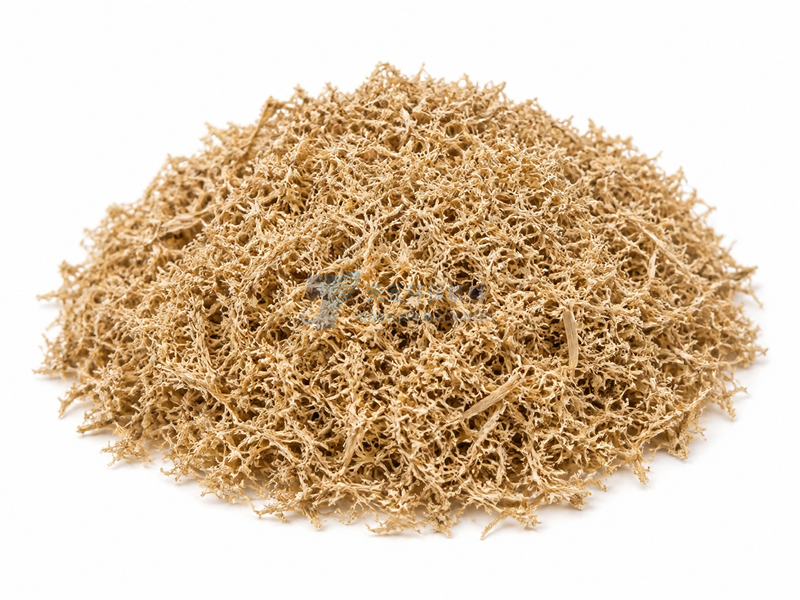
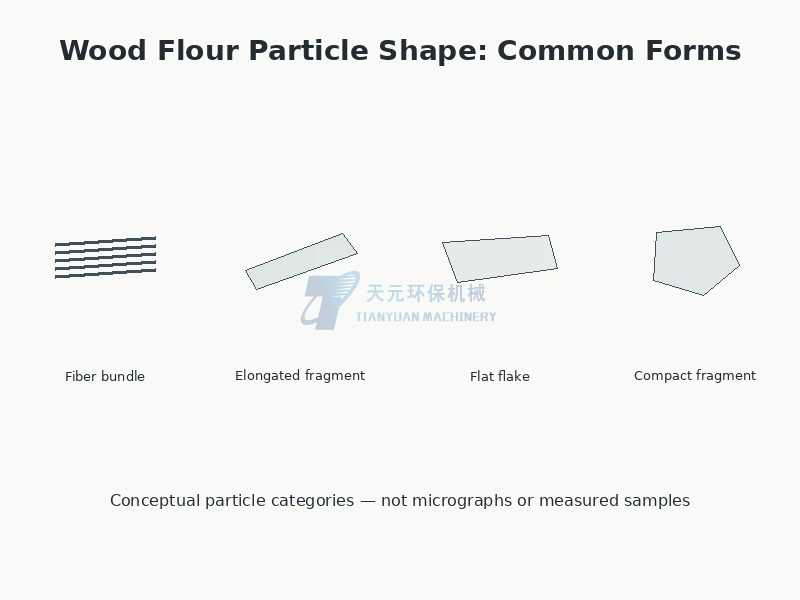
Wood flour is not a population of identical spheres. A real batch may contain fiber bundles, elongated fragments, flakes, compact fragments and fines. Their geometry can influence how particles interact in hoppers, feeders and conveying equipment, and may also affect dispersion and performance in wood-plastic composites or other formulations.
Key conclusion: particle size describes how large particles are; morphology describes their shape and proportions. The two are related but not interchangeable. When feeding, mixing, surface finish or reinforcement matters, particle shape should be assessed as a separate property rather than inferred from mesh size or D50.
Particle shape is not the same as particle size
A sieve opening limits whether a particle can pass through a particular aperture under the test conditions. It does not make the particle spherical or define every dimension of an irregular fiber fragment. Two batches with similar sieve results can still differ in length, width, thickness, fiber-bundle content and surface irregularity.
The USDA Forest Products Laboratory chapter on wood flour describes pulverized wood as a mixture of fiber bundles and fiber fragments. It discusses typical aspect ratios around 1–5 for the particles considered in that reference. This is a literature description, not a universal range, acceptance limit or Tianyuan test result.
Common forms found in wood flour
A practical visual description may distinguish fiber bundles, elongated fragments, flat flakes, compact fragments and agglomerates. These labels help describe what is present, but they are not a substitute for a defined measurement method. A particle may also appear different when it rotates or lies at another angle to the camera.
How morphology is described
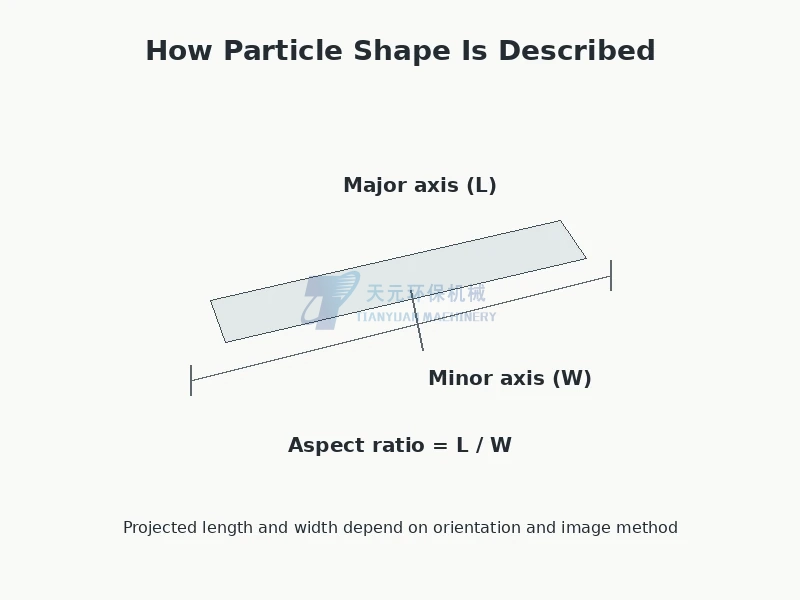
Common two-dimensional descriptors include projected length, projected width, aspect ratio, circularity and other shape factors. Aspect ratio is often expressed as projected length divided by projected width. The exact definition must be stated because image orientation, particle overlap, dispersion and edge-detection rules can change the reported result.
- State the imaging method and magnification or pixel scale where relevant.
- Describe sample dispersion and whether preparation may break up agglomerates or fiber bundles.
- Define how length and width are identified for irregular particles.
- Report a distribution or range when one average could hide a small population of long fibers or flakes.
- Use a sample that represents the production lot, not a hand-picked attractive particle.
Image analysis can complement sieve analysis, but the two methods answer different questions. A sieve result is related to passage through an aperture; an image result describes projected geometry under the stated preparation and analysis method. Do not silently treat them as interchangeable.
Why shape matters in handling and feeding
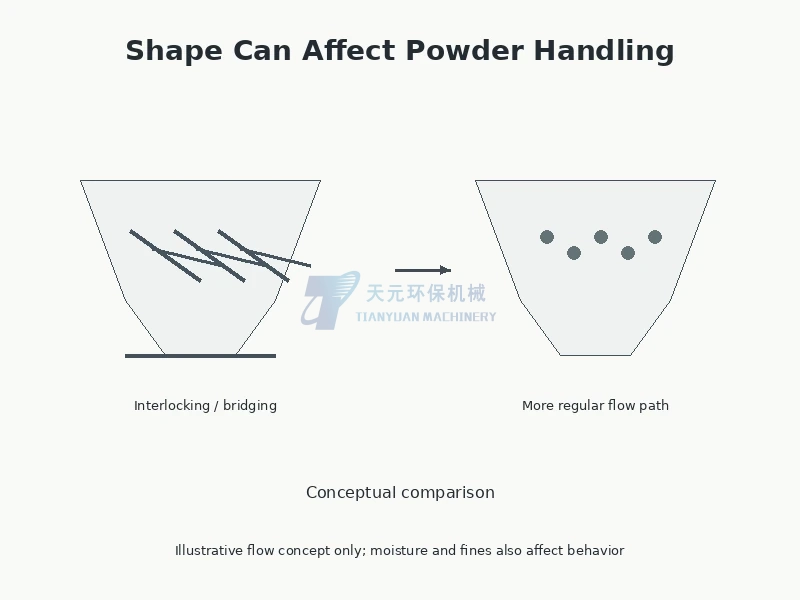
Elongated, fibrous or irregular particles can contact, interlock and rub against one another. Under some conditions this can contribute to cohesive behavior, inconsistent discharge or bridging in hoppers and feeders. A 2026 TU Delft study of spruce and poplar wood powders describes wood powders as hygroscopic and heterogeneous and reports flow problems associated with irregular fibrous particles. Its materials and calibrated model parameters are specific to that study, not universal design values for every wood powder or Tianyuan machine.
Shape is only one part of bulk behavior. Moisture, fine-particle content, bulk density, storage time, consolidation, surface condition and feeder geometry also matter. A photograph alone cannot prove that a powder will bridge, and a more rounded appearance does not guarantee trouble-free conveying.
How shape can affect end-use performance
The useful morphology depends on the application. A wood-plastic composite may be sensitive to particle aspect ratio, fiber-bundle integrity, wetting by the polymer matrix and dispersion during compounding. Other filler applications may place more emphasis on consistent dosing, packing, surface finish or appearance.
A 2015 SciELO study on wood flour geometry in HDPE composites found that increasing the proportion of higher-aspect-ratio ground shavings improved some measured properties up to a point under its specific formulation and test conditions; higher proportions did not continue to improve every property. A 2021 wood flour/polyethylene study also examined particle size, aspect ratio and injection temperature together. These studies show why morphology can matter, but they do not establish that longer particles are always better or that one shape suits every product.
For a different application, the preferred shape may be different. The end user should validate the powder in the actual formulation or process before a morphology target becomes a purchasing or production limit.
How to include shape in a specification
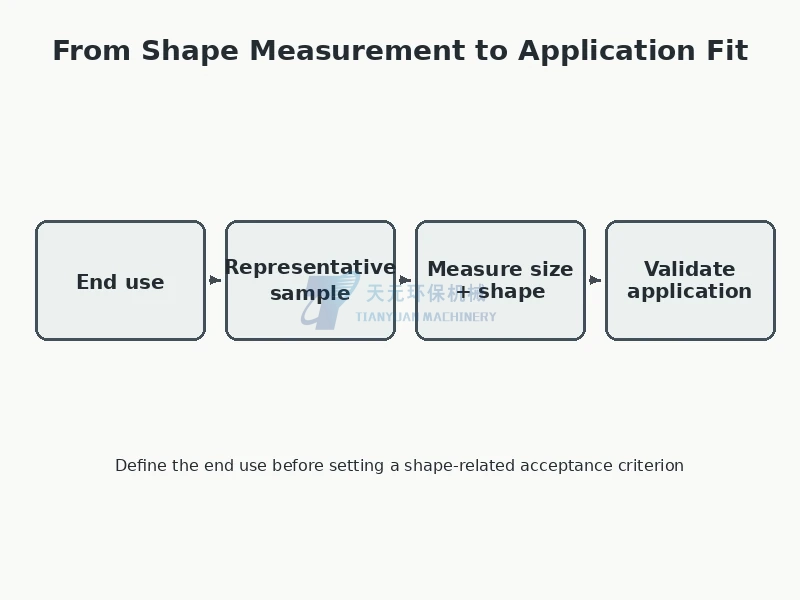
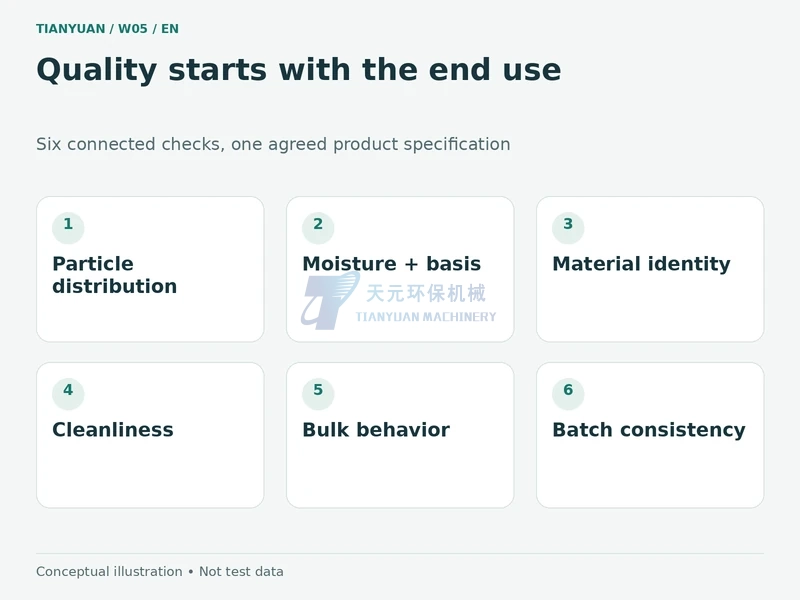
- Define the end use and the property that particle shape is expected to influence.
- Agree particle-size distribution and its measurement basis separately from shape.
- Decide whether fiber bundles, flakes or agglomerates need to be reported or limited.
- If needed, specify image-analysis descriptors such as projected length, width and aspect-ratio distribution.
- Record moisture basis, sample conditioning and representative sampling procedure.
- Validate handling or end-use performance under the actual process conditions before setting acceptance limits.
There is no single aspect-ratio or circularity threshold that can be applied to all wood flour. Numerical limits should come from the customer’s application, an agreed method and representative validation—not from a generic article or another supplier’s study.
Tianyuan process evaluation
For a Tianyuan project, the practical sequence is to identify the feedstock, define the end use and finished-product requirements, prepare a representative sample, assess fine grinding and classification, then measure particle size and any shape descriptors that matter to the application. The existing wood flour quality guide covers the broader acceptance factors, while the hardwood and softwood comparison explains why species labels alone do not predict grinding performance.
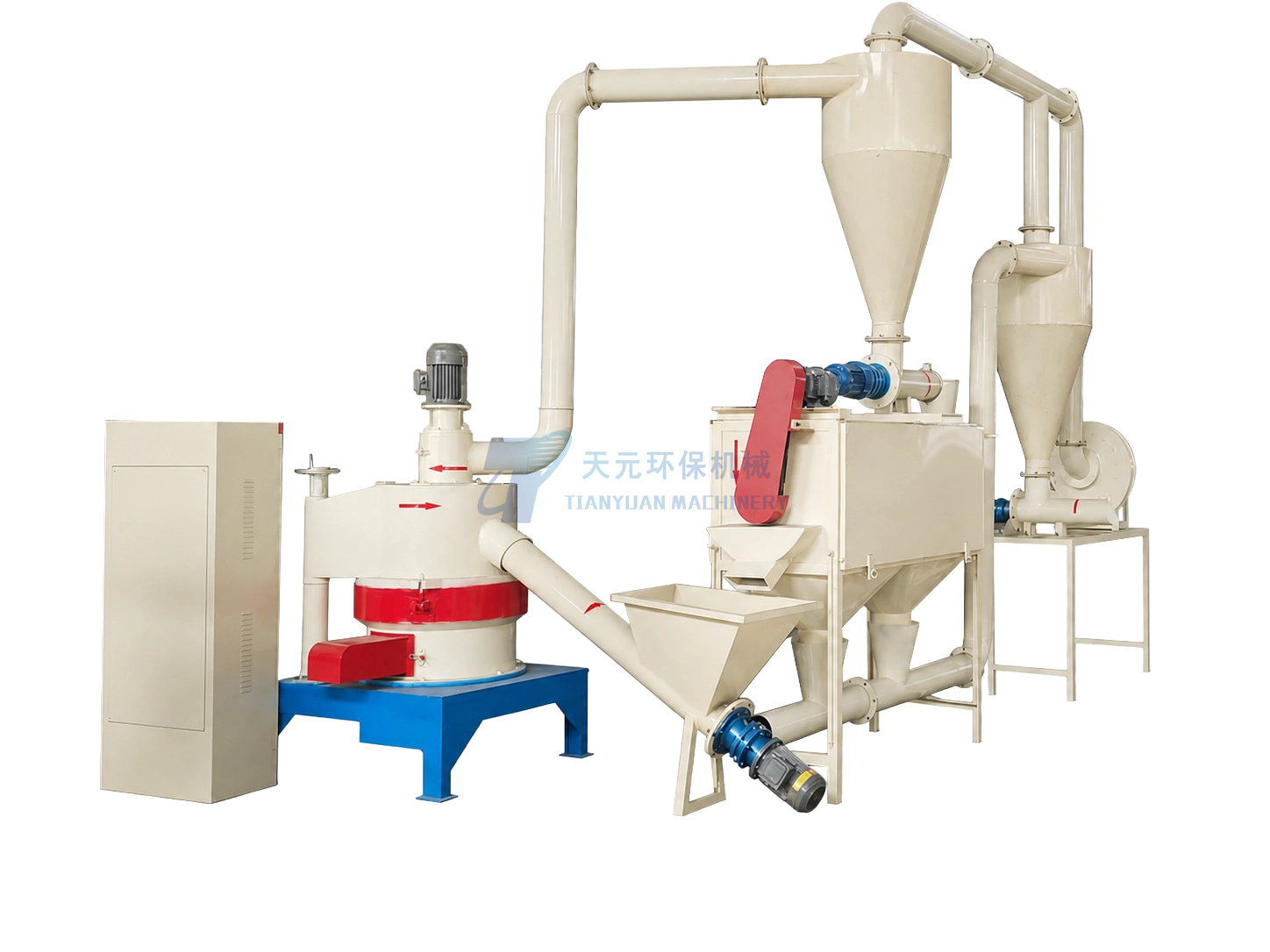
The TYMF6R-600 is a downstream fine-grinding machine for prepared woody or plant-fiber feed. Its confirmed range is 30–325 mesh, 100–500 kg/h and a maximum feed diameter of 5 mm. These are model-specific equipment ranges, not a particle-shape guarantee and not a promise that the finest fineness and highest throughput will be achieved together. Actual output depends on the material, feed condition, target fineness and site conditions.
Wood flour and some other fine organic powders can present combustible-dust hazards. Particle-shape qualification does not replace a material-specific safety review. See the UK HSE wood-dust guidance for workplace context; ordinary dust collection is not, by itself, a complete fire- and explosion-protection design.
FAQ
Is a higher aspect ratio always better?
No. It may help reinforcement in some composite formulations, but elongated or fibrous particles can also affect feeding, interlocking and dispersion. The end use decides which trade-off matters.
Do particles with the same mesh size have the same shape?
No. A sieve designation does not define the length, width, thickness or shape of every irregular particle.
Can ordinary sieving measure particle shape completely?
No. Sieving describes passage through an aperture. Length, width and aspect ratio generally require suitable image analysis or another defined method.
Does finer wood flour always flow better?
No. Fine-particle content, moisture, agglomeration and interparticle interactions can all change flow behavior.
Can Tianyuan guarantee one fixed aspect ratio from the mill model alone?
No. The material, preparation, measurement method and intended application must be defined and representative samples evaluated before a shape-related limit can be claimed.
Conclusion
Wood flour particle shape can influence flow, feeding, mixing and end-use performance, but there is no single best shape for every species and application. Evaluate morphology alongside particle-size distribution, moisture, feed identity and the actual end use, using a defined method and representative samples.