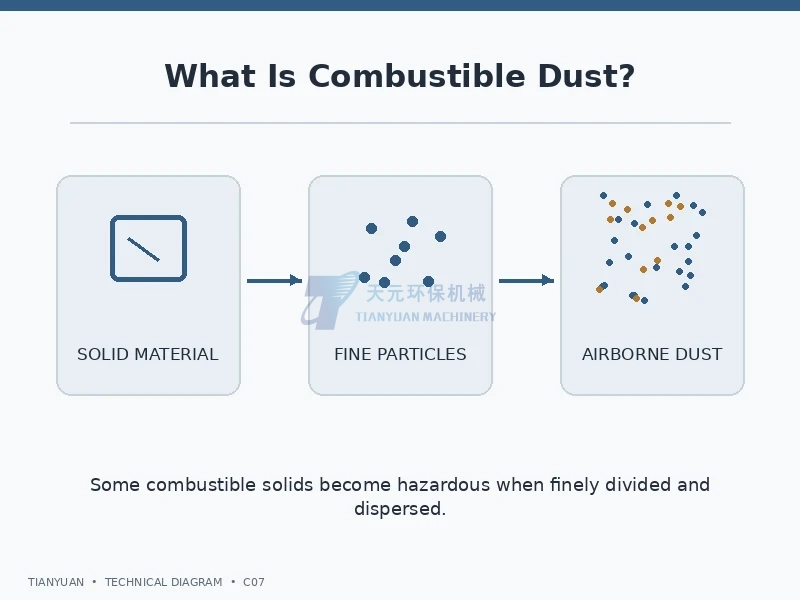

Particle size changes how powder interacts with air, heat and ignition sources. When a combustible material is ground into smaller particles, the available surface area generally grows relative to its mass, and part of the powder may be more easily dispersed in moving air. Both effects can change the conditions for dust ignition and rapid burning.
Core conclusion: Finer combustible dust often warrants greater attention to ignition and deflagration risk, but particle size is not a stand-alone safety test. There is no universal mesh number or micrometre limit above which every powder is safe. Material chemistry, particle shape, size distribution, moisture, agglomeration, dispersion, dust concentration and ignition conditions all matter.
Why smaller particles change the available surface
Imagine the same material divided into progressively smaller particles. For roughly the same total mass, the sum of the exposed particle surfaces generally increases as size decreases. For a combustible solid, this can allow faster interaction with oxygen and can change heating, ignition and flame propagation. This is a physical explanation, not a prediction of the actual explosion behavior of a particular powder.
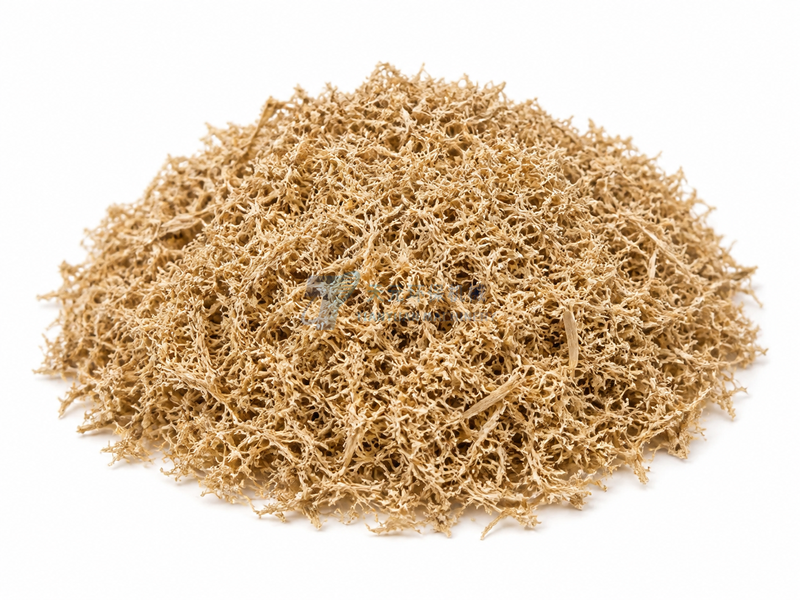
The relationship is influenced by particle geometry. Flakes and fibers may have high surface-to-mass ratios even when one dimension is relatively large. Porosity, surface oxide layers, moisture and agglomeration can also change which surface is accessible to the surrounding gas. A single sieve designation does not capture all those properties.
Why particle size affects dust clouds
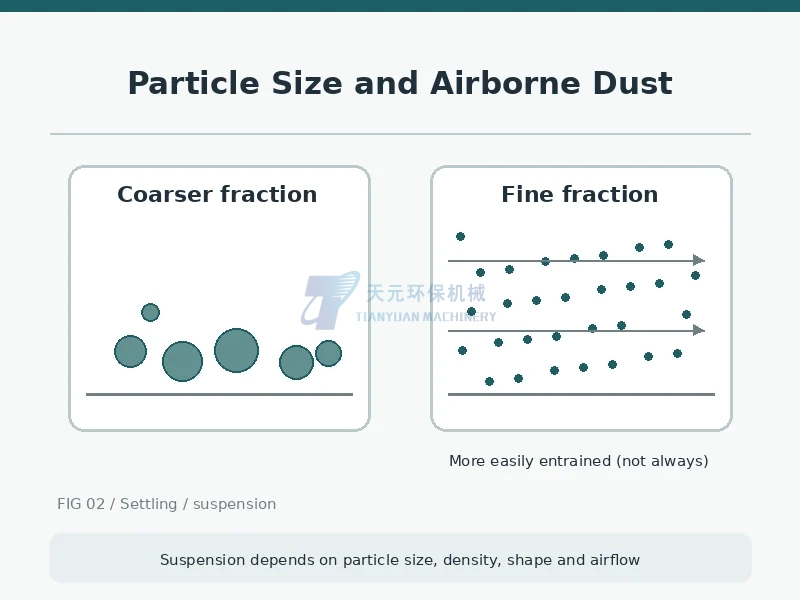
A powder must interact with the surrounding flow before a dust cloud can form. Smaller particles are often easier for ventilation, mechanical agitation, pneumatic conveying or an accidental disturbance to entrain, although the outcome also depends on density, shape, cohesion, humidity and air velocity. Fine material that has settled on equipment can become airborne again when disturbed.
For a powder-processing plant, potential dust-cloud locations include milling and classification chambers, conveying pipes, screening points, cyclone outlets, dust collectors and bagging stations. A coarse-looking bulk feed can still produce a finer airborne fraction at these locations. The dust that is actually suspended may not match the size distribution of a product sample taken from a finished bag.
Particle size, ignition and deflagration
The U.S. Occupational Safety and Health Administration (OSHA) states that particle size typically influences both the ease of ignition and the severity of a combustible-dust deflagration. The UK Health and Safety Executive (HSE) similarly warns that fine grinding of a combustible solid may make it easier to ignite or allow ignition with less energy. These are important hazard-identification principles; they are not universal numerical rules.
Whether dust ignites or propagates flame also depends on the material, available oxygen, dust concentration, moisture, ambient humidity, particle shape and the ignition source. For some materials, coatings, agglomeration or particular physical behavior can complicate simple “smaller is always worse” assumptions. Neither visual appearance nor particle size alone establishes minimum ignition energy (MIE), the dust deflagration index (Kst) or maximum explosion pressure (Pmax). These require material-specific test evidence where relevant.
Why there is no universal safe size cutoff
You may encounter 420 μm (approximately the opening of a U.S. No. 40 standard sieve) or 500 μm in older standards and screening guidance. These values have been used for terminology and presumptive classification; they are not universal safety thresholds. OSHA’s official 2013 interpretation explicitly discusses fibers, flakes and agglomerates that may not pass a particular sieve yet can still present a deflagration hazard.
A process handling apparently coarse particles may also generate smaller material by abrasion during transfer, screening or milling. Therefore, “larger than 420 μm,” “does not pass a certain screen,” or “low dust visible to the operator” cannot by itself justify omitting combustible-dust assessment. The correct question is whether a representative combustible fraction can form and be ignited in the actual process conditions.
What D10, D50 and D90 cannot tell you alone
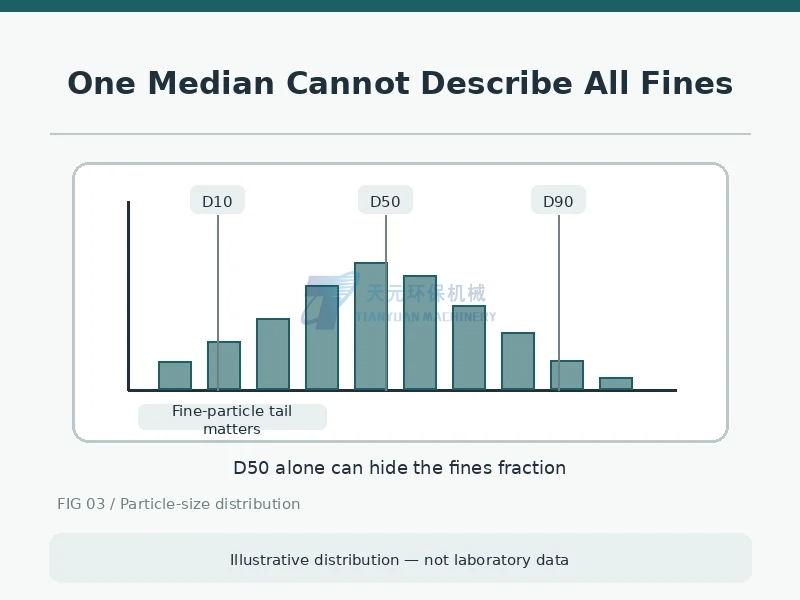
A reported D50 is a median of a particle-size distribution on the stated measurement basis, such as volume or mass. It does not describe the entire sample. Two powders with similar D50 values can contain different amounts of fines, and a product mesh specification does not directly reveal the size of dust that becomes airborne in ducts or settles inside collectors.
- Confirm whether the distribution is reported by mass, volume, number or another basis, and state the measurement method.
- Consider D10, D50 and D90 together with the fine fraction, not as independent explosion limits.
- Account for particle shape, fibers, flakes and agglomeration; screening and laser-based methods may characterize irregular powders differently.
- Where practical and safe, characterize representative dust from actual dust-generating locations, not only finished product.
- Do not translate a mesh grade into a combustible-dust classification or a tested ignition energy.
Applying this to Tianyuan powder lines
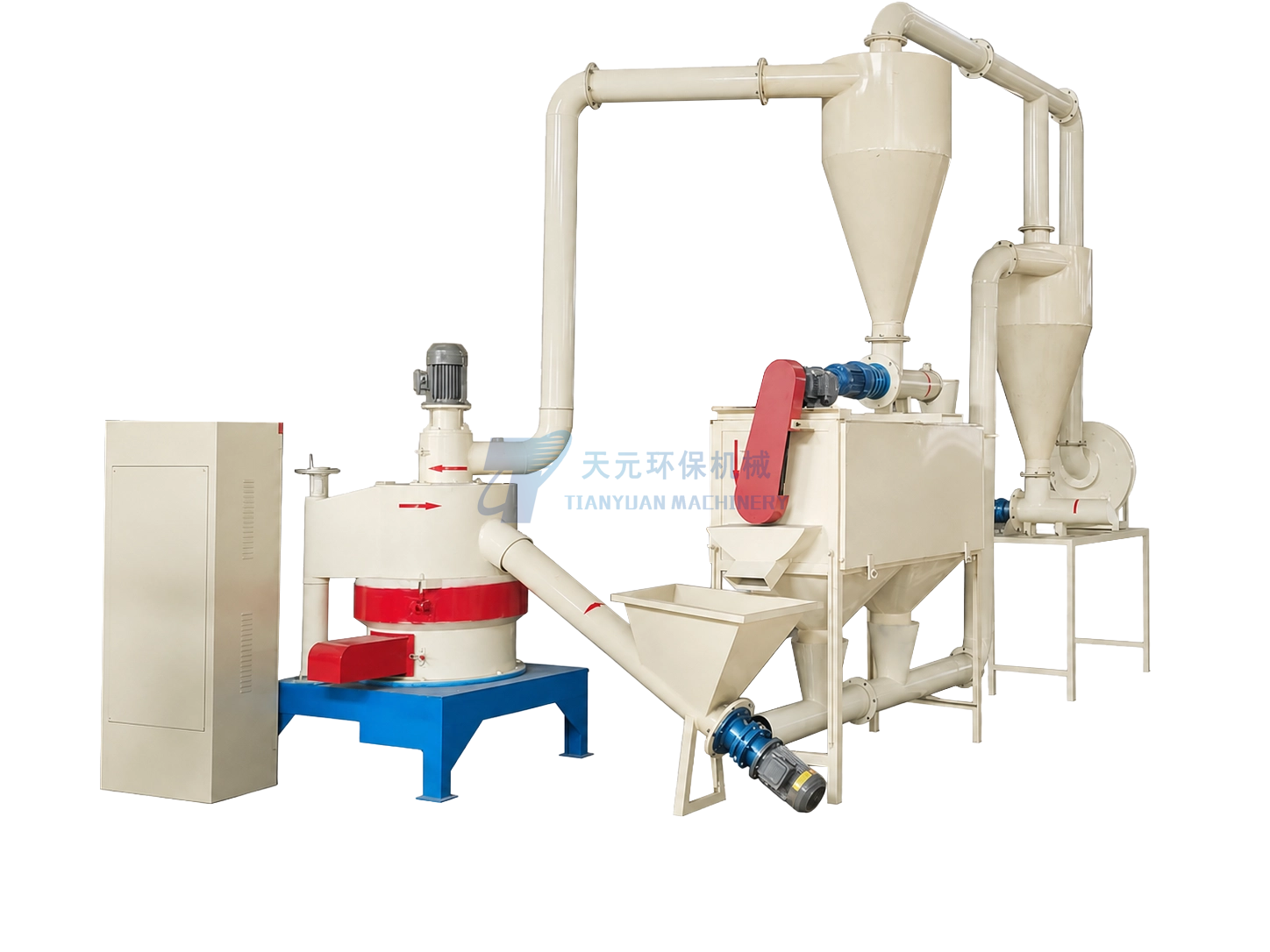
At Tianyuan, the TYMF6R-600 wood-powder mill is specified at 30–325 mesh, 100–500 kg/h and a maximum feed diameter of 5 mm; the TYJSMF500 metal-powder grinding mill is specified at 20–325 mesh, 50–500 kg/h and feed size ≤5 mm. Actual throughput depends on material and conditions. These are processing specifications—not results of combustible-dust tests.
In either kind of line, the relevant fraction may appear at a classifier, screen, pneumatic-conveying section, cyclone, bag or cartridge collector, return conveyor or packing point. A dust-collector sample may be finer than the bulk finished product, so its hazard cannot be inferred from the advertised mill fineness. Wood dust and some metal powders may be combustible; metal-powder reactivity must be evaluated for the specific alloy and powder condition.
A cyclone or ordinary dust collector does not by itself constitute a complete fire- and explosion-protection system. The required engineering controls depend on a qualified assessment of the process and the actual collected dust.
Sampling and hazard assessment
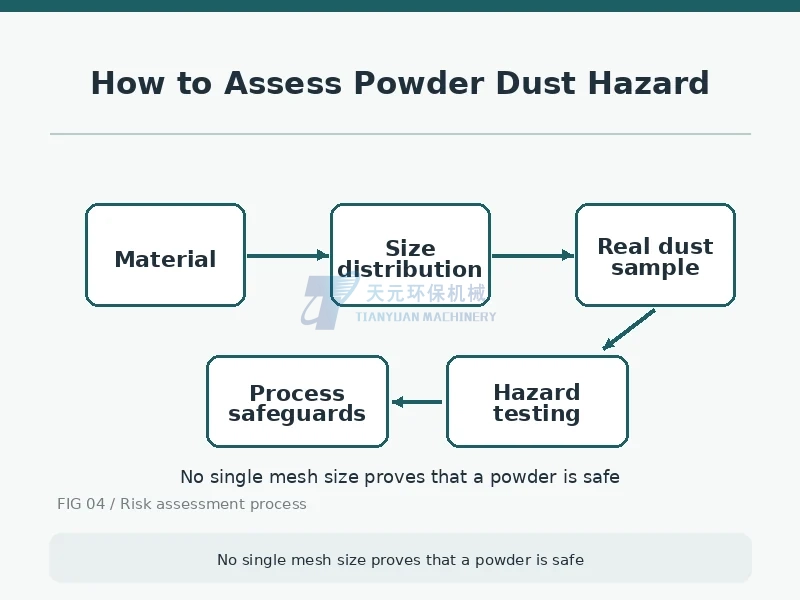
A defensible review starts with the real material and representative operating conditions. Determine material composition and potential combustibility; map places where finer particles are created or concentrated; collect appropriate representative samples using safe methods; document particle-size distribution, moisture and shape; and arrange suitable laboratory hazard testing when required. Qualified professionals should interpret the results against the applicable local requirements.
Published tables or values from nominally similar materials can help screen for possible hazards but may not represent a particular powder batch or production stage. Testing conditions, sampling method and the actual particle-size fraction must be known before applying results to ignition-source control, dust collection, isolation or explosion-protection design.
FAQ
Does a smaller particle always mean a more dangerous dust?
Often a finer combustible fraction deserves greater attention, but there is no universal monotonic rule across all materials. Density, chemistry, shape, oxide layers, moisture, dispersion and other process variables can change the outcome.
Does a particle size above 420 μm mean the powder is safe?
No. That figure has historical screening and terminology uses. Fibers, flakes, agglomerates and fines created during handling may still present a hazard.
Can 200 mesh or D50 alone tell me the explosion risk?
No. Neither a nominal mesh specification nor one median size describes all airborne fines, ignitability or deflagration behavior.
Should dust from a collector be assessed separately from finished product?
It may need separate representative sampling and evaluation because the collected fraction can differ substantially from the bulk product.
Can the same dust-hazard numbers be used for wood powder and metal powder?
No. Dust properties and test results are material- and sample-specific; do not transfer values between unlike powders.
Conclusion
Particle size matters because it changes surface exposure and often how readily dust becomes airborne, both of which can influence ignition and burning behavior. It must be assessed alongside the full size distribution, material properties and real process conditions. A powder line should use representative samples and qualified hazard review rather than a mesh limit or mill specification as a safety guarantee.