Fine powder packaging is the final interface between powder processing and transport, storage or customer use. A powder that leaves a grinder or screen may be suitable for its particle-size target yet still be difficult to fill, weigh or protect in a package.
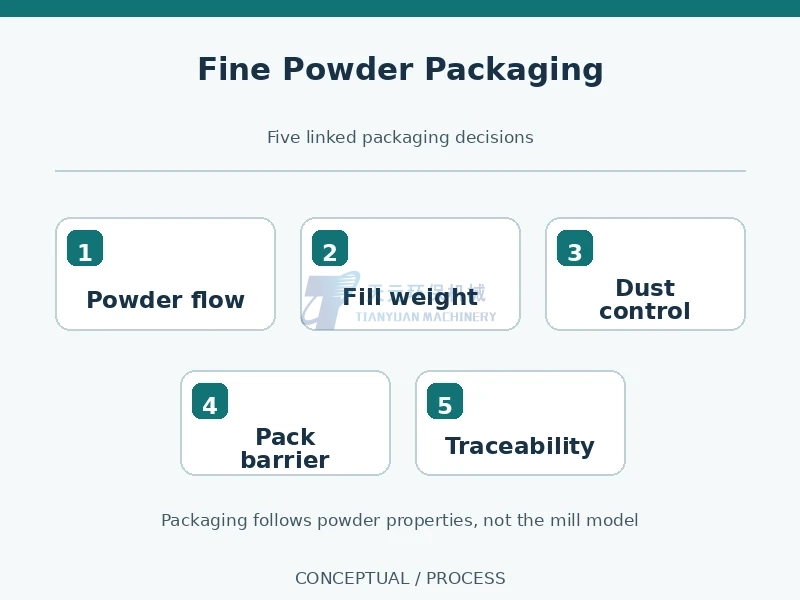
Key answer: fine powder packaging should be designed around five connected requirements: powder flow into the pack, accurate net mass, containment of airborne dust, suitable package protection, and traceable identification. The package must be selected for the actual powder and end use—not from the milling-machine model or mesh size alone.
Why one packaging specification cannot fit every powder
Two powders with the same nominal mesh size can behave very differently. They may have different particle shapes, moisture uptake, aeration, bulk density and tendencies to adhere or form agglomerates. A lightweight wood flour can fill a much larger volume than a dense metallic powder at the same net mass. Even one powder may settle after filling as entrained air escapes or the package is vibrated.
The decision is therefore not simply “bag or drum?” Start with the powder specification, how it behaves in the filling zone, the customer’s storage requirements, and the material’s safety profile. Pack dimensions must be checked against practical bulk density and settling behavior rather than inferred from mesh size.
Which powder properties affect bag filling?
- Particle-size distribution and particle shape: influence cohesiveness, dust release, segregation and flow through openings.
- Loose and settled bulk density: influence occupied volume, package size and settling after filling. These are not the same as true material density.
- Moisture, hygroscopic behavior and caking: can change flow and storage stability.
- Flowability under the actual handling conditions: determines whether a material bridges, forms a stable channel or discharges consistently.
- Dustiness and air entrainment: affect bag-mouth containment and whether a filled package changes shape as air escapes.
- Combustibility, reactivity and oxidation sensitivity: require material-specific review before the fill station, liner and storage configuration are finalized.
It is usually better to assess these properties together than to rank a powder by one angle-of-repose reading or by its D50. The packaging design must also account for whether a finished product has been screened or classified and how sensitive it is to contamination during the final transfer.
How should dust be contained at the filling point?
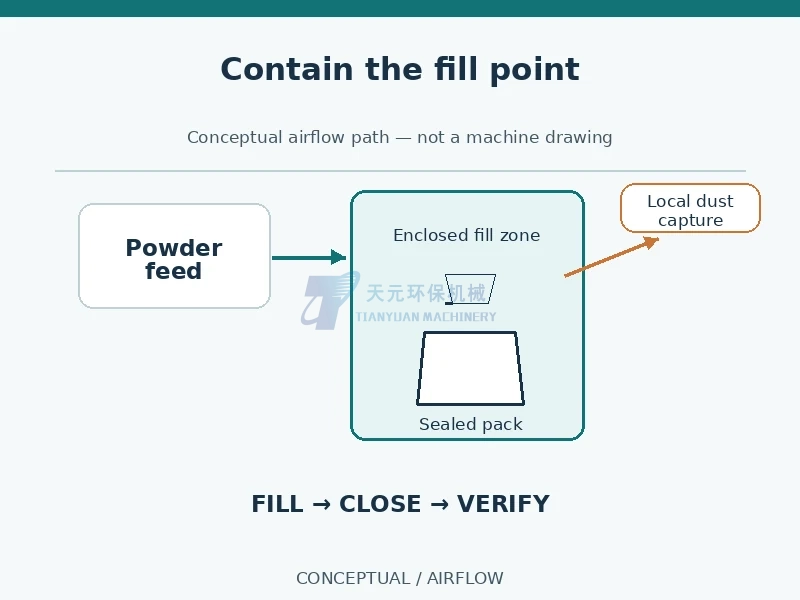
Bag mouths, chutes, temporary openings and displaced air are common points where fine powder can escape. Enclosure or a close-fitting bag connection, suitable extraction near the source, and a controlled cleaning method can reduce uncontrolled spread. The UK Health and Safety Executive recommends enclosing harmful-substance processes where practicable, using closed transfer and appropriately designed local exhaust ventilation to limit exposure.
A high-efficiency filter placed elsewhere in the building does not replace good source capture. The airflow and containment arrangement should be designed for real filling rates and powder properties, while any collected dust should be evaluated before being returned to finished product. See HSE guidance on containment and local exhaust ventilation.
How is net fill weight verified?

Net mass = gross mass − tare mass. A filling system may use manual-assisted weighing, controlled gravity discharge, screw-based dosing or another validated method. The choice is driven by flow, target amount, cleaning needs and dust hazard—not by the assumption that all fine powders flow like grains.
For a gravimetric fill, the process should account for bag or container tare, coarse and fine feed control where applicable, material still falling after shutoff, powder attached to equipment surfaces, and settling after filling. A checkweighing step and a documented calibration and sampling plan provide more useful assurance than the stated resolution of the scale alone.
No universal filling tolerance or repeatability figure can be claimed without the packaging specification, local rules and tests on representative product. The upstream mill’s hourly production rate is not automatically the packaging station’s verified capacity.
What packaging barrier and closure are needed?
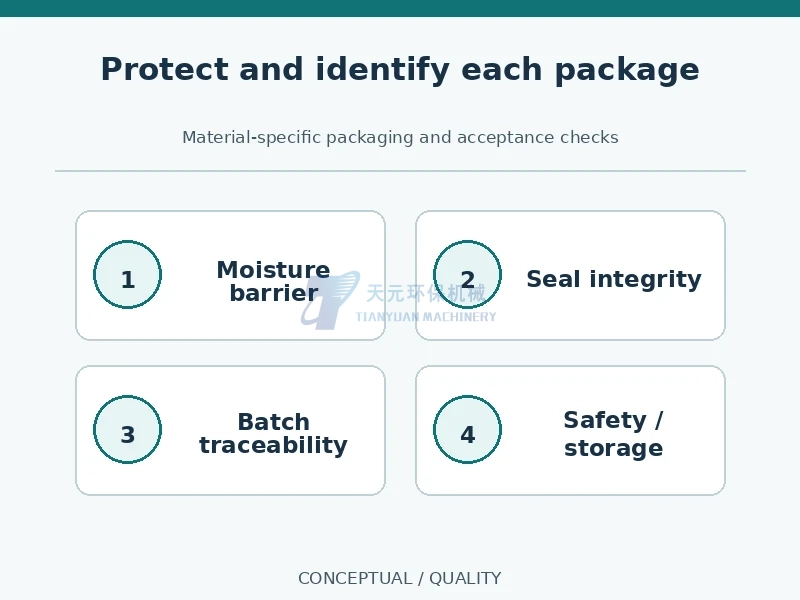
Packaging material should be evaluated for moisture resistance, leak resistance, physical strength, handling damage, compatibility with the powder and the planned storage period. A suitable liner or multi-layer package may be useful for some products, but the specification should be based on documented performance requirements rather than a generic claim that one bag is airtight or moisture-proof.
Closure quality matters as much as the bag film. Check seams, closures, product trapped in a seal, punctures and the condition of packages after handling. Products sensitive to oxygen or moisture need an agreed storage specification; an inert-atmosphere option cannot be assumed safe or effective for every metal powder and must not be improvised.
Wood flour and metal powder: different checks
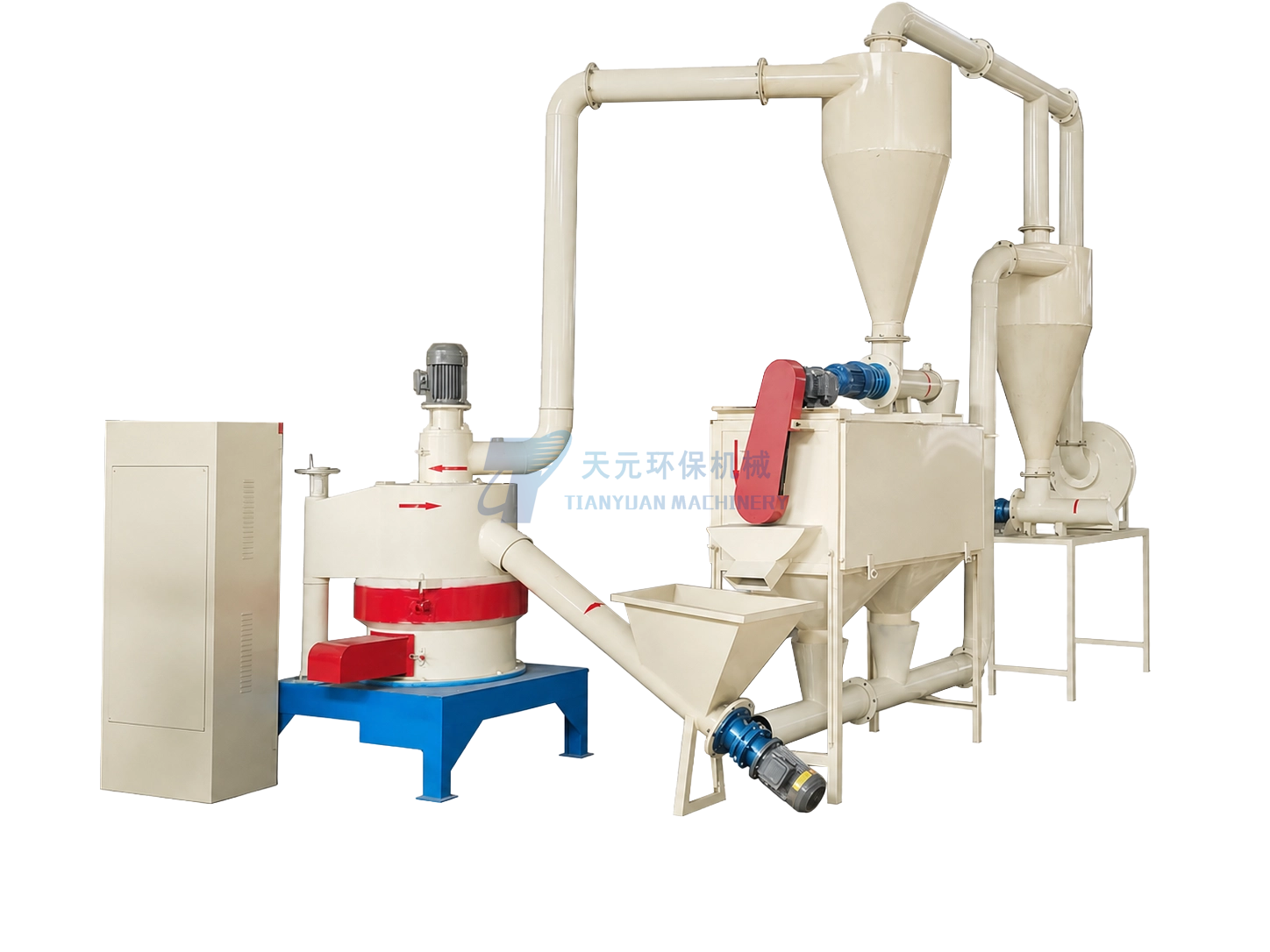
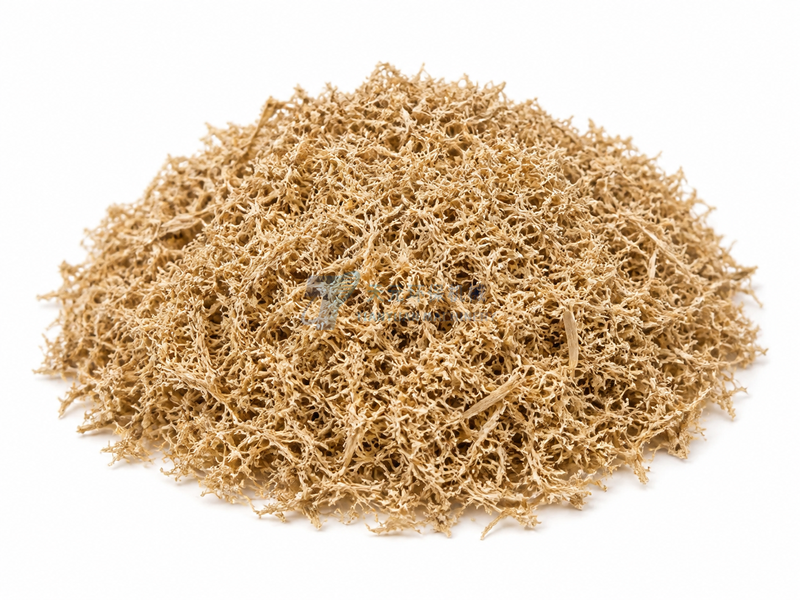
For wood-based powder, important packaging questions include moisture control, low bulk density, fiber-related flow behavior, dust release and the possibility of settling. Tianyuan’s TYMF6R-600 wood-powder equipment page shows grinding, separation, screening and collection as process stages; packaging should be considered a downstream interface and specified for the actual finished powder.
For mechanically prepared metal powder, density, particle morphology, abrasion, oxidation and possible dust reactivity may alter the necessary packaging and handling method. The TYJSMF500 metal-powder mill page documents powder recovery, screening and finished-product handling as distinct process stages. The machine’s own grinding specifications must not be mistaken for a bagging machine’s filling or accuracy specifications.
Wood dust and certain metal dusts can be combustible; OSHA identifies both categories as examples. Ordinary enclosure, dust filtration or grounding alone does not amount to a complete combustible-dust protection design. Where indicated by the material, qualified professionals should assess ignition sources, electrostatic control, dust accumulation, equipment protection, packaging compatibility and relevant transport requirements. See OSHA combustible-dust guidance.
Pre-shipment quality and traceability checklist
- Confirm material name or grade, intended specification and lot or batch identifier.
- Record the agreed net mass and the method used to verify it.
- Check relevant product characteristics, such as particle-size grade and moisture, when included in the supply specification.
- Inspect seams, closures, visible leakage and transport handling damage.
- Confirm storage conditions and whether the package protects against the specific moisture or oxygen exposure identified for the product.
- Apply batch traceability and handling labels; where a product is classified as hazardous, use the applicable destination-country hazard communication, SDS and transport requirements.
For hazardous chemicals shipped in the United States, OSHA’s Hazard Communication Standard includes specific container-label and safety-data-sheet provisions. These rules should be assessed for applicability; a generic product-name sticker is not necessarily a substitute for required hazard information.
FAQ
Can bag size be calculated from mesh alone?
No. A useful package-volume estimate needs actual bulk density, aeration and settling behavior as well as the target net mass. Mesh size by itself does not determine package volume.
Does a precise weighing scale guarantee accurate finished bags?
No. Flow interruptions, material falling after shutoff, tare variation, product adhesion and calibration or sampling practice can affect final net mass.
Does every wood-flour package need the same inner liner?
No. The correct liner or bag depends on moisture sensitivity, intended use, storage conditions, dust release and safe handling.
Is vacuum or nitrogen packing automatically suitable for metal powder?
No. The actual metal and particle properties, oxidation sensitivity, possible reactivity and professional hazard evaluation govern whether such a process can be used.
Can dust collected around the filling station be blended back into finished powder?
Not without evaluating lot identity, particle-size distribution, contamination and the applicable product acceptance criteria.
Conclusion
Fine powder packaging succeeds when the material can be filled predictably, the actual net mass is verified, dust is controlled at the source, the package protects the powder, and each lot remains traceable. These decisions belong to the downstream powder-handling process, not to the grinder model alone; combustible or reactive materials require additional specialist safety assessment.