
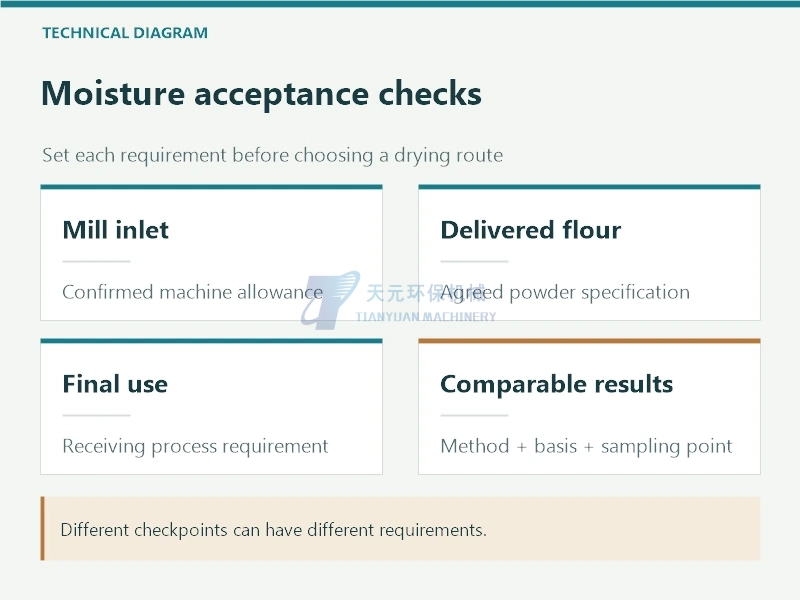
Whether chips, sawdust or shavings need drying depends on their condition at the fine mill inlet. A supplier’s description of material as dry or wet is insufficient. Machine acceptance, finished flour specifications and downstream requirements are separate checks.
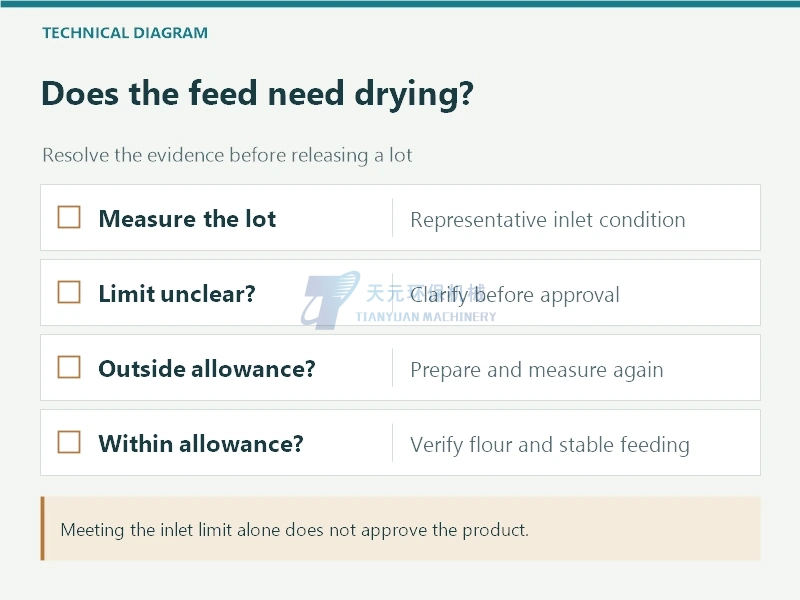
Consider omitting pre-drying only when representative measurements meet the confirmed inlet conditions and the process can repeatedly deliver acceptable flour. If moisture exceeds the permitted conditions, or controlled verification shows that reducing it is necessary to meet the target, prepare the material before feeding. Missing limits or measurements require clarification, not an assumed universal percentage.
Contents
Separate the three moisture requirements
Mill inlet, delivered flour and final use
Write down the mill’s permitted inlet condition, the moisture specification for delivered flour and the requirement of the receiving process. They may differ. Flour suitable for shipment is not automatically ready for a particular resin formulation; a downstream limit is not automatically the best mill-inlet target either.
For each requirement, record the test method, wet or dry basis, sampling point and who approves acceptance. The wood moisture and grinding guide explains the mechanisms. This article addresses the practical decision to include drying in a proposed route.
Measure material that represents the actual inlet
A dry handful from the top of a pile cannot approve a lot. Sample across relevant sources, storage locations and deliveries, keep individual results with their lot identity, and use a method suited to loose chips or sawdust. The wood moisture and grinding guide covers moisture basis and representative measurement in detail. Because wood exchanges moisture with the surrounding air, as the USDA Wood Handbook moisture chapter explains, an earlier supplier report may no longer describe the material at the inlet.
| Question | Record | Decision value |
|---|---|---|
| Which condition was tested? | Sampling point, lot, date and storage history | Represents the fine-mill inlet |
| What does the percentage mean? | Method and wet or dry basis | Allows a valid comparison with the limit |
| How variable is the lot? | Individual results and unusual fractions | Avoids approving every portion from an average |
| What will the flour be used for? | Delivery specification and application | Separates inlet approval from final acceptance |
Choose between preparation, clarification and assessment
Do not feed a lot into fine milling when its measured condition exceeds the confirmed machine allowance. Prepare it into the allowed condition and recheck. If the allowance or measurement basis is unknown, keep the decision open; absence of data does not demonstrate that drying is unnecessary.
Material that meets the inlet condition still needs acceptable flour quality, repeatable feeding and batch consistency. Additional drying may be unnecessary if these are satisfied. Where problems occur, examine size, shape, contamination and equipment condition alongside moisture. Choose moisture adjustment when a controlled comparison supports it, rather than assigning every fault to wet feed.
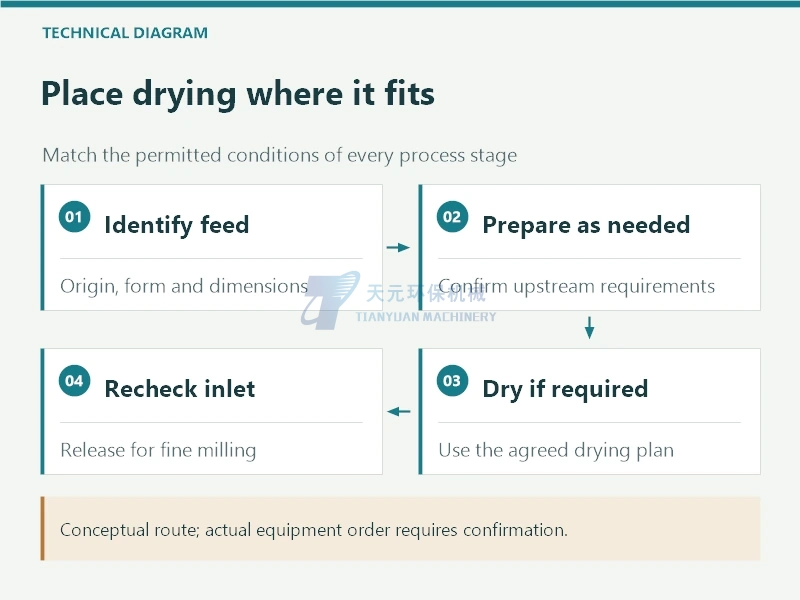
Place drying around the actual feed preparation route
Coarse-processing capability is not fine-mill approval
Logs, branches and bulky offcuts require suitable preparation. A particular upstream machine accepting wetter material does not give a downstream powder mill the same inlet conditions. Choose the order using the material form and the requirements of both the preparation and drying equipment.
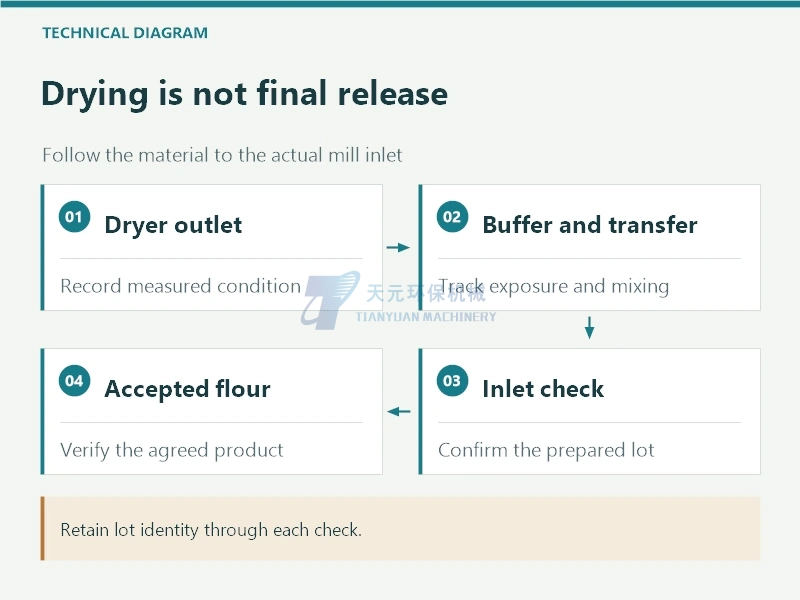
Clemons’ Wood Flour chapter describes size reduction and classification as central production operations. The diagram here is a conditional process explanation, not an equipment layout. After drying, check dimensions, mixing and moisture again; a completed drying step is not itself permission to feed the mill.
Compare complete routes to the same accepted product
Compare routes with and without drying on a common raw-material basis and identical accepted-flour criteria, including drying heat, milling electricity, recirculation and rejects. Wet feed mass also contains water, so it does not equal useful powder output. The wood moisture and grinding guide explains how to set this energy boundary, and the wood flour and pellet LCA case study by Pokhrel and colleagues is an example of explicitly defined production and transport boundaries.
Release the prepared feed at the mill inlet
One dryer-outlet reading does not represent an entire lot after buffering, transfer and mixing. Check that the feed still meets the confirmed condition before fine milling. Record any required cooling or conditioning, and review whether storage or handling can change the prepared material.
Use the grinding test preparation guide to agree measurements, flour acceptance and continuous-operation observations in advance. Retain linked feed and powder records. Evaluate accepted powder rather than visible discharge alone. Sample quantity, test duration and acceptance thresholds belong in the actual test plan.
Apply TYMF6R-600 specifications within their scope
The published TYMF6R-600 ultrafine wood powder mill ranges are 30–325 mesh, 100–500 kg/h and a maximum feed diameter of 5 mm. This is fine milling after necessary preparation. The finest grade and highest throughput are not a simultaneous guarantee or a test result for your material. Elongated pieces also require a check of complete dimensions and permitted form.
The product page states that suitable materials should have a moisture content of less than 15%, without specifying a wet or dry basis. Confirm the basis and measurement method with the technical team in the project documentation. A model acceptance boundary is not the optimum drying target for every wood type, fineness or application. TYMF6R-600 performs fine milling after necessary preparation; an upstream crusher accepting wet feed does not establish the same acceptance here.
Include repeat checks and dust control
Revisit the drying decision when material source, season or storage practice changes. A single accepted sample cannot stand for all future supply. Record the changes and observations that call for another assessment, and agree the verification frequency for the project.
Drying and powder transfer also need appropriate dust controls. HSE wood-dust guidance supports capture before dust spreads. Dust collection and fire and explosion protection should be assessed for the actual material and installation.
Frequently asked questions
Must all wood be dried before grinding?
No. Measure representative inlet moisture, confirm the allowance and verify product and operating requirements. Material already satisfying them may not need additional drying.
Can air-dried sawdust go straight into the mill?
Air drying describes its history, not its present acceptance. Check the condition after storage and transfer, together with dimensions, contamination and feeding behavior.
Is a published moisture allowance the optimum drying target?
No. An acceptance boundary and an optimum process target are different questions. The wood moisture and grinding guide explains how to validate a working range inside the equipment limits.
Should drying come before or after crushing?
Use the material form and the permitted conditions of each stage to decide. Coarse preparation and fine milling may accept different moisture conditions.
Is the driest material always the cheapest to process?
That cannot be assumed. Compare the complete routes at identical accepted-flour requirements, including heat, electricity, recirculation and rejects.
What to prepare next
Provide material origin, complete dimensions, actual inlet moisture and its measurement method, required flour specifications and intended use. These allow the technical team to decide whether drying is needed and where it belongs in the process.
The studies cited here describe their own materials and methods. They are not test results for Tianyuan Machinery equipment; limits for your project come from its own measurements and trials.