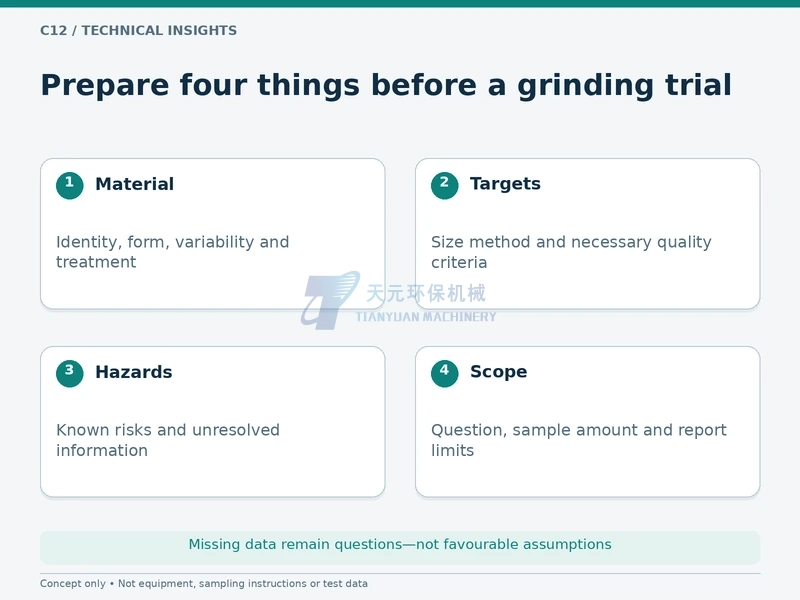
“Send some material and see whether it grinds” leaves essential questions unanswered. A useful trial needs to connect the material actually supplied, its preparation history and the measurements that will decide whether the result meets the intended use.
Key answer: Before a grinding trial, prepare an accurate material description, a representative feed sample, measurable finished-powder targets, relevant hazard information and an agreed scope. Sample quantity, test duration and acceptance limits must be agreed for that material and equipment; there is no universal number of kilograms that proves every application.
Contents
Decide what question the trial must answer
A feasibility trial asks whether specified feed can produce an acceptable powder under the tested conditions. A comparison trial examines agreed operating alternatives. A sustained-production test or whole-line acceptance exercise addresses a wider scope, including interfaces and stability. A short sample run cannot automatically answer all three questions.
State a practical question before selecting settings: for example, whether the prepared feed meets an agreed particle-size criterion after milling. Identify which quality properties will actually be measured and which require later work. “Finest powder, maximum throughput and minimum energy at once” is not an agreed acceptance specification.
Describe the material as received, not just its name
- Material identity, grade or known composition, and the process that generated it.
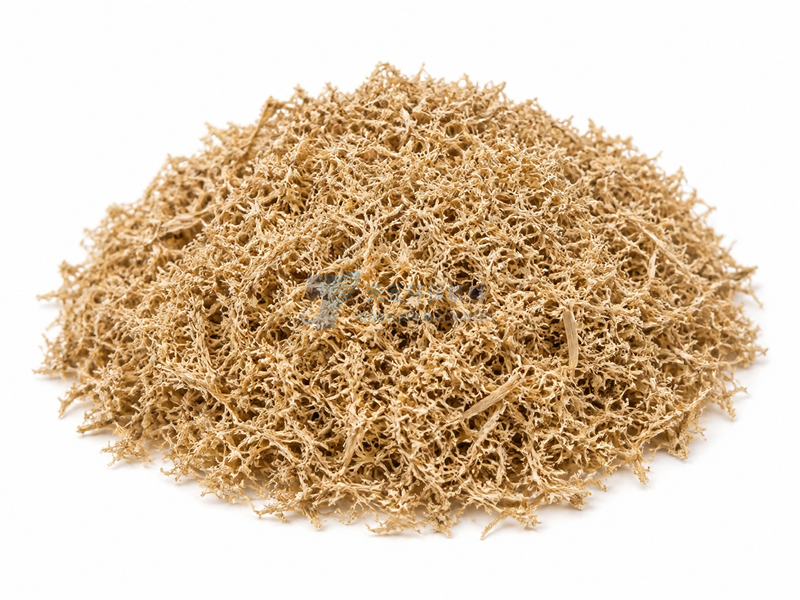
- Form and size distribution: granules, fragments, turnings, flakes or fibres, including oversize pieces.
- Known moisture, oil, coatings, contaminants and typical batch variability.
- Cleaning, drying, pre-crushing or other treatment already performed.
- Known hazards and any information that remains unknown or unmeasured.
Do not fill a missing measurement with an optimistic assumption. Photographs can help show shape, but do not establish composition, moisture, contamination or safe processing conditions. A wood species name does not determine the actual moisture or fibre condition of the submitted batch.
Make the sample represent the intended production feed
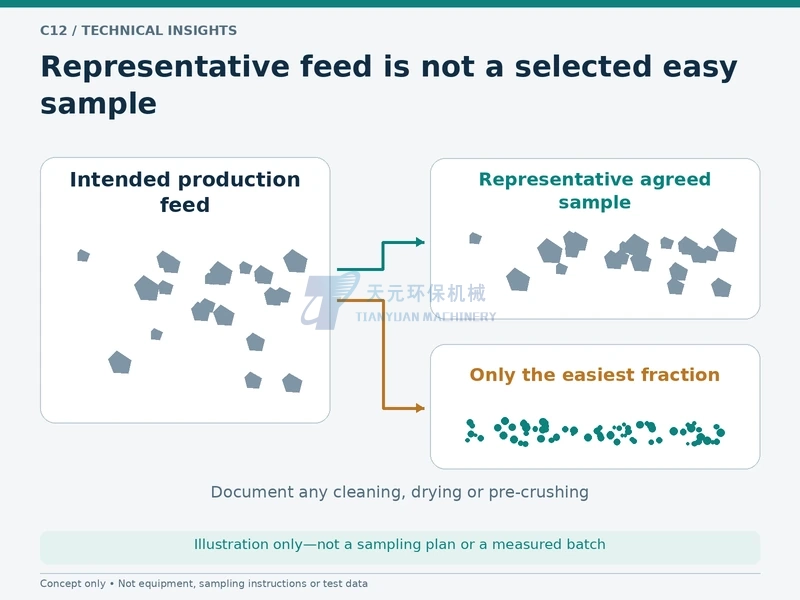
RETSCH’s sample-preparation guidance explains why representative division matters. For a production milling trial, there is an additional requirement: preserve the relevance of the intended mill feed. An analytical sample already reduced to fine powder is not a substitute for the coarse input the machine will actually receive.
Avoid selecting only the driest, smallest or cleanest pieces. Equally, identify unusual contamination or an abnormal lot rather than silently presenting it as routine feed. The sampling plan must consider the batch, segregation and safe access; agree it with the receiver or qualified personnel instead of inventing a fixed number of grab samples.
When the trial uses pre-crushed material, record how it was prepared and the resulting size condition. Any cleaning or drying must be agreed and documented. Making an ideal sample without recording the change can hide a problem that returns during production.
Turn a fineness request into measurable acceptance criteria
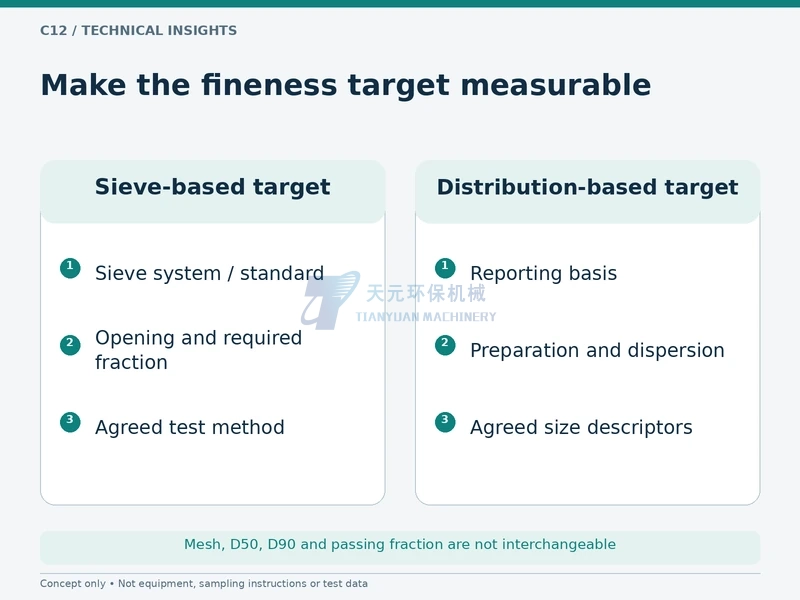
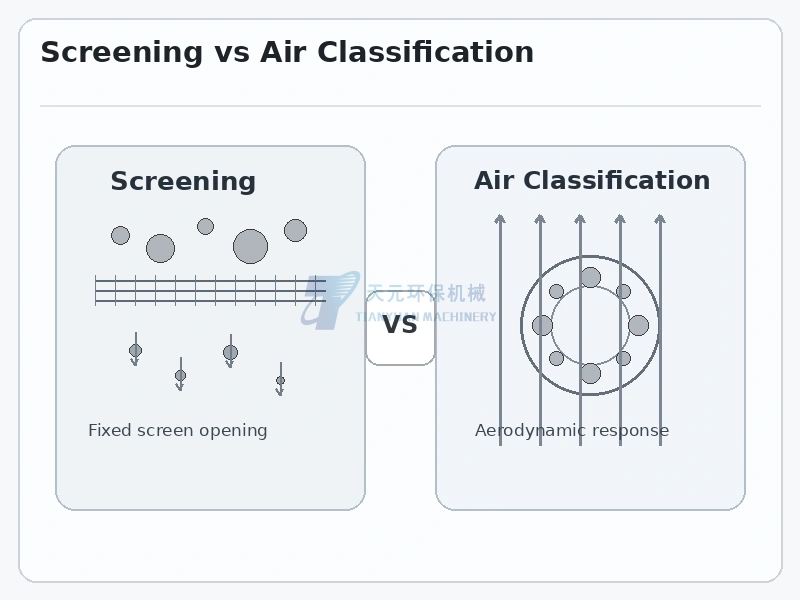
For sieve-based requirements, state the sieve standard or system, actual opening, required passing or retained fraction and test method. Particle-size separation methods must not be treated as interchangeable measurement promises. Where a particle-size distribution is required, agree the reporting basis, dispersion and preparation method. D50, D90 and sieve passing percentages are not interchangeable without qualification.
Choose additional quality criteria according to use: purity, contamination limits, moisture or particle form where relevant. State what qualified output means and the observation interval used to calculate it. Address start-up and return material in the reporting scope; instantaneous feed rate alone does not establish accepted-powder production.
Agree quantity and safe receipt before shipping
The required amount depends on feed size and variability, equipment hold-up, trial purpose, operating comparisons, analysis and retained samples. Equipment selection itself depends on material and reduction duty. RETSCH’s application laboratory process illustrates discussing requirements and sample information before testing; this is an industry reference, not a promise that Tianyuan offers identical equipment, pricing or reports.
Ask the receiver to confirm the material can be accepted, the required amount and the documents and packaging needed. For combustible, reactive, oily, wet or unidentified material, disclose known hazards and provide an applicable safety data sheet when available or required. Qualified personnel must resolve classification and transport obligations; do not improvise a shipping method.
OSHA’s combustible-dust information and its hazard guidance explain why material-specific review matters. Do not burn, heat or wash an unknown powder yourself to establish its safety. An absent hazard value means missing information, not proof that the sample is harmless.
Use Tianyuan model limits as input checks, not guarantees
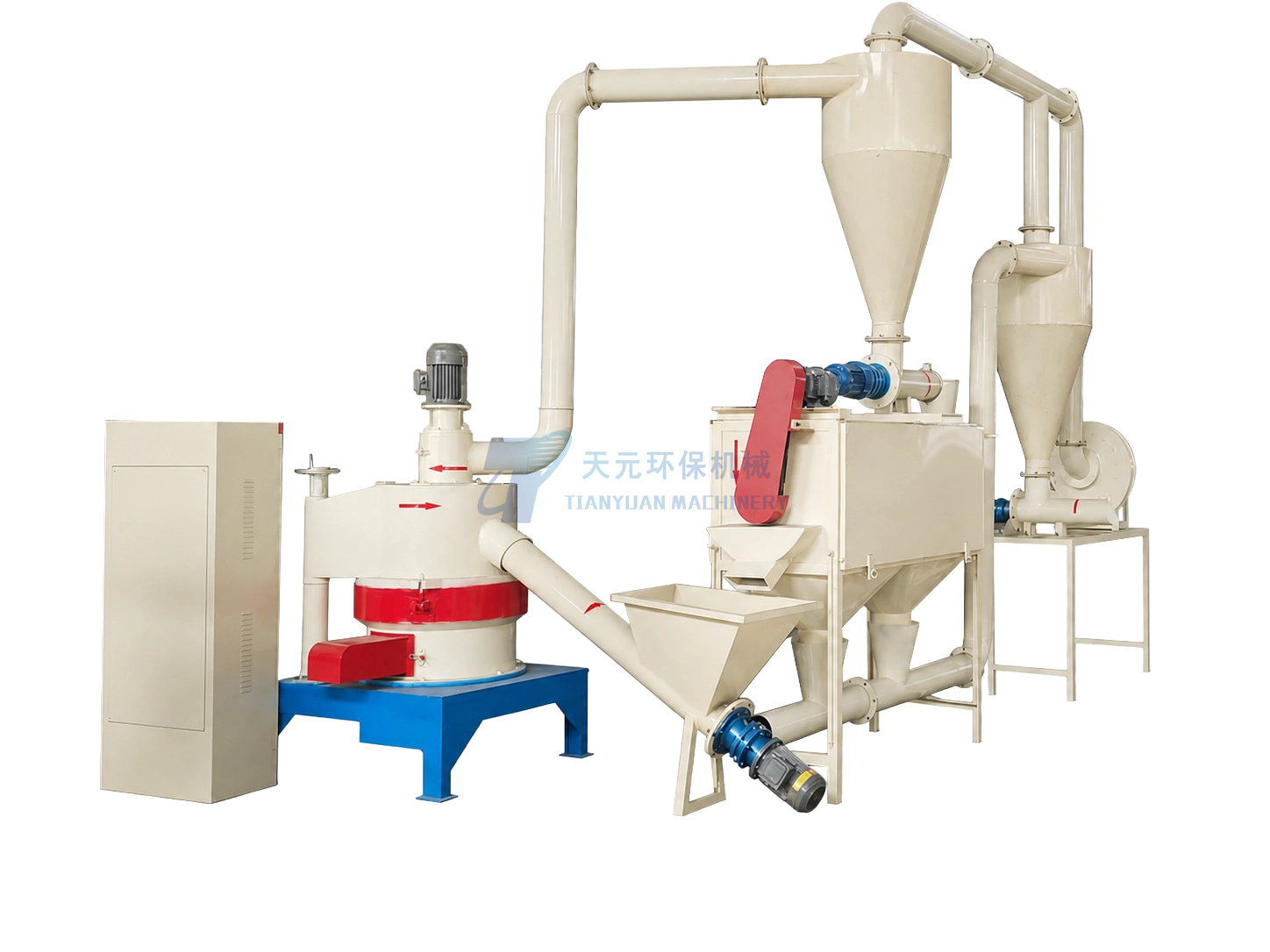
The TYMF6R-600 is for fine milling of suitably prepared woody or plant-fibre material, not direct coarse reduction of logs. The TYJSMF500 is for suitable metals and alloys assessed for mechanical powder production, not mineral ore.
The confirmed maximum feed condition for these two models is 5 mm; for TYMF6R-600 the stated basis is maximum feed diameter. Meeting that dimension is only one entry requirement. Shape, ductility, moisture, oil, contaminants and hazards still need review. Refer to the individual model’s confirmed fineness and throughput ranges; meeting the feed size does not guarantee every target combination.
Agree the report boundary before the trial starts
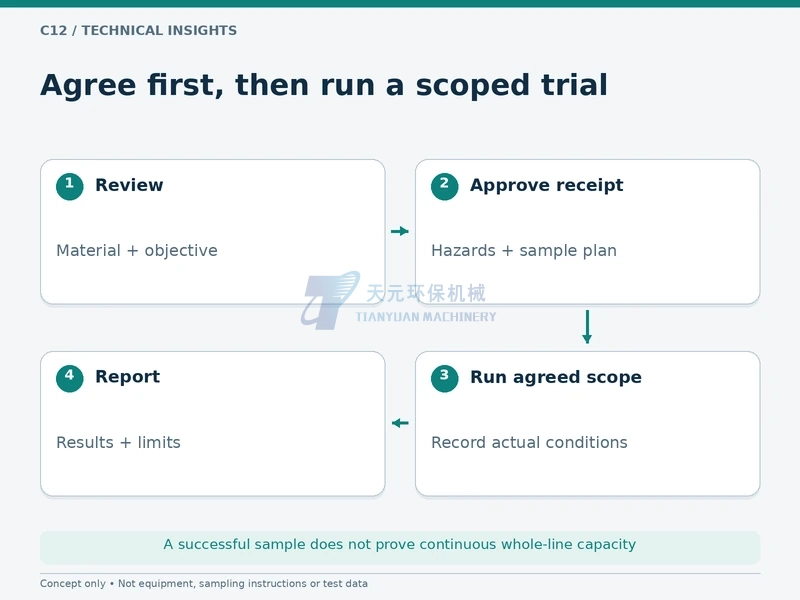
A useful written scope identifies the received sample, pretreatment, model, actually recorded operating conditions, measurement methods, acceptance criteria and output observation interval. It should identify rejected or returned fractions and limitations. Record untested points explicitly rather than leaving readers to assume that all operating conditions were validated.
- Material and intended feed state; treatment history.
- Target fineness and measurement method; other necessary quality criteria.
- Definition of accepted output and the scope of the test.
- Known hazards and unresolved safety information.
- Sample quantity and receiving conditions: to be agreed, not guessed.
- Requested report, retained samples and limits on interpreting the result.
This is a preparation checklist, not a completed test record. Missing fields remain open questions. Use Tianyuan’s contact page to communicate the trial brief; agree acceptance and logistics before sending material.
FAQ
Are photographs enough to decide whether a material can be milled?
They can help identify form, but do not establish composition, moisture, contamination, hazards or sustained milling performance.
Should every material be sent in the same quantity?
No. The receiver must agree the amount against the feed and trial scope. This article does not prescribe a universal sample weight.
Should I make the sample as clean and dry as possible?
It must represent the agreed feed condition. Any cleaning or drying should be discussed and recorded so the trial does not conceal normal production variability.
Is “100 mesh” a complete target?
No. Define the sieve system or opening, passing requirement and method, or explicitly agree a different distribution-based specification.
Does one acceptable sample prove whole-line capacity?
No. Sample quality, sustained qualified output and whole-line stability require different scopes of verification.
Conclusion
Good grinding test preparation aligns the sample, the intended equipment inlet and measurable product criteria. Record material and treatment honestly, agree safety and receiving conditions, define the trial and report scope, then confirm quantity. The goal is a result that answers the real production question—not an unusually easy sample that produces a misleading success.