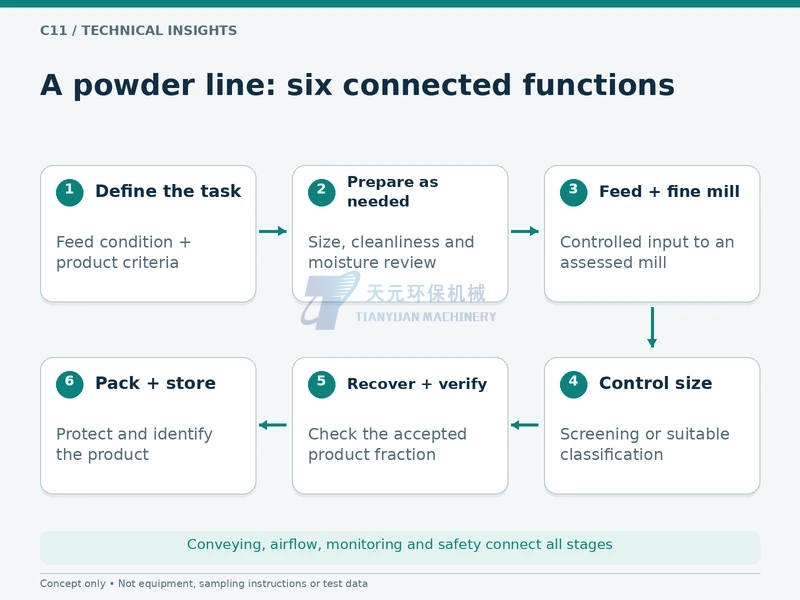
A powder processing line is more than a row of machines. It needs a defined feed condition, an agreed finished-powder specification, and separate routes for acceptable product, oversize material and dust-laden gas.
Key answer: Typical functions are feed qualification, necessary pretreatment, controlled feeding, fine milling, particle-size control, product recovery and verification, then packaging and storage. Conveying, gas–solid separation, dust capture, monitoring and safety measures connect these stages. This is a functional sequence—not a universal equipment layout.
Contents
Start with the feed and the acceptance target
Name the material, but also describe its form, size distribution, moisture or oil condition, contaminants, variability and known hazards. “Wood” may mean logs, chips or prepared small fragments; “metal” may mean tangled turnings, flakes or clean granules. These inputs do not require identical preparation.
Define the product through an agreed test method and acceptance criterion. A mesh number alone does not state the sieve standard, opening size or required passing fraction. Where a particle-size distribution is specified, record the measurement basis and preparation method. Purity, moisture and particle shape may also matter to the intended use.
Use pretreatment only where the incoming material requires it
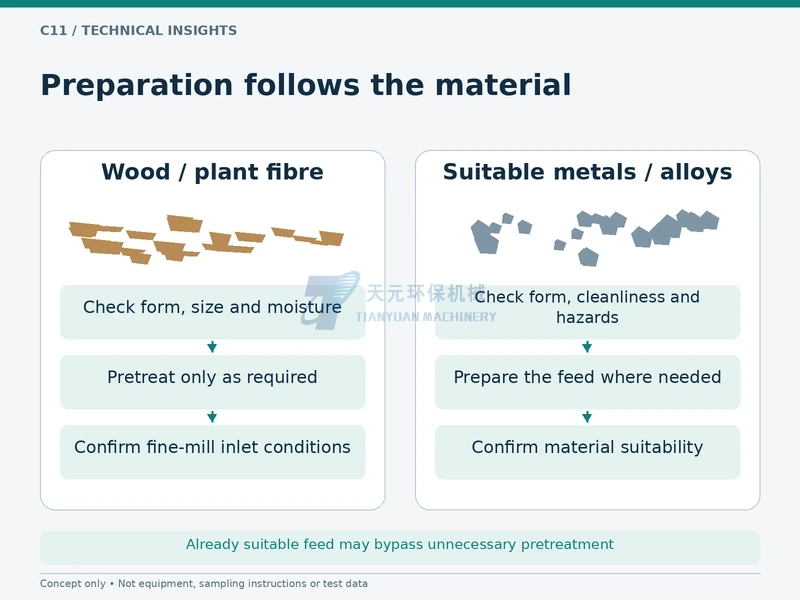
Wood and plant fibre
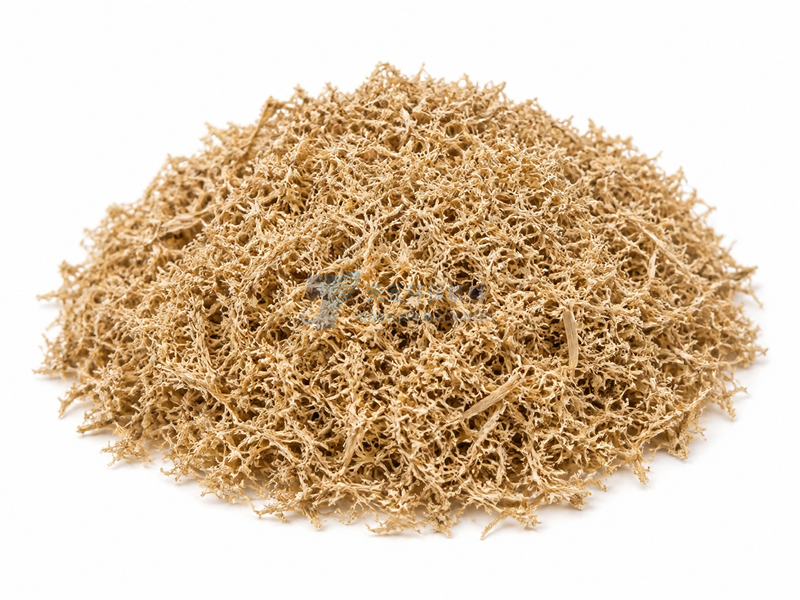
Chipping, coarse reduction and foreign-material removal may be needed before fine milling. Drying is conditional on the incoming moisture, equipment suitability and final specification; it is not a compulsory identical stage for every feed.
Suitable metals and alloys
Sorting, assessed cleaning and preliminary size reduction may be required. Oily, wet or unidentified mixed feed must not be treated as equivalent to clean, suitable metal granules. Material compatibility and hazards come before processing.
Pretreatment aims to meet the next stage’s inlet conditions. It does not guarantee the finished-powder size. Already suitable feed may bypass coarse reduction, while unsuitable feed may require a different processing route rather than simply another machine.
Coordinate controlled feeding with fine milling
The feeder must deliver material at a manageable rate. Bridging, interruptions or surges can destabilize downstream operation. A fixed screw speed does not automatically mean a fixed mass flow: bulk density and screw filling can change. Conveying and verified mass dosing should therefore be treated as different functions.
Milling reduces size or changes particle form; classification organizes the resulting size fractions. Hosokawa Alpine’s grinding and classifying overview shows both separate and integrated arrangements. A classification function therefore does not always mean a separate external machine. Dosing and weighing is likewise a coordinated material-flow and control task, rather than simply a conveyor setting.
Do not confuse particle-size control with powder recovery
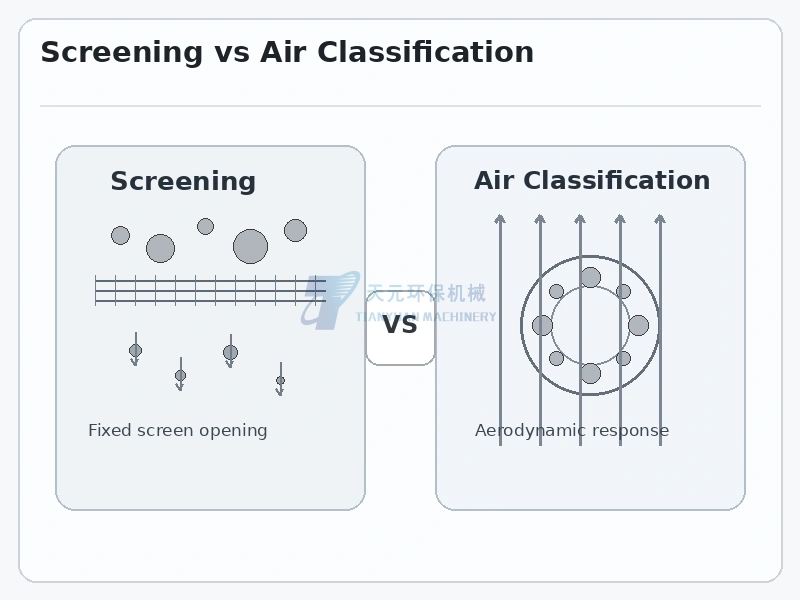
Screening and air classification have different separation principles and must be selected for the material and specification. A cyclone primarily separates solids from a gas stream; a filter captures residual airborne particulate. Neither cyclone discharge nor filter dust is automatically accepted finished product.
A real line may collect material in a cyclone before screening, or classify it inside a mill before recovery. The position of each device depends on the mill and airflow design. Oversize return also needs a controlled route: circulating load, repeated heating, contamination and changing material behaviour must be considered instead of assuming unlimited regrinding.
Draw the product path and the gas path separately
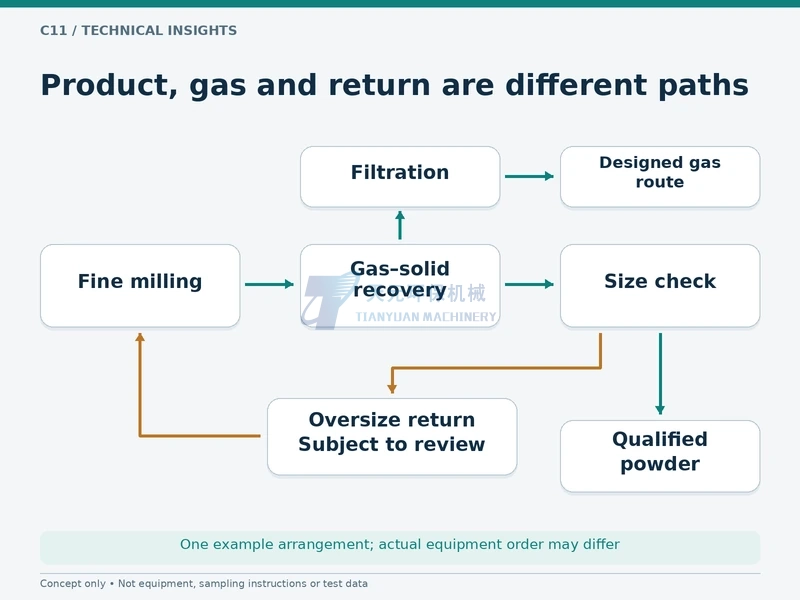
The EPA cyclone guidance describes inertial gas–solid separation, while its fabric-filter guidance explains particle capture and operating indicators such as pressure differential. These functions support the line, but cleaning the gas does not certify the powder’s size.
The product path should identify recovery, size verification, accepted output and rejected or returned fractions. The gas path should identify pneumatic transport or extraction, separation, filtration and the designed gas outlet or assessed recirculation route. Pressure losses, leakage and poor solids discharge can affect both paths; required monitoring is a design decision, not something proved by a fan nameplate.
Where Tianyuan’s two core mills fit
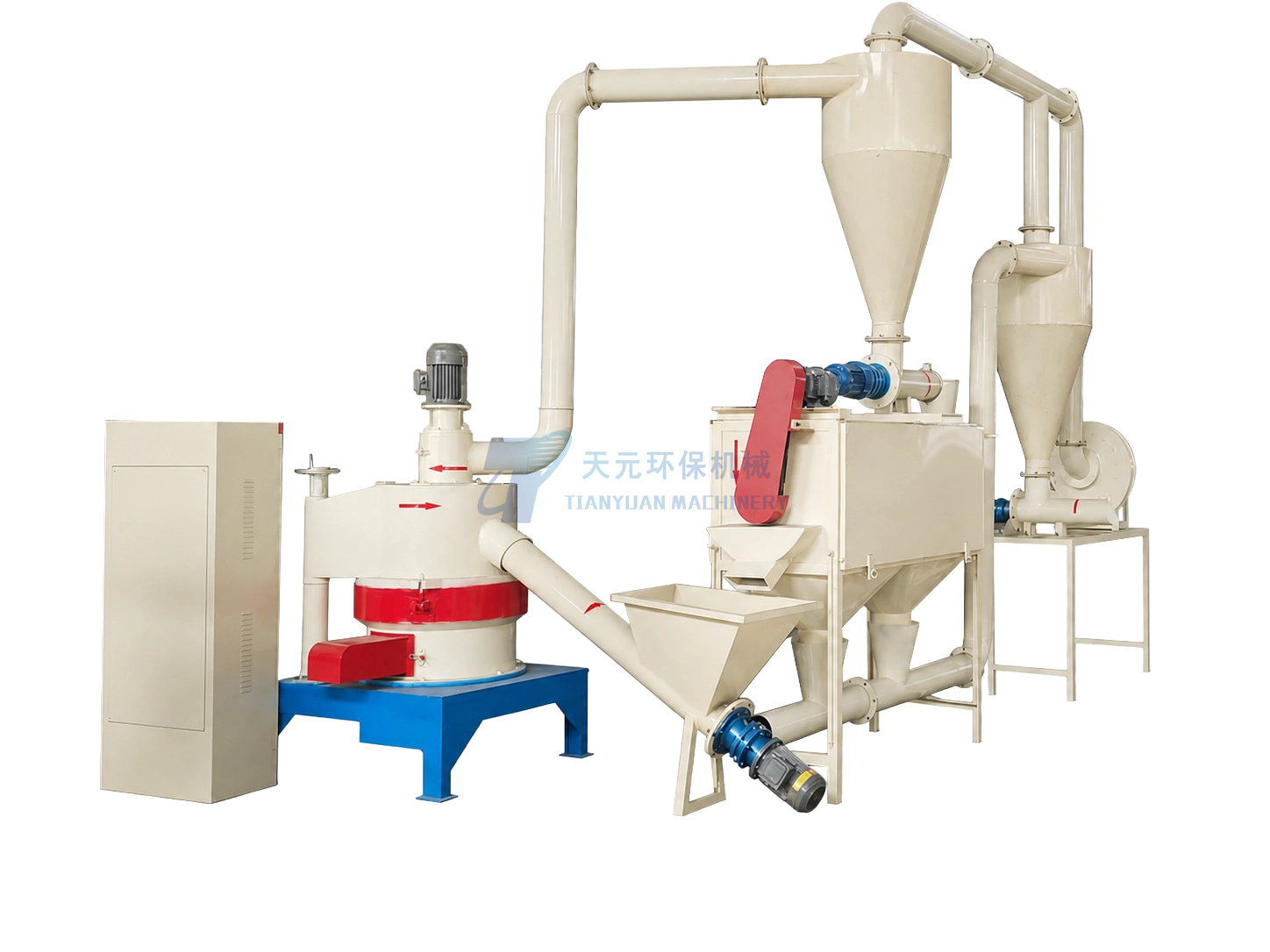
The TYMF6R-600 ultrafine wood powder mill is a downstream fine-milling machine for appropriately prepared woody or plant-fibre feed, not a log crusher. Its confirmed reference range is 30–325 mesh and 100–500 kg/h, with a maximum feed diameter of 5 mm.
The TYJSMF500 metal powder grinding mill is for suitable metals and alloys assessed for mechanical powder production, not stones or mineral ores. Its confirmed reference range is 20–325 mesh and 50–500 kg/h, with feed no larger than 5 mm.
Actual performance depends on material, feed condition, target fineness and site conditions. The upper ends of these ranges are not a simultaneous guarantee. These mill specifications are neither whole-line acceptance figures nor ratings for conveyors, screens, collectors, packaging equipment or other mill models.
Verify qualified output, interfaces and safety
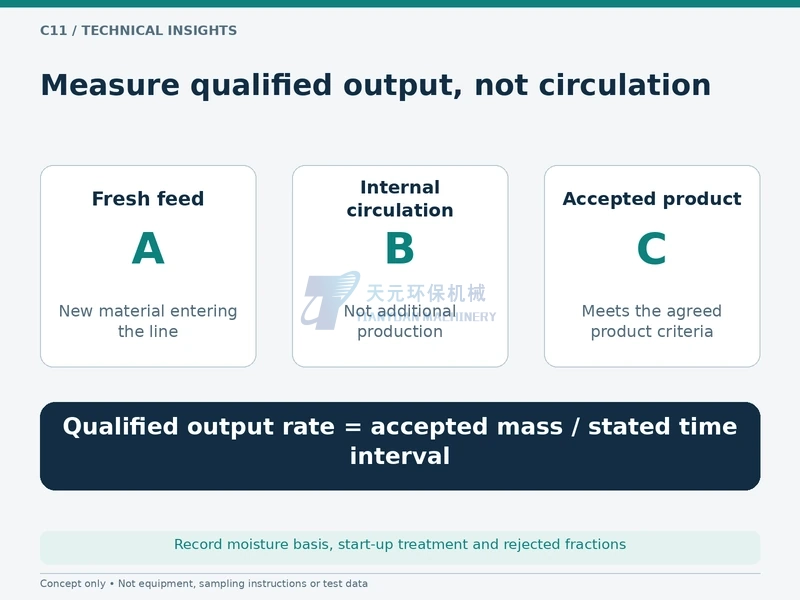
Distinguish fresh feed, material circulating within the line and qualified finished powder. A clear output measure is the mass of accepted product divided by the stated observation interval, with moisture basis, start-up treatment and rejected fractions identified. Counting return material again inflates throughput; a single sample or motor rating cannot prove continuous line capacity.
The limiting stage may be feeding, milling, screening, discharge, collection or packaging. Verify stable operation at their interfaces as well as product quality. Record the agreed conditions instead of comparing capacities stated on different bases.
OSHA identifies wood and various metal dusts as possible combustible dusts. Reception, milling, transfer, filtration, return and packing belong in a material-specific hazard assessment. Ordinary dust capture or grounding is not a complete fire and explosion protection design. The diagrams here are explanatory, not construction or safety drawings.
FAQ
Does every line need a separate dryer?
No. The need and method depend on feed moisture, equipment suitability and the product specification. Do not add a universal drying target without assessment.
Can a cyclone replace a screen?
Do not treat the functions as interchangeable. Gas–solid recovery does not establish compliance with an agreed sieve or particle-size criterion.
Can oversize material be returned indefinitely?
Not by default. Recycle load, heating, contamination and changes in the material require evaluation and control.
Does a mill rated up to 500 kg/h guarantee that much accepted powder?
No. A model’s reference range is not a whole-line acceptance guarantee. Actual conditions, rejection and other stages constrain output.
Can the same line simply be copied for wood flour and metal powder?
No. Feed preparation, milling suitability, gas handling and material hazards must be reviewed separately.
Conclusion
Plan a powder processing line by defining the input, finished-product criteria and safety boundaries first. Then connect the required preparation, feeding, milling, size control, recovery and packaging functions. Keep product, gas and return paths explicit, and verify the line through qualified output under agreed conditions—not machine count or an isolated mill rating.