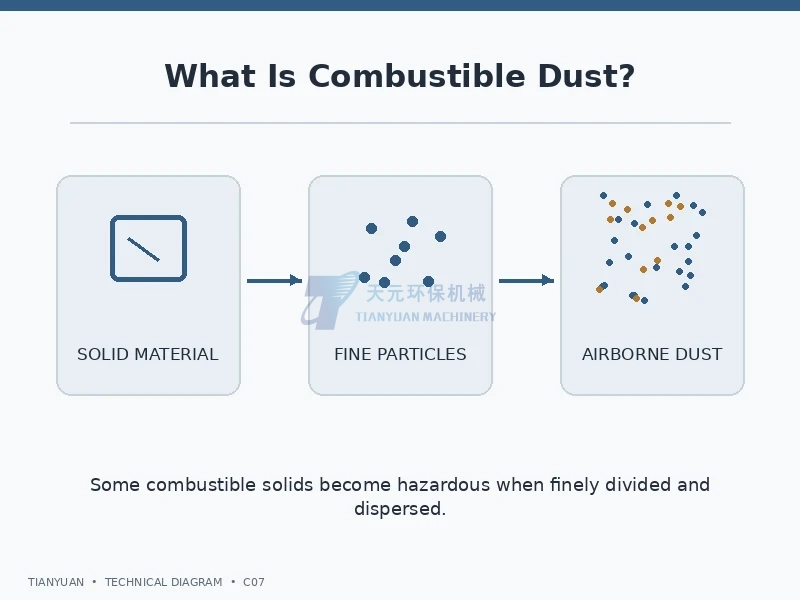
Combustible dust is a particulate solid that can present a fire or rapid-combustion (deflagration) hazard when dispersed in air or another oxidizing atmosphere under suitable conditions. It can include fine powder, fibers, flakes and other particulate forms. A material that seems difficult to ignite as a solid piece may behave differently after it is reduced to dust.
Key takeaway: Not every dust is combustible. But wood flour, many organic powders and some metal powders can become hazardous when finely divided and handled in equipment that produces dust clouds. A powder cannot be declared safe simply because its parent material is familiar, its mesh size is known or an ordinary dust collector is installed.
Definition: what makes dust combustible
The U.S. OSHA combustible-dust guidance describes combustible dust as particulate solid material capable of presenting fire or deflagration hazards across a range of concentrations in an oxidizing atmosphere. In practice, the same process material may appear as larger pieces at the feed stage, fine powder at the mill outlet, suspended dust inside a conveying duct and settled dust on plant surfaces. Each state creates a different exposure and ignition scenario.
A dust hazard assessment therefore asks two separate questions: Is the material capable of burning or deflagrating in dust form? And can the equipment or workplace create the conditions for ignition and fire propagation? Identifying a combustible material does not by itself prove a dust explosion is imminent, but failing to recognize it can cause serious design errors.
Which powders can be combustible?
OSHA lists examples from wood processing, food and agriculture, plastics, rubber, paper, pharmaceuticals, coal and metalworking. Some familiar examples include sawdust and wood flour; sugar, flour and starch; polymer dust; and some metal powders such as aluminum, magnesium, zinc or iron. These are hazard-identification examples, not laboratory classifications for every batch or alloy.
| Powder group | Examples | What needs checking |
|---|---|---|
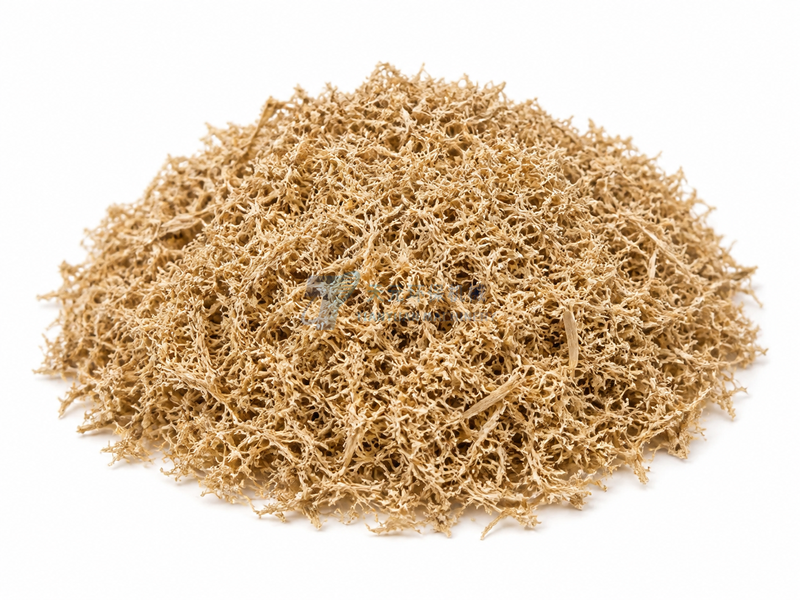
| Wood and plant materials | Wood flour, sawdust, fine fibrous residue | Moisture, particle size, suspended fines and deposits |
| Organic and polymer powders | Flour, sugar, starch, some plastic powders | Composition, additives, particle size and handling conditions |
| Metals and alloys | Certain aluminum, magnesium, zinc and iron powders | Grade, oxidation, shape, particle size and possible reactivity |
The crucial point is that safety behavior is sample- and process-specific. Different grades, moisture levels and particle-size distributions can produce different test results. A generic list of combustible materials cannot replace assessment of the powder actually produced at a particular site.
Fire, flash fire and the explosion pentagon
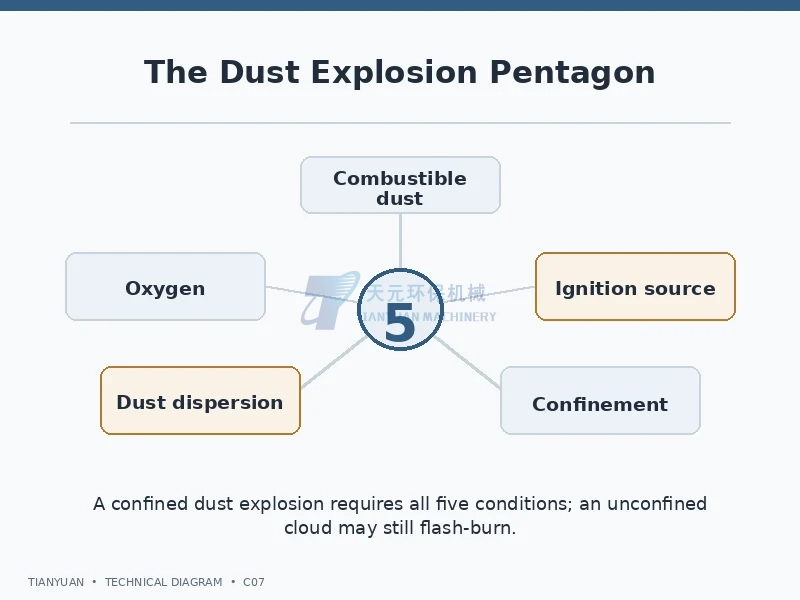
A deposit of combustible dust may create a local fire or smoldering hazard. When a combustible dust cloud is dispersed in air and encounters a sufficient ignition source, rapid flame propagation or a flash fire may occur. In a confined or partly confined space, this can also create a dangerous pressure rise.
A common teaching model is the dust explosion pentagon: combustible dust (fuel), oxygen, an ignition source, sufficient dispersion/concentration and confinement. The first three correspond to the fire triangle. The additional two help explain why dust inside process equipment can produce an explosion. Importantly, a hazardous flash fire can also occur in an unconfined dust cloud, so “the workshop is open” must not be treated as proof of safety.
Relevant spaces include mills, cyclone separators, dust collectors, silos, ducts, bagging enclosures and other parts of a powder-processing line. An ignition source may be electrostatic discharge, mechanical sparks, frictional heating, hot surfaces or other sources appropriate to the process. Their likelihood depends on the actual material and machine configuration.
Why particle size and deposits matter
Smaller particles generally have a greater surface-area-to-mass ratio and may remain suspended more readily, which can affect ignition and flame propagation. However, there is no single safe mesh number or universal particle-size cutoff for every powder. Older OSHA guidance uses 420 µm as a screening reference while also warning that coarser material may generate fine particles through abrasion. Mesh size alone is not an explosion test.
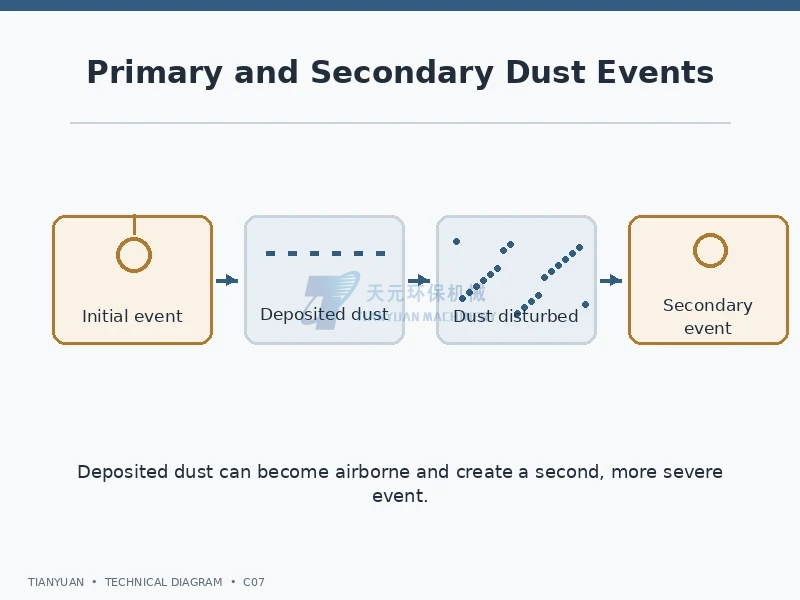
Dust can also accumulate on beams, ledges, equipment housings and floors. An initial event inside a collector, duct or mill may disturb those deposits and disperse additional dust into the air. If that cloud ignites, a secondary event can be more severe than the initial one. The U.S. Chemical Safety Board’s combustible-dust investigation documents the importance of recognizing hidden and accumulated dust hazards.
How to identify and test dust hazards
Begin with the real material: composition and grade, representative powder samples, particle-size distribution, moisture, presence of oils or additives, processing temperature and the ways dust can be dispersed. Review the material safety data sheet or supplier information as a starting point, but do not assume a short or incomplete SDS establishes the absence of a hazard.
Where combustibility or explosibility remains uncertain, a qualified laboratory may be needed. Depending on the hazard analysis, relevant measurements can include Kst (dust deflagration index), Pmax (maximum explosion pressure), MIE (minimum ignition energy), MEC (minimum explosible concentration), and dust-cloud or dust-layer ignition temperatures. Not every parameter is needed for every project; a qualified specialist should select the testing plan and ensure the sample represents the actual process.
Do not borrow a published Kst for “wood dust” or “metal powder” and present it as a measured result for Tianyuan equipment or a customer’s feedstock. Experimental values vary with sample and test conditions. The 2025 edition of NFPA 660, Standard for Combustible Dusts and Particulate Solids provides a consolidated technical framework for combustible-dust hazards; applicability and legal obligations depend on the jurisdiction and adopted codes.
Practical control measures for powder lines
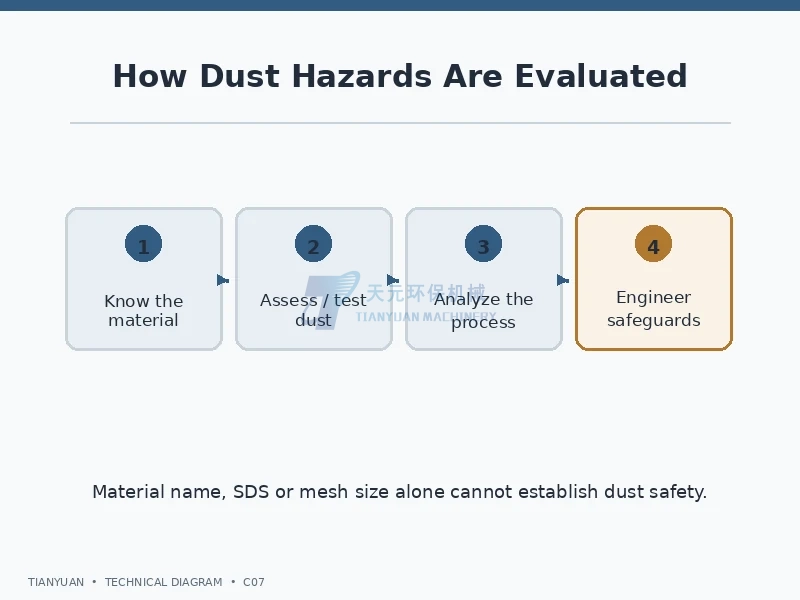
Combustible-dust risk control is broader than buying a filter. The goal is to prevent hazardous dust releases and ignition, manage deposits, and limit the consequences if an event nevertheless occurs. The actual design should follow a dust-hazard assessment by qualified professionals.
- Identify hazardous powders and all points where dust clouds or deposits can occur, including milling, classification, conveying, screening and packaging.
- Use suitable containment, local extraction, leak management and housekeeping so deposits do not accumulate unchecked.
- Evaluate ignition-source controls, including electrostatic bonding and grounding, electrical equipment selection, hot surfaces and mechanical sparking.
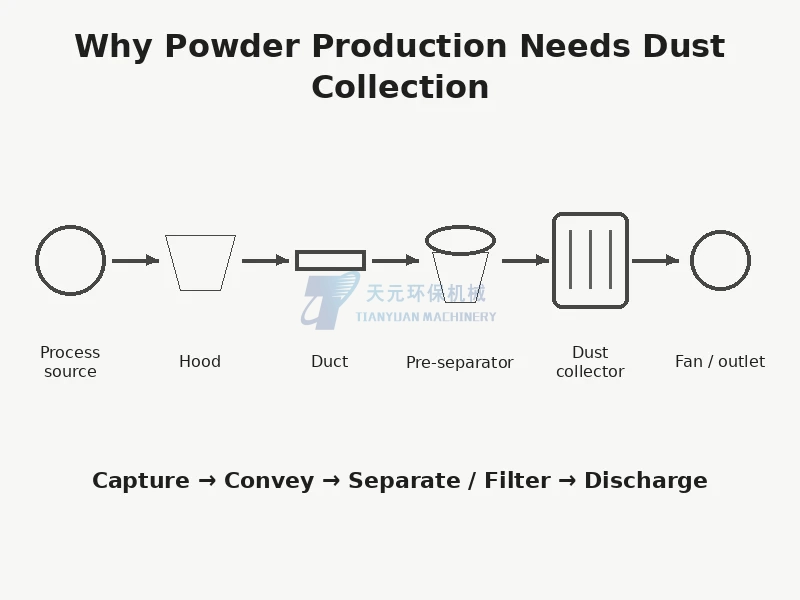
- Select dust collectors and any pre-separators for the actual dust; ordinary filtration alone is not complete explosion protection.
- Where indicated by the hazard analysis, evaluate deflagration venting, suppression, isolation, inerting or other engineered safeguards.
- Assess compatibility carefully: some reactive metal powders can introduce hazards with water, so wet collection is not a universal substitute for specialist design.
What this means for Tianyuan equipment
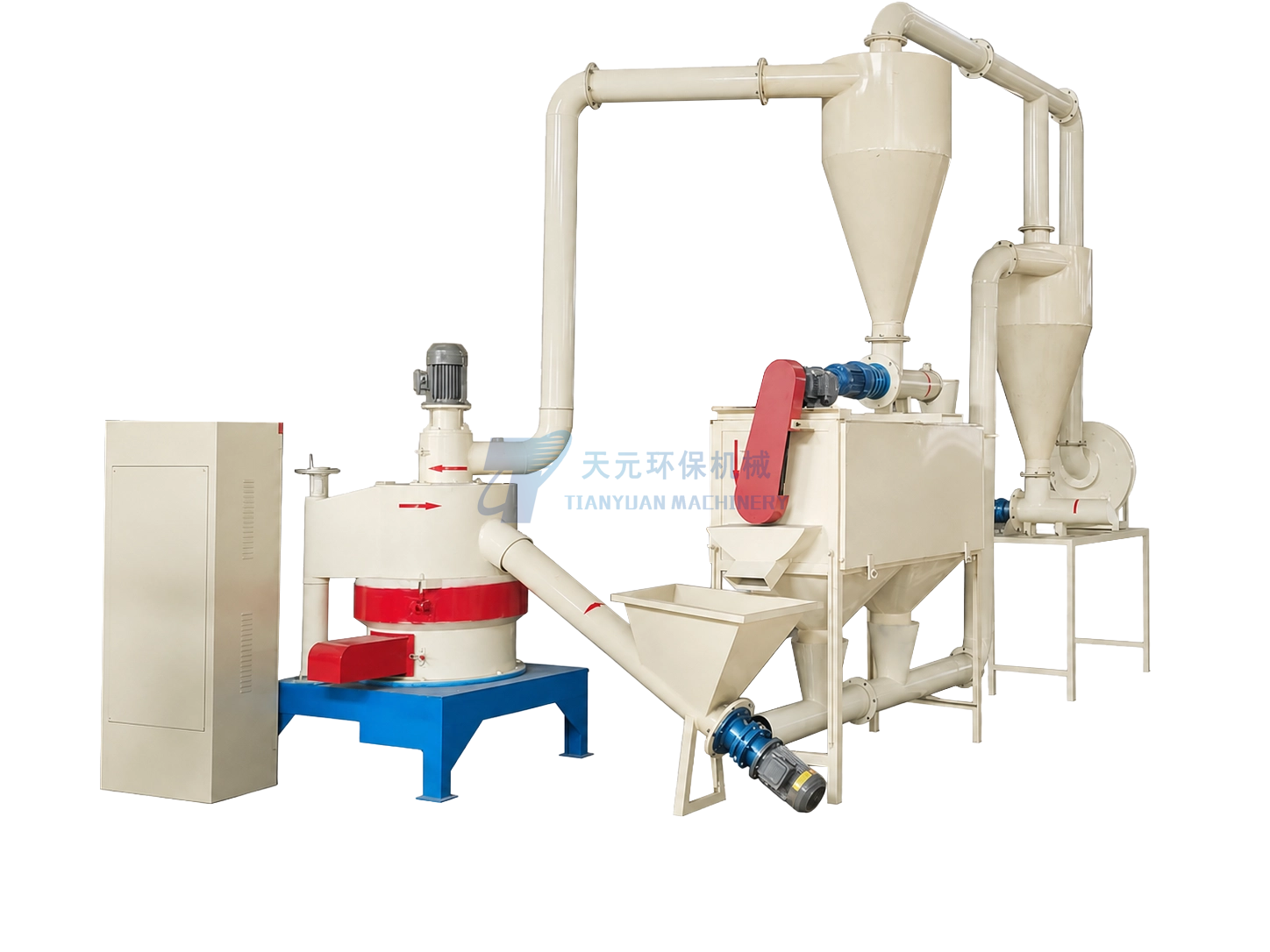
Tianyuan’s TYMF6R-600 wood powder mill produces fine wood-based and fibrous powders after suitable feed preparation. The TYJSMF500 metal powder grinding mill mechanically reduces suitable metal feedstock. Both applications can create airborne fines during grinding and downstream handling, yet wood powder and each metal or alloy must be assessed on their own merits.
A material may be technically grindable but still require process restrictions, additional safeguards or a different system configuration. Published cyclone and dust-collector arrangements describe material separation and filtration; they should not be interpreted as a declaration of explosion-proof suitability for all combustible dusts. For any specific project, confirm material hazards before final equipment selection.
Frequently asked questions
Is wood flour a combustible dust?
Wood flour is a widely recognized example of potentially combustible dust. The exact fire or explosion hazard depends on the powder sample and how it is handled, dispersed and ignited.
Can a metal be difficult to ignite in bulk but hazardous as powder?
Yes. OSHA notes that metals such as aluminum or iron can exhibit hazardous behavior in sufficiently fine dust form even when the bulk material behaves differently.
Does a dust explosion always require a fully sealed vessel?
Confinement can generate dangerous explosion pressure, but an unconfined combustible dust cloud may still produce a hazardous flash fire. An open area is not automatically safe.
Is a cyclone plus baghouse enough to prevent a dust explosion?
No. Cyclones and filters perform separation and dust collection. Combustible-dust prevention and protection require a separate assessment and, where appropriate, engineered safeguards.
Can mesh size or an SDS prove that dust is non-combustible?
No. They are useful starting information but cannot replace representative sample assessment and appropriate testing when the risk is uncertain.
Conclusion
Combustible dust is a property and hazard of certain particulate materials under specific process conditions—not a universal label determined by one mesh size. Reliable decisions begin with the actual powder, evaluate the possibility of airborne dust clouds and deposits, and use qualified hazard assessment to choose process, collection and protection measures.