Short answer: A cyclone separator and a dust collector do different jobs. A cyclone uses centrifugal and inertial forces to remove a large share of the heavier particles from a particle-laden air stream, while a dust collector—such as a fabric filter or cartridge collector—captures the finer dust that remains. In many powder-processing lines they are installed in series rather than treated as interchangeable equipment.
Terminology: In this article, “dust collector” means a filter-based baghouse or cartridge collector. A cyclone is also a dust-collection device in the broader sense.
Cyclone and dust collector: the key difference
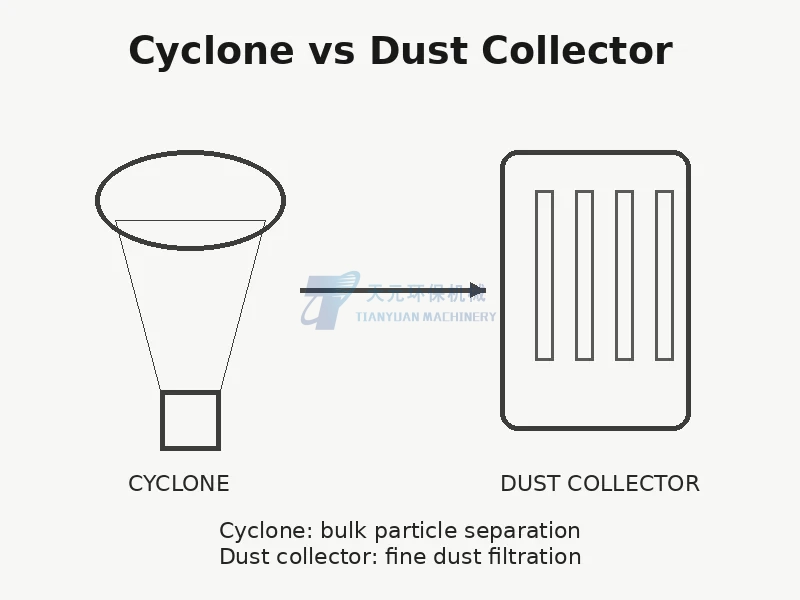
The easiest way to distinguish them is by their primary function. A cyclone is mainly a gas-solid separator. A dust collector is mainly a final particulate-control device. Both may recover powder, but the mechanism, target particle range and role in the airflow system are different.
- Cyclone separator: removes a large portion of entrained solids using centrifugal and inertial forces.
- Dust collector: captures the remaining fine particulate using filter media or another dedicated collection mechanism.
- Combined system: the cyclone reduces the solids loading before the gas reaches the final dust collector.
What does a cyclone separator do?
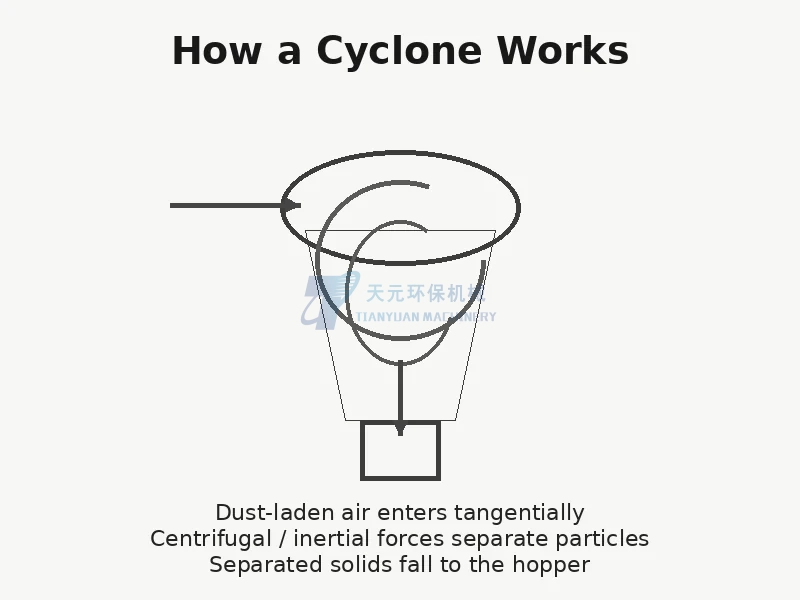
Dust-laden air enters the cyclone tangentially and forms a rotating flow. Particles with sufficient inertia move toward the outer wall, lose momentum and fall toward the hopper, while the cleaned or partially cleaned gas leaves through the outlet. The U.S. EPA describes cyclones as devices that use centrifugal and inertial forces and notes that they are often used as pre-cleaners to reduce particulate loading on downstream collection equipment.
This makes the cyclone useful when a powder line carries a relatively high solids load and a meaningful part of that material can be separated before final filtration. In grinding systems it may also recover process material that is then screened, classified, recycled or collected, depending on the process design.
What does a dust collector do?
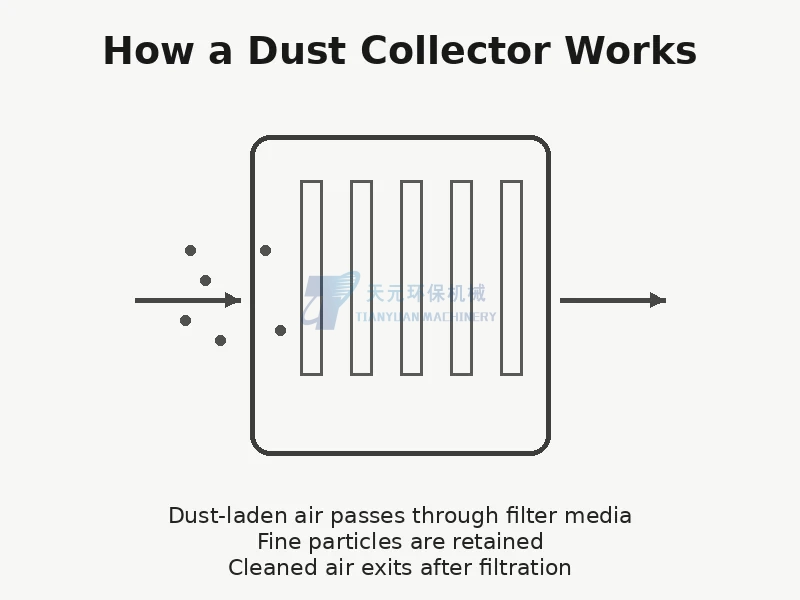
A dust collector handles the finer particulate that remains in the air stream. In a fabric-filter or baghouse system, contaminated gas passes through filter media while particles are retained on the filter surface and in the dust cake. The EPA notes that fabric filters can capture small micrometer and sub-micrometer particles and commonly achieve very high collection efficiency when correctly designed and operated.
The dust collector therefore should not be described as simply another cyclone. Its pressure drop, filter area, cleaning method, allowable temperature and moisture conditions, and dust-discharge arrangement all have to be considered separately.
Why are cyclone and dust collector often used in series?
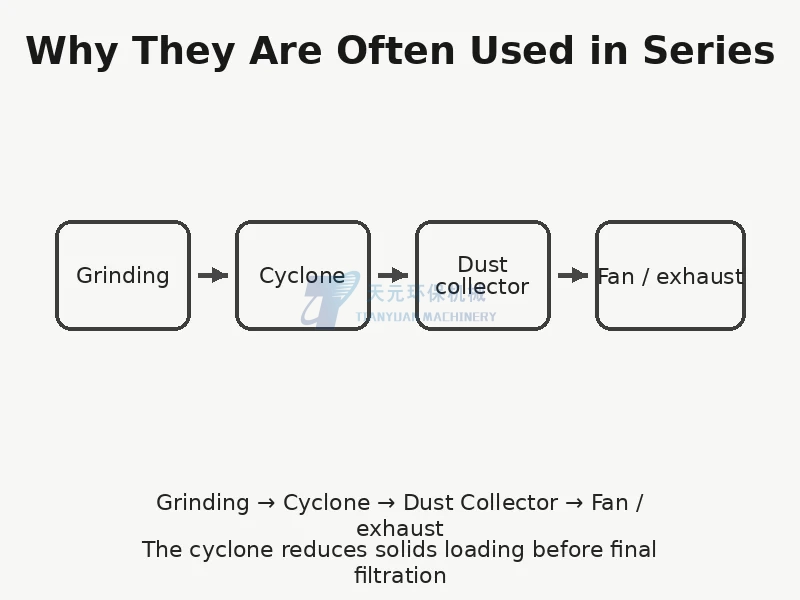
A common process sequence is grinding or pneumatic transport → cyclone separation → dust collection → fan or exhaust. The cyclone removes a large fraction of the recoverable solids first. The downstream collector then sees a lower particulate loading and focuses on the fine dust that is more difficult to separate by inertia alone.
That arrangement is not mandatory for every process. A low-dust application may use a filter collector without a cyclone, while another process may use multiple stages. The correct configuration depends on the material, particle-size distribution, airflow, dust concentration, temperature, moisture, pressure drop, emission target and safety requirements.
How this applies to Tianyuan powder-processing lines
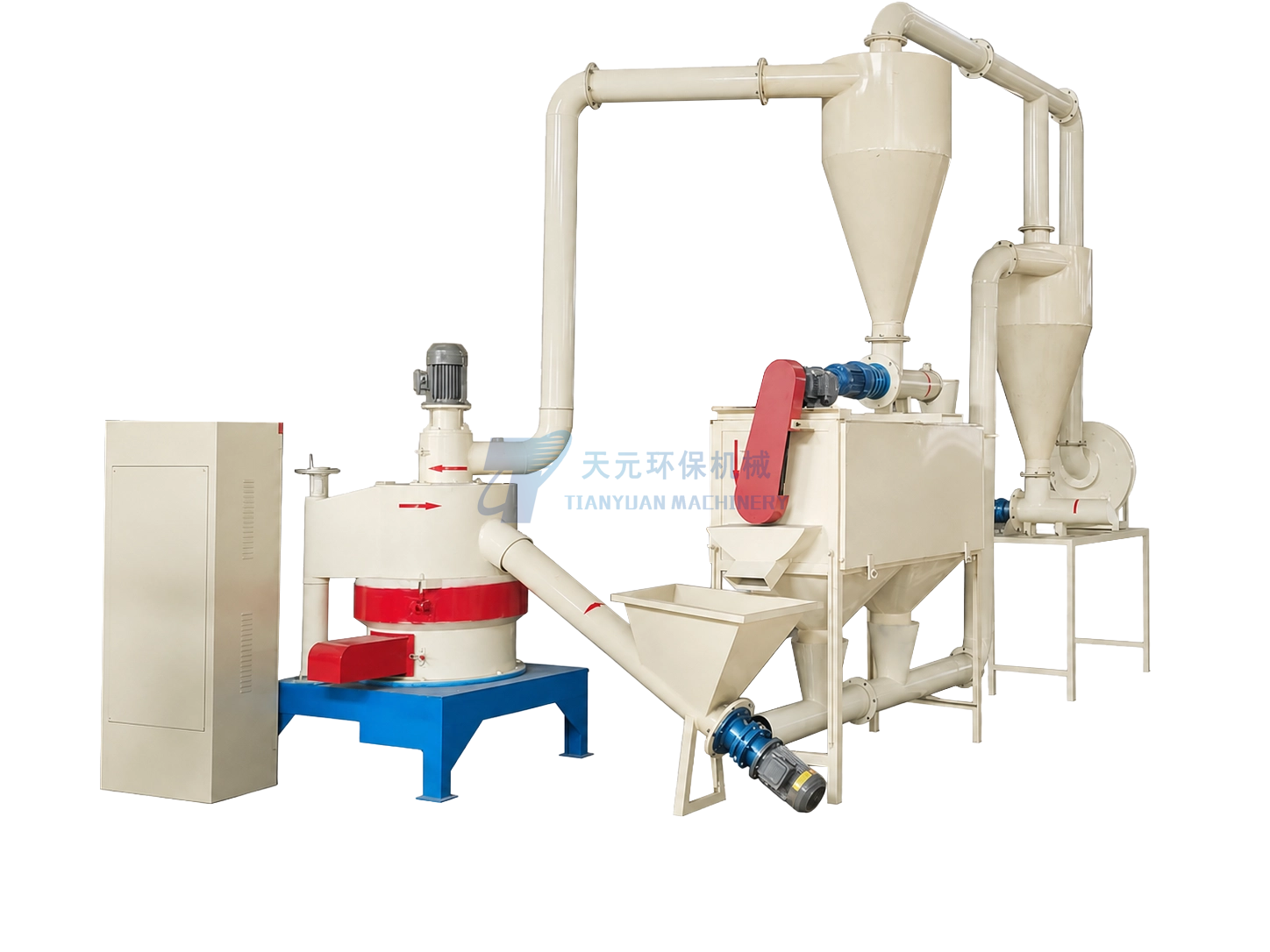
On Tianyuan’s published powder-equipment process pages, the cyclone separator and dust collector are shown as separate process stages. For example, the TYMF6R-600 wood-powder line describes material-air separation in the cyclone before the remaining dust is handled by the dust collector. This is a process-role distinction, not a claim that every project must use exactly the same configuration.
The same engineering rule applies to metal-powder projects: equipment selection must be based on the actual material and operating conditions. A cyclone, a baghouse or a cartridge collector is not by itself a complete combustible-dust safety system. Where combustible metal dust, wood dust or another hazardous powder is involved, the project requires a separate professional dust-hazard and explosion-protection assessment.
What information is needed before choosing the system?
- Material and dust properties
- Feed and airborne particle-size distribution
- Airflow and expected dust loading
- Gas temperature and moisture
- Stickiness or caking tendency
- Combustibility or explosion characteristics
- Required product recovery route
- Local emission and workplace requirements
FAQ
Can a cyclone completely replace a dust collector?
Usually no. A cyclone is most effective as a bulk separator or pre-cleaner, while very fine dust commonly requires a downstream filtration or collection stage.
Can a dust collector be used without a cyclone?
Yes in some systems, especially when the solids loading is low. Whether a cyclone is needed should be decided from the loading, particle size, pressure drop and maintenance requirements.
Is the powder discharged from a cyclone automatically finished product?
No. Cyclone discharge may be finished product, a mixed size fraction, an intermediate product or material that still needs screening, classification or recycle.
Does a cyclone remove the finest dust efficiently?
Cyclone performance depends strongly on particle size, density, geometry and operating conditions. Fine particles are generally more difficult to remove by inertial separation alone.
Conclusion
A cyclone separator and a dust collector are complementary devices with different primary duties. The cyclone performs bulk gas-solid separation; the dust collector captures the finer residual particulate. In many powder-processing systems, using them in sequence provides a practical balance between powder recovery, filter loading and air cleaning—but the final design must be based on the actual material and process conditions.