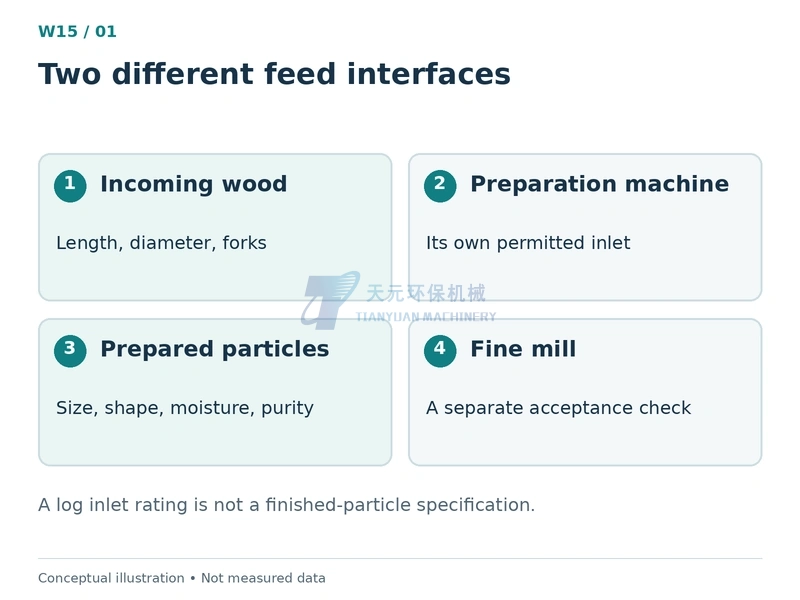
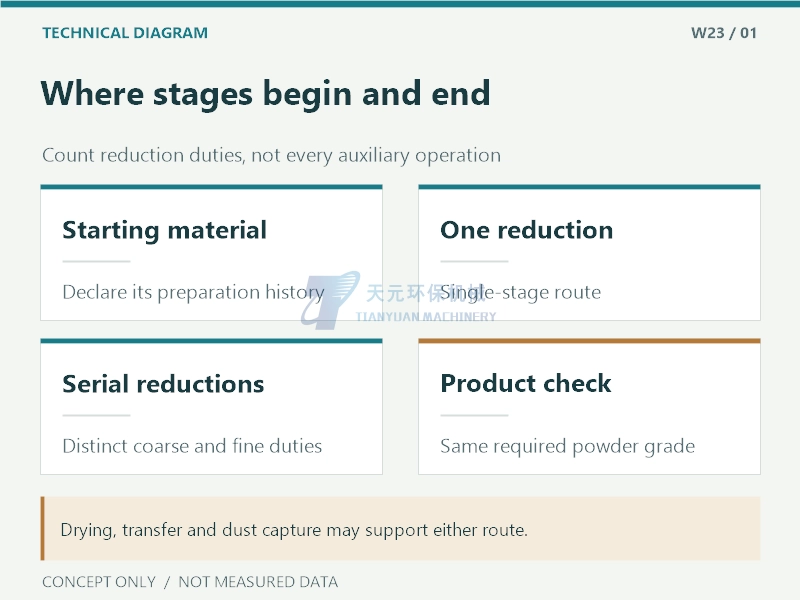
A wood flour plant might receive screened sawdust, wood chips or bulky processing residues. Even when two customers want the same grade of finished flour, these starting materials may require very different routes. The useful comparison is not a count of machines but what each size-reduction stage must accomplish.
Single-stage wood grinding uses one size-reduction stage to turn compatible feed into the required flour. Multi-stage wood grinding assigns sequential reduction duties, such as coarse preparation followed by fine milling. Choose the route that accepts the actual feed and reliably meets the product specification. Additional stages do not automatically increase capacity or reduce cost; auxiliary operations are not necessarily separate grinding stages.
Contents
Define what counts as a grinding stage
Count size-reduction duties within the stated boundary
Single-stage means one reduction stage between the declared starting material and the target powder. It may still need inspection, cleaning, feeding, drying, product separation or dust collection. A multi-stage route has two or more sequential duties that deliberately reduce particle dimensions. If a supplier has already crushed the wood, acknowledge that upstream operation instead of comparing raw logs with prepared sawdust as though they had the same history.
A coarse-particle return to the same milling stage is not necessarily a new downstream stage. A single-stage circuit can include classification and a return loop. Record both the serial reduction stages and recirculation in the route diagram so two different arrangements are not confused by the same terminology.
When a single-stage route may be suitable
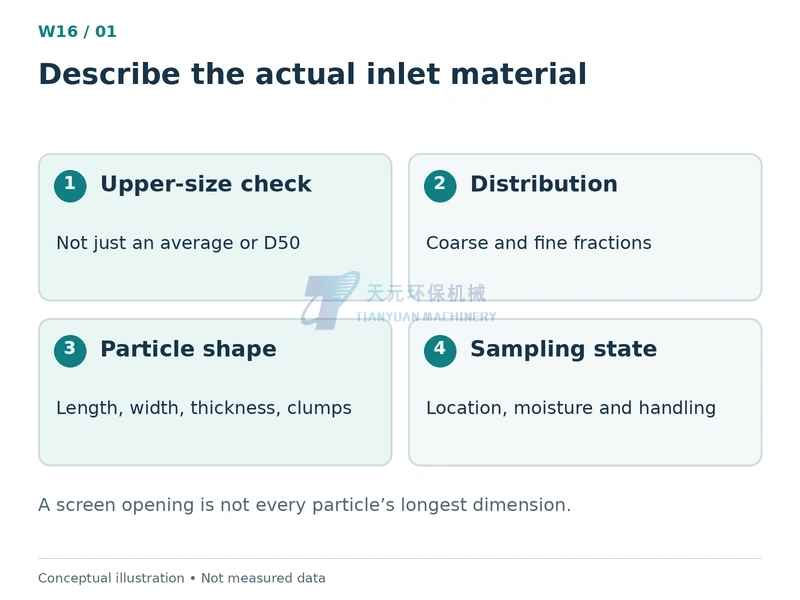
One reduction stage deserves assessment when the feed is already compatible with the fine mill. Its size distribution, full piece dimensions, moisture, contamination status and feeding behavior all matter. The guide to feed size in wood grinding explains why a mean value or short material label cannot establish that the whole lot is suitable.
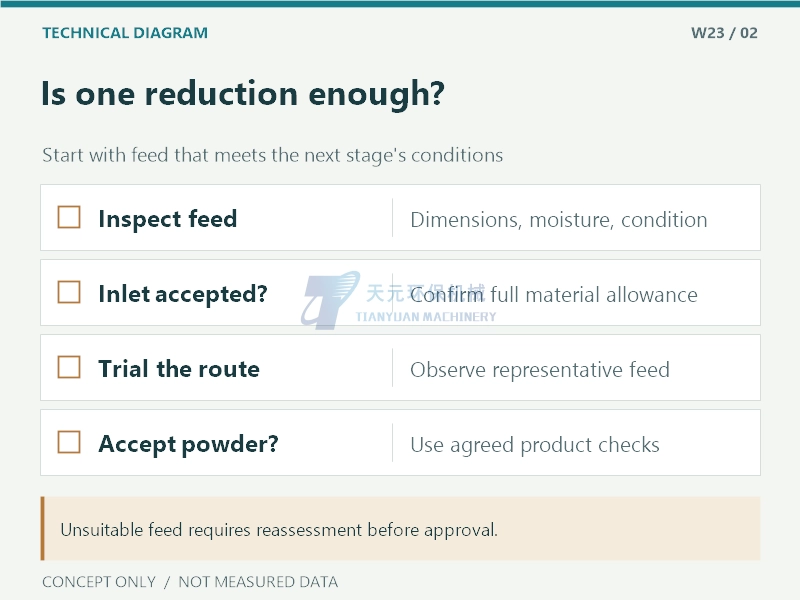
The potential advantage is a simpler material path, with fewer intermediate reductions and handovers. But omitting a necessary preparation stage is not simplification. If representative trials do not deliver the agreed powder, or the material falls outside the confirmed inlet conditions, do not force the same route. Identify whether size, shape, moisture or another condition calls for preparation.
How a multi-stage route divides the work
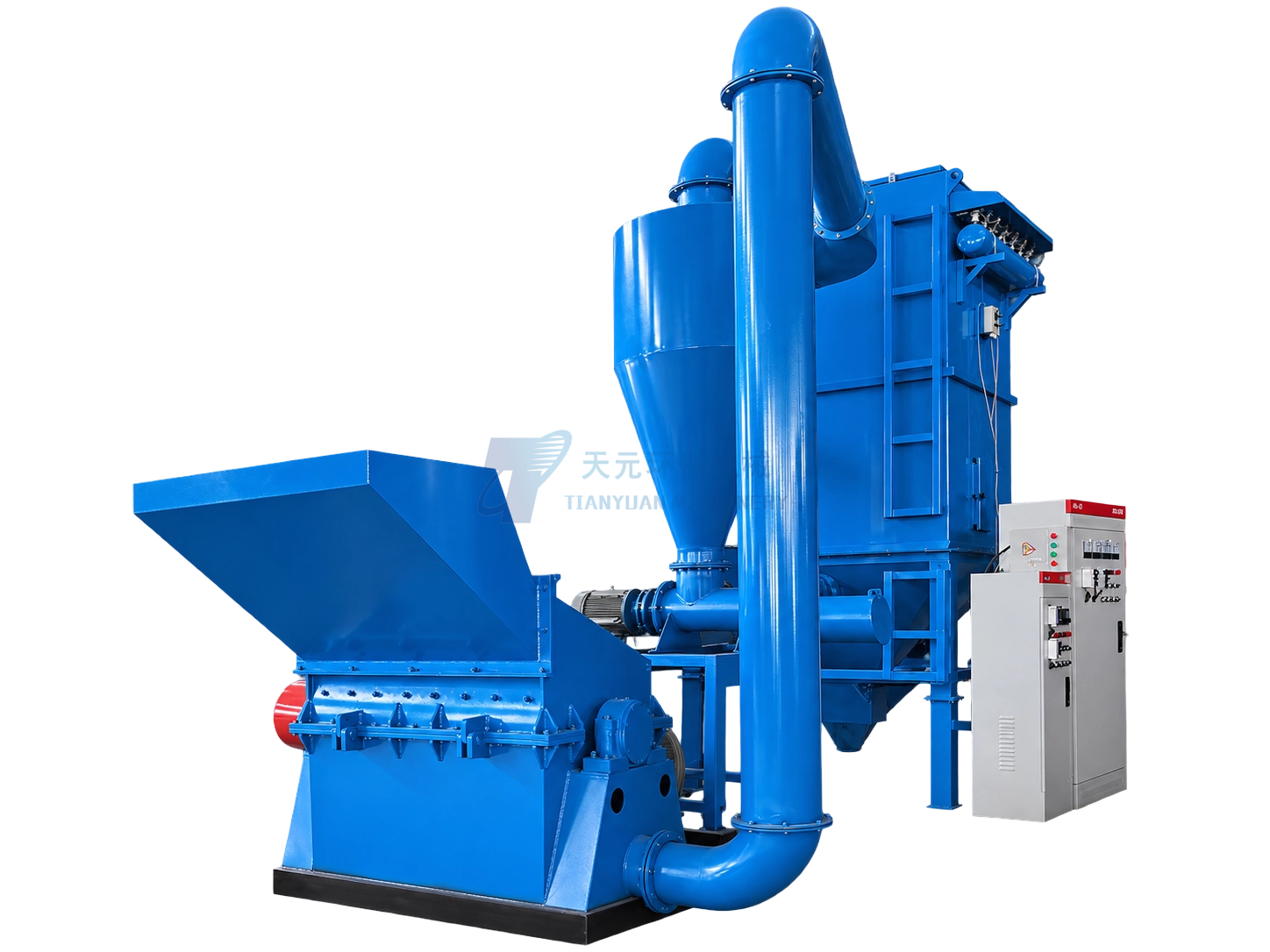
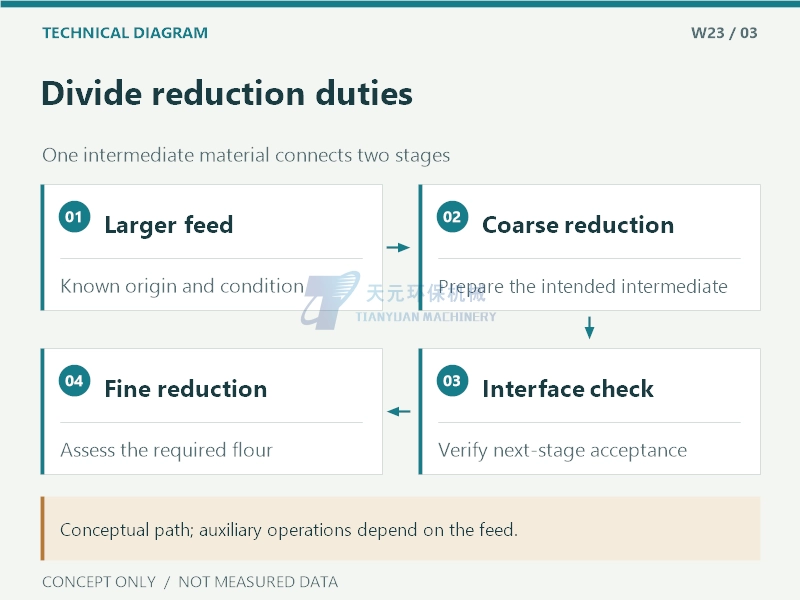
Wood chips and relatively bulky processing residues often need an upstream reduction duty, with a defined intermediate material that can then enter fine milling. The wood pretreatment guide outlines the related preparation questions. Cleaning, drying and buffering may be placed where the actual equipment conditions permit; the same layout is not appropriate for every feed.
Clemons' Wood Flour chapter describes the common logic of reducing larger raw material before pulverizing and classifying it. This is a general production framework, not a specification for a particular Tianyuan line. Each stage should have a stated inlet, intended output and reason for being installed. A machine without a necessary duty only adds complexity.
Qualify the material between stages
Do not assume that an upstream machine's nominal screen opening establishes compatibility with a downstream machine. Check full dimensions, coarse fractions, elongated fibers, moisture and contamination in the actual intermediate lot. Ensure its transfer and feeding behavior are suitable for the next stage. An accepted and consistently prepared feed may make an additional reduction step unnecessary.
A multi-stage route also needs a clear handover: who checks intermediate material, how identity is maintained, and where nonconforming lots are held for assessment. Do not rely on a larger hopper or continuous upstream flow to establish acceptance at the fine-mill inlet. A valid stage interface is a material condition, not simply a connection between two pieces of equipment.
| Comparison | Single-stage route | Multi-stage route |
|---|---|---|
| Starting feed | Already compatible for the required reduction | Needs distinct sequential reduction duties |
| Handover points | Inlet and finished powder | Additional intermediate material checks |
| Cost boundary | One reduction plus all auxiliaries and returns | All reductions, auxiliaries and intermediate handling |
| Acceptance | Same final powder specification | Same final specification plus intermediate criteria |
Compare the complete cost per accepted powder output
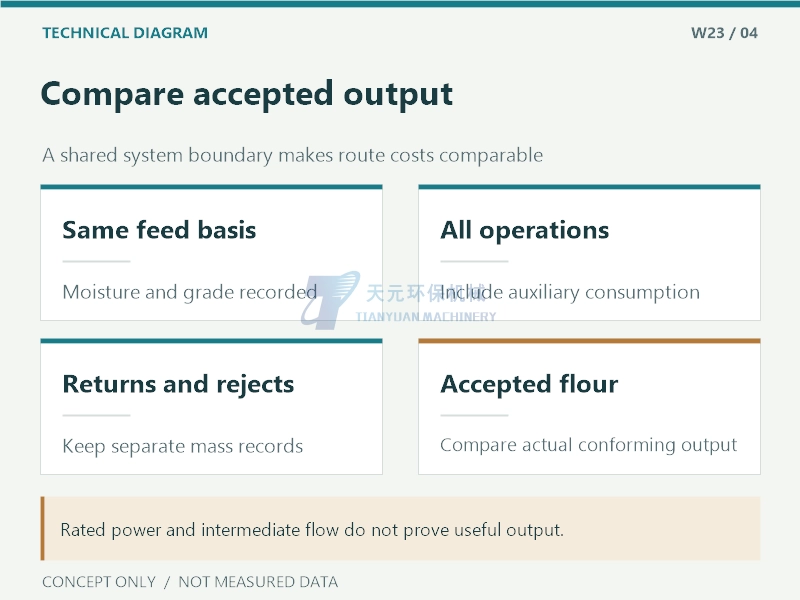
Compare the same feed basis and final product specification. Include each reduction stage, conveying and other auxiliary equipment, returns, rejected material, interruptions, consumables and intermediate handling. Record the measurement period and moisture basis. Rated motor power or visible discharge is not energy use or accepted output. A fair energy comparison relates the recorded process consumption to the accepted powder on the agreed basis.
In their specific Douglas-fir grinding study, Wang and colleagues found similar energy consumption for single and combined stages in part of the tested size range, while the two-mill arrangement provided steadier production of finer material. That is evidence from its own feedstocks and equipment, not a universally favorable result and not a Tianyuan performance estimate.
Use a representative trial to compare candidate routes
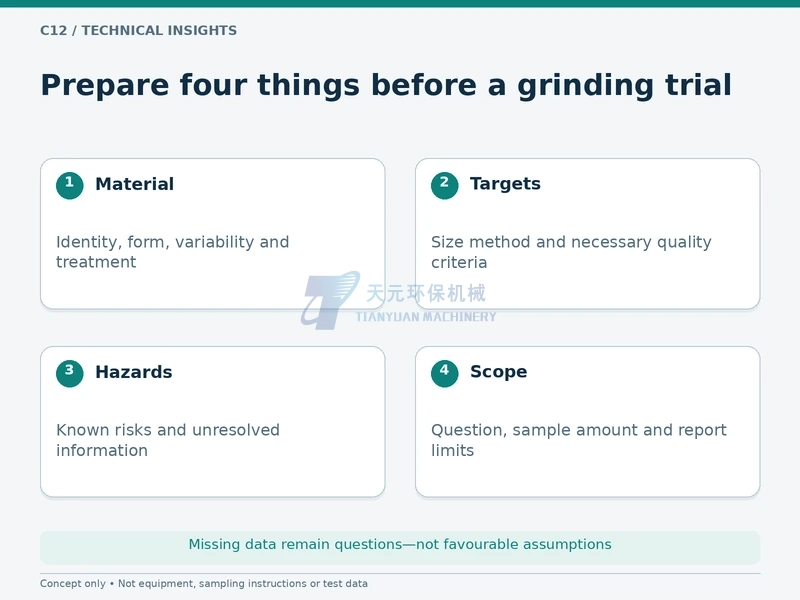
Use the grinding test preparation guide to agree representative lots, inlet measurements, intermediate checkpoints and visible operating observations before the trial. Define finished-powder acceptance in advance, with help from the wood flour quality factors guide. Keep accepted powder, retained material, returns and rejects traceable rather than treating every intermediate discharge as saleable product.
Changing the number of stages also changes the layout and potentially its dust and material-handling points. HSE wood dust guidance supports effective capture at source. Appropriate safeguards, fire and explosion protection, electrical suitability and maintenance arrangements require site-specific expert assessment. Never treat material handling during unsafe operating conditions as an ordinary test procedure.
Place the wood powder mill in its proper role
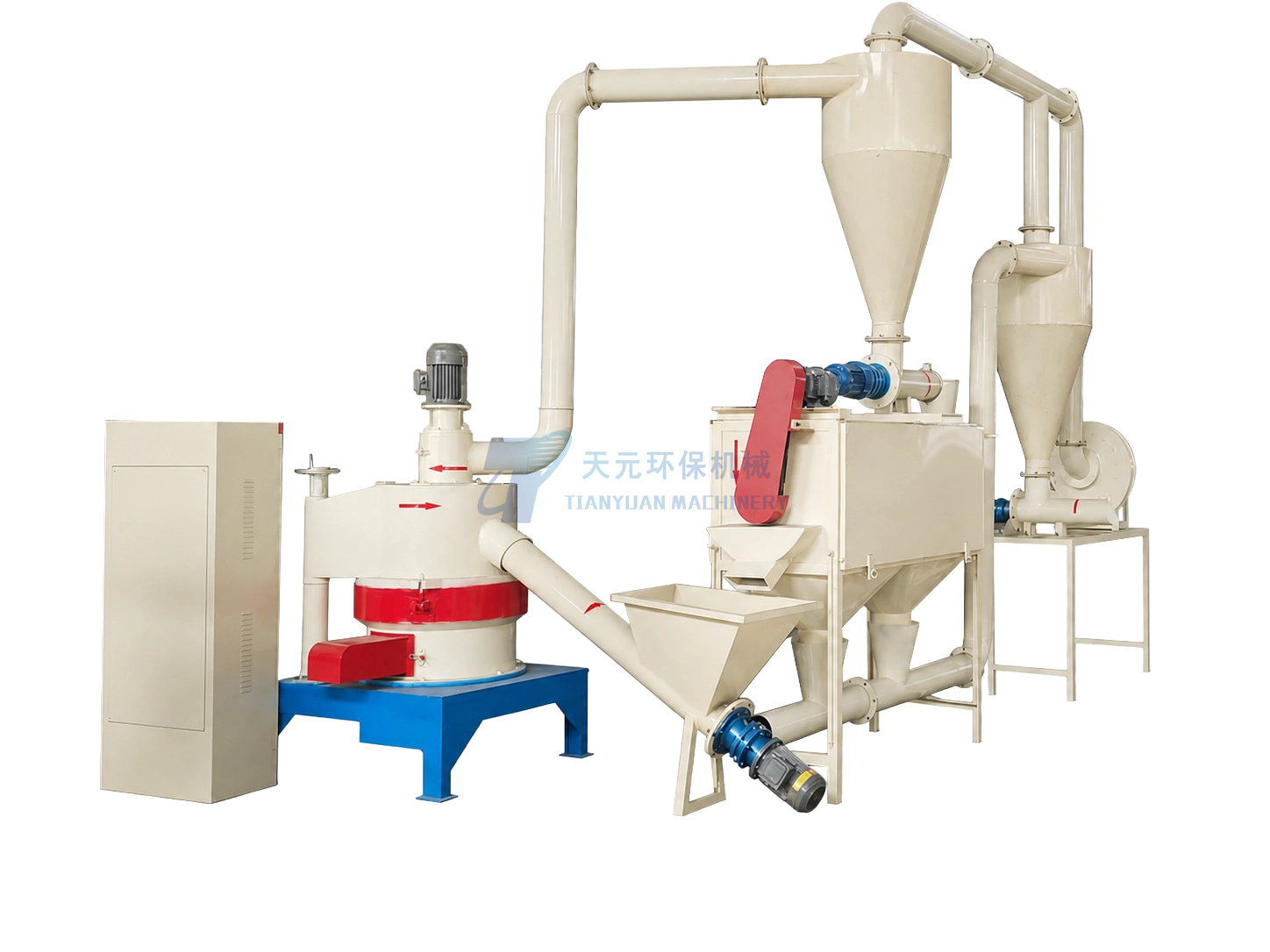
The published TYMF6R-600 ultrafine wood powder mill range is 30–325 mesh, 100–500 kg/h and a maximum feed diameter of 5 mm. It is a fine-milling machine for suitable prepared feed, not a bulk wood crusher. Confirm full dimensions and permitted shape and moisture, not just one diameter value. The quoted limits do not promise the highest fineness at the highest output for any given material.
A project should match the actual feed and target grade to the confirmed duties of every stage. Make the final route decision using agreed inlet conditions, trial evidence, product acceptance and installation assessment. Neither the number of mills nor a nominal range alone establishes the result.
Frequently asked questions
Does one grinding stage mean only one machine in the plant?
No. It describes one size-reduction duty within the defined boundary. Preparation, feeding, classification, collection and dust control may still be necessary.
Can any sawdust be processed into flour in one stage?
No. Confirm the whole feed's dimensions, moisture, contamination and handling characteristics against the mill's accepted conditions, then verify the delivered powder.
Does multi-stage grinding always save electricity?
No general saving can be promised. Compare documented energy consumption and accepted output within the same boundary and at the same grade.
Is returning coarse material equivalent to a second grinding stage?
Not necessarily. Returning material to the same reduction stage differs from a separate downstream duty. Describe both clearly in the route.
What indicates that another reduction stage should be considered?
Evidence that the actual incoming material is incompatible with the next stage, or controlled trials cannot meet agreed requirements. Investigate the cause before choosing an added operation.
What to prepare next
Provide representative material, complete feed dimensions and condition, preparation history, target flour specification, intended application and planned duty. Compare actual accepted output from suitable routes within one agreed boundary before specifying the number of sequential reduction stages.