Wood pretreatment for powder production starts by defining what the fine mill is allowed to receive. Logs and branches are incoming raw materials, not automatically suitable mill feed. The goal of pretreatment is a traceable, controlled feed—not a claim that the complete wood-flour process has already been finished.
Key answer: Identify and sort the raw material, then choose cutting, chipping or coarse crushing from its dimensions and shape. Add intermediate size reduction, contaminant removal and moisture conditioning where required. Recheck the prepared material and establish controlled feeding; do not prescribe the same equipment list for every project.
Contents
Work backward from the fine-mill feed interface
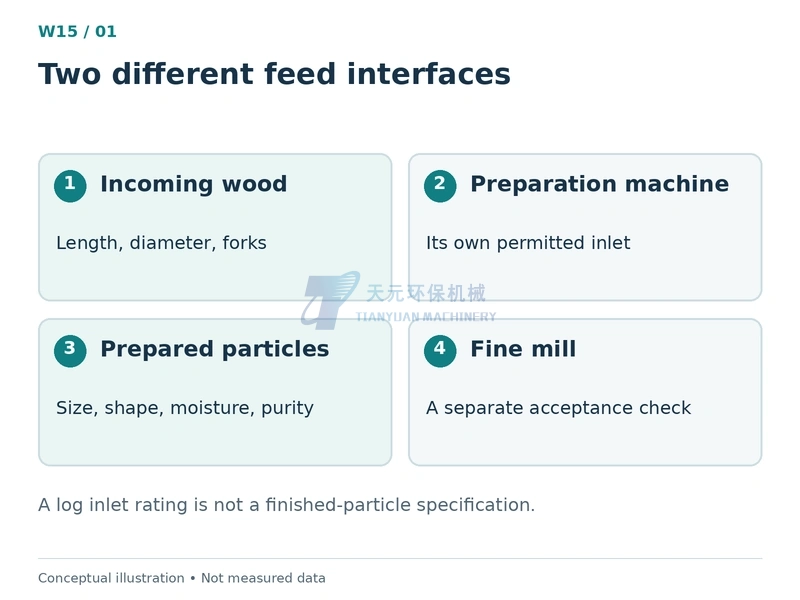
Keep two interfaces separate. The first receives whole timber or branches and must accommodate their length, diameter, curvature, forks and attachments. The second receives prepared particles for fine milling. A chipper’s ability to accept a log says nothing by itself about whether its product meets the fine mill’s feed requirement.
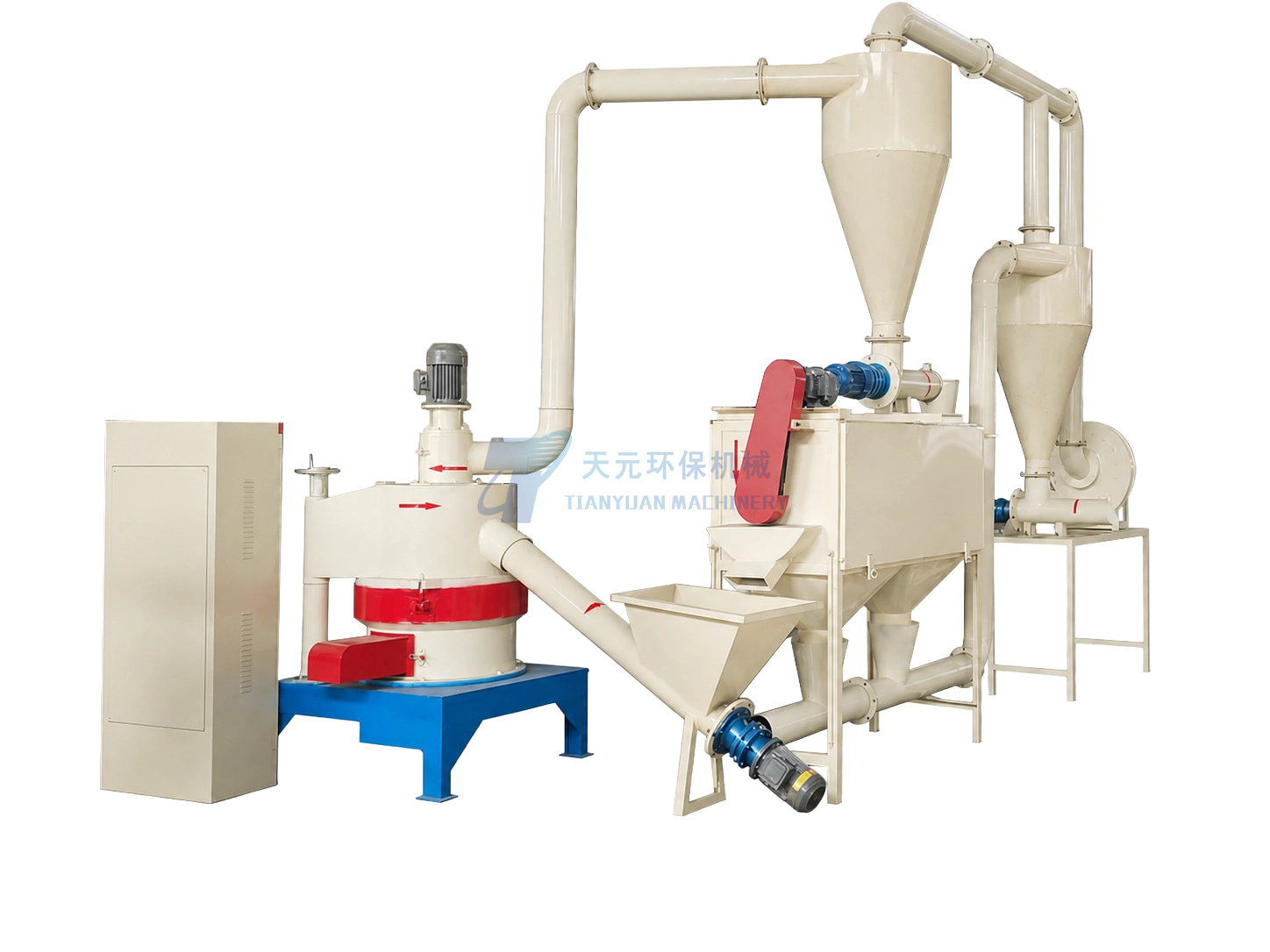
For the TYMF6R-600, the confirmed range is 30–325 mesh, 100–500 kg/h, maximum feed diameter ≤5 mm. The 5 mm limit belongs to this model—not every chipper, branch crusher or wood mill. Actual capability depends on material, feed condition, target fineness and site conditions; maximum fineness and maximum output are not simultaneous guarantees.
Separate source identity, foreign objects and attached material
Do not merge clean logs, ground-contact pruning waste, coated timber and demolition wood under a single “wood” label. Record source, species or mixture, treatment history, bark, foliage, soil and foreign objects. Isolate unidentified streams until their suitability is resolved.
Debarking and separation are application-dependent decisions
Whether bark, leaves or other attachments must be removed depends on the agreed color, ash, composition and end-use requirements. Debarking is neither mandatory nor dispensable for every project. Magnetic separation addresses magnetically responsive objects; it does not replace assessment of non-magnetic metal, stones or chemical contamination.
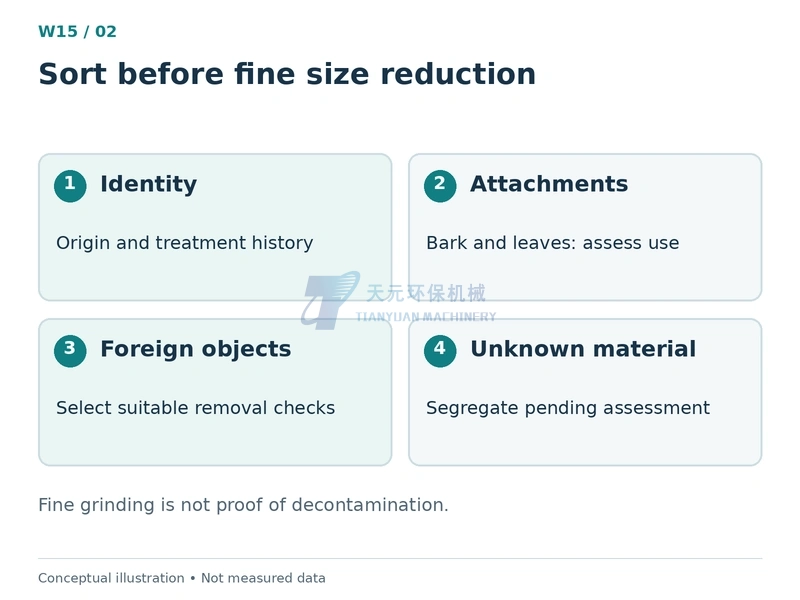
Specify the relevant inspection and separation methods from the actual material stream and risk assessment. Do not treat size reduction as a cleaning method: reducing a contaminant to powder does not establish product suitability.
Reduce size in stages and inspect each stage’s output
| Operation or choice | Purpose | Output to verify |
|---|---|---|
| Cutting or fork preparation where needed | Meet the first machine’s inlet conditions | Length, diameter, form and permitted feeding |
| Chipping or coarse crushing | Produce material for the next operation | Actual particle distribution, not a machine label |
| Intermediate reduction or screening when needed | Control oversize and long fragments | Fine-mill size/shape conditions and oversize destination |
| Conditioning and cleanliness recheck where needed | Stabilize the downstream feed | Moisture basis, remaining foreign material and storage state |
Knife settings and screen openings do not establish the longest dimension of every discharged particle. Check representative output, including exceptional long fragments, and divert nonconforming material to the appropriate preparation stage rather than hiding it behind an acceptable average.
Wang and colleagues’ 2018 study provides an example of staged wood grinding. Its hammer-mill and rotor-impact system is not the Tianyuan configuration; its performance figures are not design values for this project.
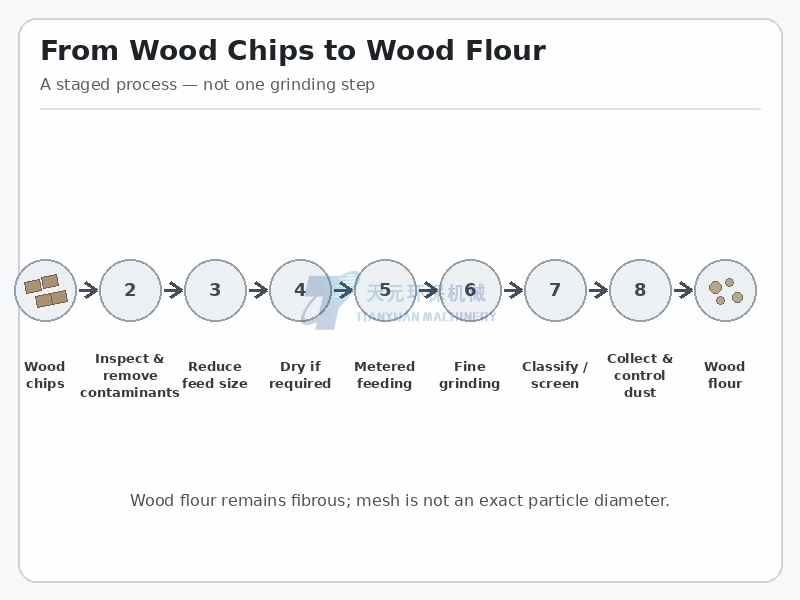
This article ends at prepared-feed release. See the existing wood-chips-to-wood-flour process article for downstream grinding, classification and collection.
Make drying conditional and protect the prepared feed
Measure moisture on a stated wet or dry basis and confirm the permitted condition with the equipment’s technical team. Add drying or controlled conditioning only where needed. Whether size reduction precedes a particular dryer depends on that dryer’s allowed feed and the chosen process; there is no universal sequence for unspecified equipment.
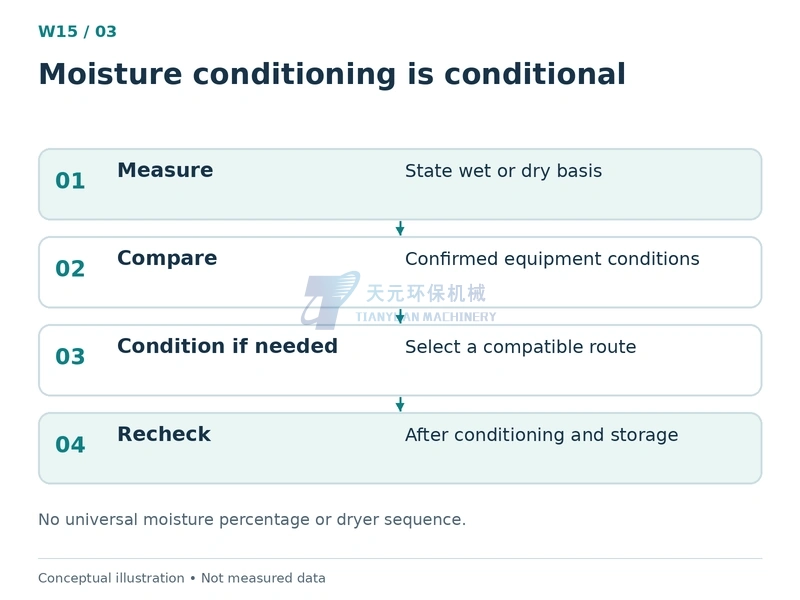
Recheck at the handover point after storage, weather exposure or mixing of batches. A previous acceptable measurement is not a permanent certificate for later handling. The wood-moisture article explains measurement bases; this article does not prescribe a universal optimum or replace dryer selection.
Match usable throughput, not wet-wood nameplate tonnage
Incoming wet-wood mass, prepared-feed mass and accepted flour mass are different quantities. In m_dry = m_received × (1 − w_wb), w_wb is moisture mass divided by received wet mass, expressed as a fraction—not a dry-basis percentage. The resulting dry matter is still not saleable flour: separation, losses and rejected material remain to be accounted for.
Compare effective flows over the same time window and on a stated moisture basis. Include upstream interruptions, buffer behavior and batch variation. A buffer can separate some timing fluctuations, but cannot correct oversize or unsuitable feed. Do not equate a crusher’s nominal wet-feed capacity with qualified fine-powder output.
Create a prepared-feed release record before the trial
A useful handover record identifies the batch, completed operations, dimensions and method, moisture and basis, contaminant checks, unresolved issues, sampling point, storage after sampling and observed mass-feeding behavior. Record measured values and unknowns instead of filling in an imaginary pass result.
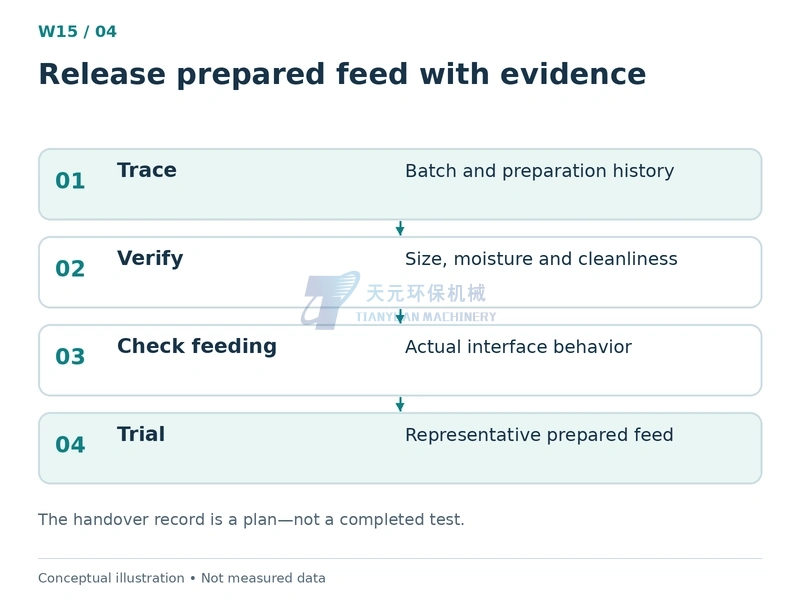
Send representative prepared feed for a grinding trial and retain the incoming-material and preparation records. A hand-picked bag of small clean particles cannot validate a route that will actually supply coarse mixed material. Agree sample quantity, duration and acceptance with the trial scope; no universal batch size is specified here.
Include pretreatment in the safety assessment
Large-material feeding, cutting and transfer require equipment-specific guarding and site review. Dust control should be considered during preparation, not added only at packaging. HSE’s wood-dust guidance and fire/explosion guidance provide general hazard context; the actual installation needs competent material-specific assessment. Ordinary dust collection and grounding are not a complete protection system.
Frequently asked questions
Can whole logs enter the TYMF6R-600 directly?
It should not be used as a whole-log crusher. Prepared feed must meet its maximum diameter of ≤5 mm and other confirmed conditions.
Does every branch project need both a chipper and a crusher?
No. Select one or more stages from incoming form, equipment limits and measured output. Do not fix the machine count before checking these interfaces.
Must bark always be removed?
It depends on the end use and agreed color, ash and composition requirements. There is no universal promise for every feedstock.
Is drying the whole log first sufficient?
Do not choose that route without the dryer’s feed requirements and process assessment. Size preparation and moisture conditioning must be coordinated.
Is an acceptable average chip size enough?
No. Also check oversize, long fragments, moisture, cleanliness and controlled feeding before releasing material to the fine mill.
Conclusion
The pretreatment endpoint is a suitable fine-mill feed: traceable, clean enough for its use, within confirmed size and moisture conditions and able to feed consistently. Select only necessary stages, check each output and validate representative prepared material rather than copying a fixed machine list.