Turning wood shavings to wood flour is feasible for suitable material, but the ability to break a shaving does not establish a reliable powder-production process. Start with the source, contamination, geometry, moisture and intended powder specification—not the assumption that every light, thin flake is ready for the mill.
Key answer: Clean, traceable wood shavings may become useful wood flour after the necessary preparation and verification. Direct feeding is an option only when the material meets the selected mill’s confirmed feed requirements and feeds reliably. A fine wood mill is not a universal processor for long curls, whole timber or unidentified mixed waste.
Contents
Identify the shaving stream before selecting equipment
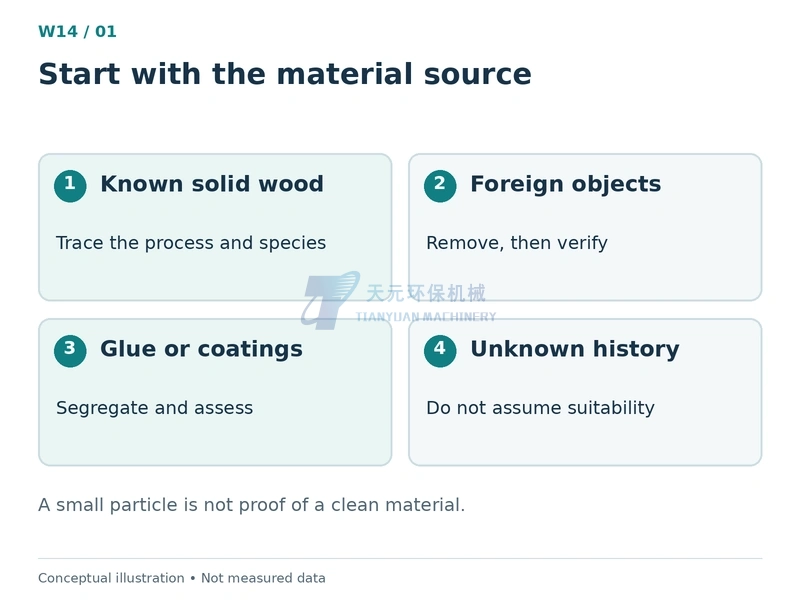
Record the species or mixture, the operation that generated the shavings, contact with adhesives or coatings, storage conditions and any previous use. Clean solid-wood planer shavings are a different assessment case from coated-board residues, used bedding or mixed workshop waste.
In Pokhrel and colleagues’ 2021 study, verified clean mill residues including shavings were converted into wood flour. That supports evaluation of an identified feedstock; it does not validate contaminated mixtures or establish Tianyuan capacity, yield or cost.
Keep uncertain streams separate
Keep unknown or treated streams separate until their composition and end-use suitability are assessed. Physical size reduction does not remove an adhesive, preservative or coating merely by making it less visible. Remove identifiable foreign objects before downstream processing and verify the cleaned material; a photograph alone cannot establish purity.
Thin flakes are not automatically small enough
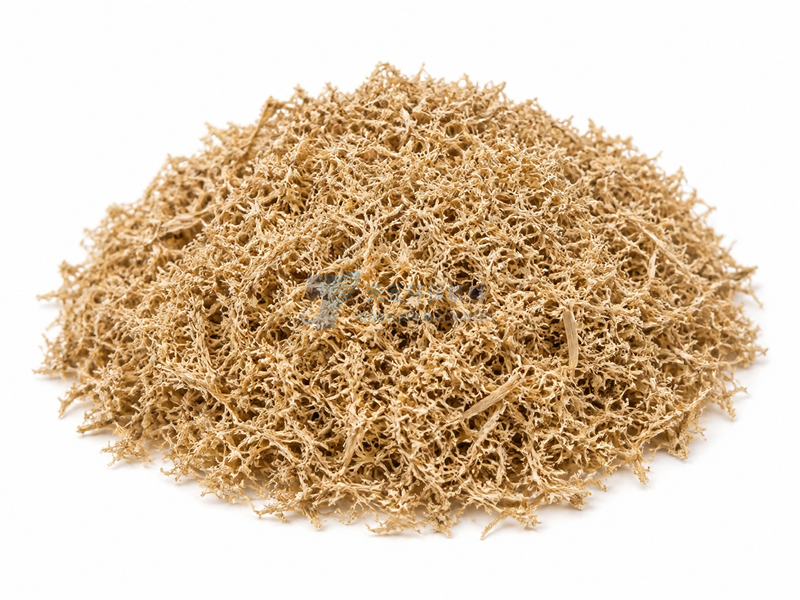
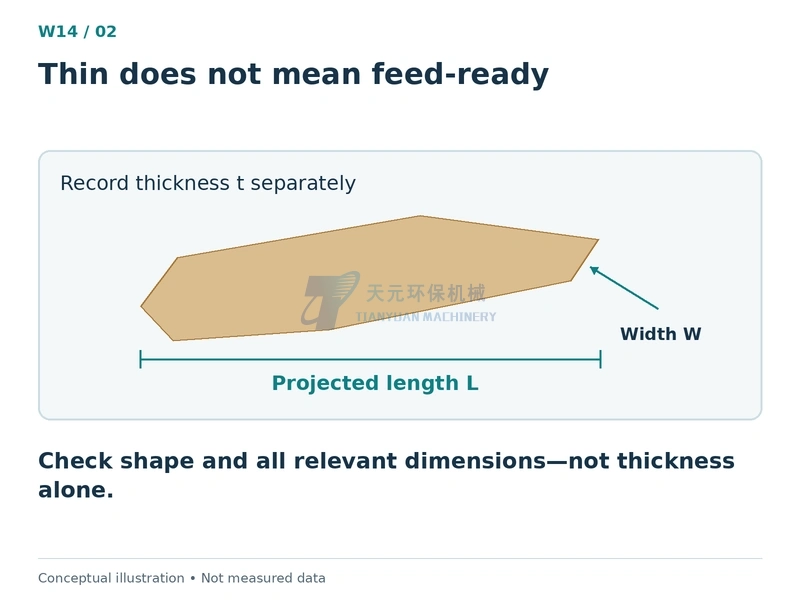
A curled shaving can be thin while remaining long and wide. Describe length, width, thickness, curl and clumps rather than reporting thickness alone. The TYMF6R-600 has a confirmed maximum feed diameter of ≤5 mm; irregular shavings also need an agreed dimensional and shape assessment. A thickness below 5 mm is not permission to feed a long ribbon.
A 2023 study of pine and poplar shavings found that preparation method changed particle characteristics and flow properties. This is a reason to test the actual prepared stream, not to copy another machine’s screens or energy values.
Where long curls interlock or prevent controlled discharge, assess suitable cutting, crushing or deagglomeration before the fine mill. Check the hopper and feeder with representative material rather than assuming that loose material will always discharge evenly.
Choose preparation steps from the actual feed condition
| Incoming condition | Evaluation or action | Do not assume |
|---|---|---|
| Clean and within confirmed feed conditions | Verify sustained feeding and powder acceptance | Suitability guarantees the highest output |
| Long curls, oversize or entangled flakes | Evaluate shortening or size reduction; recheck the feed | A thin shaving is an acceptable particle |
| Moisture outside permitted conditions or variable | Measure on a stated basis; condition or dry when required | One moisture target suits every application |
| Unknown origin, coating, glue or foreign material | Segregate, identify and assess; reject where unsuitable | Grinding makes contamination disappear |
Do not add every possible machine by default. A stage may be omitted only when the incoming material already meets the next operation’s requirements. Use the wood-moisture guide to distinguish wet and dry basis; the permitted feed condition must be confirmed for the actual model and material.
This article addresses shaving suitability and preparation decisions. The broader sequence after feed preparation is covered in the wood-chips-to-wood-flour process guide.
Evaluate mass flow and accepted powder, not loose volume
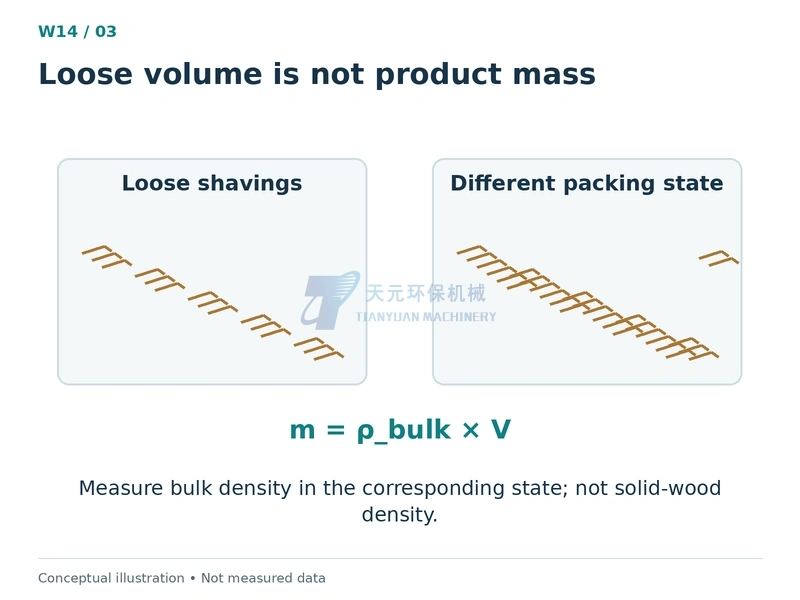
The accounting identity m = ρ_bulk × V relates material mass to volume and bulk density measured in the same packing state. Bulk density is not solid-wood density and is not a fixed value for all shavings. A feeder’s volumetric rate therefore cannot be used as a guaranteed powder mass rate.
Separate fresh feed, circulating material and accepted product. Record interruptions, oversize, rejected powder and losses so repeated circulation is not counted as new output. Compare costs per unit of saleable conforming powder at the same specification and moisture basis, including preparation and rejected-material handling. No universal saving or yield follows from the word “shavings”.
What should a useful shaving trial establish?
Agree on particle-size or sieve-residue criteria and the test method, product moisture and its basis, relevant contaminants and any application-specific morphology requirement. Select material that represents normal supply variation. Sample quantity, duration and repetitions should follow the agreed purpose; this article does not invent a universal test batch.
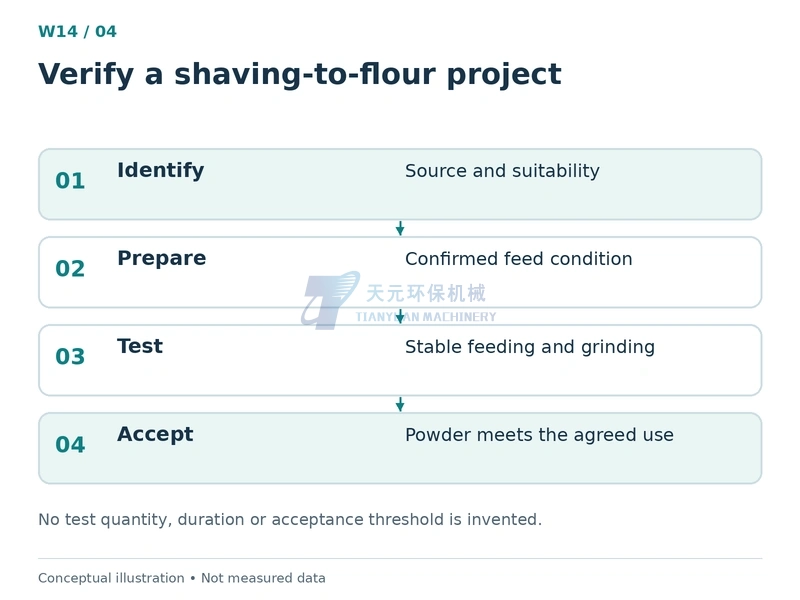
- Confirm the material’s identity and the suitability of its intended use.
- Record preparation and check the actual feed interface.
- Observe controlled feeding and account for accepted powder separately from return material.
- Use matching time windows and measurement boundaries for mass and energy records.
A trial plan is not a completed trial. Mark unmeasured items as unknown, and use the grinding-test preparation guide before sending material.
Tianyuan model limits and wood-dust assessment
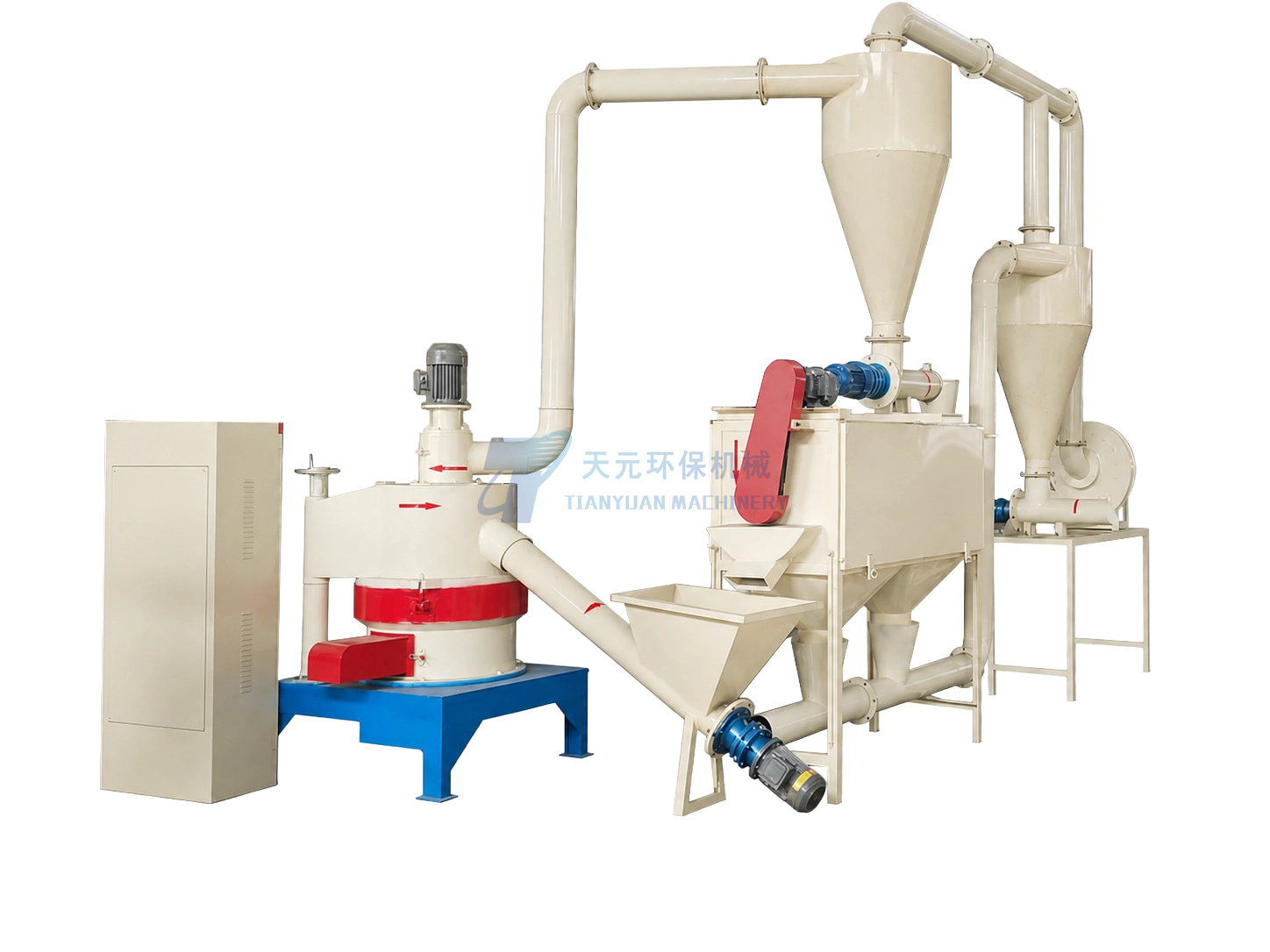
The TYMF6R-600 wood flour mill is a downstream fine-grinding machine for assessed, prepared woody or plant-fiber material. Its confirmed range is 30–325 mesh, 100–500 kg/h and maximum feed diameter ≤5 mm. The finest product and highest output are not promised together; actual capability depends on material, feed condition, target fineness and site conditions. These values do not apply to upstream or auxiliary equipment.
HSE identifies wood-dust exposure hazards; its fire and explosion guidance addresses a separate process risk. Obtain material- and site-specific professional assessment. Ordinary extraction and grounding alone are not a complete fire/explosion protection design.
Frequently asked questions
Can shavings enter the fine mill directly?
Only after the mill’s confirmed size, shape, moisture and cleanliness conditions are met and feeding suitability is established. Thinness alone is insufficient.
Must every batch be crushed again?
No. An already suitable feed may not need another size-reduction stage. Oversize, long curls or feeding problems require an appropriate preparation assessment.
Are furniture-factory shavings equivalent to clean solid-wood shavings?
Not automatically. Check for composite boards, adhesives, coatings and oils. The factory label does not establish the material composition.
Does apparently dry material still need a moisture check?
Yes. Appearance is not a measured value. State the method and wet- or dry-basis definition and consider batch variation.
Can output be promised from the word shavings alone?
No. Define product acceptance, feed condition, the system boundary and representative testing before making a project-specific commitment.
Conclusion
Wood shavings can be a useful wood-flour feedstock when origin, cleanliness, dimensions and handling are controlled. Prepare only what is necessary, verify the mill interface and judge the project by accepted powder—not by flake thinness, loose volume or a model’s maximum figures.