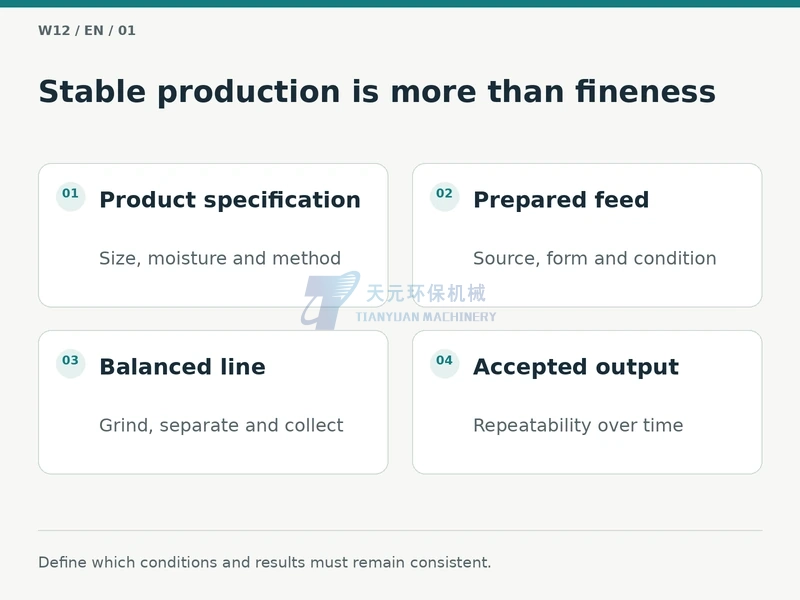
Making one fine sample and continuously delivering an accepted product are different tasks. In ultrafine wood powder production, a tighter product target leaves less room for changes in feed condition, grinding performance, separation and collection. The practical question is not only “can it reach this fineness?” but “can it keep meeting the specification at a verified output?”
Key conclusion: Stable production means repeatable accepted powder, not merely high feed rate or a single favorable sieve result. Define the target and measurement method, qualify the feed, and evaluate the whole line under sustained conditions. “Ultrafine” alone is not a numerical specification or proof of any machine’s capability.
Contents
Define the target before calling the powder ultrafine
Use the customer’s application to define the required particle distribution, test method, moisture basis and any shape or cleanliness requirement. State what must pass and what oversize is permitted. A nominal mesh number, a median value and the maximum particle size describe different things; they should not be substituted for one another.
For this article, “ultrafine” describes a demanding fine-powder target relative to the starting feed; it does not introduce a universal micrometre threshold. Do not convert that word into a claim that a named mill can produce any arbitrarily small powder. Agree the product specification before selecting settings or quoting output.
A finer target changes the useful work required
In their Douglas-fir trials, Wang and colleagues measured increasing specific energy as the product became finer. Those results belong to the tested hammer/rotor-impact system, not to Tianyuan equipment; neither their transition size nor energy values are universal design limits.
The operating implication is to compare accepted product at the target, rather than the amount placed in the hopper. More material passing through a mill does not prove that more saleable powder is being produced. A changed target may require a different balance of feed, grinding and separation within the equipment’s approved range.
For a proposed trial calculation, define specific energy as measured electricity within an agreed boundary divided by the accepted-product mass on a stated moisture basis. Include the same equipment and time period in every comparison; do not compare one run’s main-motor energy with another run’s complete-line consumption.
Feed variation can become output variation
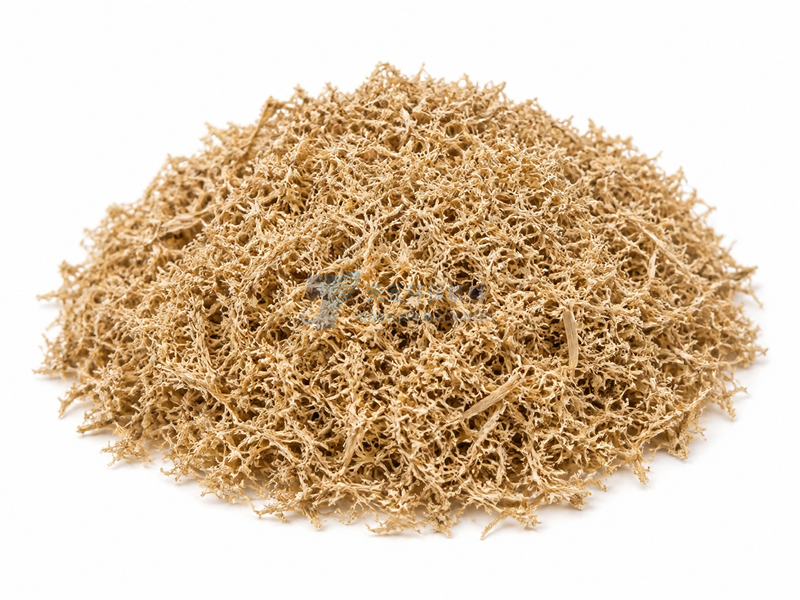
Record species or controlled blend, particle dimensions, moisture, contamination and the condition of the stored feed. Then check whether these remain comparable during the run. One dry handful or a supplier description such as “sawdust” does not describe the full lot.
A useful diagnostic sequence is to compare the incoming lot, the actual mass delivered to the mill and the resulting product before changing the machine. A higher volumetric feeder setting is not necessarily a higher mass rate. Different moisture bases also make apparently identical percentages non-comparable; see the wood moisture and grinding guide.
When the feed falls outside the approved equipment condition, prepare it first. Do not compensate for unsuitable feed by increasing speed, airflow or feed rate without a validated operating procedure.
Grinding, classification and collection must remain balanced
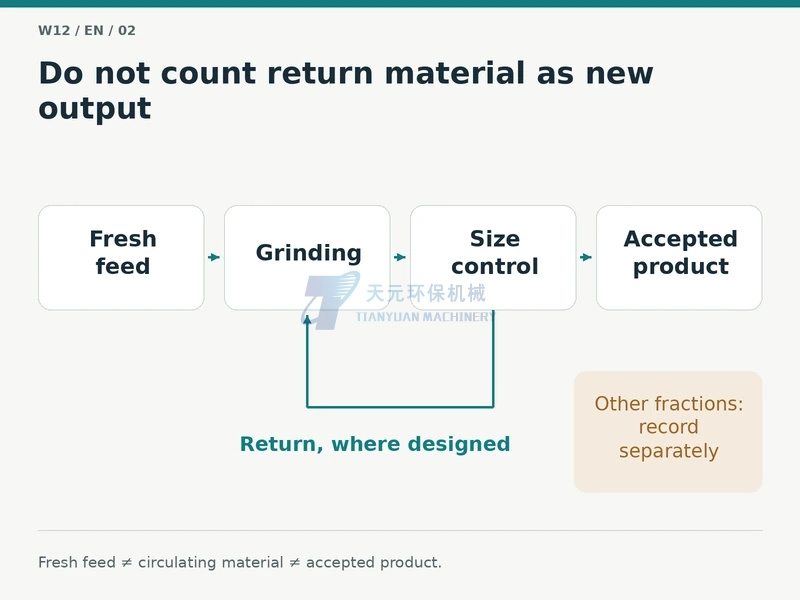
In a line with a return stream, fresh feed, circulating material and accepted output are separate quantities. Reprocessing the same coarse fraction increases internal activity but does not create additional new product. Track rejected fractions, collected dust and material retained in the system separately.
Use the following table as an investigation plan, not as a diagnosis from a single symptom. Check airflow, separation and discharge only by the approved operating and maintenance procedures; collector dust is not automatically an accepted product fraction.
| Observation | Check together | Do not assume |
|---|---|---|
| More feed; little change in accepted output | Product distribution, return stream and system inventory | Hopper throughput equals saleable output |
| Product becomes coarser during a run | Feed condition, separation performance and measurement consistency | The mill is the only possible cause |
| Variable discharge or rising filter resistance | Discharge path, extraction condition and permitted operating indicators | A larger fan setting is the solution |
| Different results after sample preparation | Sampling, dispersion and whether particles were broken | A measurement change proves production changed |
Distinguish heat, agglomeration and measurement effects
Trend material or outlet temperature at defined locations together with electrical load, product results and operating time. A change is a signal to investigate, not a universal alarm value. This article prescribes no temperature, speed or airflow limit: those must come from the equipment instructions and the material-specific assessment.
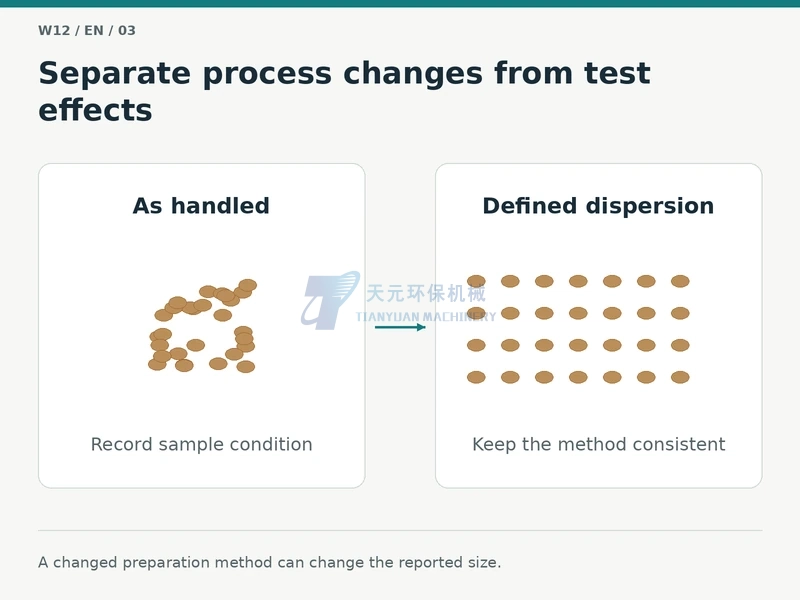
Malvern Panalytical’s dispersion guidance distinguishes separating agglomerates from damaging primary particles. Therefore a finer laboratory reading after stronger dispersion need not mean that milling improved. Keep the preparation method fixed and report its conditions.
For a fine woody powder that appears to cake or discharge irregularly, investigate sample condition, moisture and powder handling before simply milling longer. Record both the powder as handled and the agreed dispersed measurement when those answer different quality questions.
Demonstrate stability over an agreed run
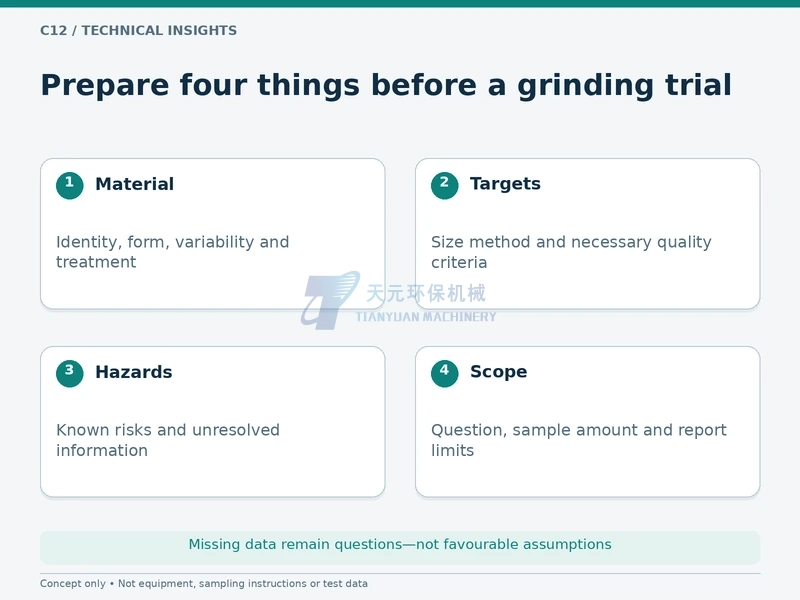
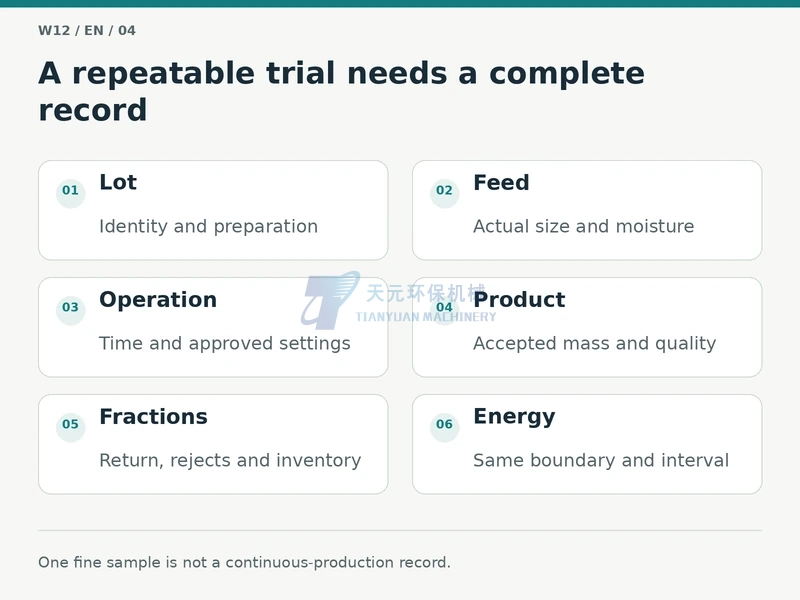
Prepare a trial plan before the material arrives. Use representative feed and an agreed evaluation period, rather than an invented universal sample mass or test duration. Separate start-up observations from the operating interval used for the performance claim.
- Identify the lot, preparation history, actual feed dimensions and moisture method.
- Record the initial settings and every approved adjustment with a time reference.
- Measure accepted output and sample at agreed points during the evaluation interval.
- Keep return material, rejected material, retained inventory and dust fractions identifiable.
- Compare particle results, moisture and application requirements with the agreed specification.
- State the energy boundary and disclose interruptions or material changes.
This proposed record makes a result reproducible; it is not a Tianyuan test report or a guaranteed acceptance standard. The grinding-test preparation guide provides the upstream information to agree before testing.
Tianyuan equipment and safety boundaries
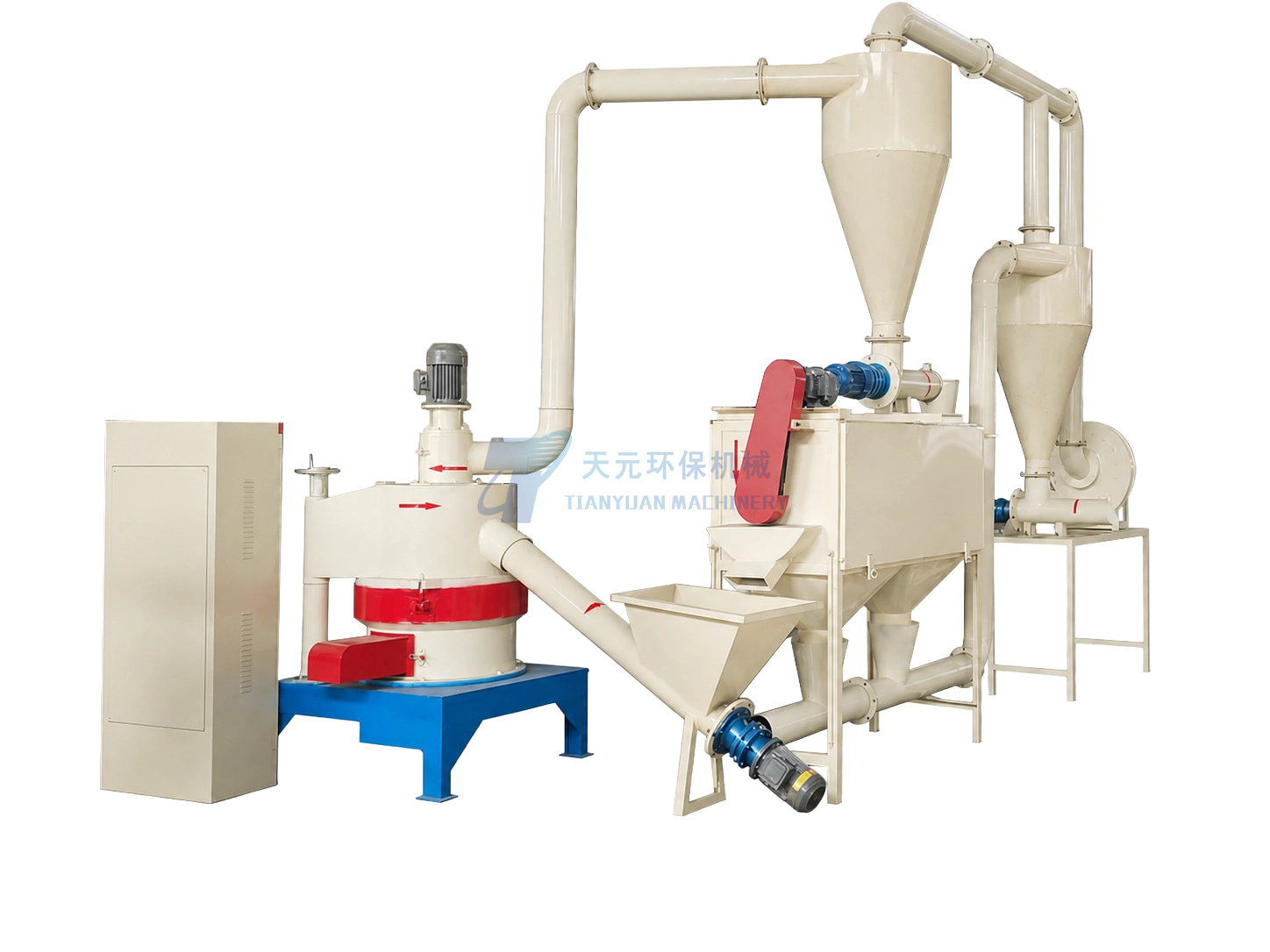
The TYMF6R-600 is a downstream fine-grinding machine for appropriately prepared woody or plant-fibre material, not a machine for directly crushing whole logs. Its confirmed range is 30–325 mesh, 100–500 kg/h and maximum feed diameter ≤5 mm. Actual capacity depends on material, feed condition, target fineness and site conditions; the finest product and highest output are not promised together.
These ranges do not define another model, a universal shape limit or an unrestricted ultrafine capability. Confirm the actual feed geometry, not just one dimension, and do not assume arbitrary long strands are acceptable because their diameter is small.
HSE identifies fire and explosion risks from wood dust. Ordinary extraction and grounding are not a complete protection design. Keep product acceptance separate from the material- and site-specific safety assessment.
FAQ
Does a finer target always mean the line is unstable?
No. Stability must be demonstrated for the material, target and configuration. The point is to verify accepted output and control conditions, not to declare all fine production unstable.
Can a finer screen alone solve the problem?
Not necessarily. Feed, grinding, separation, collection and measurement must work together. Change components or settings only within a validated equipment configuration.
Does more return material mean higher production?
No. Return material is recirculated inventory. Report net accepted product separately so the same material is not counted repeatedly.
Is the driest feed automatically the best?
No universal optimum is established here. Meet the approved feed condition, state the moisture basis and validate production and safety together.
What proves a stable production claim?
A representative run with traceable feed, consistent testing, accepted-product mass, operating records and disclosed interruptions—not a single fine sample.
Conclusion
Stable ultrafine wood powder production is a controlled product-and-process result. Define the product, keep the feed comparable, balance the line, separate measurement effects from process changes and report accepted output over a documented run. A finer target is a reason for better verification, not for unsupported capacity or safety promises.