Changes in feeding, screening or output between batches do not necessarily mean that a wood powder mill has developed a fault. Feed moisture and its variation within the batch are process inputs worth checking alongside feed size and operating conditions.
Key conclusion: define the moisture measurement and calculation basis first, then validate a workable feed range within the equipment’s permitted conditions. Neither “the drier the better” nor a single percentage for every wood species is a reliable selection rule.
Contents
Define the moisture basis before comparing percentages
Wood moisture content is commonly expressed on a dry basis. A wet-basis result uses a different denominator. The USDA wood–moisture reference explains the dry-basis convention used for wood. Always identify which basis the instrument, supplier and acceptance specification use.
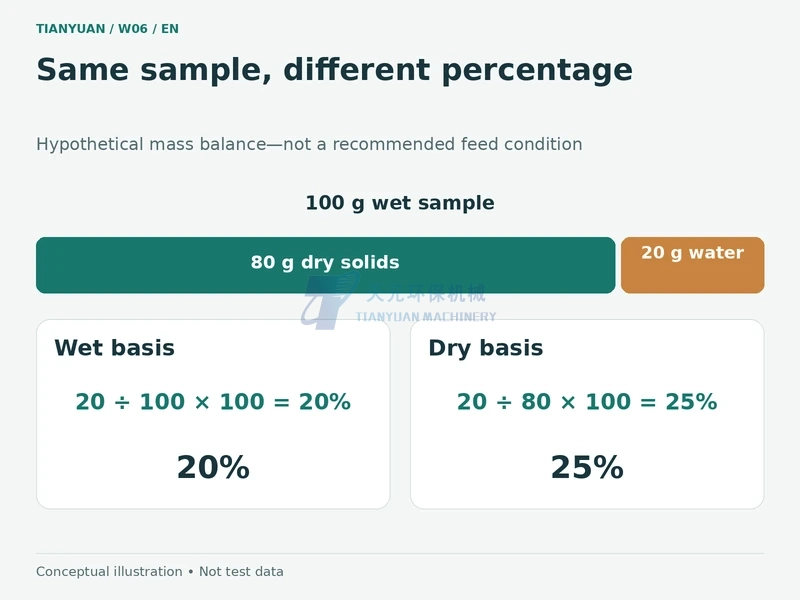
Dry-basis moisture (%) = water mass ÷ dry-solid mass × 100.
Wet-basis moisture (%) = water mass ÷ total wet-sample mass × 100.
For an arithmetic illustration only, suppose a 100 g wet sample contains 80 g dry solids and 20 g water. Its moisture is 20% wet basis but 25% dry basis. Both describe the same hypothetical sample. These are not Tianyuan test results, recommended feed values or permission to operate above a machine’s feed limit.
Do not compare two percentages until their bases and methods are compatible. Record any conversion rather than silently changing a supplier’s specification.
Separate the effect on material from the effect on the line
Moisture is linked to wood’s mechanical response. A published Douglas-fir comminution study also found that moisture and equipment type affected measured energy use. Its hammer- and knife-mill results are not a performance test of Tianyuan equipment and cannot be converted into a guaranteed production rate for another machine.
For a practical assessment, observe three interfaces: continuous feed delivery, the particle distribution after grinding, and stable screening and collection. When moisture differs from the validated condition, investigate adhesion, agglomeration and changes in effective size reduction. Also check feed dimensions, contaminants and classifier condition; a difficult batch is not automatically a moisture fault.
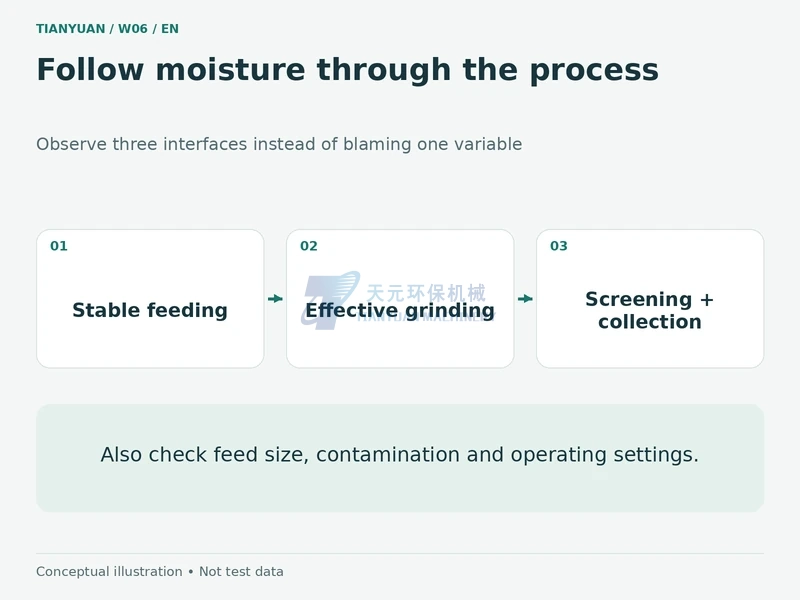
Record the complete condition when an abnormality appears. A statement such as “output dropped when wetter feed arrived” is an observation to investigate, not proof that water was the only changed variable.
Measure material that actually represents the feed
Create a sample record identifying the source, sampling locations and times, material temperature, storage method and test time. One reading from a stockpile surface does not automatically represent the complete batch. Keep different batches identifiable rather than combine them without a record.
USDA moisture-measurement guidance discusses representative material, moisture change after sampling and method limitations. Oven mass loss can include volatile constituents; an electrical meter also needs to be suitable and calibrated for the material being tested. Do not assume a reading from a board-oriented meter is a reference measurement for loose chips or flour.
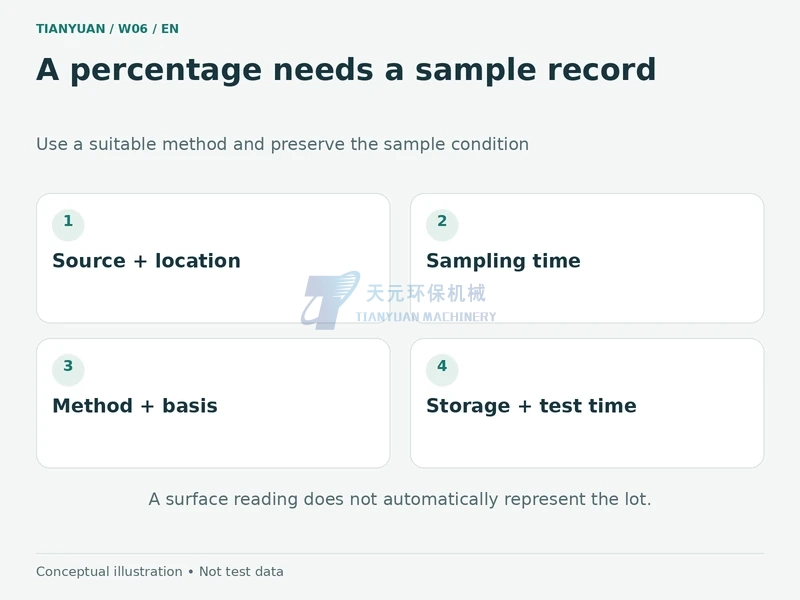
Choose a documented method with the receiving party or testing laboratory. Use consistent sampling and preservation when comparing lots. This article does not assign a universal sample mass, drying temperature, test time or meter correction.
Validate a working range inside the equipment limits
First confirm the manufacturer’s permitted feed condition and the customer’s finished-product moisture requirement. They are separate constraints. Then assess representative feed states within those limits, keeping species or controlled blend, feed size, target fineness and measurement procedure comparable.
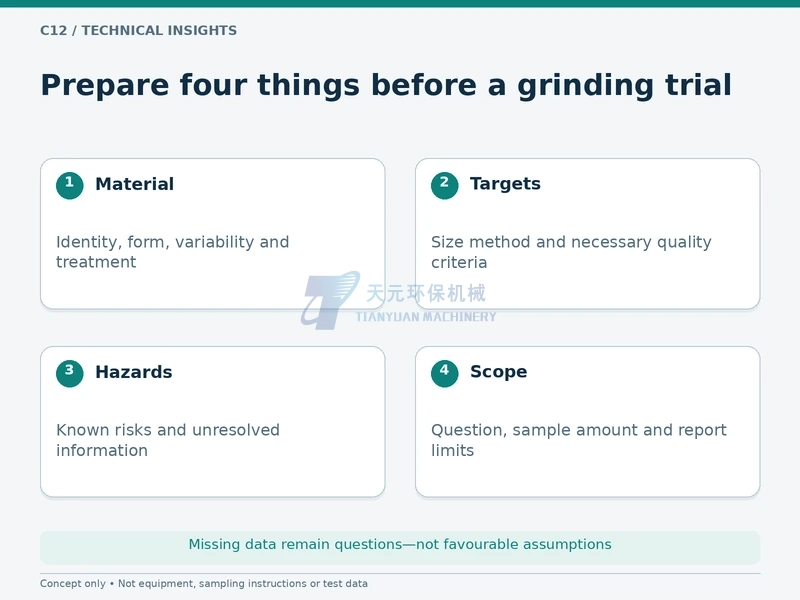
A useful trial record links the measured feed condition to feeding stability, operating settings, accepted product output and final particle distribution. Record changes made during a run instead of presenting the runs as identical. The existing grinding-test preparation guide provides a starting point for defining those objectives.
If feed is outside the equipment’s permitted condition, prepare it before milling. Do not use higher feed rate or an undocumented setting change as a substitute for compliance. Without a valid comparison, there is no defensible universal “best moisture” or guaranteed capacity at a chosen percentage.
Compare accepted dry solids and the complete energy boundary
Record feed mass, accepted-product mass, their moisture, particle results and run time. Wet mass contains water as well as solids, so a wet-feed rate alone is an incomplete comparison between moisture conditions. State whether the calculation uses incoming material or product that actually passes the specification.
For energy comparisons, identify the numerator and denominator: main-mill electricity, line electricity or a wider boundary including drying; then identify the accepted-product mass basis. Keep these measures separate rather than label all of them “milling energy.”
Where drying is necessary, consider drying demand, material losses, subsequent grinding and moisture regained in storage together. Pursuing lower moisture does not by itself demonstrate lower total cost. No drying schedule or universal energy value is prescribed here.
Tianyuan application boundary: feed condition is not an optimum
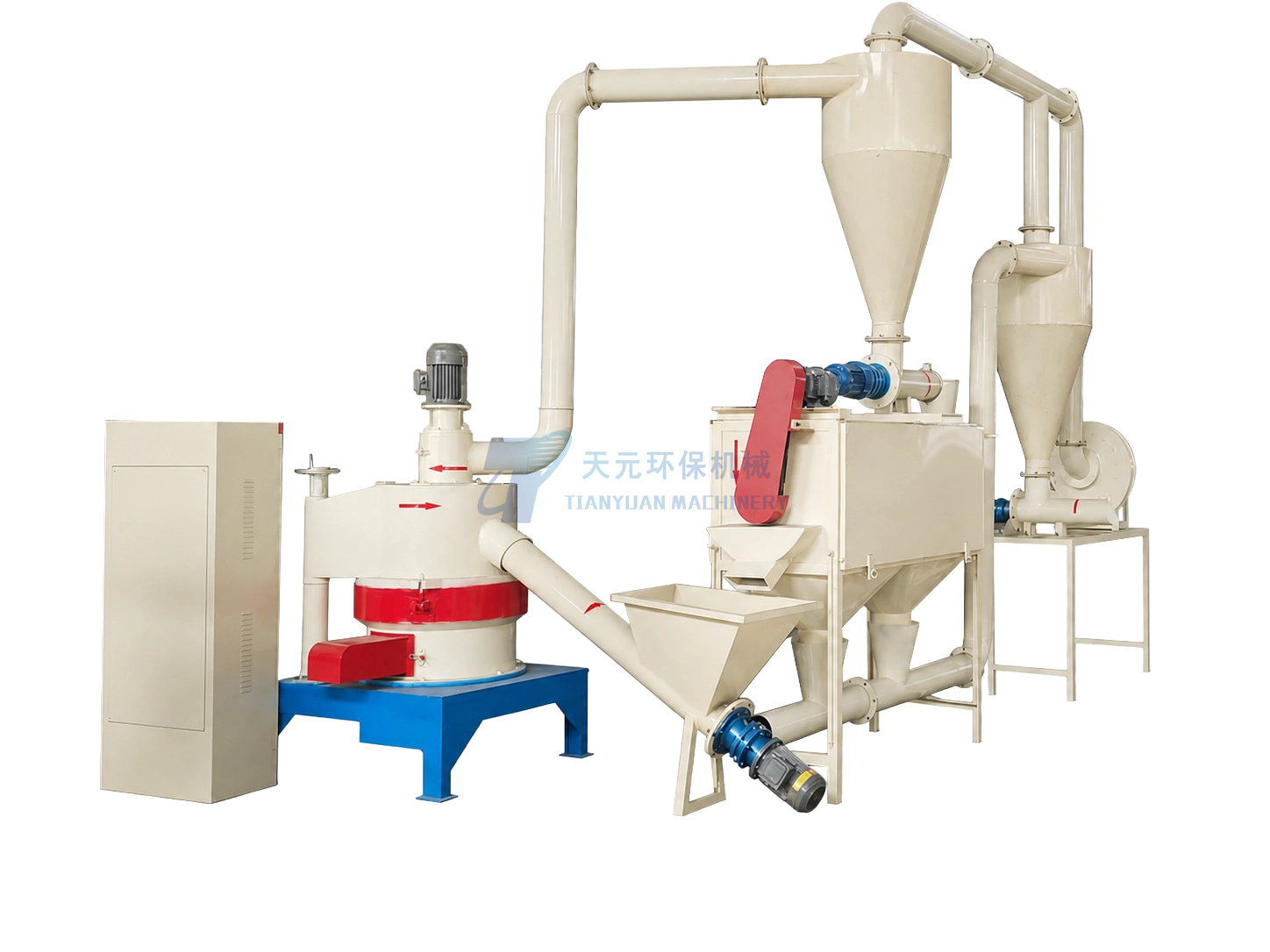
The TYMF6R-600 performs downstream fine grinding of appropriately prepared woody or plant-fiber feed. Its confirmed range is 30–325 mesh, 100–500 kg/h and maximum feed diameter of 5 mm. Actual capacity depends on material, feed condition, target fineness and site conditions. The range is not a guarantee that every combination is achievable, nor a specification for other models.
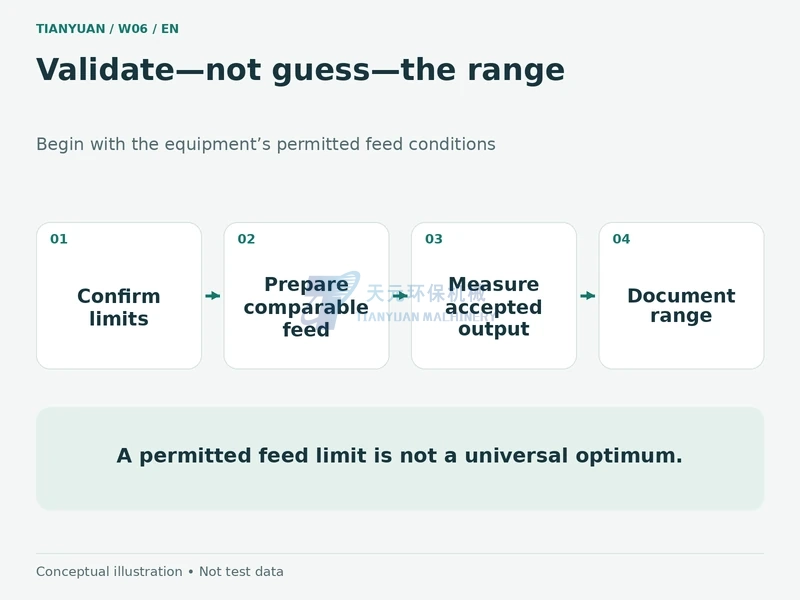
A product-page moisture condition defines an equipment application boundary; it is not proof of an optimum for every species. Confirm its measurement method, wet/dry basis and applicability to the actual feed before a trial. This article does not extend the manufacturer’s permitted range.
Quality and safety still need separate review. HSE wood-dust guidance and woodworking fire/explosion guidance address risks that are not resolved merely by choosing a moisture percentage. Ordinary dust collection or grounding is not a complete fire- and explosion-protection system.
FAQ
Can feed that feels dry be accepted without measurement?
No. Hand feel cannot replace the agreed measurement method or establish the condition of an entire batch.
Is 20% dry-basis moisture the same as 20% wet basis?
No. Their denominators differ. State or convert the basis before comparing results.
Will drier wood always require less total energy?
That is not a safe guarantee. Compare the same material and accepted product, and state whether drying and supporting operations are included.
Does acceptable feed moisture guarantee acceptable delivery moisture?
No. Feed, mill discharge and delivery are different sampling points and times. Verify the required finished-product condition separately.
Can humidity control replace combustible-dust protection?
No. Humidity is not a substitute for a material- and process-specific hazard assessment and suitable protection.
Conclusion
Manage wood moisture as a measured process input, not an impression or an unexplained percentage. Align the basis and sampling method, validate within the equipment limits, and compare accepted product with a clearly defined energy boundary. That approach separates moisture effects from other process changes without inventing a universal optimum.