Wood flour can look fine and uniform yet still fail its intended application. A purchasing specification needs to describe the powder that the customer can actually use, not simply repeat the mill model or the finest mesh available.
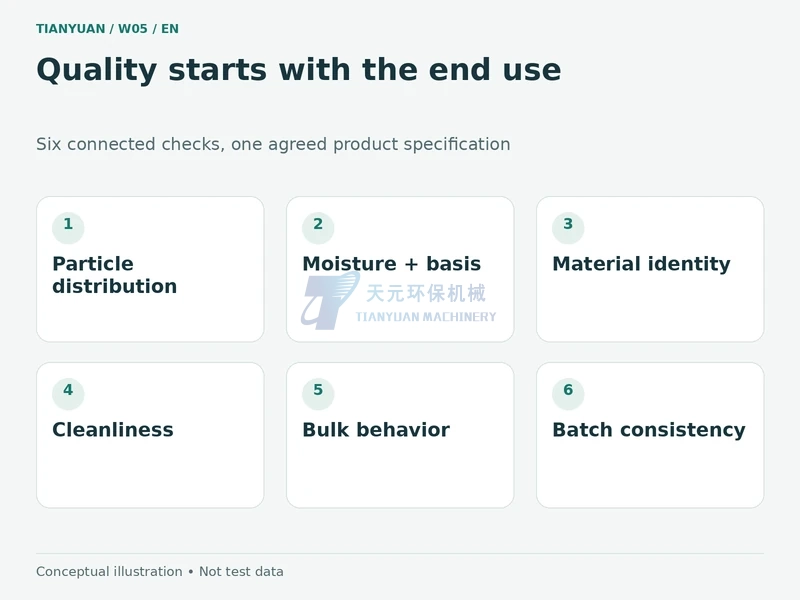
Key conclusion: define the end use first, then control particle distribution and shape, moisture, material identity, contamination, bulk behavior and batch consistency with agreed methods. Quality means reproducible compliance with that specification—not the finest possible powder.
Contents
Start with an acceptance specification, not an appearance
USDA’s Wood Flour chapter connects species selection and size classification with downstream use. The practical implication is to define requirements for the intended formulation or process rather than advertise a universal grade for all wood-plastic composites, fillers or other applications.
Build an acceptance sheet with four fields: the property, the method, the sampling condition and the responsible party. For a coarse-particle limit, identify the measurement and acceptance fraction. For moisture, state the calculation basis. Agree the criteria before comparing quotations: two suppliers may otherwise use the same label for different products.
Check particle distribution and shape together
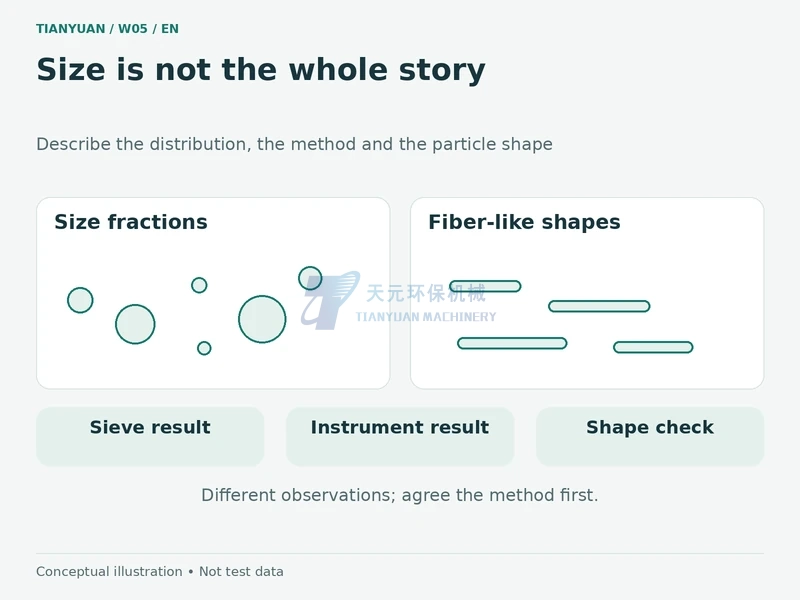
A nominal mesh label does not describe every particle in the batch. Ask how the main fraction, coarse tail and remaining fiber bundles will be assessed. A sieve pass percentage and an instrument-reported median size are different descriptions; neither should be substituted silently for the other.
For comparisons, keep the sieve designation, operating procedure and sample condition consistent. With an instrument method, record sample dispersion and the reporting basis. Where particle shape matters to the end use, agree a separate morphology check rather than expecting an average diameter to answer that question. The illustration below is conceptual, not a measured distribution or micrograph.
A finer target is a choice, not an automatic quality improvement. Request evidence that the target suits the application before accepting extra processing or rejecting a coarser grade that already meets the agreed requirement.
Record moisture with its basis and sample history
Wood exchanges moisture with its surroundings, as explained in the USDA wood–moisture reference. Therefore, a reported percentage should be accompanied by the method, wet- or dry-basis definition, sampling point and sampling time. An opened sample stored before testing may no longer represent the freshly collected product.
Keep feed moisture, finished-powder moisture and delivery acceptance separate. They answer different questions. A feed condition that permits stable milling does not automatically satisfy a customer’s finished-product limit. Use one agreed procedure for comparing lots, and record any conditioning performed before the test.
Identify the source and the contaminants of concern
Record species or a controlled species mixture, source process, bark inclusion and any history of coatings, adhesives or treatment. Do not describe clean sawmill residue and unidentified mixed recycling material as equivalent feedstocks merely because both are wood-based.
Color can be an observation in a consistency check, but it is not proof of purity. A darker lot needs investigation against its source and processing history, not an automatic diagnosis of burning. Similarly, an ash measurement and a metal-contaminant check answer different questions. Specify suitable tests for the actual concern; one result should not be presented as proof that all contaminants are absent.
Define bulk behavior and the application-validation boundary
For a meaningful bulk-density comparison, use the same filling and loose or tapped condition. Do not substitute solid-wood density for powder bulk density. Also agree how feeding consistency will be observed, rather than judge the powder from how full a bag appears.
Separate measured properties from downstream claims. A sample passing sieve and moisture checks has not thereby demonstrated composite strength, mixing performance or suitability for every formulation. An application trial must identify what was tested and which claims remain unverified. Published research is not a Tianyuan production test.
Make the sample represent the production lot
Define the lot and follow a safe, representative sampling plan. Record the product stream, collection times and sample division. Do not select only the finest bag or mix filter dust, accepted product and recycle material without identifying their origins.
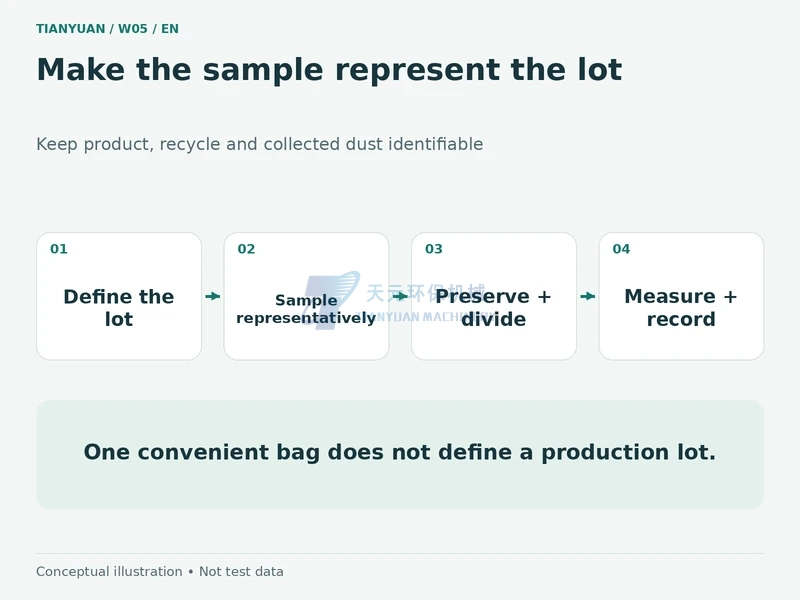
USDA moisture-measurement guidance stresses representative material and protecting a sample against moisture change. Agree sample quantity, inspection frequency and permitted variation for the application; none is assigned a universal value here. Keep a labeled retained sample when the agreed procedure requires it.
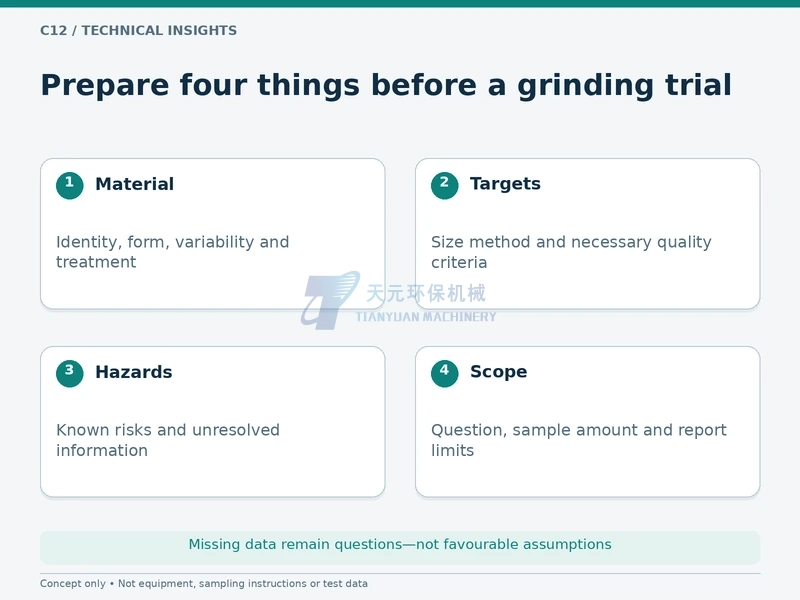
For a milling evaluation, the existing grinding-test preparation guide explains how to connect supplied feed with measurable objectives. For production acceptance, extend that discipline to repeated lots rather than treating one successful sample as permanent qualification.
Tianyuan process judgment: work backward from the product
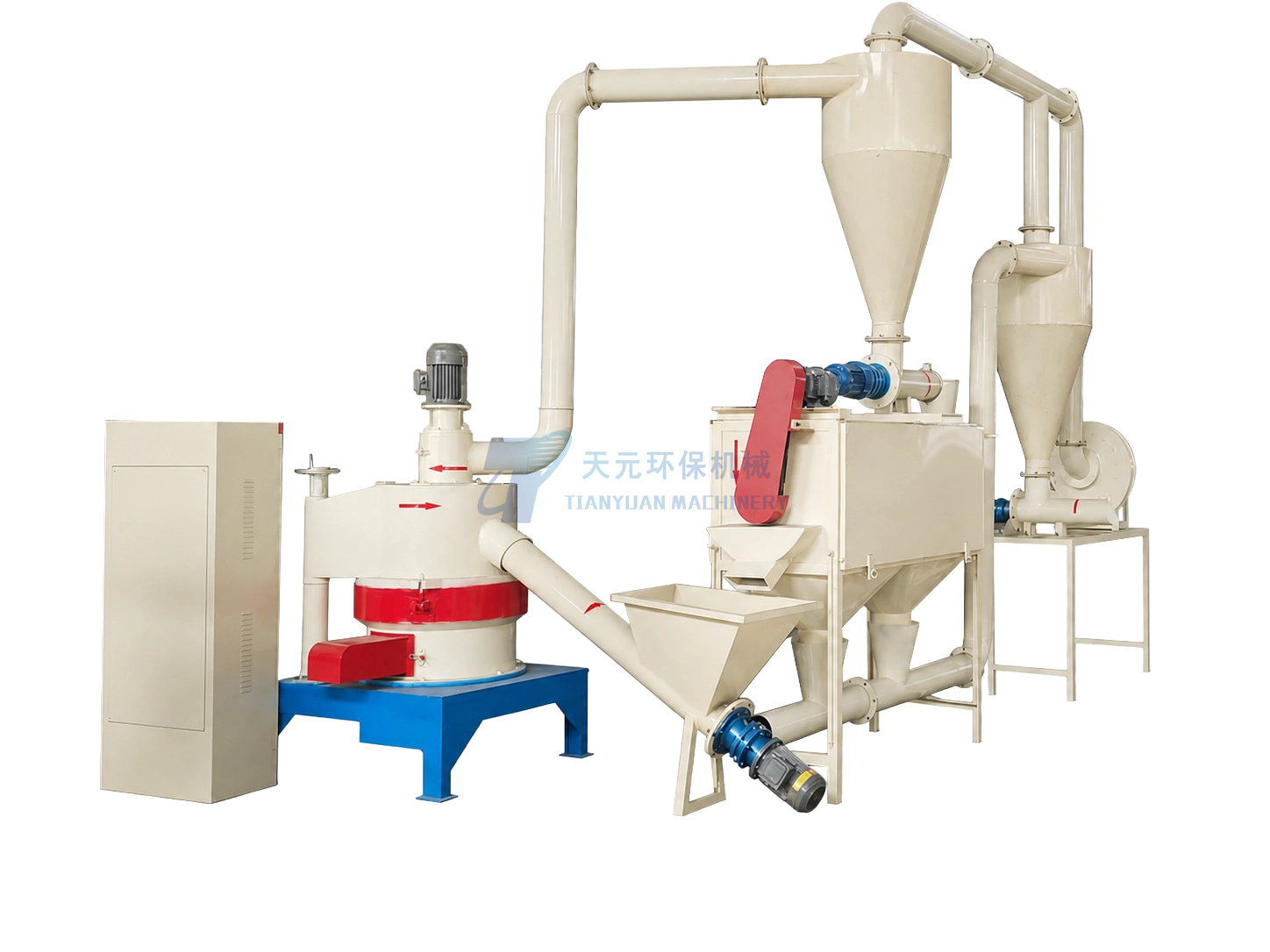
For a Tianyuan project, use the acceptance sheet to decide which preparation, fine-grinding and classification stages need assessment. The TYMF6R-600 is a downstream fine-grinding machine for prepared woody or plant-fiber feed, not a primary log crusher. Its confirmed range is 30–325 mesh, 100–500 kg/h and a maximum feed diameter of 5 mm. Actual output depends on material, feed condition, target fineness and site conditions; the finest setting and highest throughput are not a combined guarantee, and these figures do not apply to other models.
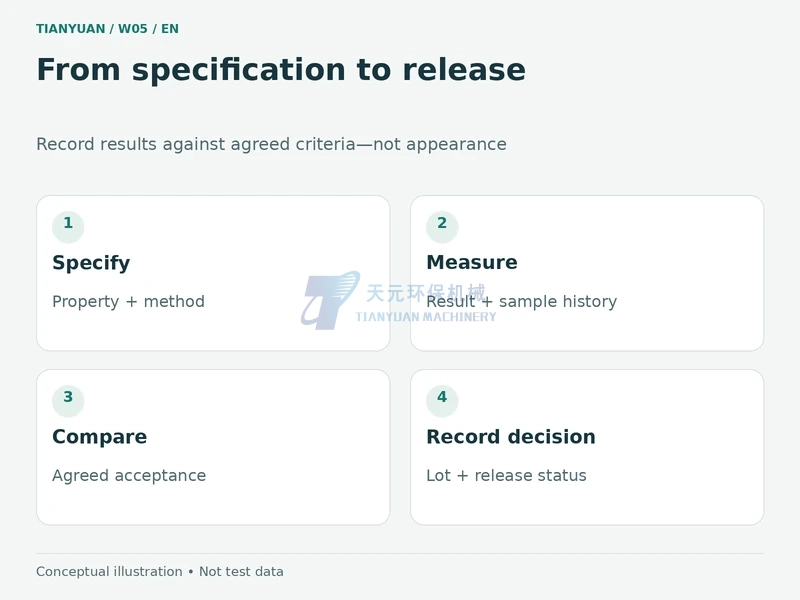
A useful release record identifies the lot, test method, result, agreed limit and release decision. Keep the quality decision separate from the safety assessment. HSE’s wood-dust guidance and fire/explosion guidance address hazards that a product-quality certificate does not remove. Ordinary collection or grounding is not a complete protection design.
FAQ
Can two wood flours with the same mesh designation be interchanged?
Not on that information alone. Compare the measurement method, distribution, source, moisture and application requirements before substitution.
Is finer wood flour always higher quality?
No. The correct target is the grade that meets the intended use. Additional fineness needs application justification, not a blanket quality claim.
Does a pale color prove high purity?
No. Establish the source and test for the contaminants that matter. Appearance alone cannot replace those checks.
Is dust collected in a filter automatically finished wood flour?
No. Identify its origin, particle characteristics and cleanliness before deciding whether it can enter the product stream.
Does a successful milling sample qualify every future batch?
No. The result applies to the tested material and scope. Ongoing feed control and a production inspection plan are still needed.
Conclusion
Control wood flour quality through a clear end-use specification, comparable measurements and representative sampling. Select the process around accepted product requirements instead of treating a machine rating, photograph or single mesh label as proof of quality.