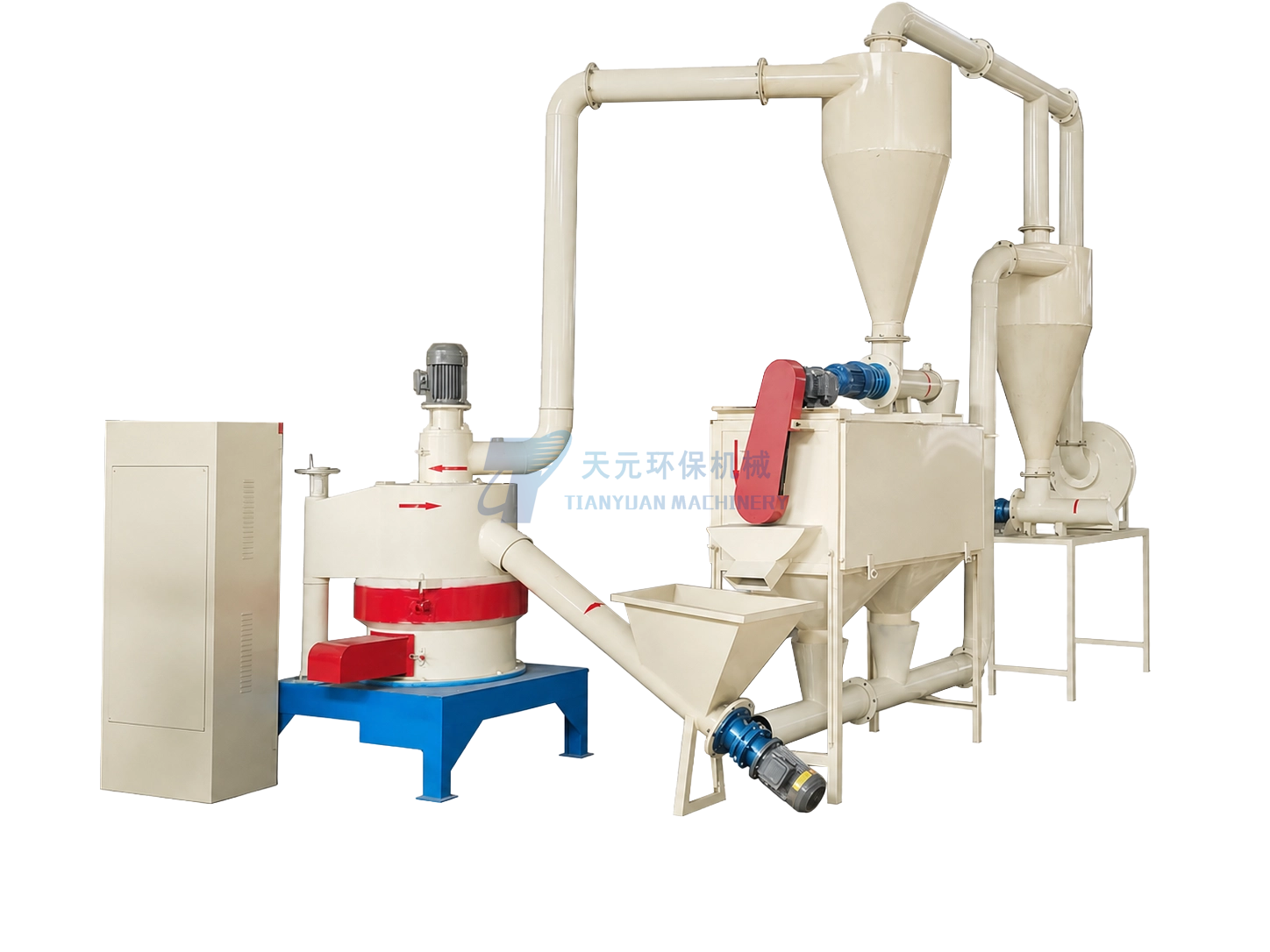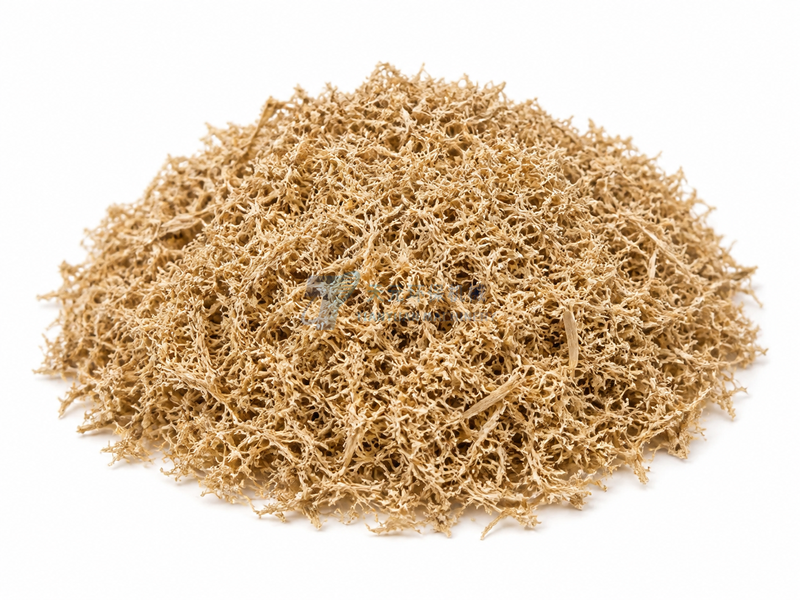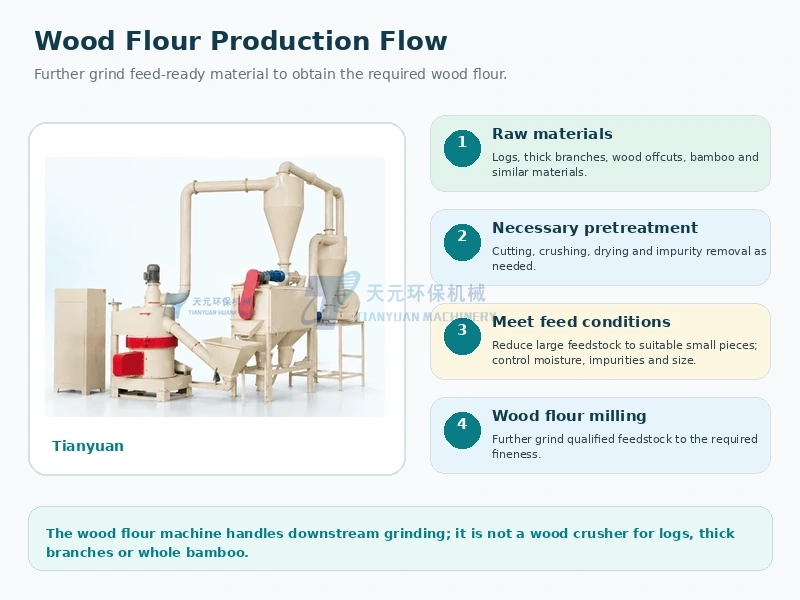
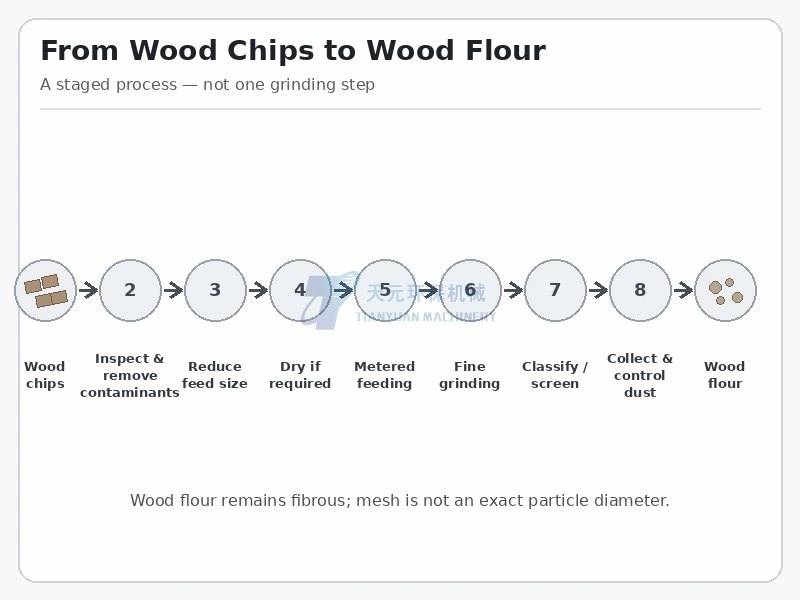
Wood chips do not normally become finished wood flour in one step. A stable process usually combines raw-material inspection, size reduction, moisture control when needed, metered feeding, fine grinding, classification or screening, product collection and dust control. The exact route depends on the chip size, moisture, wood species, fiber structure and the final powder specification.
Key Answer
For the TYMF6R-600 route, the fine-grinding stage requires prepared feed no larger than 5 mm. If incoming wood chips are larger, they should be chipped or crushed before fine grinding; if moisture is unsuitable for stable milling, drying should be added before the fine mill. The TYMF6R-600 is positioned for 30–325 mesh wood powder at 100–500 kg/h, but actual capacity depends on material, feed condition, target fineness and site conditions. Chipping, crushing and necessary drying are pretreatment stages; the wood powder mill is the downstream fine-grinding stage.
Contents
From Wood Chips to Wood Flour: Process Overview
The most useful way to design the line is to separate pretreatment from fine powder production. Large wood, branches, offcuts and coarse chips first need to be converted into a small and reasonably uniform feed. The prepared material then enters the fine-grinding stage, where the target powder size is developed and controlled. This distinction avoids the common mistake of expecting one wood powder mill to accept every form of raw wood directly.
A typical route is sorting → chipping/crushing when required → drying when required → metered feeding → fine grinding → classification/screening → cyclone/product collection → dust collection → finished-product verification. Some steps can be omitted when the incoming material already meets the next machine’s feed condition.
1. Inspect the Raw Material Before Any Grinding
Start by identifying what the “wood chips” actually contain. Clean sawmill chips, planer shavings and clean sawdust behave very differently from demolition timber, used formwork or mixed recycling residues. Before selecting equipment, confirm wood species, chip dimensions, moisture condition and contamination risk.
- Remove metal, stones and other hard foreign objects before downstream equipment.
- Separate treated, painted, glued or otherwise chemically contaminated wood unless its suitability has been specifically assessed.
- Check whether bark, sand or other mineral contamination is acceptable for the final application.
- Use representative material rather than one unusually clean sample when evaluating a production line.
This first step protects the machines, but it is also a product-quality step. Once contamination is ground into fine powder, removing it becomes much more difficult.
2. Reduce Wood Chips to a Stable Fine-Mill Feed Size
Fine wood flour production works more consistently when the fine mill receives a narrow, controlled feed size. Reviews of lignocellulosic comminution describe very fine biomass milling as a multistage operation: coarse materials are first cut or crushed, followed by intermediate and fine milling. This is one reason industrial wood-powder lines commonly use chippers or crushers before the fine mill rather than relying on the final mill for the entire size-reduction duty.
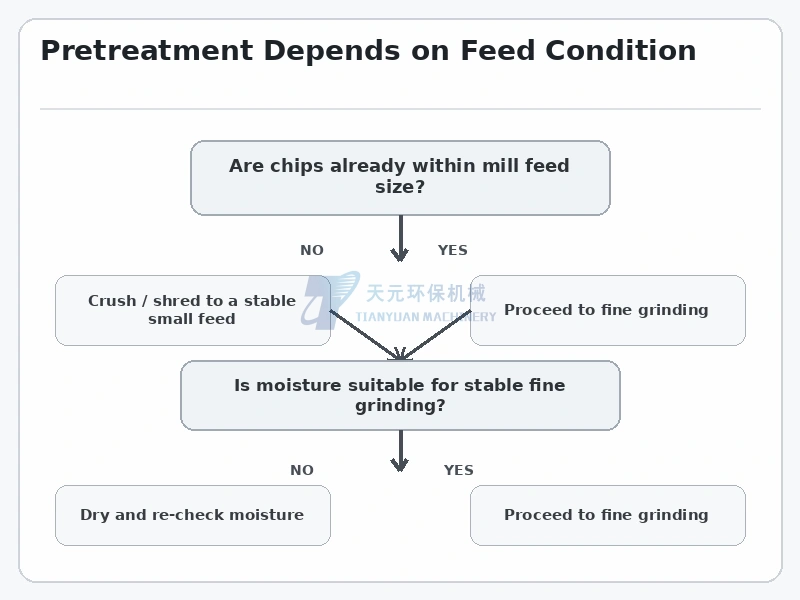
For the confirmed TYMF6R-600 specification, the maximum feed diameter is 5 mm. If chips are larger than this, use suitable chipping or crushing equipment first. If sawdust or small particles are already within the feed requirement, a separate chipping stage may be unnecessary. The goal is not to add machines automatically; it is to present the fine mill with a stable feed it can process continuously.
3. Control Moisture Before Fine Grinding
Moisture changes how wood fibers cut, fracture, flow and separate. Wet or highly variable feed can reduce throughput, promote sticking or agglomeration, make screening less stable and change the apparent fineness of the finished product. Drying should therefore be decided from measured material condition and the target process, not added as a ritual step to every line.
If the material is already suitably dry and stable, it may move directly to the next stage. If moisture is too high for the selected fine-grinding route, drying should be completed before the mill and the feed should be rechecked after drying. The dryer type and operating condition must be selected for the real material and local safety requirements.
4. Meter the Prepared Material Uniformly
A fine mill works best with a consistent feed rate. Sudden surges can change mill loading, residence time, classification behavior and finished-powder consistency. A screw conveyor or another controlled feeder is therefore not just a transport device: it is part of process stability. Feed should be as uniform as practical in size, moisture and bulk behavior before entering the fine-grinding system.
5. Fine-Grind the Prepared Wood Feed
After pretreatment, the small prepared particles enter the wood powder mill. Wood is a fibrous lignocellulosic material, so fine grinding changes not only nominal particle size but also fiber length, width and aspect ratio. Published studies on wood flour show that species and milling conditions can produce different particle morphologies even when the same screen is used. This is why “mesh” alone does not describe every relevant property of wood flour.
For the TYMF6R-600, the confirmed product range is 30–325 mesh with a nominal capacity range of 100–500 kg/h. These are equipment-range values, not a guarantee that the finest specification and maximum capacity occur at the same time. Actual output changes with wood species, fiber toughness, feed condition, target fineness, classification load and site conditions.
6. Classify, Screen, Collect and Control Dust
Fine grinding alone does not automatically produce a saleable, uniform product. The downstream system determines which particles are accepted, which are returned or rejected, and how the powder is collected. Depending on the line, an air classifier can provide dynamic fineness control, while a final screen can remove occasional oversize particles or agglomerates. A cyclone separates product from conveying air, and the dust-collection system controls fines that remain in the air stream.
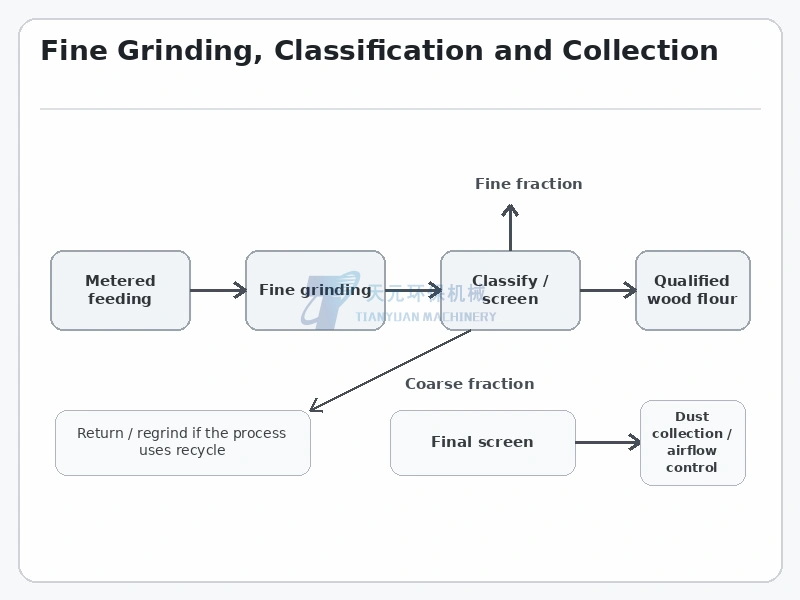
This is also why screening and air classification should not be treated as identical operations. A screen separates by physical aperture, while air classification depends on aerodynamic behavior. Fibrous wood particles may respond differently in the two systems.
When Can Pretreatment Stages Be Skipped?
| Incoming material | Likely pretreatment logic | Reason |
|---|---|---|
| Clean, dry sawdust already ≤5 mm | May skip chipping/crushing; verify moisture and feed stability | Feed is already close to fine-mill requirement |
| Dry chips larger than 5 mm | Reduce size before fine grinding | Protects the fine mill from oversize feed and stabilizes loading |
| Wet chips or wet sawdust | Dry as required, then verify feed condition | Moisture can disturb milling, classification and screening |
| Branches, slabs or large offcuts | Chipping followed by crushing if needed | Large material requires staged size reduction |
| Recycled or demolition wood | Sort and inspect aggressively before any grinding | Metal, mineral and chemical contamination can damage equipment or contaminate powder |
A process line should therefore be configured from the incoming feed, not copied from a generic equipment list. Two customers asking for “80 mesh wood flour” may need very different upstream equipment if one starts with clean dry sawdust and the other starts with wet branches.
What Should Be Verified Before the Powder Is Accepted?
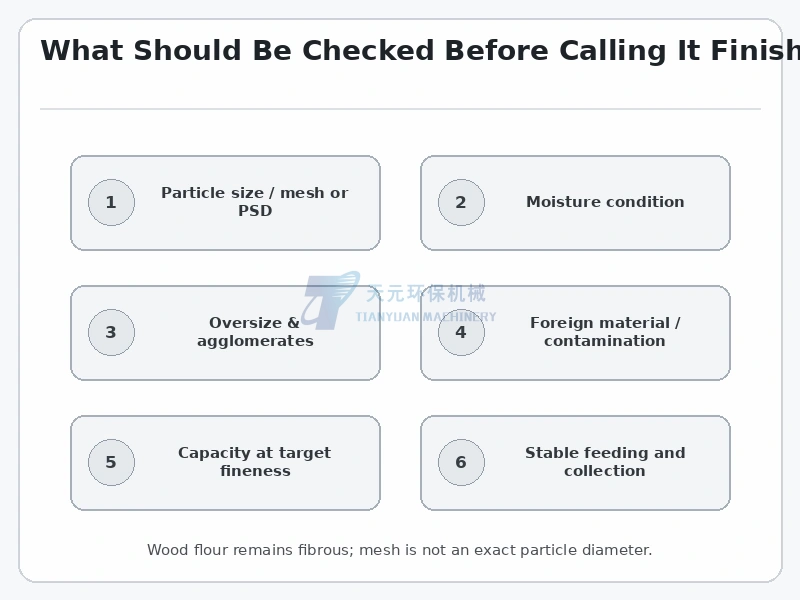
- Particle-size requirement: mesh, percent passing, or a particle-size distribution such as D50/D90 when relevant.
- Moisture condition of the finished product.
- Oversize particles, agglomerates and screen residue where required.
- Foreign material and contamination relevant to the downstream use.
- Qualified-product capacity at the target fineness, not only gross feed rate.
- Stable feeding, collection and dust control during continuous operation.
Wood flour remains fibrous after grinding. Research on fractionated wood flour shows that even prolonged sieving does not make every particle dimension equal to the nominal mesh opening. For WPC and other applications, particle size and morphology can affect downstream processing and product properties. The acceptance specification should therefore match the real use of the powder.
Tianyuan Process Judgment for Wood-Chip Projects
For a wood-chip-to-flour project, Tianyuan should first ask for the raw-material form, largest chip size, moisture, wood species, target fineness and required qualified-product capacity. If the chips are too large, add size reduction; if the material is too wet for stable fine milling, add drying; if the target powder requires tighter control, configure suitable classification and screening. Representative sample testing is the preferred way to confirm unusual wood species, mixed residues or demanding fineness targets before finalizing the line.
The key boundary is clear: the wood powder mill is the downstream fine-grinding machine. Chippers, crushers and dryers prepare the feed; they are not substitutes for the final wood-flour mill, and the fine mill should not be described as a universal machine for unprepared logs or arbitrary wet waste.
Wood-Dust Safety Must Be Designed Into the Process
Fine wood dust is not only a housekeeping issue. OSHA identifies wood dust as a respiratory and skin hazard and also notes that accumulations of fine wood dust can create fire and explosion hazards. Production lines should therefore include source capture, suitable dust collection, good housekeeping, control of ignition sources and a site-specific safety review. Do not assume that an ordinary fan or dust collector by itself constitutes a complete combustible-dust safety system.
FAQ
Can wood chips go directly into a wood powder mill?
Only if the chips already meet the mill’s feed-size and condition requirements. For the TYMF6R-600, the confirmed maximum feed diameter is 5 mm, so larger chips need pretreatment before fine grinding.
Do wood chips always need drying?
No. Drying is required when the incoming moisture is unsuitable for stable fine grinding and downstream classification. Measure the real feed condition rather than assuming every material needs the same drying step.
Is sawdust easier to process than wood chips?
Often yes, because sawdust may already be small enough to bypass chipping or crushing. Moisture, contamination, fiber structure and the target fineness still need to be checked.
Is wood flour particle size exactly the same as the mesh opening?
No. Wood flour is fibrous and irregular, and particle orientation affects sieving. Mesh is a screening specification, not an exact diameter for every particle.
What is the TYMF6R-600 operating range?
The confirmed standard used for Tianyuan content is 30–325 mesh final fineness, 100–500 kg/h capacity and maximum feed diameter of 5 mm. Actual capacity varies with material, feed condition, target fineness and site conditions.
Technical References
- Polymers (2021): Comparative Study of Wood Flour and Wood Pellets Manufactured from Secondary Processing Mill Residues
- Bioengineering (2018): Comminution of Dry Lignocellulosic Biomass — milling technologies and multistage size reduction
- USDA Forest Products Laboratory: The use of wood fibers as reinforcements in composites
- OSHA: Wood Dust — Hazard Recognition
- OSHA Woodworking eTool: Fire and Explosion
Conclusion
Turning wood chips into wood flour is a staged preparation-and-grinding process. The correct line removes contaminants, reduces oversize feed, controls moisture where necessary, meters material into the fine mill, grinds to the required range, separates acceptable powder and verifies the finished product. Starting with prepared feed is the difference between a stable fine-grinding system and trying to make one machine solve every upstream problem.